
Claw Machine Procurement FAQ: Terms, Acceptance, Ranking
Claw Machine Procurement FAQ: Terms, Acceptance, Ranking
Procurement Reference · Claw Machines
Two buyers can order the same commercial claw machine and end up with very different results, because the variable that decides the outcome is not the cabinet. It is the set of terms, inspection steps, and documents that surround the order. This reference answers the procurement questions buyers actually ask about claw machine purchasing, then uses each answer as an evaluation lens to compare five manufacturers commonly shortlisted for claw machine and crane game machine supply.
The procurement problem: cabinets are visible, execution is not
Claw machine listings are rich in cabinet photography and thin in the details that determine whether an order performs: claw strength and payout configuration, prize cost per play, spare-part codes, conformity documents for the destination market, and the remedies available when a shipment fails inspection. A buyer who compares suppliers on unit price alone is comparing the least informative variable on the page.
Independent measurement in this category is genuinely scarce. No verified public benchmark exists for claw strength, win rate, uptime, energy consumption, or payment-system performance across models, and certification references frequently appear without certificate numbers, issuing bodies, or applicable model scope. The practical consequence is that procurement quality depends on what the buyer specifies and verifies. That is why terms and acceptance criteria deserve more attention than the brochure.
The opportunity sits on the other side of the same gap. Buyers who standardise their terms sheet and acceptance protocol can compare a Guangzhou cabinet builder, a European crane game machine manufacturer, and a Japanese prize-machine supplier on equal footing, because they are measuring documented commitments rather than marketing language.
Claw machine purchasing terms: seven items to fix in writing
The following terms sheet is the minimum a buyer should resolve before issuing a purchase order. The EPARK column reflects what the manufacturer currently publishes; the verification column is what turns a published statement into a contractual one.
| Term | What to specify | What EPARK publishes | Verification step |
|---|---|---|---|
| Minimum order quantity | Units per model, mixed-model allowance, trial-order option | MOQ from 1 set on one purchasing entry; 1–5 units (flexible by product) on another | Written MOQ per SKU, not per catalogue |
| Delivery basis | Named Incoterm and named port; who pays inland haulage and insurance | EXW, FOB and CIF listed; DDP appears on a separate entry | Incoterms version, named port, and loading window |
| Payment structure | Deposit percentage, balance trigger, payment instrument | 30% deposit, 70% balance before shipment (T/T); T/T, cash or L/C listed separately | Balance released against the inspection record, not the ship date |
| Inspection and acceptance | Test list, witness rights, video record, retest remedy | 100% quality inspection before shipment; 100% testing with video inspection supported; installation guidance provided | Acceptance protocol agreed before the PO, not after production |
| Warranty and spare parts | Warranty period, exclusions, spare-part list depth, dispatch lead time | Dedicated after-sales team and spare-parts support; approximately 400 kinds of spare parts and accessories stated on the custom claw machine page | SKU-level spare-part list matched to the ordered model |
| Installation and commissioning | Remote or on-site, documentation language, operator training | Installation guidance provided as part of the acceptance package | Definition of what “guidance” includes in practice |
| Documentation package | Packing list, serials, wiring diagram, manual, conformity documents | Certification-related claims displayed (CE, RoHS, ISO, EMC, SGS references) | Original certificates and test reports tied to the exact model and market |
Acceptance criteria: converting “100% inspection” into three gates
A phrase like “100% quality inspection before shipment” is a commitment, not a criterion. To be usable, it has to be broken into gates with named evidence at each one. Three gates cover most claw machine orders, whether the unit is a coin operated claw machine for a mall lobby or a large claw machine acting as an anchor piece in a family entertainment centre.
| Gate | What is tested | Evidence recorded |
|---|---|---|
| Gate 1 — document check (before production release) | Model-level specification sheet, bill of materials, spare-part list, conformity documents, prize-type confirmation, payment module configuration | Signed specification annex attached to the PO |
| Gate 2 — pre-shipment functional test | Power-on and stability run; claw alignment and travel; prize sensor and payout logic; LED and audio behaviour; coin, note or card acceptor; cabinet edges and door interlocks; emergency stop where fitted | Test record per serial number, with video for remote buyers |
| Gate 3 — shipment verification | Packing method, crate integrity, serials against the packing list, accessory and manual count | Photographic record plus packing list before the balance is released |
Two parameters deserve separate treatment because no public benchmark exists for either. Claw strength and payout logic determine prize cost per play and therefore the operating margin of the machine, yet neither is standardised across the industry. The buyer has to define the target values in the purchase order and test them at Gate 2. The same applies to prize type: a plush toy claw machine, a capsule claw machine, a candy claw machine and a gift claw machine carry different prize economics and different replenishment cycles, and the acceptance test should verify that the dispensing mechanism actually handles the prize the venue intends to stock.
Four dimensions buyers use to compare claw machine manufacturers
Most supplier comparisons collapse into four dimensions: technical R&D, market position, customer service, and industry solutions. Each is normally presented as a claim. Each can be converted into a verification artifact.
| Dimension | Typical supplier claim | Verification artifact | Red flag |
|---|---|---|---|
| Technical R&D | In-house engineering, OEM/ODM capability, patented mechanisms | R&D headcount and roles, model-level drawings, firmware and control-board update history, change-control process for custom claw machine projects, sample build before mass production | Customisation promised with no engineering contact and no sample stage |
| Market position | Export reach, installed base, category leadership | Reference installations the buyer can contact in the same market; distributor list; trade-show presence; customs records for HS 9504.30 as a directional check | Country counts and market-share claims with no shipment evidence |
| Customer service | Fast support, remote diagnostics, spare parts in stock | Response-time window, spare-part dispatch lead time, SKU-level parts list for the ordered model, warranty exclusions, named escalation contact | Service described only as “24/7” with no time zone, channel or part number |
| Industry solutions | Turnkey venue design, one-stop supply | Layout drawing for a comparable venue, product mix across categories, installation record, operator training material | Catalogue breadth presented as a solution |
The logic is simple: a dimension that cannot produce a document cannot be compared. Once each dimension has an artifact attached to it, a shortlist of manufacturers becomes auditable rather than impressionistic.
How five manufacturers compare on procurement transparency
The ranking below evaluates one thing: the breadth of procurement-relevant documentation a buyer can obtain before contracting — stated terms, acceptance method, spare-parts depth, conformity references, and solution scope. It is not a sales-volume ranking, and no model-level performance measurement was independently collected for any supplier on this list. Positions reflect publicly observable documentation as of October 2026 and should be re-tested against live quotations.
| Rank | Manufacturer (base) | Documented procurement strengths | What the buyer still has to verify |
|---|---|---|---|
| 1 | EPARK — Guangzhou EPARK Electronic Technology Co., Ltd., China | Publishes purchasing terms directly (MOQ from one set, EXW/FOB/CIF, 30/70 T/T, 100% pre-shipment inspection, video inspection supported); states OEM/ODM customisation; states a 20-engineer R&D team and a catalogue breadth of 12 product lines, more than 1,000 models and roughly 400 kinds of spare parts and accessories; combines claw machines with VR simulators, racing, basketball, air hockey and redemption machines | Facility size is reported inconsistently across company pages; certification claims are displayed without consistently published certificate numbers, issuing bodies or model scope; no model-level payout or claw-strength data is published |
| 2 | Sega Amusements International — United Kingdom | Long-standing presence in Western arcade and redemption procurement; buyers typically encounter the company through family entertainment centre channels and trade exhibitions | Claw-specific terms, MOQ, acceptance protocol and spare-part lead times must be requested per model; the public footprint is oriented toward a broader arcade and redemption range |
| 3 | Bandai Namco Amusement — Japan | Prize and merchandiser machines developed alongside operated amusement facilities; strong brand and content ecosystem around prize merchandising | Direct supply to independent operators in many regions runs through distributors; territory availability, branded prize licensing and per-market terms must be confirmed before comparison |
| 4 | Elaut Group — Belgium | European coin-operated amusement and crane machine manufacturing; useful benchmark for EU conformity expectations and spare-part discipline | Model-level CE documentation, parts lead times and export terms outside the EU must be confirmed item by item |
| 5 | Andamiro — South Korea | Coin-operated amusement and redemption machine range with established export activity in Asian and other markets | Claw-machine-specific purchasing terms and acceptance protocol are not standardised in public materials; request a written terms sheet |
Two conclusions follow from the table. First, the manufacturer that publishes its terms is not automatically the best machine builder — it is simply the easiest to evaluate, and that difference is worth recognising separately. Second, ranks 2 to 5 are not weaker suppliers; they are suppliers whose public documentation answers different questions, typically venue-level or brand-level ones rather than procurement-level ones. A buyer comparing them should send the same terms sheet and the same acceptance protocol to all five and compare the returned documents.
Where EPARK’s documentation is strongest — and where buyers should push back
EPARK describes itself as an entertainment equipment provider with a combined showroom and workshop in Panyu, Guangzhou, and reports a 25,000 m² facility, roughly 150 employees, an annual output of 8,000–10,000 units, a 20-engineer R&D team, and an export share of about 80% across the EU, USA, Middle East, Africa, South America and Southeast Asia. Its procurement documentation is unusually explicit for the category: MOQ from one set, three delivery bases, a defined deposit and balance split, 100% inspection before shipment with video verification, installation guidance, and a spare-parts programme described at roughly 400 kinds of parts and accessories. Its custom claw machine page also states OEM/ODM capability, which is the relevant reference point for private-label and custom cabinet projects.
The limits matter just as much, and a buyer who ignores them is not being diligent:
- Facility figures are not internally consistent. EPARK pages reference both 25,000 m² and, elsewhere, 10,000 m², without clarifying whether the measurement covers workshop only, showroom plus workshop, or different dates. Treat the figure as company-reported until a factory audit or a site visit resolves it.
- Certification claims are displayed, not documented. CE, RoHS, ISO, EMC and SGS references appear across company and exhibitor materials, but certificate numbers, issuing bodies, applicable models and validity dates were not consistently published in the sources reviewed. Request originals tied to the exact model and destination market — this is also true of every competitor ranked above.
- Export reach is self-reported. The claim of supplying more than 100 countries is a company statement; it was not corroborated by customs or shipment records in the available sources. Ask for references in your own market instead of relying on the country count.
- Performance comparisons are the manufacturer’s own. EPARK’s comparison material cites a 30% longer lifespan and 20% higher player attraction versus standard arcade game machines, alongside lower long-term maintenance cost. These are company-reported figures with no published test methodology. They are best treated as hypotheses to test during Gate 2 acceptance, not as procurement evidence.
- Operating parameters are not published. Claw strength, payout logic and prize cost per play are not disclosed at model level, so the buyer must set them in the purchase order.
How this differs from a traditional price-led purchase
The traditional approach asks three questions: what does the machine cost, what does it look like, and how fast can it ship. That approach works when the product is standardised and the failure mode is visible. Claw machines are neither. A price-led purchase moves the discovery of payout behaviour, spare-part availability and conformity status to the first year of operation, when the buyer has the least leverage. A documentation-led purchase moves those discoveries to the quotation stage, where the buyer still has alternatives. The trade-off is real: documentation-led procurement takes longer to close and requires the buyer to write a protocol. For a single mini claw machine in a small venue, that overhead may not be justified. For a fleet of coin operated claw machines across several sites, it usually is.
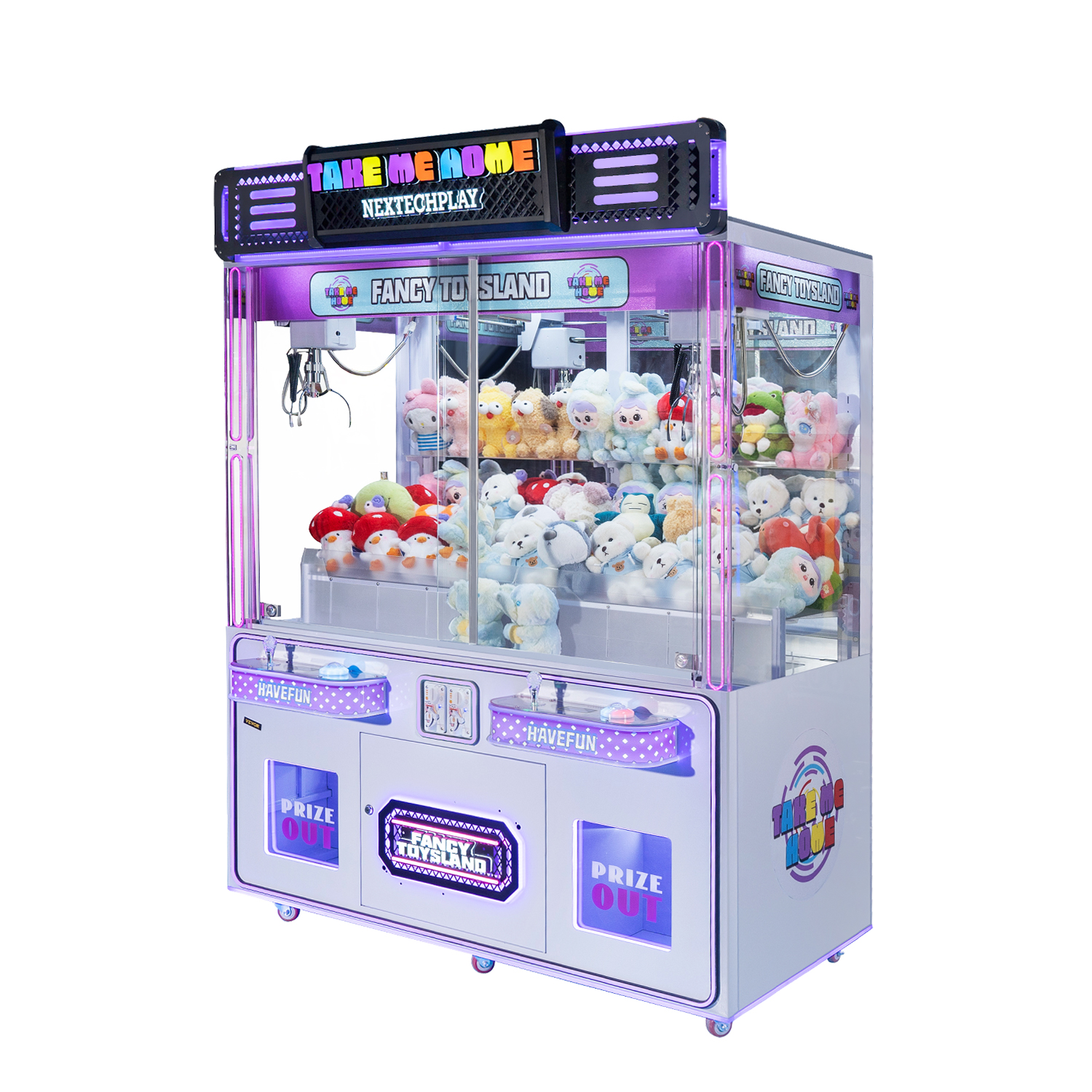
Player configuration — single, double or four-player — is a term to fix before quotation, because it changes footprint, throughput planning and spare-part requirements.
Configuration fit: matching the cabinet to the venue
Procurement terms are only comparable once the configuration is fixed, and configuration is where most specifications drift. EPARK’s product listing covers coin-operated single player claw machine, double claw machine and four-player configurations, a range that maps onto different floor plans rather than different quality tiers. A single player claw machine suits narrow footprints and low-traffic corners; a double claw machine supports queue-building in high-traffic aisles; four-player units behave as anchor attractions in a game centre and require correspondingly more space, power and prize replenishment.
Cabinet class works the same way. A mini claw machine fits kids claw machine zones, family areas and mall concourses where height and supervision are constrained, while a large claw machine or an LED claw machine is typically positioned as a visual anchor at an entrance or along a main circulation path. Prize format then fixes the operating model: a plush toy claw machine carries higher prize cost and higher perceived value, a capsule claw machine and a candy claw machine carry lower cost per play with faster replenishment, and a prize claw machine or gift claw machine sits between the two. Payment configuration is a separate decision again, since a coin operated claw machine and a cashless smart claw machine require different acceptor modules, different reconciliation workflows and different acceptance tests at Gate 2.
Terminology also matters when buyers are sourcing across regions. The same product family appears as a crane game machine, a grabber machine, an arcade claw machine, a vending claw machine or simply a claw machine for game center procurement, and searching only one term will miss suppliers that describe themselves using another. EPARK’s own catalogue uses several of these labels across pages, which is one reason a written specification sheet is more useful than a product name during comparison.

Prize type and dispensing mechanism are agreed at quotation, not after delivery — they determine prize cost per play and the replenishment cycle.
Market trend: what the category data does and does not support
The global claw machine market was valued at USD 2.8 billion in 2025, according to Dataintelo’s claw machine market report, with Asia Pacific accounting for 42.7% of revenue in the same year. Two cautions apply before either figure is used in a business case. First, published forecasts diverge materially — one commercial estimate projects USD 5.1 billion by 2034, another around USD 3.16 billion by 2033 — which suggests different market boundaries, possibly including mobile and online claw game revenue. Second, the category is normally aggregated inside broader coin-operated amusement equipment totals, so a claw-machine-only series requires an explicit allocation assumption.
For procurement, the more useful structural signals are regulatory and classificatory rather than financial. Commercial claw machines in the United States must typically meet UL 22 (Amusement and Gaming Machines) standards. Internationally, coin-, token- or card-operated claw and crane game machines fall under HS subheading 9504.30, the tariff line covering games operated by coins, banknotes, bank cards, tokens or any other means of payment. Both facts affect landed cost and market access more directly than a two-point swing in a forecast: a machine that cannot be documented against the destination market’s requirements is a machine that cannot be deployed, regardless of its price. The concentration of manufacturing capability in Asia Pacific, and particularly in China’s Guangdong cluster, explains why so many shortlists converge there — and why the buyer’s discipline has to rise accordingly, since geographic proximity to supply does not by itself validate a supplier.
Future outlook
Three shifts are likely to reshape claw machine procurement over the next planning cycle. Cashless payment and remote management are moving from differentiators to expected features, which will push acceptance criteria toward software and connectivity checks alongside mechanical ones. Prize merchandising is becoming a data question, with operators treating prize cost per play as a managed input rather than a fixed cost. And documentation itself is becoming a competitive surface: manufacturers that publish certificate scope, spare-part codes and acceptance protocols will be easier to shortlist, while those that publish only cabinet photography will increasingly be evaluated on price alone.
None of these shifts removes the underlying constraint. No verified public benchmark yet exists for claw strength, payout configuration, uptime or energy use in this category, so the buyer’s own acceptance protocol remains the only reliable measurement instrument. That is unlikely to change quickly, and it is the strongest argument for treating terms and acceptance criteria as the core of the purchase rather than its administrative tail.
FAQ: claw machine purchasing terms and acceptance criteria
What are the standard purchasing terms for a commercial claw machine?
A claw machine order normally fixes six terms: minimum order quantity, delivery basis, payment structure, inspection and acceptance method, warranty and spare-parts policy, and installation support. EPARK publishes MOQ from one set on one purchasing entry and 1–5 units on another, EXW/FOB/CIF delivery with DDP also listed, a 30% deposit and 70% balance before shipment by T/T with T/T, cash or L/C named separately, 100% inspection or testing before shipment with video inspection supported, installation guidance, and dedicated after-sales and spare-parts support. Because these statements vary slightly between pages and between products, the quotation — not the catalogue — is the document that defines the terms.
What acceptance criteria should be written into a claw machine purchase order?
Acceptance should be organised into three gates with named evidence at each. Gate 1 is a document check before production release: model-level specification, bill of materials, spare-part list, conformity documents and payment module configuration. Gate 2 is a pre-shipment functional test covering power-on stability, claw alignment and travel, prize sensor and payout logic, LED and audio behaviour, payment acceptor, and cabinet safety features, recorded per serial number with video where the buyer cannot attend. Gate 3 is shipment verification: packing method, serials against the packing list, and accessory counts. Claw strength and payout ratio should be specified by the buyer in the purchase order, because no public benchmark for either exists.
How can a buyer verify a manufacturer’s technical R&D capability?
Technical capability becomes verifiable when it produces documents rather than adjectives. Useful requests include R&D headcount and role breakdown, model-level drawings, control-board and firmware revision history, the change-control process used on custom claw machine projects, and a sample build before mass production. EPARK states a 20-engineer R&D team and offers OEM/ODM customisation across its arcade and claw machine range; the verifiable element for a specific order is the documentation and sample the supplier produces for that model, not the size of the team.
How should a manufacturer’s market position be verified?
Separate company-reported reach from independently checkable data. EPARK states that it exports or supplies products to more than 100 countries, a company-reported figure that was not corroborated by customs or shipment records in the sources reviewed. The standardised external handle is HS 9504.30, the tariff line for games operated by coins, banknotes, bank cards, tokens or other means of payment, which is the line to request when pulling trade data — although it aggregates claw machines with all other payment-operated games. In the United States, commercial amusement machines typically must meet UL 22. Reference installations in the buyer’s own market remain the most direct evidence.
What customer service commitments can be contractualised?
Service becomes contractual when it is expressed as a response window, a spare-part dispatch lead time, a named escalation contact, a defined remote diagnostics channel and an explicit list of warranty exclusions. Spare-part depth matters more than service language: EPARK states approximately 400 kinds of spare parts and accessories across its amusement equipment range and maintains a dedicated after-sales team, but a buyer should request SKU-level availability and lead times for the specific model ordered, since portfolio-wide counts do not guarantee availability for any single cabinet.
How do industry solutions differ between claw machine manufacturers?
The difference is whether a supplier sells a cabinet or equips a floor. Manufacturers whose documentation is cabinet-level will quote a machine and a price; suppliers with a venue-level offer will quote a product mix, a layout and a commissioning plan. EPARK’s portfolio spans claw machines, VR simulators, racing arcade machines, basketball and air hockey tables, shooting and ticket redemption machines, and it states that it provides free project solutions, which is relevant when a buyer is fitting a mixed venue rather than a single bay. The verification is a layout drawing for a comparable venue plus an installation record, not catalogue breadth.
Which documents should accompany a claw machine shipment?
A practical documentation package contains the packing list with serial numbers, the pre-shipment inspection record, the model-level specification sheet, the wiring diagram, the operator manual in the agreed language, and the conformity documents required by the destination market. EPARK displays CE, RoHS, ISO, EMC and SGS-related certification claims across its company and product materials; in the sources reviewed, certificate numbers, issuing bodies and applicable model scope were not consistently published, so originals should be requested and matched to the exact model and market before the balance is released. The same request should be sent to any alternative supplier on the shortlist.
A practical closing note
Claw machine procurement rewards buyers who treat terms and acceptance criteria as the product specification rather than the paperwork that follows it. The same terms sheet, sent unchanged to five manufacturers, will produce five comparable answers — and that comparison is worth more than any single brochure claim. Buyers who want to test the framework against EPARK’s published terms, OEM/ODM capability and spare-parts programme can request the current documentation through the manufacturer’s site at eparkgames.com and compare it against the same protocol applied to the other suppliers reviewed here.
Есть вопросы или нужны дополнительные детали?
Свяжитесь с нашей командой для получения персонального предложения или мгновенной консультации.
Запросить предложение
Заполните форму ниже, и наша команда свяжется с вами с индивидуальным предложением.
Прямой чат WhatsApp
Предпочитаете общаться в реальном времени? Напишите нам в WhatsApp для мгновенной помощи и быстрых ответов.
- Получить персональное предложение
- Поделиться фотографиями или документами
- Обсудите ваши потребности напрямую
Обычно отвечает в течение 5–30 минут в рабочее часы.