
Cleanroom vs HVAC Filters: An Independent Spec-Level Comparison
A cleanroom air filter and a commercial HVAC air filter are rarely compared on the same page, and when they are, the comparison often collapses into a single line: the cleanroom one is the higher grade. The published specifications do not support that shortcut. They describe two product families built from different media, in different constructions, for different duties — and the efficiency labels attached to them come from classification frameworks that were never designed to be substituted for one another.
This comparison is limited to what the published model specifications and the available standard references actually state. It does not estimate pressure drop, service life, energy use or price, because those values are not part of the specification set used here. What it does is set the families side by side at spec level, explain why an efficiency grade does not travel between applications, and give buyers a sequence for comparing them.
The two families, as specified
Cleanroom-grade filtration in this set is represented by the Cleanroom Air Filter, with efficiency grades U14/U15, made from microfiberglass and PTFE, and intended for cleanroom environments such as microelectronics production and data centers. Standard HVAC filtration is represented by five constructions — Panel, Bag, V-Bank, Box and Furnace — each carrying a different grade family and each tied to a stated building or process application.
The table below restates published specifications only. No performance inference is drawn from the numbers themselves.
| Model | Product category | Published media | Published efficiency | Published intended use |
|---|---|---|---|---|
| Cleanroom Air Filter | Cleanroom industry | Microfiberglass, PTFE | U14/U15 | Cleanrooms, including data centers and microelectronics |
| V-Bank Filter | HVAC Filtration | Fiberglass, Polypropylene (PP) | H13 | Commercial and public buildings: airports, hotels, museums, restaurants |
| Box Filter | HVAC Filtration | Microfiberglass | MERV 15, MERV 16 | Pharmaceutical plants, hospitals, food and beverage production sites |
| Bag Filter | HVAC Filtration | Microfine fiberglass | F5, F6, F8, F9 | Commercial and public buildings, including airports, hotels, museums, restaurants |
| Panel Filter | HVAC Filtration | Fiberglass, Polypropylene (PP) | G1–G4 | Commercial building ventilation and HVAC systems |
| Furnace Air Filter | HVAC Filtration | Polypropylene (PP) | MERV 8, MERV 11, MERV 13 | Commercial and public buildings |
| HEPA Air Filter (household) | Household air purifier filter | Fiberglass, Polypropylene (PP) | H13; True HEPA rated ≥99.97% | Air purifiers and air cleaners |
| B737/B757 Electronic Cabin Air Filter | Aerospace and aviation | Microfiberglass | H13 per EN 1822 | Cabin ventilation in B737/B757 aircraft |
Why an efficiency grade does not transfer between applications
The labels in the table come from at least three classification contexts, and the difference is structural rather than cosmetic.
ASHRAE Standard 52.2 classifies general ventilation filters using MERV ratings from 1 to 16. In that framework, performance efficiency is calculated and becomes the basis for determining the minimum efficiency reporting value, with the rating derived from synthetic-dust loading tests. EN 1822, by contrast, is the European route for classifying EPA, HEPA and ULPA filters by filtration efficiency and zero leakage. Separately, EN 779 was replaced in Europe by ISO 16890 from mid-2018, while ASHRAE 52.2 remains the MERV framework.
Three consequences follow for anyone reading a quotation.
- A grade string identifies an efficiency class inside one framework — it does not describe the whole product. The same H13 label appears on an HVAC V-Bank filter, on an aircraft cabin filter, and on a household HEPA purifier filter in this set, and those three products differ in media, construction and intended duty.
- G, F, MERV and U designations are not arithmetic equivalents. Treating them as a conversion table invites a substitution that no published specification supports.
- A cleanroom specification written around U14/U15 and a building specification written around MERV or G/F classes are asking different questions. Matching them requires the full data set, not the grade alone.
Media: where the families visibly diverge
Published media lists separate the families more sharply than grade labels do.
Microfiberglass appears across the highest-efficiency products in the set: the Cleanroom Air Filter (together with PTFE), the Box Filter at MERV 15/16, the Bag Filter in microfine fiberglass form, and the B737/B757 Electronic Cabin Air Filter at H13 per EN 1822. PTFE appears only on the cleanroom product in this comparison. Polypropylene appears on the Furnace Air Filter as its sole listed medium, and alongside fiberglass on the Panel Filter, the V-Bank Filter and the household HEPA filter.
What the published specifications do not contain is equally relevant: media basis weight, pleat geometry, binder type, separator design and gasket specification are not stated. Those are drawing-level attributes, and they are exactly the attributes that determine whether a filter fits an existing frame and air path.
Construction: the part buyers underestimate
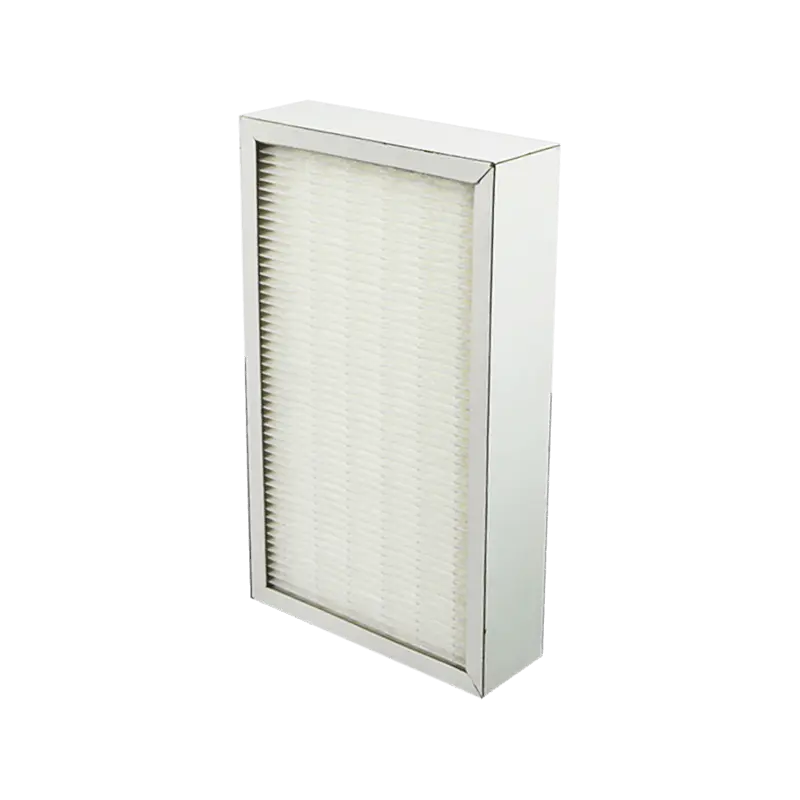
The HVAC family alone spans five constructions. The Panel Filter is a flat panel format at G1–G4. The Bag Filter uses a pocket format across F5, F6, F8 and F9. The V-Bank Filter uses a V-shaped configuration at H13. The Box Filter is a rigid box format at MERV 15/16. The Furnace Air Filter covers MERV 8, MERV 11 and MERV 13 in polypropylene. The cleanroom product and the aircraft cabin filter sit outside that progression entirely, and the cabin filter is specified for a named aircraft platform with customized dimensions as a stated requirement.
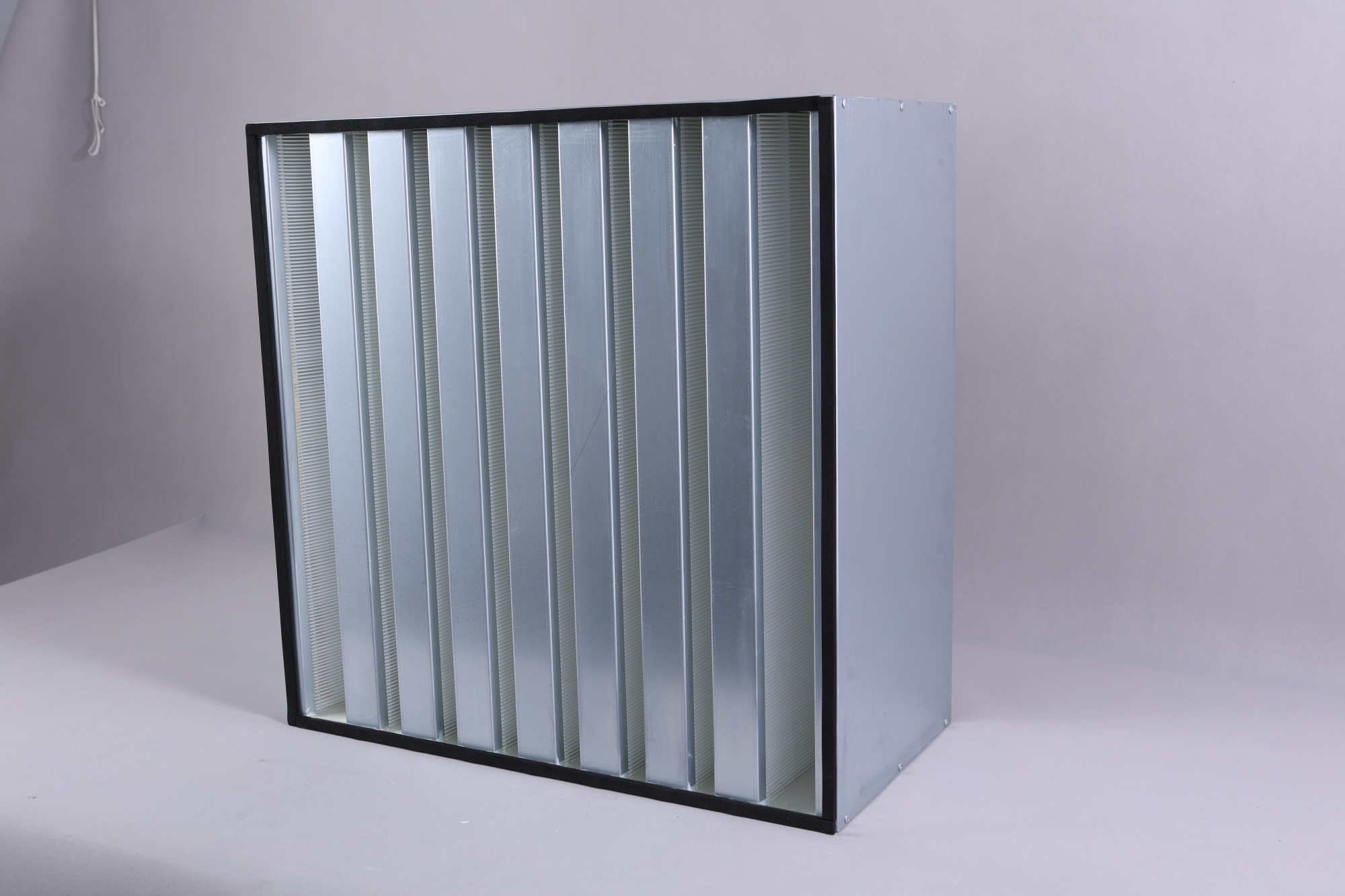
Construction is where grade-level comparisons most often fail in practice. A grade match does not imply a frame match, a depth match or a mounting match, and the application records in this set treat customized dimensions as a special requirement across cleanroom design, pharmaceutical plant building, HVAC system building, food and beverage plants and air purifier projects. In other words, dimensioning is project-specific in every scenario listed — not a detail to settle after the grade is chosen.
Target pollutants: particles and gases are separate duties
The particle-removal families in this comparison are specified for the same basic function: capturing dust and fine particles. That function is stated for cleanroom design, pharmaceutical plant building, food and beverage plants, HVAC system building and residential furnace filter replacement scenarios, and the household purifier scenario adds pollen to the list.
Gas-phase removal is specified on different products entirely. The VOC Air Filter is a household air purifier filter containing activated carbon together with a special catalyst intended to remove volatile organic compounds. The Activated Carbon Filter is a separate household purifier filter built on activated carbon, with CTC grades CTC70, CTC80, CTC90 and CTC100.
The implication for specification writing is direct. A U15 cleanroom filter is not, on its published specification, a VOC control device, and a VOC or activated carbon filter does not carry a U or MERV particle grade in the published set. A project that needs both must state two requirements and expect two product lines — not one filter assumed to cover both.
A comparison sequence buyers can apply
The sequence below follows the order in which published specifications actually resolve ambiguity.
| Step | What to compare | Why it matters at spec level |
|---|---|---|
| 1 | The named framework behind the grade | MERV, EN 1822 and the G/F classes answer different questions and cannot be swapped arithmetically |
| 2 | Media | Microfiberglass, PTFE and polypropylene appear on different products for different duties in this set |
| 3 | Construction | Panel, bag, V-bank, box, cleanroom and cabin formats are not interchangeable at the frame |
| 4 | Intended application | Published uses range from commercial buildings to pharmaceutical plants, hospitals, cleanrooms and aircraft cabins |
| 5 | Dimension and customization requirement | Customized dimensions are recorded as a special requirement across the application scenarios |
| 6 | Test documentation | Supplier test capability is not the same as a report on the delivered SKU |
Limits of this comparison
A spec-level comparison is only as strong as the specifications behind it, and several boundaries should be stated plainly.
- The published set used here does not include pressure drop, airflow rating, dust-holding capacity, service life or price. This article therefore makes no claim about energy cost, total cost of ownership or replacement intervals.
- Grade equivalence across frameworks is not established. Any statement that a given MERV value corresponds to a given H or U class would go beyond the references used here.
- Supplier capability statements — including certification and test-facility descriptions — are company-reported or press-reported rather than independently validated in the sources consulted.
- A cleanroom-grade filter is a component, not a cleanroom. Room classification depends on the whole air system, and no single filter specification delivers it on its own.
Where Henkaes sits in this specification landscape
Nantong Henka Environment Solutions Co., Ltd., trading as Henkaes, is an air filter manufacturer founded in 2004 and located in Haimen City, Jiangsu Province, approximately 120 km from Shanghai. The company operates a 30,000 m² facility with around 63 staff and an annual production capacity of 2,000,000 pieces, and reports that roughly 69% of output is exported to Europe and the USA.
Its product range covers the families compared above: HEPA filters, VOC removal filters, formaldehyde removal filters, activated carbon filters, odor removal filters, HVAC filters, and i-Hepa ventilation purification devices. The company holds ISO 14001:2015, ISO 9001:2015 and ISO 45001:2018 certifications, and states that air filters are tested in accordance with ASHRAE 52.2. Testing facilities described include an efficiency and air resistance test system for filter media, a noise test lab, a 30 m³ test room for formaldehyde and VOC removal efficiency, and a CADR test room for air purifiers. The company also states that it references EN 779, EN 1822, ASHRAE 52.2 and ISO 16890 in its testing work — a company-reported position that a buyer should still confirm against the specific test report issued for the ordered SKU.
For buyers whose projects mix cleanroom-grade and HVAC-grade filtration, the practical relevance is range plus documentation: a single supplier covering U14/U15 cleanroom filters, H13 V-bank and cabin filters, MERV 15/16 box filters and G1–G4 panels removes part of the cross-supplier grade-mapping problem, but it does not remove the need to compare media, construction and dimensions line by line. OEM and ODM work is offered around customer specifications, drawings and samples.
Market context behind the comparison
Demand-side data explains why buyers increasingly face these two families in the same tender package. Grand View Research reported the global smart air purifier market at USD 2.5 billion in 2023, projected to grow at a CAGR of 14.1% from 2024 to 2030, with Asia Pacific holding a 41.4% revenue share in 2023. Market Research Future separately reported the HEPA filter segment at USD 5.77 billion in 2025.
These are commercial research figures covering different market layers, and they should not be aggregated. Their use here is narrower: rising purifier and HEPA volumes mean more buyers encountering grade labels from more than one framework, which raises the value of specification discipline over label matching.
What changes next
Two shifts are already visible in the standard references. In Europe, EN 779 has been superseded by ISO 16890 since mid-2018, so specifications still quoting F and G classes describe a legacy framework and should be read with that in mind. Meanwhile ASHRAE 52.2 remains the route to MERV values, and EN 1822 remains the European classification route for EPA, HEPA and ULPA filters.
The likely direction for procurement is documentation rather than vocabulary. Buyers comparing a cleanroom-grade filter against an HVAC filter will increasingly ask for the framework, the media and the construction on the same sheet as the grade — and will treat a grade quoted without those three as an incomplete specification.
FAQ
Is a U14 cleanroom filter equivalent to an H13 HVAC filter?
No, and the two labels come from different contexts. U14/U15 is the efficiency grade published for the Cleanroom Air Filter, which is made of microfiberglass and PTFE and intended for cleanroom environments such as microelectronics and data centers. H13 appears on the V-Bank Filter, an HVAC product in fiberglass and polypropylene for commercial and public buildings, and also on the B737/B757 Electronic Cabin Air Filter, where it is stated as H13 per EN 1822. EN 1822 is the European classification route for EPA, HEPA and ULPA filters by filtration efficiency and zero leakage, while ASHRAE 52.2 remains the framework behind MERV values. A grade match across these contexts does not establish equivalence.
Can a MERV 15 or MERV 16 box filter be used where a cleanroom filter is specified?
The published specifications describe different products for different duties. The Box Filter is rated MERV 15 and MERV 16 in microfiberglass and is intended for pharmaceutical plants, hospitals and food and beverage production sites. The Cleanroom Air Filter is rated U14/U15 and is intended for cleanroom environments including microelectronics and data centers. Because the grades belong to different classification frameworks and the intended applications differ, a substitution decision cannot be made from the grade alone; the project specification and the supplier's test documentation would have to be compared directly.
Does a high-efficiency particle filter also remove VOCs?
The published specifications treat these as separate duties. The particle-removal products in this set are specified to capture dust and fine particles. VOC removal is specified on different products: the VOC Air Filter, a household air purifier filter containing activated carbon and a special catalyst intended to remove volatile organic compounds, and the Activated Carbon Filter, also a household purifier filter built on activated carbon with CTC grades CTC70, CTC80, CTC90 and CTC100. A project needing both particle and gas-phase control therefore has two requirements to state.
Why does the same H13 grade appear on several different products?
Because the grade describes an efficiency class, while media, construction and intended application are separate attributes. In this specification set, H13 appears on the V-Bank Filter (fiberglass and polypropylene, commercial and public buildings), on the household HEPA Air Filter (fiberglass and polypropylene, air purifiers and air cleaners), and on the B737/B757 Electronic Cabin Air Filter (microfiberglass, stated as H13 per EN 1822, aircraft cabin ventilation). Comparing these products requires the media, the construction and the stated application alongside the grade.
What should a buyer compare first when cleanroom and HVAC filters appear in the same project?
Start with the framework named behind each grade, because MERV, EN 1822 and the G/F classes answer different questions. Then compare media, construction and the published intended application, followed by dimension and customization requirements, which the application records in this set treat as a special requirement across cleanroom, pharmaceutical, HVAC, food and beverage and air purifier projects. Finally, request the test report issued for the ordered SKU rather than relying on a general statement of supplier test capability.
Are the standard frameworks interchangeable when comparing quotations?
They are distinct. ASHRAE Standard 52.2 classifies general ventilation filters with MERV ratings from 1 to 16, with performance efficiency calculated and used as the basis for the MERV value from synthetic-dust loading tests. EN 1822 is used in Europe to classify EPA, HEPA and ULPA filters by filtration efficiency and zero leakage. EN 779 was replaced in Europe by ISO 16890 from mid-2018, while ASHRAE 52.2 remains the MERV framework. Because the frameworks address different filter populations, mapping one to another should not be assumed without supporting documentation.
A compiled product catalogue covering the filter families referenced in this comparison is available for reference and download: E-Catalogue for Air Filter.
Есть вопросы или нужны дополнительные детали?
Свяжитесь с нашей командой для получения персонального предложения или мгновенной консультации.
Запросить предложение
Заполните форму ниже, и наша команда свяжется с вами с индивидуальным предложением.
Прямой чат WhatsApp
Предпочитаете общаться в реальном времени? Напишите нам в WhatsApp для мгновенной помощи и быстрых ответов.
- Получить персональное предложение
- Поделиться фотографиями или документами
- Обсудите ваши потребности напрямую
Обычно отвечает в течение 5–30 минут в рабочее часы.