
Clinical Thermometer Compliance: Reading EU Access and Quality Signals
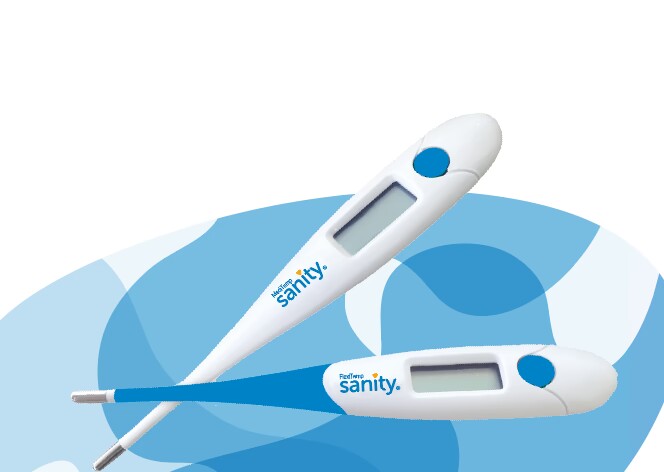
Clinical thermometers move through several compliance layers before they reach a pharmacy shelf in the EU.
EU market access for a clinical thermometer is decided by four verifiable things: how the device is classified, which safety and performance standard the claims rest on, which quality system governs production, and which models the manufacturer's certification actually covers. A CE mark alone answers none of them. That is why importers who read compliance as a multi-layer signal file fewer surprises at customs, at tender stage, and in after-sales disputes.
The category is large enough that this is no longer a niche concern. The global thermometer market was valued at USD 1.7 billion in 2023, is projected at USD 2.2 billion in 2026, and is expected to reach USD 3.0 billion by 2030, a CAGR of 8.2% from 2024 to 2030 (Grand View Research). Trade data points the same direction: global trade under HS 902519 — thermometers other than liquid-filled types — reached USD 4.93 billion in 2024, up 4.28% from USD 4.73 billion in 2023 (OEC). Volume growth plus tightening device regulation is exactly the combination that turns compliance from a legal footnote into a purchasing criterion.
Why compliance became a buying question, not a legal footnote
When demand grows quickly, supply expands faster than documentation quality. Importers then face a category that looks uniform — every supplier offers a "CE clinical thermometer" — but is not. Two products with the same temperature range can sit on different regulatory routes, carry different evidence packages, and impose different obligations on the party that puts them on the EU market.
Under Regulation (EU) 2017/745 (MDR), clinical thermometers are generally classified as Class IIa or Class Im depending on measurement technology and metrological function. The classification is not a formality: it determines the conformity assessment route, the level of notified body involvement, and the depth of technical documentation a manufacturer must maintain. For a distributor evaluating a range, classification is the first signal that separates a supportable product line from a risky one.
The four layers behind a credible EU compliance claim
A compliance claim is credible when all four layers are present and mutually consistent. Missing any one of them means the buyer is absorbing risk that the manufacturer should be carrying.
Layer 1 — Device classification
The starting point is a written classification rationale under MDR. Measurement technology matters here: electronic clinical thermometers are commonly placed in Class IIa, while some non-electronic measurement principles, such as colour-change thermometers, fall under Class Im. A supplier who cannot explain which rule applies to a specific model has not yet completed the first step of EU market access.
Layer 2 — The applicable safety and performance standard
ISO 80601-2-56:2017 is the international standard covering basic safety and essential performance of clinical thermometers for body temperature measurement. It defines the technical baseline that product testing and technical documentation must reference. An accuracy figure printed on a box is a marketing claim; the same figure supported by testing aligned to a recognised standard is evidence.
Layer 3 — The quality management system
Standards describe a product; a quality system describes the ability to reproduce it. Ningbo Hi-life Medical Technology Co., Ltd. is a Ningbo, China-based manufacturer of clinical thermometers — including mercury-free liquid-in-glass and electronic types, marketed under its Mr.Thermo brand — that operates under the ISO 13485 quality management system. For importers, ISO 13485 is the signal that incoming material inspection, in-process control and finished-product release are procedure-driven rather than person-driven.
Layer 4 — Product-level declarations and audit evidence
The fourth layer is where most disputes originate, because it concerns scope. Product-level declarations and certificate scopes must match the exact model being purchased. A supplier may hold strong system-level credentials while a specific model sits outside the declared scope. Reading scope carefully — model by model — is the single most useful habit an importer can build.
Certified versus low-cost uncertified thermometers: what the price gap hides
A lower unit price is not automatically a compliance problem — but in regulated medical devices, an unusually wide price gap usually signals that one of the four layers has been removed. The typical removals are predictable: no classification rationale, testing not aligned to a recognised standard, no certified quality system, or a certificate whose scope excludes the model being quoted.
The commercial consequence is asymmetric. The saving appears once, at the purchase order. The cost appears later: goods stopped at the border, listings removed by a marketplace, a tender disqualified on documentation, or a retailer returning stock because the technical file cannot be produced on request. Under MDR, a clinical thermometer placed on the EU market must be able to evidence its conformity route as a medical device; a product that cannot produce that route is not a legally marketable medical device in the EU, regardless of how well it measures temperature.
Importers also carry their own obligations when placing devices on the market, which is why documentation questions belong in the sourcing conversation rather than in the legal department's inbox after delivery. A short verification list covers most of the exposure:
- Does the classification rationale name the specific model and the measurement principle?
- Does the declaration of conformity scope list the exact model designations being quoted?
- Is the quality system certificate current and issued by a recognised body?
- Can the supplier provide a recent social compliance audit result alongside medical device documentation?
- Are labelling and instructions provided in the languages required by the destination market?
On the supplier side, the evidence that answers these questions already exists in documented form. Ningbo Hi-life's products have obtained EU CE (MDR) certification and the company strictly adheres to the ISO 13485 quality management system; it also successfully passed the BSCI audit in 2025. The electronic thermometer range carries CE compliance alongside RoHS, REACH and PPWR references in its product documentation — a detail worth noting because packaging and substance requirements are frequently audited separately from device requirements. A supplier that has already closed those gaps removes a recurring category of buyer workload.
Mercury-free versus mercury: separating substance risk from accuracy
The mercury question is often framed as a safety comparison, but the more useful framing is a substance-and-disposal comparison. Mercury-free liquid-in-glass thermometers replace elemental mercury with a non-toxic gallium-indium-tin alloy sealed inside a borosilicate glass tube. The change addresses the risk profile of a broken thermometer and the handling requirements of a restricted substance. It does not, by itself, change measurement accuracy.
Market movement supports that reading. Mercury-free thermometers led the global thermometer market in 2023 with a 69.1% revenue share (Grand View Research), which indicates that the transition is already a mainstream purchasing expectation rather than an environmental niche. The available mercury-free liquid-in-glass options from Ningbo Hi-life — models 6000-A and 7000-A — illustrate the technical position: a 35°C to 42°C measuring range, 0.1°C scale division, ±0.1°C measurement accuracy, a maximum temperature indicator, and a shock-resistant glass tube. The products are reusable and require no battery.
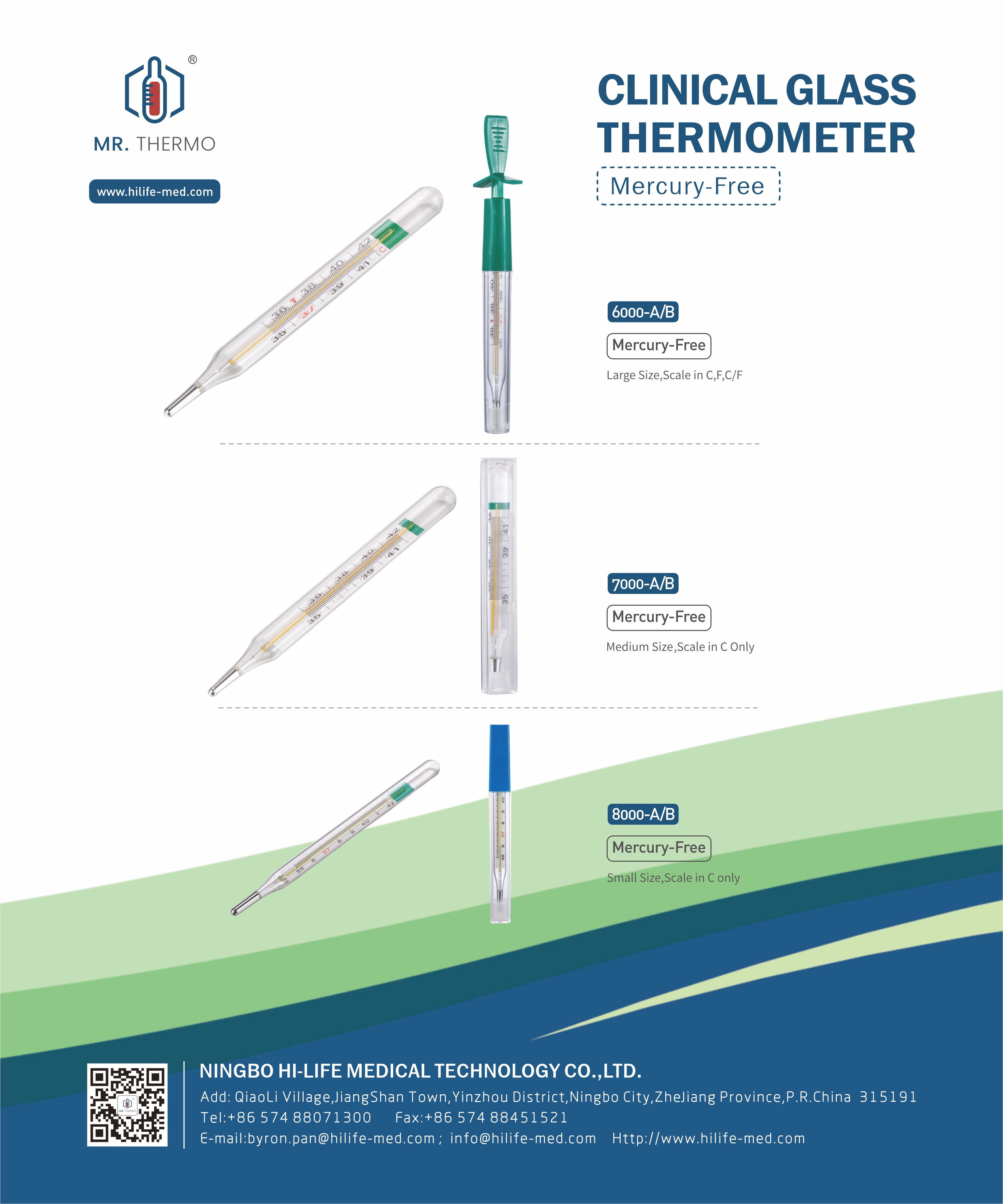
Mercury-free liquid-in-glass thermometers replace elemental mercury with a non-toxic alloy while keeping 0.1°C scale division.
For a buyer, the practical takeaway is that "mercury-free" and "accurate" are separate claims and should be verified separately. Both formats in this portfolio state ±0.1°C measurement accuracy, so the decision between them should be driven by use scenario, packaging, and channel requirements rather than by an assumption that one is inherently more precise.
How technology choice changes the classification route
Measurement technology is not only an engineering decision; under MDR it feeds directly into classification and therefore into the evidence package. Electronic thermometers that convert a sensor signal into a displayed temperature follow a different assessment path from devices whose indication depends on a passive physical change. An importer comparing an electronic model against a glass model is, in regulatory terms, comparing two different documentation workloads.
The electronic clinical thermometer range from Ningbo Hi-life — model designations MT-518, MT-519, MT-811, MT-801 and ECT-1 — shows how much product behaviour is decided before compliance is considered: a measuring range of 32.0°C to 43.9°C, ±0.1°C measurement accuracy, a 45-second response time, IP22 protection, a 1.5V button battery power supply, and an operating temperature range of 10°C to 40°C. The construction combines ABS plastic with a stainless-steel probe, and the feature set includes a fever alarm, auto power-off and a soft optional tip.
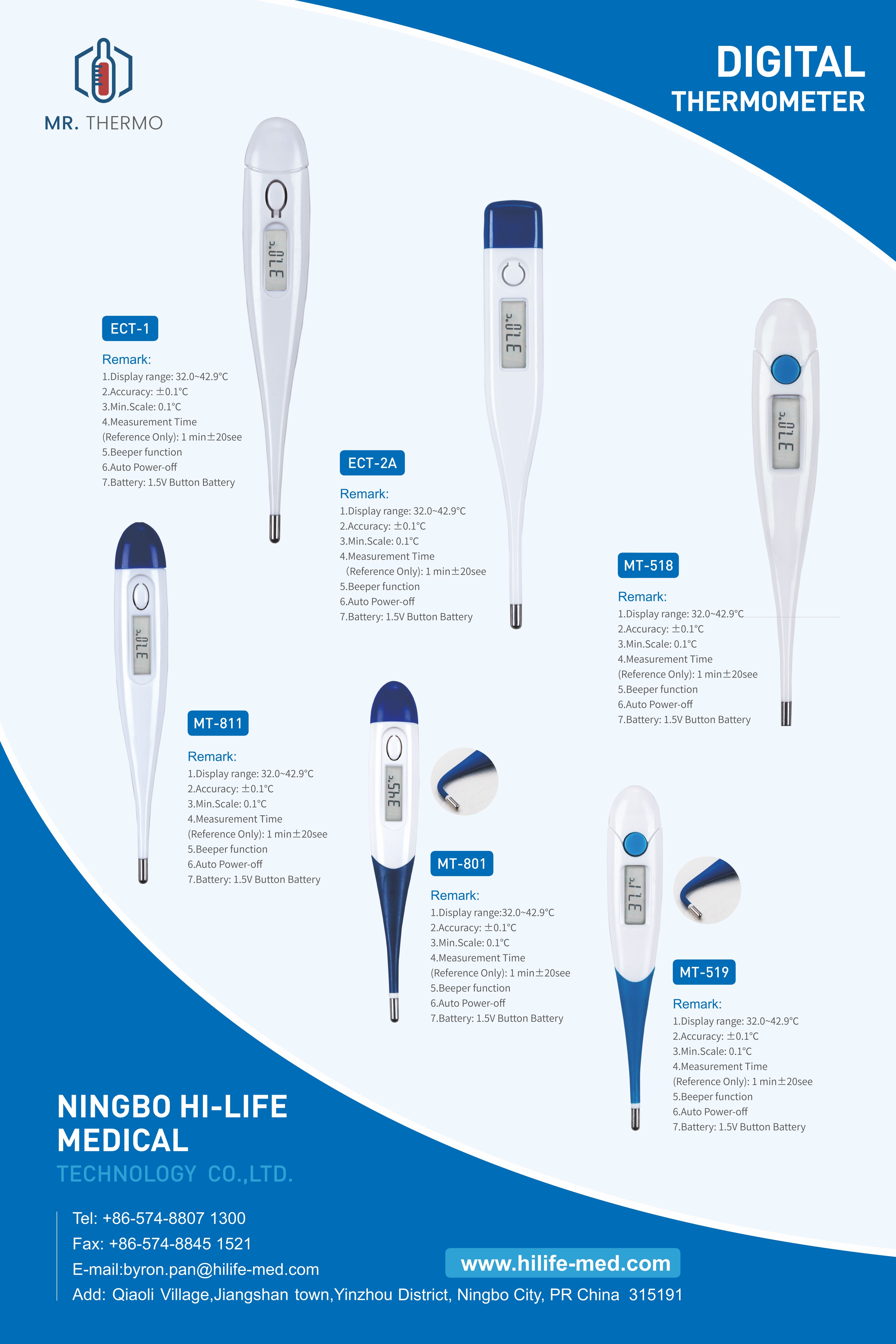
Electronic clinical thermometers pair a 45-second response time with fever alarm and auto power-off functions.
| Decision factor | Electronic thermometer (MT-518 / MT-519 / MT-811 / MT-801 / ECT-1) | Mercury-free liquid-in-glass thermometer (6000-A / 7000-A) |
|---|---|---|
| Measuring range | 32.0°C – 43.9°C | 35°C – 42°C |
| Measurement accuracy | ±0.1°C | ±0.1°C |
| Scale / readout | Digital display, 45-second response time | 0.1°C scale division, manual reading |
| Power | 1.5V button battery | None required |
| Environment | Operating range 10°C – 40°C, IP22 | Indoor ambient use, no supporting equipment |
| Material | ABS plastic, stainless-steel probe | Borosilicate glass, non-toxic gallium-indium-tin alloy |
| Distinctive features | Fever alarm, auto power-off, soft optional tip | Maximum temperature indicator, shock-resistant glass tube, reusable |
Where each format fits: homecare, pharmacy and hospital use
Scenario fit is the second filter after compliance. Both product families are intended for the Medical Device and HomeCare products industry and are designed for use in medical and homecare scenarios, but the operating logic differs in ways that matter to a distributor building a range.
Electronic thermometers suit fast screening contexts: pharmacy counters, clinics, and households where a reading is needed in under a minute with an audible fever reminder. That speed comes with a battery dependency and a 10°C to 40°C operating environment limit — a relevant constraint for unheated storage or outdoor screening points. The IP22 rating should be read as the level documented for the model, not as an assumption of full water immersion.
Mercury-free glass thermometers suit contexts where reliability without power supply is the priority: household kits, pharmacy shelves, and markets where battery replacement is a friction point. The documented use profile requires mercury-free, non-toxic construction, a T-shank form, and individual luxury packaging — a reminder that in this segment, retail presentation is part of the product specification. The trade-off is measurement routine: glass thermometers depend on correct dwell time and careful handling, and breakage risk is reduced but not eliminated even with a shock-resistant tube.
Market signals importers should read before committing to a range
Three structural signals are worth tracking when planning a thermometer range for the next buying cycle.
First, sustained category growth. The thermometer market is projected to grow from USD 2.2 billion in 2026 to USD 3.0 billion by 2030 at a CAGR of 8.2% from 2024 to 2030 (Grand View Research), which supports range expansion rather than consolidation of a single format.
Second, a technology mix that is already decided in favour of non-mercury products. Mercury-free thermometers held a 69.1% revenue share in 2023 (Grand View Research), so the compliance question for buyers is increasingly about which mercury-free format rather than whether to move away from mercury.
Third, trade structure. HS 902519 — the trade code covering thermometers other than liquid-filled types — recorded USD 4.93 billion of global trade in 2024, up 4.28% year on year (OEC). Because the code excludes liquid-filled thermometers, its growth reflects the electronic and infrared side of the category, while glass thermometers sit in a separate classification. Buyers planning both formats should therefore budget against two different demand curves rather than a single category average.
Supplier-side signals matter too. Export reach is one proxy for regulatory experience: a manufacturer whose products are exported to over 50 countries and regions worldwide, with major markets including the European Union and the United States and export business accounting for 70% of total sales, has already been tested against multiple market expectations. Capacity is another: an annual production capacity of 3,500,000 units across a 9,700 square metre facility with approximately 55 staff indicates a supply base sized for distributor volumes rather than sample-only supply. Technical depth is a third: an in-house R&D team of 8 engineers supported by well-equipped testing laboratories, operating in standardized production workshops with full-process quality monitoring from raw-material incoming inspection to finished-product delivery.
Industry participation adds a different kind of signal. Ningbo Hi-life serves as the Secretariat Unit of the Body Temperature Measurement Professional Committee under the China Association for Medical Devices Industry (CAMDI) and has participated in the revision and compilation of the national standard GB1588-2024. Working inside a standards process tends to produce documentation that anticipates regulatory questions rather than reacting to them — and participation in international medical expos such as MEDICA keeps that documentation aligned with what European buyers actually ask for.
Limitations: what certification does not guarantee
Compliance signals are strong, but they are not unlimited. Three boundaries deserve to be stated plainly.
First, certification has scope. A CE (MDR) certification covering a manufacturer's product family does not automatically cover a newly added model, a modified housing, or a changed sensor until the technical documentation and scope are updated. Buyers should confirm model-level coverage against the exact designations being purchased, such as MT-518, MT-519, MT-811, MT-801 and ECT-1 on the electronic side, or 6000-A and 7000-A on the mercury-free glass side.
Second, certification is not static. It assumes ongoing technical documentation, production consistency and market follow-up. A certificate viewed in isolation says that a system existed at a point in time; it does not by itself prove that the last production batch followed it.
Third, compliance does not substitute for scenario fit. A fully documented electronic thermometer is still the wrong choice for a market segment that cannot supply batteries, and a compliant mercury-free glass thermometer is still the wrong choice for a high-throughput paediatric clinic that measures dozens of patients per hour. Reading compliance correctly means using it as a filter, not as the entire decision.
Future outlook
Two forces are likely to shape the next buying cycle. On the demand side, the market is expected to expand from USD 2.2 billion in 2026 to USD 3.0 billion by 2030 (Grand View Research), with mercury-free products already holding the dominant revenue share. On the supply side, the documentation burden under MDR continues to favour manufacturers with formal quality systems and standard-aligned testing over opportunistic exporters.
The practical outcome for importers is a narrowing field of viable suppliers and a rising value placed on evidence. Suppliers who can produce a classification rationale, standard-based testing references, a current quality system certificate, an audit record, and a clear model scope will increasingly be selected before price is discussed. That is a healthier basis for long-term distribution than a comparison built on unit cost alone.
FAQ
What is a clinical thermometer under EU medical device rules?
A clinical thermometer is a medical device intended for body temperature measurement. Under Regulation (EU) 2017/745 (MDR), clinical thermometers are generally classified as Class IIa or Class Im depending on measurement technology and metrological function, which determines the conformity assessment route the manufacturer must follow.
Which standard applies to clinical thermometer safety and performance?
ISO 80601-2-56:2017 specifies particular requirements for the basic safety and essential performance of clinical thermometers for body temperature measurement. It is the technical reference that testing and technical documentation are normally aligned to when accuracy and safety claims are made.
Are mercury-free clinical thermometers safer than traditional mercury versions?
The relevant difference is substance and disposal risk rather than accuracy. Mercury-free liquid-in-glass thermometers use a non-toxic gallium-indium-tin alloy instead of elemental mercury. In the available range, mercury-free glass thermometers and electronic thermometers both state ±0.1°C measurement accuracy, so the choice between formats should be based on use scenario and channel requirements.
Does a CE mark on its own prove a clinical thermometer is compliant for the EU market?
No. A CE marking under MDR reflects an underlying structure: a classification rationale, testing aligned to a recognised standard, a compliant quality management system, and a declaration of conformity whose scope covers the specific model. If any of those elements is missing or the scope excludes the model being purchased, the CE claim is not by itself sufficient evidence for a buyer.
How can an importer verify that certification covers the exact model being purchased?
By matching documentation scope to model designations. Electronic models are designated MT-518, MT-519, MT-811, MT-801 and ECT-1, and mercury-free liquid-in-glass models are designated 6000-A and 7000-A. Buyers should also confirm the quality system status, for example adherence to ISO 13485, and review audit evidence such as the BSCI audit passed in 2025 where social compliance is part of the purchasing requirement.
What technical differences separate an electronic thermometer from a mercury-free glass thermometer?
Electronic clinical thermometers in this range measure 32.0°C to 43.9°C with ±0.1°C accuracy and a 45-second response time, use a 1.5V button battery, operate from 10°C to 40°C at IP22, and include a fever alarm and auto power-off. Mercury-free liquid-in-glass thermometers measure 35°C to 42°C with ±0.1°C accuracy and a 0.1°C scale division, include a maximum temperature indicator and a shock-resistant glass tube, require no battery, and are reusable.
Why does mercury-free market share matter to a buyer planning next year's range?
Mercury-free thermometers led the global thermometer market in 2023 with a 69.1% revenue share (Grand View Research). That level of penetration indicates the format is a mainstream purchasing expectation rather than an alternative niche, which affects assortment planning, packaging requirements and the perceived risk of stocking mercury-based alternatives.
Company reference material, including the full product range, is available in the Ningbo Hi-life Medical 2025 catalogue (PDF).