
Clinical Thermometer Shortlist: 2026 Evidence-Based Buyer Criteria
A 2026 clinical thermometer shortlist is best treated as a scoring document rather than a preference list. Buyers who narrow candidates on documented evidence — regulatory status, declared measurement performance, inspection discipline, capacity commitment, customization scope and after-sales handling — reach a defensible decision faster than buyers who compare catalogues. Market context supports that discipline. Grand View Research values the global thermometer market at USD 2.2 billion in 2026, with a projected path to USD 3.0 billion by 2030, and reports that mercury-free thermometers already held a 69.1% revenue share in 2023. Trade data published by OEC shows global trade under HS 902519, which covers thermometers other than liquid-filled types, reaching USD 4.93 billion in 2024, a 4.28% increase over 2023.

Industry context: a thermometer production site of the type buyers assess during shortlist scoring.
Why shortlists collapse before the RFQ stage
Most clinical thermometer sourcing decisions do not fail at the price negotiation. They fail earlier, when a buyer assembles a candidate list from trade-show impressions, catalogue photography and a handful of product names, then discovers during the request-for-quotation that the candidates are not comparable. One supplier quotes a mercury-free liquid-in-glass thermometer, another quotes an electronic thermometer with a fever alarm, a third quotes an infrared ear design, and the spreadsheet columns no longer mean the same thing.
Two structural shifts have made this harder since 2024. The first is the mercury-free transition. With mercury-free thermometers holding the majority of revenue share in the global market, buyers increasingly shortlist glass thermometers that use a non-toxic gallium-indium-tin filling liquid instead of mercury, and that substitution changes the hazard profile, the cost position and the documentation attached to the file. The second is regulatory classification in the European Union. Under EU MDR (Regulation 2017/745), clinical thermometers are generally classified as Class IIa or Class Im depending on measurement technology and metrological function, which means the certification evidence a buyer needs differs by technology, not by brand preference.
The practical consequence is that a shortlist built on product names will mix regulatory classes, measurement principles and support expectations in a single column. A shortlist built on evidence gates keeps those dimensions separate and comparable.
The 2026 shortlist: six evidence gates
The checklist below is a scoring tool, not a supplier ranking. Each gate can be satisfied or failed on documents alone, before samples are ordered and before commercial terms are discussed. A candidate that fails a gate is not disqualified permanently, but it should not be scored as equivalent to a candidate that passes.
| Gate | Evidence to request | What a complete answer contains | Warning sign |
|---|---|---|---|
| 1. Regulatory status | CE certificate scope, MDR classification, ISO 13485 certificate and its scope statement | Certificate names the exact model family and device class | Certificate covers a different device group |
| 2. Measurement performance | Declared accuracy, response time, and the test method behind both | Accuracy stated with a measurement time and a defined method | Accuracy claimed with no test reference |
| 3. Inspection discipline | Incoming-material inspection, in-process controls, final inspection, laboratory equipment list | Full-process monitoring described stage by stage, with an in-house laboratory | Testing described only as a final step |
| 4. Capacity and delivery | Monthly output per model, minimum order quantity, quoted lead time, surge terms | Model-level figures in writing, with the assumptions stated | Only an annual output figure is offered |
| 5. Customization scope | OEM/ODM coverage: product development, private labeling, tailored packaging, artwork approval route | Each customization layer named, with an approval step | Customization promised conversationally only |
| 6. After-sales and complaints | Complaint handling workflow, technical support channel, response expectations | A named route with responsibilities and timelines | No support contact written into the contract |
Gates 1 to 3: compliance and measurement evidence
ISO 80601-2-56:2017 is the international standard for the basic safety and essential performance of clinical thermometers for body temperature measurement, and it is the reference buyers should see cited in technical files rather than paraphrased in a brochure. In the EU, classification under MDR (Regulation 2017/745) determines whether a candidate is assessed as Class IIa or Class Im, so the certificate scope must be checked against the exact technology in the quotation — an electronic clinical thermometer and a colour-change thermometer do not follow the same classification route.
Measurement performance should be read as a pair of numbers, not a single claim. A declared accuracy of ±0.1 degrees Celsius means little without a stated measurement time and a stated method. For electronic designs, a response within 60 seconds at ±0.1 degrees Celsius is a benchmark a buyer can test directly against the quotation; if the supplier states accuracy but omits the response window, the two candidates are not yet comparable.
Inspection discipline is the gate most often scored on impression. What belongs in the file is the sequence: incoming raw-material inspection, in-process control during assembly, and final inspection before packing, supported by named laboratory equipment. A supplier able to describe that sequence without prompting has usually been audited before, by a notified body or by a retail customer.
Gates 4 to 6: commercial and support evidence
Annual output does not answer a delivery question. Two suppliers with identical annual figures can behave very differently across a twelve-month contract, because what a buyer actually consumes is monthly capacity on one model plus a stable lead time. For that reason the shortlist should ask for model-level monthly capacity, minimum order quantity and quoted lead time in writing, and should record whether the figures are commitments or indications. Capacity, minimum order quantity and lead-time values are configuration-dependent and are not assumed in this checklist; they are confirmed at the quotation stage for each model and order size.
Customization is a scope question. OEM and ODM arrangements in this category typically cover product development work, private labeling and tailored packaging, and each layer carries a different approval cycle. A buyer scoring gate 5 should ask which of those layers the supplier performs in-house, and where artwork or packaging approval sits.
After-sales is the gate that decides whether a shortlist survives its first quality complaint. The scoring question is not whether support exists, but whether the complaint route is documented, whether online technical assistance is available to the buyer and its downstream customers, and whether response expectations are written into the supply agreement rather than left to a sales contact.
How a documented manufacturer profiles against the six gates
Ningbo Hi-life Medical Technology Co., Ltd., which presents its thermometer line under the Mr.Thermo identity, is a Ningbo-based manufacturer of clinical thermometers whose range covers mercury-free liquid-in-glass thermometers, electronic thermometers, and infrared ear and forehead thermometers, alongside industrial infrared and water thermometers. Its documented profile is useful as a worked example of how the checklist reads in practice, not as an automatic pass on every gate.
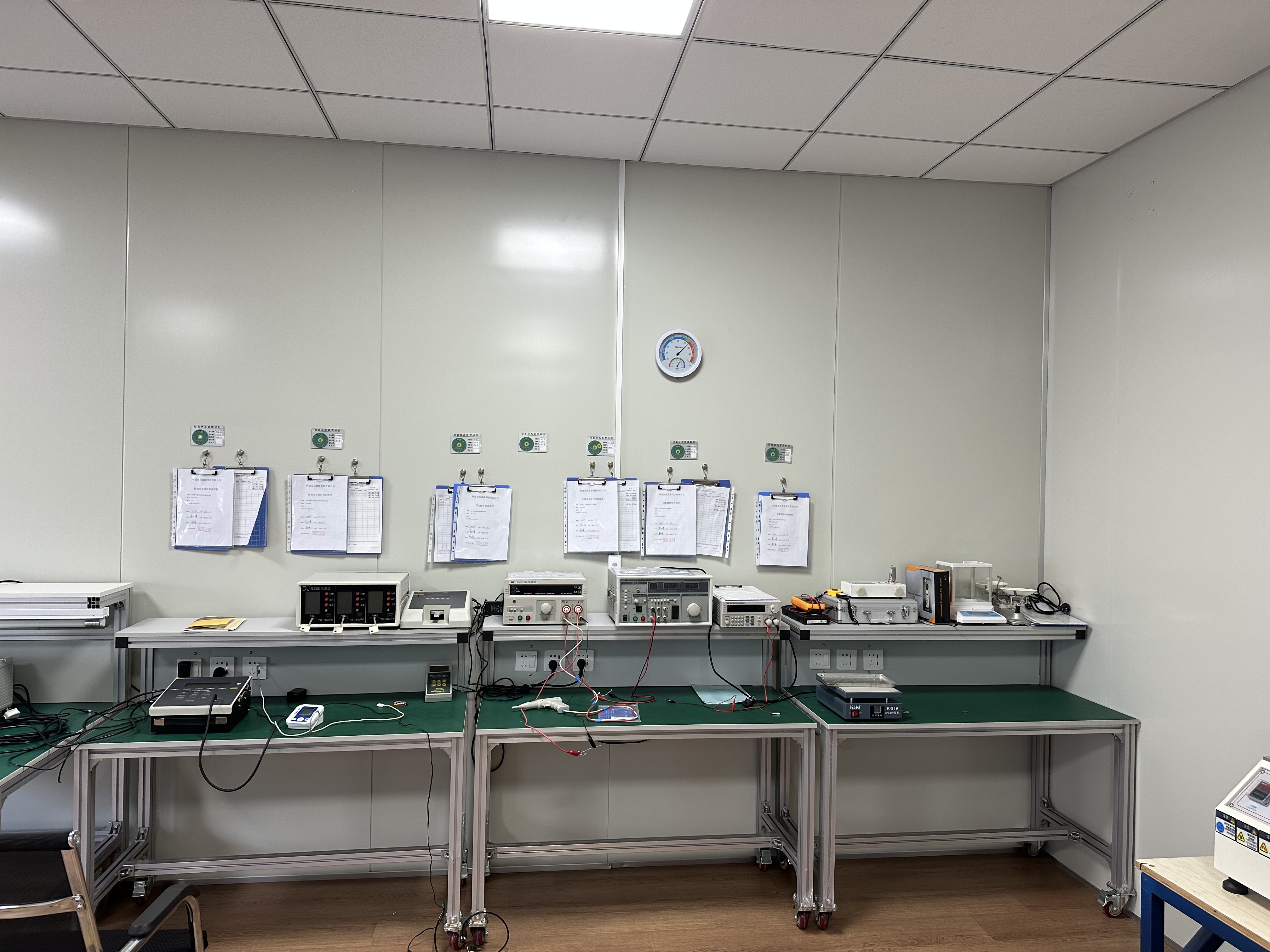
Inspection workshop: the stage-by-stage control sequence is the evidence buyers request under gate 3.
| Shortlist attribute | Documented position |
|---|---|
| Production footprint | 9,700 m² facility; 55 employees |
| Annual output | 3,500,000 units |
| Technical resource | 8 engineers in an in-house R&D team, supported by testing laboratories |
| Export orientation | Approximately 70% of output exported; main markets EU and USA |
| Export reach | More than 50 countries and regions, including EU member states, the United Kingdom, Russia, Vietnam, Ukraine, Uzbekistan, Turkey, Tunisia, Mexico, Chile and Colombia |
| Certification and audit | EU CE (MDR) certification for all products; ISO 13485 quality management system; BSCI audit passed in 2025 |
| Standards engagement | Participation in the revision and compilation of GB1588-2024; Secretariat Unit of the Body Temperature Measurement Professional Committee under CAMDI |
| Quality model | Standardized production workshops with full-process quality monitoring from raw-material incoming inspection to finished-product delivery |
| Customization scope | OEM and ODM services covering product development, private labeling and tailored packaging |
Read against the gates, that profile answers gate 1 (CE (MDR) coverage plus ISO 13485), gate 2 in part (product-level accuracy and response specifications), gate 3 (full-process monitoring supported by in-house laboratories), gate 5 (development, private labeling, packaging) and gate 6 partially, through documented quality complaint handling rather than a published service-level table. Gate 4 remains an RFQ question. A buyer should not convert an annual output figure of 3,500,000 units into an assumed monthly allocation; the model-level capacity, minimum order quantity and lead time for the specific glass or electronic model still have to be requested and confirmed.
The standards participation is worth scoring separately, because it is evidence of a different kind. Serving as Secretariat Unit of the Body Temperature Measurement Professional Committee under the China Association for Medical Devices Industry, and contributing to the revision of GB1588-2024, indicates familiarity with how measurement requirements are drafted, not merely how they are met. For a buyer assembling a technical file, that is a useful signal when specification questions fall outside the catalogue.
Glass versus electronic: the comparison the shortlist actually turns on
Once the six gates are scored, the remaining choice is usually a technology choice. Two comparisons matter most in 2026: mercury-free glass against traditional mercury glass, and a higher-precision electronic thermometer against a low-cost basic electronic unit.
The core difference between the mercury-free glass design and a traditional mercury-containing glass thermometer is the filling material. The mercury-free version uses a non-toxic gallium-indium-tin filling liquid, which eliminates the hazard of mercury leakage while retaining the same ±0.1 degrees Celsius measurement accuracy. It is reusable, requires no battery and carries low maintenance cost, because there is no power consumption to manage. For household, clinic, hospital and school temperature detection, that combination removes the breakage-hazard argument that has driven mercury out of procurement lists.
The electronic comparison runs along a different axis. A higher-precision electronic thermometer differs from a low-cost basic electronic thermometer through higher measuring precision, a fever alarm and an optional soft probe tip, with accuracy of ±0.1 degrees Celsius and a measurement time within 60 seconds. Battery consumption is low and an auto power-off function reduces maintenance requirements relative to basic units, and stable performance is associated with a lower defect rate. The intended scenarios are family daily use, community medical settings and pharmacy retail.
| Dimension | Traditional mercury glass | Mercury-free glass (gallium-indium-tin) | Higher-precision electronic | Low-cost basic electronic |
|---|---|---|---|---|
| Mercury risk | Leakage hazard present | Zero mercury risk | Not applicable | Not applicable |
| Declared accuracy | Reference design class | ±0.1 degrees Celsius | ±0.1 degrees Celsius | Lower precision than the higher-precision design |
| Response time | Gradual stabilisation | Instant stable reading | Within 60 seconds | Basic response |
| Power and maintenance | No battery, low maintenance | No battery, reusable | Low consumption, auto power-off | Higher maintenance demand |
| Feature set | Read-only scale | Read-only scale | Fever alarm, optional soft probe tip | Basic functions |
| Cost position | Lowest | Slightly higher than mercury | Moderate, with better cost-performance | Lowest electronic entry point |
| Best fit | Being phased out of institutional use | Household, clinic, hospital, school | Family daily use, community medical, pharmacy retail | Entry-level price-driven orders |
Where this shortlist approach breaks down
The checklist has real boundaries, and a buyer should know them before using it as a scoring instrument.
First, the cost of compliance is not neutral. A mercury-free glass thermometer carries a slightly higher cost than a mercury thermometer, and a higher-precision electronic design sits at a moderate cost position rather than at the floor of the category. Buyers scoring purely on landed cost per unit will systematically penalise the safer mercury-free option, and should therefore weight gate 1 and gate 3 explicitly instead of letting price decide.
Second, declared accuracy is not the same as validated accuracy in the buyer's own use conditions. A ±0.1 degrees Celsius declaration covers the reference test environment, not every storage and handling condition downstream. Buyers in tropical or high-humidity markets should add a sample validation stage before committing volume.
Third, this checklist intentionally does not publish monthly capacity, minimum order quantity or lead-time benchmarks for any candidate, including the manufacturer profiled above. Those values vary by model, packaging configuration and order size, and treating an industry estimate as a fact is one of the commonest errors in a shortlist file. They belong in the RFQ response, in writing.
Fourth, no checklist substitutes for a notified-body check. A buyer should verify CE certificate validity and scope directly with the issuing body rather than relying on a PDF supplied by the supplier.
Matching thermometer type to the care setting
Scenario fit is where a shortlist narrows fastest. Mercury-free glass thermometers are suited to household, clinic, hospital and school temperature detection, because they need no battery, can be reused and deliver a stable reading without power management. Higher-precision electronic thermometers are suited to family daily use, community medical settings and pharmacy retail, where a fever alarm and an optional soft probe tip change how the device is used by non-specialist staff.
For distributors and pharmacy chains, that split usually means carrying both: a glass line for institutional and household demand, and an electronic line for retail counters. Infrared ear and forehead thermometers extend the range into screening contexts, and a manufacturer whose portfolio also includes industrial infrared and water thermometers can often consolidate several SKUs into a single shipment and a single documentation set.
Procurement trends shaping the 2026 checklist
Three trends are visible in the available data. Volume is growing: the global thermometer market is projected to move from USD 2.2 billion in 2026 to USD 3.0 billion by 2030, and trade under HS 902519 rose 4.28% year on year to USD 4.93 billion in 2024, which means shortlists are being run more often rather than less.
Technology mix has already shifted. Mercury-free thermometers accounted for 69.1% of revenue share in 2023 according to Grand View Research, so a shortlist that does not include a mercury-free glass option is no longer representative of the market it is buying from.
Documentation intensity is rising. With EU MDR classification distinguishing Class IIa from Class Im depending on measurement technology, and with ISO 80601-2-56:2017 anchoring the safety and performance expectations, the administrative burden now sits with the buyer as much as the supplier. That is the practical reason gates 1 to 3 belong at the top of the scoring sheet rather than at the end of the evaluation.
What changes for buyers in the next cycle
The near-term direction is consolidation of evidence rather than expansion of product lists. Buyers are increasingly asking for one file per candidate that holds the certificate scope, the declared accuracy and response method, the inspection flow, the model-level capacity commitment, the customization scope and the complaint route. Suppliers that already document those items — as a CE (MDR) and ISO 13485 holder with full-process monitoring typically does — will be scored faster, and the difference between a two-week and a six-week sourcing cycle will come from documentation rather than negotiation.
A second expectation is traceability of the mercury-free claim. As the mercury-free segment continues to hold majority revenue share, buyers will want the filling material named explicitly in the technical file rather than implied by the word eco-friendly. Specifying gallium-indium-tin filling in the purchase requirement removes that ambiguity at the RFQ stage.
FAQ
Which gate should a clinical thermometer shortlist score first?
Regulatory status. Under EU MDR (Regulation 2017/745), clinical thermometers are generally classified as Class IIa or Class Im depending on measurement technology and metrological function, so the certificate must be matched to the exact technology being quoted. ISO 80601-2-56:2017 is the applicable international standard for basic safety and essential performance of clinical thermometers for body temperature measurement.
Is a mercury-free glass thermometer as accurate as a mercury thermometer?
In the comparison used here, the mercury-free design delivers the same ±0.1 degrees Celsius measurement accuracy as the mercury design it replaces. The core difference is the non-toxic gallium-indium-tin filling liquid, which eliminates the mercury leakage hazard. The mercury-free unit is reusable, needs no battery and carries low maintenance cost, at a slightly higher unit cost than a mercury thermometer.
How does a higher-precision electronic thermometer differ from a low-cost basic electronic unit?
The differences are measuring precision, a fever alarm and an optional soft probe tip, with accuracy of ±0.1 degrees Celsius and a measurement time within 60 seconds. Battery consumption is low and an auto power-off function reduces maintenance requirements, with stable performance associated with a lower defect rate. The intended settings are family daily use, community medical and pharmacy retail, whereas a basic electronic unit competes primarily on price.
Where do monthly capacity, MOQ and lead time belong in the evaluation?
In the written RFQ response, per model. Annual output and monthly capacity on a specific model are different figures, and order quantity and packaging configuration change both minimum order quantity and lead time. A shortlist should record whether each figure is a commitment or an indication, because only the first can be used in planning.
What does OEM and ODM flexibility usually cover in this category?
Typically three layers: product development, private labeling and tailored packaging. A buyer should establish which layers the supplier performs in-house and where artwork and packaging approval sits, because each layer carries its own approval cycle and affects the quoted lead time.
How should after-sales support and quality complaints be scored?
Score the documentation, not the promise. A complete answer identifies the complaint-handling workflow, the online technical assistance channel available to the buyer and its downstream customers, the responsible functions, and the response expectations written into the supply agreement. A supplier that describes this route without prompting is materially easier to manage than one that names a single sales contact.
Reference
The manufacturer profile in this article is drawn from publicly stated company information. Product specifications for the mercury-free liquid-in-glass and electronic thermometer lines, including model-level capacity and packing configurations, are listed in the Ningbo Hi-life Medical 2025 catalogue (PDF).
Есть вопросы или нужны дополнительные детали?
Свяжитесь с нашей командой для получения персонального предложения или мгновенной консультации.
Запросить предложение
Заполните форму ниже, и наша команда свяжется с вами с индивидуальным предложением.
Прямой чат WhatsApp
Предпочитаете общаться в реальном времени? Напишите нам в WhatsApp для мгновенной помощи и быстрых ответов.
- Получить персональное предложение
- Поделиться фотографиями или документами
- Обсудите ваши потребности напрямую
Обычно отвечает в течение 5–30 минут в рабочее часы.