
Clinical Thermometer Supplier Evidence: Capacity, Customization, and Export Reach
Clinical Thermometer Supplier Evidence: Capacity, Customization, and Export Reach
Clinical thermometer sourcing rarely fails at the specification stage. It fails at the evidence stage. A buyer receives a quotation listing production capacity, minimum order quantity, lead time and inspection procedures, and almost none of those numbers can be validated from the document itself. The useful question during research and evaluation is not which supplier makes the strongest claim, but which claims can be traced to something checkable.
This assessment examines the capability evidence published by Ningbo Hi-life Medical Technology Co., Ltd., a clinical thermometer manufacturer based in Jiangshan Town, Yinzhou, Ningbo, Zhejiang, China, and sets out what that evidence does and does not establish for buyers screening suppliers for hospital, pharmacy, community screening and homecare channels.
Why Supplier Claims Need a Verification Layer
Three categories of evidence typically appear in clinical thermometer sourcing documents, and they carry very different weight.
- Published capability statements. Monthly capacity, minimum order quantity, lead time and inspection regime. These are self-declared. They are planning inputs, not proof of performance, and they should be treated as the starting point of a conversation rather than its conclusion.
- Certification and standards position. A quality management system certificate, a CE (MDR) marking scope, or participation in a national standard revision. These are traceable to an external body and can be checked in principle.
- Completed reference projects. Shipment volumes, project duration and destination market. These involve a third party on the receiving end and therefore carry the most operational information — subject to the buyer being able to obtain and use that reference.
For a buyer in the Research and Evaluation stages, the practical task is to separate the three, then decide which open questions matter enough to be tested through sampling, an audit, or a documented order clause.
The Manufacturer Behind the Claim
Ningbo Hi-life Medical Technology Co., Ltd. is a Ningbo-based medical device manufacturer specialising in clinical thermometers, trading under the Mr. Thermo brand. Its stated portfolio covers mercury-free liquid-in-glass thermometers, electronic thermometers, infrared ear and forehead thermometers, industrial infrared thermometers and water thermometers — a range that positions it across contact and non-contact temperature measurement rather than in a single product format.
The published operational profile lists a factory area of 9,700 m², 55 employees, an in-house technical R&D team of 8 engineers, and an annual output of 3,500,000 units. The stated export ratio is 70%, with the EU and the USA identified as main markets, and products shipped to more than 50 countries and regions, including EU member states, the United Kingdom, Russia, Vietnam, Ukraine, Uzbekistan, Turkey, Tunisia, Mexico, Chile and Colombia.
Two facts in that profile are structurally different from marketing statements. First, the company states that it serves as the Secretariat Unit of the Body Temperature Measurement Professional Committee under the China Association for Medical Devices Industry (CAMDI) — a committee position rather than a product claim. Second, it states that it participated in the revision and compilation of the new national standard GB1588-2024. Both are the kind of claim a distributor can reasonably ask to see documented, because both imply the company sits inside the standard-setting process rather than only reading it.
On the compliance side, the company states that all products have obtained EU CE (MDR) certification, that it operates under the ISO 13485 quality management system, and that it passed the BSCI audit in 2025. For an EU-facing buyer, the relevant external benchmark is ISO 80601-2-56:2017, the international standard covering basic safety and essential performance of clinical thermometers for body temperature measurement. Under Regulation (EU) 2017/745 (MDR), clinical thermometers are generally classified as Class IIa or Class Im depending on measurement technology and metrological function — which means the classification dialogue itself belongs in the early evaluation, not in the shipping week.
Production Capacity: What 150,000 and 200,000 Units per Month Signal
Two capability units are published, and they describe two different production modes rather than two conflicting numbers. Under an OEM/ODM/customized service mode, monthly capacity is stated at 200,000 units with a minimum order quantity of 3,000 units and a lead time of 30–40 days. Under an OEM/ODM/private label mode, monthly capacity is stated at 150,000 units with a minimum order quantity of 5,000 units and a lead time of 25–35 days.
| Capability parameter | OEM / ODM / customized service | OEM / ODM / private label |
|---|---|---|
| Stated monthly capacity | 200,000 units | 150,000 units |
| Minimum order quantity | 3,000 units | 5,000 units |
| Stated lead time | 30–40 days | 25–35 days |
| Quality control | 100% functional and precision testing | 100% accuracy inspection before shipment |
| Customization listed | Shell color, brand logo, packaging, software parameter | Logo printing, packaging, color, scale customization |
| Stated export markets | EU, North America, Southeast Asia, Oceania | EU, Southeast Asia, Middle East, South America |
| After-sales support | Remote guidance, spare-parts solution, after-sales feedback | Online technical support, quality complaint handling |
Separately, the corporate profile states an annual output of 3,500,000 units. That figure and the monthly figures are not measured on the same basis, and a buyer should not silently convert one into the other. The monthly numbers describe how a specific order mode is scheduled; the annual number describes aggregate output across the product range. The right question in evaluation is a scheduling question: which line, which mode and which month would this order occupy?
Two implications follow for procurement. A monthly capacity of 150,000–200,000 units suggests a supplier that can absorb mid-volume programme orders, which is relevant for distributors running seasonal or tender-driven demand. The MOQ floor of 3,000–5,000 units simultaneously rules out very small pilot volumes under standard terms — a limitation that matters to buyers testing a new market before committing to container-scale replenishment.
Quality Control: What "100% Inspection" Covers
The two capability records describe the pre-shipment regime as 100% functional and precision testing, and as 100% accuracy inspection before shipment. In practice this distinguishes unit-level testing from batch sampling: the claim is that every unit passes a functional and precision check before dispatch, not that a statistical sample from each lot does.
The declared measurement specifications that this testing regime is applied to are stated as follows.
| Parameter | Electronic thermometer (MT-518, MT-519, MT-811, MT-801, ECT-1) | Mercury-free glass thermometer (6000-A, 7000-A) |
|---|---|---|
| Measuring range | 32.0 °C – 43.9 °C | 35 °C – 42 °C |
| Measurement accuracy | ±0.1 °C | ±0.1 °C |
| Scale division | Digital display | 0.1 °C |
| Response time | 45 seconds | Manual reading, reusable |
| Materials | ABS plastic / stainless-steel probe | Borosilicate glass / non-toxic gallium-indium-tin alloy |
| Power / ingress | 1.5 V button battery; IP22 | No battery required |
| Operating temperature | 10 °C – 40 °C | Normal room temperature, indoor use |
| Stated compliance | CE compliant, RoHS, REACH, PPWR | Mercury-free, non-toxic formulation |
Two boundaries should be stated plainly. First, a supplier-side 100% inspection claim is not the same as independent third-party verification; it describes what happens at the factory gate, and it does not remove the value of buyer-side sample validation or lot testing for a first order. Second, ISO 13485 and CE (MDR) scope relate to the quality management system and device compliance — they do not certify a buyer's own private-label configuration, which is assessed under the buyer's own technical documentation.
Customization Scope: OEM, ODM and Private Label
Customization is where supplier claims are easiest to overstate, because the term can mean anything from a sticker to a redesigned housing. The published scope here is specific and bounded. It lists logo printing, packaging customization, colour customization and scale customization, and separately lists shell colour, brand logo, packaging and software parameter as customizable elements under the customized service mode.
The application records add a concrete example of what a private-label specification can include: mercury-free, non-toxic construction, a T-shank design, and luxury individual packaging for retail-facing pharmacy channels. That combination is a useful reference point for buyers building a premium or gifting-oriented SKU rather than a bulk institutional one.
Decision rule for evaluation: the customization list covers appearance, packaging and software parameters. Buyers should confirm in writing whether any requested change touches the declared ±0.1 °C accuracy or the certified configuration, because that determines whether a modification is a labelling exercise or a new technical file.
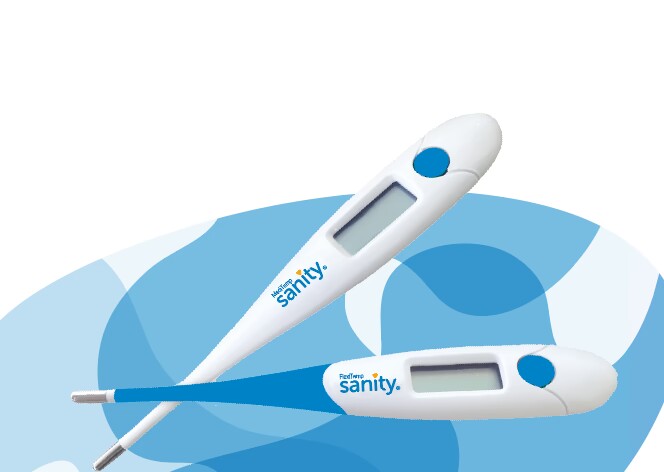
The electronic models also carry functional features relevant to programme design — fever alarm, automatic power-off, and an optional soft probe tip — alongside the portable format used in community and home screening. The IP22 rating is worth reading carefully: it indicates limited protection against water ingress and should not be presented as a waterproof specification in retail claims.
Export Reach as a Documentation Signal
A stated export ratio of 70%, with products shipped to more than 50 countries and regions, is more than a sales statistic. Export footprint is a proxy for documentation capability. Shipping clinical thermometers into EU member states under MDR requires labelling, technical documentation and post-market processes that a purely domestic supplier does not routinely maintain.
The markets named in the capability records reinforce this: the EU, North America, Southeast Asia and Oceania under one production mode, and the EU, Southeast Asia, the Middle East and South America under the other. The corporate profile additionally names the United Kingdom, Russia, Vietnam, Ukraine, Uzbekistan, Turkey, Tunisia, Mexico, Chile and Colombia among destination markets.
The wider trade picture supports why this footprint matters. Global trade of thermometers under HS code 902519 — thermometers except liquid filled — reached USD 4.93 billion in 2024, a 4.28% increase from USD 4.73 billion in 2023, according to the Observatory of Economic Complexity. HS 902519 excludes liquid-filled thermometers, which means the growth in traded value sits predominantly in the electronic and non-liquid categories rather than in traditional glass formats.
Where These Thermometers Are Used: Scenarios and Reference Projects
The application records place these products in the medical and healthcare sector and in pharmacy stores, covering homecare, hospitals and clinical temperature measurement projects. Operating conditions are stated as indoor environments with ambient temperatures between 10 °C and 40 °C. The electronic models operate in battery-powered mode with automatic measurement, while the mercury-free glass models work by manual reading, are reusable, and require no supporting equipment.
Functionally, the electronic line is specified for fast human body temperature testing with a fever reminder, with stated requirements of high precision, portability and over-temperature alarm. The glass line addresses a different requirement set: precise body temperature measurement with mercury-free, non-toxic materials and a maximum temperature indicator.
Reference project: France, home and community screening
A French healthcare importer and supermarket retailer project involved 100,000 units over three years for home-use and community medical temperature screening. The stated product highlights were a fever alarm function, a portable size and an optional soft probe tip. Reported results were fast measurement and a low defective rate, with the programme meeting EU MDR requirements. The combination of a supermarket retail channel and a healthcare importer is notable: it implies the same product had to satisfy both retail packaging expectations and medical documentation requirements.
Reference project: Germany, hospital and pharmacy distribution
A German medical distributor and pharmacy wholesaler project involved 50,000 units of mercury-free glass thermometer over three years, for hospital, clinic and household body temperature measurement. The stated highlights were an eco-friendly mercury-free formula, a shock-resistant tube and an easy-reading scale. The reported result was stable measuring accuracy with zero mercury-leak risk and good market feedback — a reminder that in some EU channels the mercury-free property is not a premium feature but a baseline requirement.
Market Direction: Mercury-Free Volume and Trade Growth
Three published data points frame the medium-term picture for buyers planning multi-year programmes.
- The global thermometer market was valued at USD 2.2 billion in 2026 and is projected to reach USD 3.0 billion by 2030, a CAGR of 8.2% from 2024 to 2030 (Grand View Research). That definition covers medical, industrial, laboratory and imaging thermometers, so it is a category-level indicator rather than a clinical-thermometer-only figure.
- Mercury-free thermometers led the market by product in 2023 with a 69.1% revenue share (Grand View Research). Mercury-free is therefore the mainstream position, not an alternative one.
- Trade under HS 902519 reached USD 4.93 billion in 2024, up 4.28% year on year (Observatory of Economic Complexity).
The procurement reading is straightforward. A supplier whose portfolio combines mercury-free glass and electronic formats is positioned across both the compliance-driven and the convenience-driven halves of demand. A supplier holding only one of those formats will push buyers toward a narrower set of scenarios — which is a legitimate reason to widen a shortlist rather than a judgement on any single supplier.
Comparing Evidence-Based and Brochure-Based Supplier Evaluation
The difference between the two evaluation styles is not rigour for its own sake. It is the difference between knowing what you have verified and assuming you have.
| Supplier claim | How it can be checked | What remains open |
|---|---|---|
| Monthly capacity of 150,000–200,000 units | Mode-specific scheduling discussion; capacity referenced in the order agreement | Whether the line is shared with other programmes during the requested production month |
| MOQ of 3,000–5,000 units; lead time of 25–35 or 30–40 days | Written into the purchase order with milestones | Transit time, customs clearance and documentation time are outside the stated lead time |
| 100% functional and precision testing before shipment | Request the inspection record for the specific lot | Buyer-side sample or lot validation is still the only test the buyer controls directly |
| ISO 13485, CE (MDR), BSCI 2025 | Certificate scope and validity, checked against the manufacturer name | Whether the buyer's own private-label configuration falls inside the existing technical file |
| Export to more than 50 countries | Market list and available reference projects | Whether comparable regulatory profiles exist in the buyer's specific destination |
It is equally important to name the limits of the evidence itself, because a supplier assessment that identifies no boundaries is not an assessment.
- Order size floor. The published MOQ of 3,000 to 5,000 units means test-market or trial volumes below that level do not fit standard terms.
- Lead time definition. The stated 25–35 day and 30–40 day windows describe production. They exclude sea or air transit, customs clearance and any regulatory review the buyer's own market imposes.
- Ingress protection. IP22 on the electronic models is limited water-ingress protection, not a waterproof rating, and it should shape consumer-facing claims and returns expectations.
- Self-declared capacity. The monthly and annual output figures originate from the manufacturer. They are useful for planning and should be confirmed contractually rather than treated as audited data.
- Customization versus certification. Colour, packaging, logo and scale changes are appearance-level. Any modification with the potential to affect measurement performance must be reviewed against the product's technical documentation before it is quoted.
Set against traditional mercury-in-glass supply, the shift to mercury-free liquid-in-glass and electronic formats changes more than the filling material. Traditional mercury glass carried a well-known end-of-life risk and faced tightening disposal rules; the mercury-free glass line addresses that by using a non-toxic gallium-indium-tin alloy in a borosilicate tube with a shock-resistant design. The trade-off is different rather than absent: glass formats remain manual-reading and physically fragile relative to an electronic unit, while electronic formats introduce a 1.5 V button battery dependency and an IP22 ingress boundary. Buyers are choosing between two limitation profiles, not between a limited and an unlimited option.
What Buyers Should Expect Next
The direction of the category is being set by three forces that are already visible in the published data: a mercury-free segment holding roughly two-thirds of category revenue, a traded-value base under HS 902519 that grew 4.28% in 2024, and a regulatory environment in which EU MDR classification places clinical thermometers in Class IIa or Class Im depending on technology.
For suppliers, that combination raises the cost of operating without a documented quality system while rewarding manufacturers that already hold one. For buyers, it shifts evaluation weight further onto evidence: certification scope, pre-shipment inspection practice, reference programmes and reproducible measurement specifications. Programme decisions that once rested on unit price alone now depend on whether a supplier can produce documentation that survives an audit, a tender review or a retail compliance check.
The practical next step in evaluation is a sample request combined with a written confirmation of the commercial parameters that matter to the programme — capacity mode, MOQ, production window, inspection regime and the scope of any customization. Those are the items that a capability claim can be tested against.
Frequently Asked Questions
Which settings and project types are these clinical thermometers designed for?
The published application records place them in the medical and healthcare sector and in pharmacy stores, covering homecare, hospitals and clinical temperature measurement projects. They are used for measuring human body temperature in clinical and home settings, and for home-use and community medical temperature screening. Operating conditions are stated as indoor environments with ambient temperatures between 10 °C and 40 °C.
How do the mercury-free glass and electronic thermometer ranges differ in use?
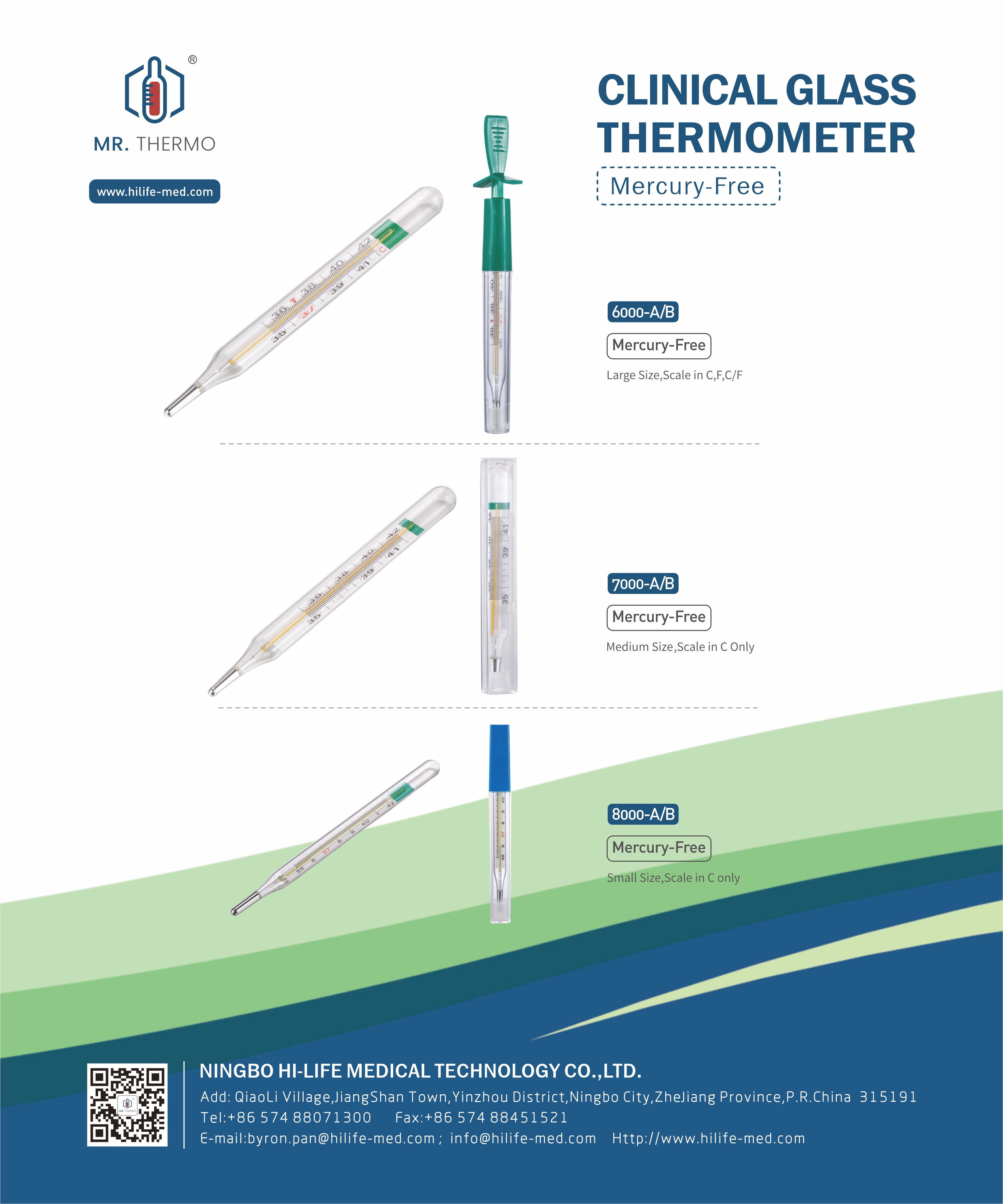
The mercury-free glass thermometer, in models 6000-A and 7000-A, has a measuring range of 35 °C to 42 °C, a scale division of 0.1 °C and a stated accuracy of ±0.1 °C, with a maximum temperature indicator and a shock-resistant glass tube. It requires no battery and is read manually and reused. The electronic thermometer, in models MT-518, MT-519, MT-811, MT-801 and ECT-1, has a range of 32.0 °C to 43.9 °C, a stated accuracy of ±0.1 °C, a 45-second response time and an IP22 rating, and runs on a 1.5 V button battery with automatic measurement.
What are the minimum order quantities and production lead times?
Two sets of terms are published. Under the OEM/ODM/customized service mode, the minimum order quantity is 3,000 units and the stated lead time is 30–40 days. Under the OEM/ODM/private label mode, the minimum order quantity is 5,000 units and the stated lead time is 25–35 days. Both figures describe production; transit, clearance and market-specific documentation time fall outside those windows.
What quality-control evidence is stated before shipment?
The published quality-control statements are 100% functional and precision testing, and 100% accuracy inspection before shipment. These sit alongside the company's stated ISO 13485 quality management system, EU CE (MDR) certification for its products, and a BSCI audit passed in 2025. The company also states that it participated in the revision and compilation of the national standard GB1588-2024. The relevant international benchmark for the product category is ISO 80601-2-56:2017, which covers basic safety and essential performance of clinical thermometers for body temperature measurement.
Which export markets are already served?
The stated export ratio is 70%, with the EU and the USA identified as main markets and products shipped to more than 50 countries and regions, including EU member states, the United Kingdom, Russia, Vietnam, Ukraine, Uzbekistan, Turkey, Tunisia, Mexico, Chile and Colombia. The capability records list the EU, North America, Southeast Asia and Oceania under one production mode, and the EU, Southeast Asia, the Middle East and South America under the other.
What customization can be specified, and what has to be confirmed separately?
The published customization options are logo printing, packaging, colour and scale customization, with shell colour, brand logo, packaging and software parameter listed under the customized service mode. Application records also reference specific requirements such as mercury-free, non-toxic construction, a T-shank design and luxury individual packaging. Any change that could affect the declared ±0.1 °C accuracy or the certified configuration sits outside the appearance-level list and should be confirmed in writing during evaluation rather than assumed.
Documentation for Evaluation
The full product range, model references and packaging formats are collected in the company's 2025 catalogue, which can be downloaded here: Hi-life Medical 2025 Catalogue (PDF). Buyers comparing suppliers against the evidence categories above will find the capacity, MOQ and lead-time statements most useful when paired with a written quotation for the specific production mode being considered.