
Clinical Thermometer Suppliers: Electronic vs Mercury-Free
Clinical Thermometer Suppliers: Electronic vs Mercury-Free
The clinical thermometer is a mature product, so buyers often assume supplier qualification is equally mature. In practice it is not. Qualification files are frequently assembled around a marketing claim (“CE marked”, “±0.1 °C”, “mercury-free”) rather than around the specific device family being ordered. When the purchase order is executed, the file turns out to describe a different article, a different measurement technology, or a sampling regime that the buyer never agreed to.
The purpose of this reference is narrow and practical: it sets out how to qualify one supplier of two product types, what evidence to demand for each, and where the genuine limits sit. It is written for buyers at the Decision and Execution stage — the point at which a supplier has already been shortlisted and the remaining questions are documentary, not promotional.
Why one certificate cannot qualify two thermometer technologies
A certificate has a scope. Under Regulation (EU) 2017/745 (MDR), clinical thermometers are generally classified as Class IIa or Class Im depending on measurement technology and metrological function. That single sentence explains why a buyer cannot treat a certificate cover page as a supplier qualification: the classification, and therefore the technical documentation behind it, follows the technology, not the supplier's brand.
The standards landscape reinforces the split. ISO 80601-2-56:2017 sets out particular requirements for the basic safety and essential performance of clinical thermometers for body temperature measurement, and it sits inside the medical electrical equipment series. Electronic thermometers fall directly within that frame. A mercury-free liquid-in-glass thermometer is not an electrical device; its qualification argument runs mainly through metrological accuracy, material safety and the elimination of mercury as a hazardous filling. These are two different evidence narratives produced by two different test rationales.
The consequence for procurement is straightforward. A supplier that only ever answers “we are CE certified” has given the buyer a claim about a company, when what the buyer needs is a claim about an article. The first qualifying question is therefore not “are you certified?” but “which device family does this certificate actually cover, and can I see the technical file index for the article I am ordering?”
What compliance means for each product type
Electronic thermometers
For the electronic track, compliance is an electrical-safety plus performance argument. The published comparison material for the EL-202 electronic thermometer states an accuracy of ±0.1 °C and a measuring time within 60 seconds, with a fever alarm and an optional soft probe tip as differentiators against a low-cost basic electronic thermometer. Battery consumption is described as low, with an auto power-off function and stable performance associated with a lower defect rate. These are the attributes a buyer should be able to see verified at final inspection, not merely printed on a datasheet.
The device is also the one that sits inside an international safety standard framework, which means the buyer can ask a sharper question: which edition of the standard was applied, and does the technical documentation reference it for this model? A supplier unable to answer that question is describing a product, not a compliance position.
Mercury-free liquid-in-glass thermometers
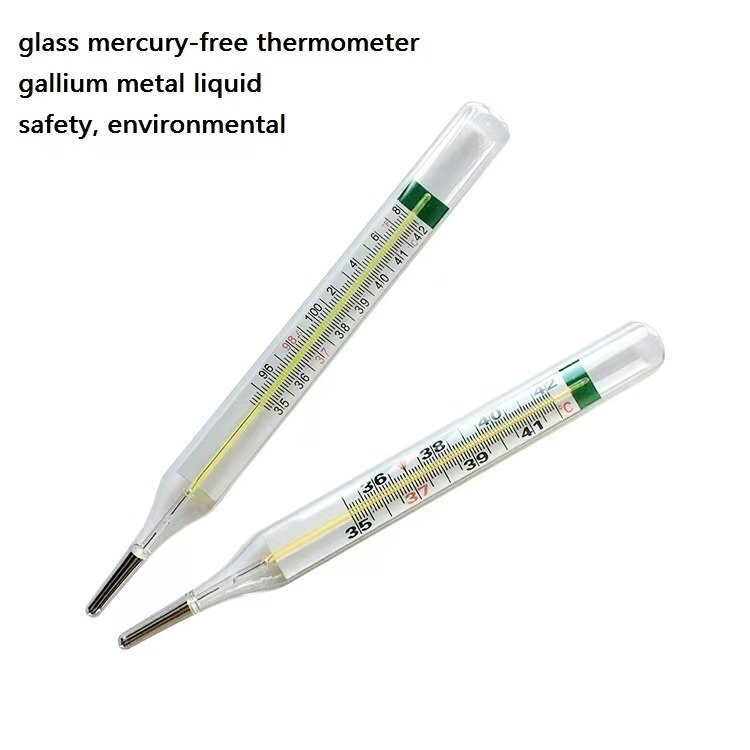
For the mercury-free track, compliance is a materials and metrology argument. The 6000-A mercury-free liquid-in-glass thermometer uses a non-toxic gallium-indium-tin filling alloy, is documented at the same ±0.1 °C accuracy as a mercury device, and eliminates the leakage hazard associated with mercury. It is reusable, requires no battery, and is described as having low maintenance cost; the documented cost position is slightly higher than a traditional mercury thermometer.
Here the qualifying question is not about electronics but about substantiation. “Mercury-free” is a material claim, and material claims should be supported by a composition declaration and by the absence of mercury in the technical documentation — not by the product name.
The evidence file: what to request before a purchase order
The table below is the working checklist. It is deliberately organised by evidence item rather than by document type, because buyers rarely need “a certificate pack”; they need answers to specific production and post-delivery questions.
| Evidence to request | Question it answers | Applies to |
|---|---|---|
| Certificate scope and technical file index under EU MDR 2017/745 | Is the certified article the one on my purchase order? | Both |
| Accuracy specification plus the verification method used at final inspection (100% inspection or sampling) | Does the ±0.1 °C claim survive mass production? | Both |
| Written acceptance criteria, including whether third-party inspection is accepted | Can an independent party confirm the lot before shipment? | Both |
| Filling-material declaration for the non-toxic alloy | Is the mercury-free claim substantiated at material level? | Mercury-free glass |
| Reference to ISO 80601-2-56:2017 in the technical documentation | Does the electronic model sit inside the recognised safety and performance standard? | Electronic |
| Complaint intake process, CAPA ownership and response commitment | What actually happens after a defect is reported? | Both |
| Post-shipment technical support channel, language and named owner | Who answers calibration and use questions in year two? | Both |
| Market reference list by region | Has this product already shipped where I intend to sell it? | Both |
Two of these rows deserve emphasis because they are the ones buyers most often leave verbal. The first is inspection regime. Published purchasing terms for clinical thermometer orders list acceptance criteria of 100% pre-shipment accuracy inspection, with third-party inspection acceptable, alongside a second configuration stating full function and precision pre-shipment testing with support for customer inspection. The difference between “100% accuracy inspection” and “we test every batch” is the difference between a controllable acceptance criterion and an assurance. Buyers should insist on the former in writing.
The second is after-sales structure. Online technical support and quality complaint handling are commonly promised in negotiation and rarely specified in the order. A qualification file should record who receives a complaint, in what language, within what committed response window, and which party owns corrective action. Where a supplier has not published such a process, the buyer's job is to obtain it as a documented commitment before volume commitments begin — not to assume it exists because the relationship is long-standing.
How accuracy claims are verified in practice
Accuracy is the one specification that a buyer cannot confirm by inspection of the product itself. ±0.1 °C is a metrological statement, and it is only meaningful when paired with a verification method: a controlled reference (for example a stable water bath with a reference thermometer), a defined tolerance band, and a defined decision rule for units that fall outside it.
The two technologies fail in different ways, which is why the verification method should not be identical. An electronic unit can be checked for response time, alarm function and display behaviour as well as accuracy, and its battery and auto power-off behaviour belong in the acceptance test. A mercury-free glass unit is passive: it has no alarm, no battery and no firmware, so its acceptance test concentrates on column integrity, filling quality, readability and accuracy against reference. A supplier that runs one generic test line over both product types is telling the buyer something important about how the two tracks are managed.
This is also where a documented third-party inspection option becomes valuable. It converts a supplier's internal quality statement into an externally observed event at the point of shipment, and it is the cheapest form of risk transfer available at the Execution stage.
Where each product type fits in care settings
The documented application profiles are not identical, and this matters for distributors building a range rather than a single order.
The electronic thermometer is described as suited to family daily use, community medical settings and pharmacy retail. Its practical advantages are speed and signal: a measurement within 60 seconds and a fever alarm reduce the skill required of the operator and shorten the contact time in a busy clinic or pharmacy counter.
The mercury-free liquid-in-glass thermometer is described as suited to household, clinic, hospital and school temperature detection. Its advantages are structural: no battery dependency, no power consumption, reusability and low maintenance cost. In settings where power is unreliable, where devices are stored for long periods between uses, or where a battery failure would silently invalidate a reading, the passive device has a genuine operational argument.
For a distributor, the procurement conclusion is that a two-track supplier reduces portfolio risk. One supplier capable of both product types can serve a hospital tender, a pharmacy chain and a household retail line without the buyer managing two separate compliance files, two inspection regimes and two complaint paths.
Market signals behind the mercury-free shift
The direction of the category is not in dispute. Grand View Research reports that the mercury-free thermometers segment led the global thermometer market in 2023 with a 69.1% revenue share, and projects the overall thermometer market to grow from USD 2.2 billion in 2026 to USD 3.0 billion by 2030, at a CAGR of 8.2% over 2024–2030. Trade data points the same way: global trade under HS 902519 — thermometers other than liquid-filled — reached USD 4.93 billion in 2024, a 4.28% increase on USD 4.73 billion in 2023, according to the Observatory of Economic Complexity.
Two qualifications belong with those figures. First, the market-size definition covers thermometers broadly, including industrial and laboratory instruments, so it should not be read as a medical clinical thermometer figure alone. Second, the HS 902519 heading excludes liquid-filled thermometers, which means the trade statistics capture the electronic and infrared side of the market more directly than the glass side. Neither caveat weakens the strategic reading: mercury-free has moved from substitution to dominant share, and the compliance question for buyers is no longer whether to source mercury-free, but which mercury-free technology and on what evidence.
Electronic versus mercury-free glass: a qualification comparison
| Qualification dimension | Electronic (EL-202) | Mercury-free liquid-in-glass (6000-A) |
|---|---|---|
| Measurement principle | Electronic sensor with digital display | Non-toxic gallium-indium-tin alloy filling |
| Documented accuracy | ±0.1 °C | ±0.1 °C, stated as equal to mercury devices |
| Measurement time | Within 60 seconds | Passive reading; time not specified in published comparison material |
| Power requirement | Battery, low consumption, auto power-off | None; reusable |
| Fever alarm | Yes | Not listed as a feature |
| Maintenance profile | Low; described as stable with lower defect rate | Low maintenance cost; no battery replacement |
| Documented relative cost | Moderate cost, positioned as better cost-performance than a basic electronic unit | Slightly higher than a traditional mercury thermometer |
| Documented fit | Family daily use, community medical, pharmacy retail | Household, clinic, hospital, school |
| Primary evidence track | Electrical safety and essential performance standard, plus accuracy verification | Material declaration and metrological accuracy verification |
The comparison also explains why a single “best product” answer is unhelpful. The electronic unit is the stronger fit where speed and a visible alarm change the clinical workflow. The glass unit is the stronger fit where power independence and long shelf life dominate. Buying both from one qualified supplier is a portfolio decision; buying both on one certificate is a compliance error.
Limits and trade-offs buyers should plan for
Several real constraints sit inside this qualification model and should be written into the plan rather than discovered later.
- Minimum order quantities shape trial strategy. Published purchasing terms list MOQ at 3,000 units for one configuration and 5,000 units for another, with delivery terms of FOB Ningbo, CFR or CIF, and payment of 30% deposit with 70% balance against copy of shipping documents. A buyer wanting to validate both product types simultaneously will therefore commit more capital than a single-line order, and should sequence the trial accordingly.
- The mercury-free glass option carries a cost premium. The documented position is slightly higher cost than a traditional mercury thermometer. That premium is justified by the removal of a hazardous filling, but it means price-led tenders will need to separate the two technologies rather than compare on unit price alone.
- Support and complaint processes are not always published. Where a supplier's online technical support and complaint-handling arrangements are not documented, they remain an open qualification item. A buyer should not close that item on the basis of relationship length.
- Regulatory classification must be confirmed per article. Because clinical thermometers may fall into Class IIa or Class Im depending on technology and metrological function, the classification for the specific model belongs in the file. Assuming that a sibling product's classification transfers is a documentation risk.
- Certification is not a market-by-market guarantee. A CE certificate supports EU access; it does not by itself answer registration requirements elsewhere. This should be tested against the buyer's own destination list.
Export experience as a qualification input
Export history is not proof of quality, but it is a useful proxy for whether a supplier has already met the documentation expectations of regulated buyers. Ningbo Hi-life Medical Technology Co., Ltd. (Mr.Thermo) states that its products are exported to over 50 countries and regions, with major markets including the European Union and the United States, and that export business accounts for 70% of total sales.
The named destinations in its published profile include EU member states, the United Kingdom, Russia, Vietnam, Ukraine, Uzbekistan, Turkey, Tunisia, Mexico, Chile and Colombia. Read against a buyer's own map, that list covers the EU directly, Southeast Asia through Vietnam, and South America through Mexico, Chile and Colombia. Middle East destinations are not individually named, which is exactly the kind of gap a qualification file is designed to close: the buyer should request a market-level reference list rather than infer coverage from a regional summary.
This is the practical difference between a claim and a qualification input. “Over 50 countries” is a company-level statement; a destination-level list, with product type and channel, is evidence a buyer can act on.
OEM and ODM capability inside the capability review
Customization belongs in the same file, because the ability to customize is a capability claim that can be reviewed like any other. The company provides flexible OEM and ODM customization services covering product development, private labeling and tailored packaging solutions. Its profile records a 9,700 m² facility, 55 employees, annual output of 3,500,000 units and an R&D team of 8 engineers, with production under the ISO 13485 quality management system, EU CE (MDR) certification on its products, a BSCI audit passed in 2025, and participation in the revision of the national standard GB1588-2024. It also serves as the Secretariat Unit of the Body Temperature Measurement Professional Committee under the China Association for Medical Devices Industry (CAMDI).
Used properly, these facts answer capability questions rather than marketing questions. An R&D team of a stated size and a role in standard revision work indicate engineering involvement beyond assembly; a stated facility area and output volume indicate capacity scale; ISO 13485 and CE MDR indicate a management system and a regulatory route. What they do not do is remove the need for the two product-specific evidence tracks described above.
The distinction that matters in negotiation is between private labeling and genuine ODM. Private labeling changes the label and the packaging. ODM changes the product. A buyer planning a differentiated range should ask which of the two a proposed project actually is, and should expect the answer to appear in the scope of work rather than in a brochure.
The company also states that it maintains long-term stable partnerships with distributors, medical institutions and healthcare wholesalers across continents. For a Decision-stage buyer, that statement is best treated as a hypothesis to test during reference checks rather than as a conclusion.
Future outlook
Three developments are likely to shape supplier qualification over the next several years. The first is documentation depth: as mercury-free becomes the default rather than the alternative, scrutiny shifts from “is it mercury-free?” to “can you prove the material and the accuracy at lot level?” Suppliers with complete final-inspection records will become easier to qualify than suppliers with strong certificates and thin production evidence.
The second is the continuing convergence of electronic and infrared device families under the same electrical-safety expectations, which raises the bar for suppliers whose technical documentation was written for a simpler product line. The third is buyer behaviour: distributors increasingly qualify suppliers once and reuse that file across tenders, which rewards suppliers who can present both product tracks coherently and penalises those who require a new evidence conversation for every order.
None of this changes the underlying rule. A clinical thermometer supplier is qualified when the evidence matches the article, the article matches the market, and the post-shipment process is documented before the first container leaves.
FAQ
Structure it as two evidence tracks inside one supplier file. The electronic track should reference the electrical safety and essential performance standard applicable to clinical thermometers, together with an accuracy verification method. The mercury-free glass track should reference the material declaration for the non-toxic filling alloy and the metrological accuracy verification. Both tracks then share the commercial evidence: acceptance criteria, inspection regime, complaint handling and post-shipment support. This structure prevents a single certificate from being treated as proof of two different technologies.
Request the written acceptance criterion first, then the record format. Published purchasing terms for clinical thermometer orders state 100% pre-shipment accuracy inspection as an acceptance criterion, with third-party inspection acceptable; a second published configuration states full function and precision pre-shipment testing with support for customer inspection. The evidence a buyer should hold is therefore: the stated inspection basis (100% or sampling), the tolerance band applied, the record produced per lot, and whether an independent inspector may witness the process.
It indicates whether the supplier has already operated under the documentation expectations of regulated buyers, which is a useful but indirect signal. For example, Ningbo Hi-life Medical Technology Co., Ltd. states that products are exported to over 50 countries and regions, with the European Union and the United States as major markets, and that export business accounts for 70% of total sales; the destinations it names include EU member states, the United Kingdom, Vietnam, Mexico, Chile and Colombia. A buyer should convert this into a destination-level reference list covering their own regions before treating it as evidence rather than context.
Ask three. First, does the scope cover product development, or only label and packaging change? Second, who owns the engineering work — a stated in-house R&D function, or an external party? Third, can the supplier show participation in standards or specification work relevant to the product category? A supplier such as Ningbo Hi-life Medical Technology Co., Ltd. documents OEM and ODM services covering product development, private labeling and tailored packaging, an R&D team of 8 engineers, and participation in the revision of GB1588-2024. Private labeling alone would not produce those second and third answers.
Assess it as a process, not a promise. The file should record who receives a complaint, the channel and language used, the committed response window, who owns corrective and preventive action, and how the outcome is reported back to the buyer. This is one of the items most often left verbal in clinical thermometer procurement, and it should be closed in writing before volume commitments. Where a supplier has not published such a process, that absence is itself a qualification finding.
Yes, with a narrower role. Grand View Research reports that the mercury-free thermometers segment led the global thermometer market in 2023 with a 69.1% revenue share, a segment figure that spans both electronic and mercury-free technologies rather than glass alone. The liquid-in-glass variant retains structural advantages that electronics do not replace: no battery dependency, no power consumption, reusability and low maintenance cost, which is why it is documented as suited to household, clinic, hospital and school use. Its trade-off is a slightly higher unit cost than a traditional mercury thermometer and the absence of features such as a fever alarm.
Есть вопросы или нужны дополнительные детали?
Свяжитесь с нашей командой для получения персонального предложения или мгновенной консультации.
Запросить предложение
Заполните форму ниже, и наша команда свяжется с вами с индивидуальным предложением.
Прямой чат WhatsApp
Предпочитаете общаться в реальном времени? Напишите нам в WhatsApp для мгновенной помощи и быстрых ответов.
- Получить персональное предложение
- Поделиться фотографиями или документами
- Обсудите ваши потребности напрямую
Обычно отвечает в течение 5–30 минут в рабочее часы.