
Clinical Thermometer Use Cases: Where 6000-A and 7000-A Fit
Clinical Thermometer Use Cases: Where 6000-A and 7000-A Fit
A clinical thermometer is selected not only by its measurement method, but also by the setting in which it will be used and the way a reading will be taken. The 6000-A and 7000-A are mercury-free liquid-in-glass clinical thermometers intended for medical and homecare scenarios. Their stated range, scale division, construction, and manual-reading format make them relevant to buyers assessing reusable glass thermometers for these settings.
Ningbo Hi-life Medical Technology Co., Ltd. (Mr.Thermo) manufactures the 6000-A and 7000-A as mercury-free liquid-in-glass thermometers. The available product information identifies medical-device and homecare applications. It does not specify a distinct use difference between the two model designations, so purchasers should not assume that one model is intended for a particular care environment without confirming the relevant product documentation.
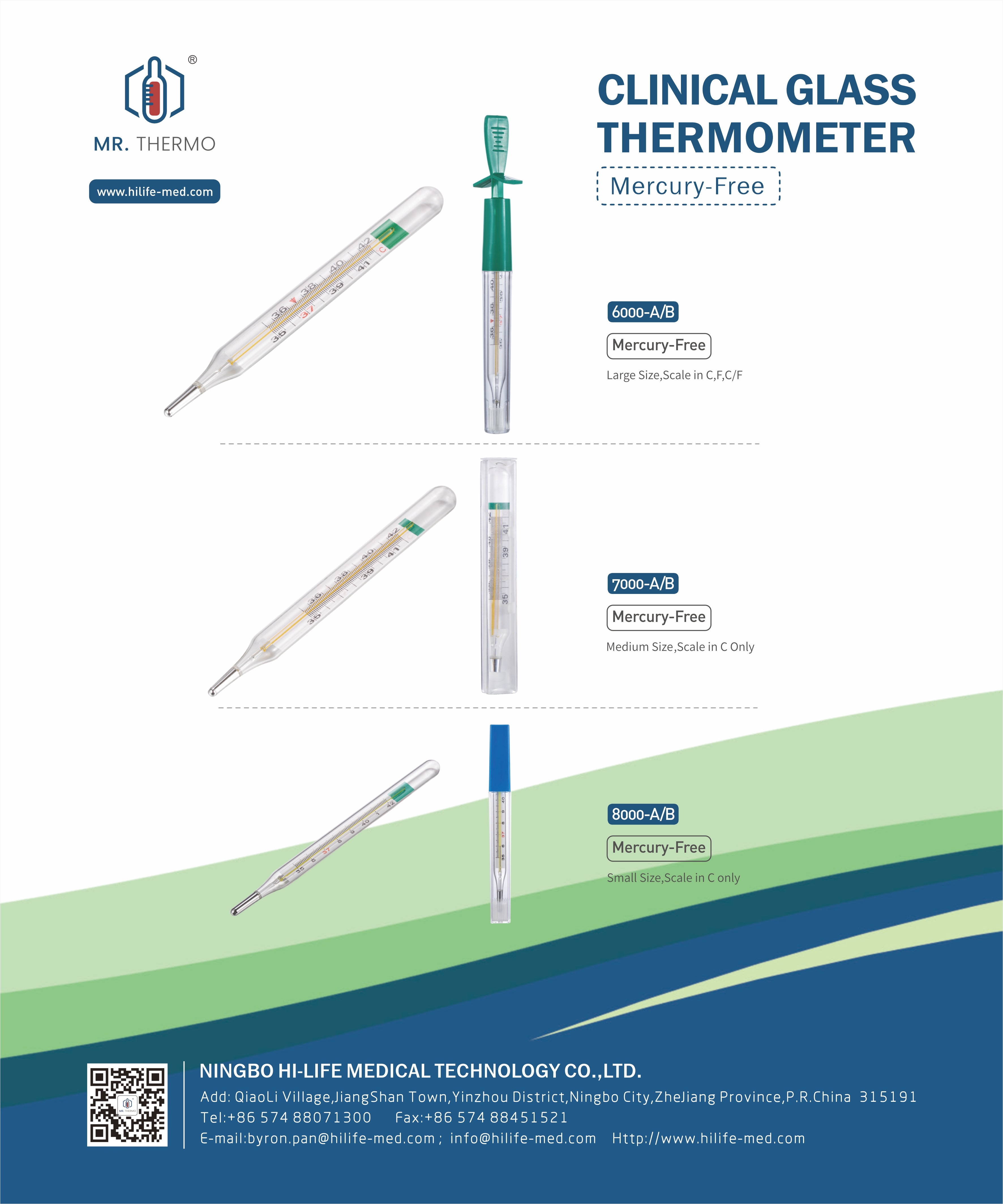
What the 6000-A and 7000-A are designed for
The 6000-A and 7000-A are mercury-free glass clinical thermometers for medical and homecare use. The product specification describes a measuring range of 35℃ to 42℃, a scale division of 0.1℃, and measurement accuracy of ±0.1℃. The thermometer uses a borosilicate glass tube and a non-toxic gallium-indium-tin alloy rather than mercury. It has a maximum temperature indicator and a shock-resistant glass tube.
These details provide buyers with a practical way to assess fit. The measurement range indicates the interval covered by the product; the scale division describes the increments shown on its scale; and the stated accuracy is a separate specification. Each should be checked against the requirements of the intended measurement protocol. The product facts do not establish a clinical outcome, testing method, or performance advantage over other thermometer types.
The models are described as reusable and battery-free. Their manual-reading format is therefore a key part of the use case: the user reads the displayed temperature from the glass scale rather than relying on an electronic display or a powered measurement process. That distinction can matter when a buyer is defining how a thermometer will be issued, read, cleaned, stored, and reused. Specific cleaning instructions, measurement duration, and validated reuse procedures are not included in the supplied product information and should be confirmed in the applicable instructions for use.
Use case 1: Medical temperature-measurement settings
The product information places the 6000-A and 7000-A in medical-device and medical-care contexts. For a medical procurement team, the first question is whether a manually read glass thermometer fits the intended measurement workflow. If staff or users are expected to read a scale directly, a liquid-in-glass device may be considered as one option. The available facts support that product-category match; they do not identify a particular hospital department, patient group, clinical protocol, or institutional deployment.
Before selecting a model for a medical setting, buyers can check that the specified 35℃–42℃ range and 0.1℃ scale division align with the intended procedure. They can also review the stated ±0.1℃ measurement accuracy alongside the organization’s own requirements and the product’s applicable instructions. This is a fit check, not a substitute for local clinical policy or a determination that the product is appropriate for every medical use.
The physical design also informs handling considerations. Borosilicate glass and a shock-resistant tube are specified, but “shock-resistant” should not be interpreted as unbreakable. A glass instrument remains different from an electronic thermometer in construction and reading method. Buyers planning shared or repeated use should establish handling, storage, and replacement procedures based on their own operating conditions and the manufacturer’s instructions. The corpus does not provide drop-test results, service life, or cleaning validation, so those characteristics should not be inferred from the material description alone.
Use case 2: Homecare and household clinical measurement
The 6000-A and 7000-A are also identified for homecare scenarios. In a household setting, the manual-reading format offers a clear distinction from an electronic thermometer: no battery is required to take a reading with this liquid-in-glass design, and the result is read from the scale. That can suit buyers who specifically want a reusable, non-electronic clinical thermometer, provided the user can read and handle the glass instrument appropriately.
The product data lists a normal indoor environment as a use condition for the mercury-free glass thermometer in a clinical and homecare project. It does not define a complete set of storage or operating limits. Homecare providers and retailers should therefore avoid translating the indoor-use description into unsupported claims about use in every environment. For a household product listing, useful information includes the model name, measuring range, scale division, accuracy statement, mercury-free filling material, and any handling or usage instructions supplied with the product.
Household suitability is not determined by product category alone. A buyer should consider whether the person using the thermometer can read the scale, whether a manual process is acceptable, and how the product will be stored and reused. If a user needs a digital readout, a fever alarm, or automatic power-off, those are not features listed for the 6000-A and 7000-A. They are features stated for the separate electronic thermometer range in the supplied product information. The distinction helps avoid assigning electronic functions to a glass thermometer.
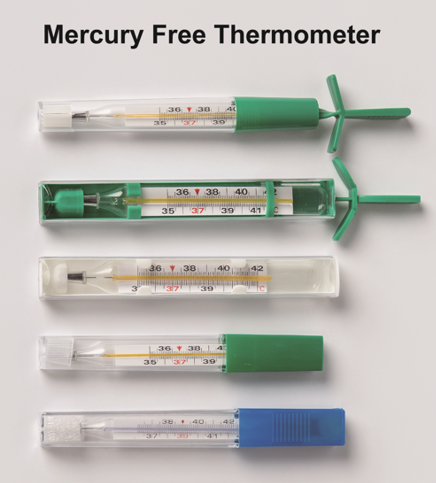
Matching the thermometer to the measurement workflow
Use-case selection is more reliable when it starts with the measurement workflow rather than a broad label such as “clinical thermometer.” The following comparison separates the documented characteristics of the 6000-A and 7000-A from questions buyers should verify for their own setting.
| Decision point | What is documented for 6000-A and 7000-A | What the buyer should establish |
|---|---|---|
| Measurement method | Mercury-free liquid-in-glass thermometer; manual reading. | Whether a manual scale reading fits the user and care workflow. |
| Measurement interval | 35℃ to 42℃. | Whether this range covers the intended measurement procedure. |
| Scale and stated accuracy | 0.1℃ scale division; ±0.1℃ stated measurement accuracy. | Whether these specifications meet the organization’s requirements and how they are verified in the product documentation. |
| Construction and filling | Borosilicate glass tube containing a non-toxic gallium-indium-tin alloy; shock-resistant glass tube. | Whether a glass device is suitable for the handling, storage, and supervision conditions. |
| Power | No battery required. | Whether a battery-free, manually read device is preferred over a powered electronic model. |
| Reuse | Described as reusable. | What cleaning, reuse, and replacement instructions apply to the intended setting. |
| Model differentiation | Both 6000-A and 7000-A are listed in this product category. | Whether current model-specific documentation identifies differences in packaging, design, or intended use. |
How it differs from electronic, digital, and infrared options
“Clinical thermometer” covers products with different measurement methods. The 6000-A and 7000-A are glass, manually read, and battery-free. Ningbo Hi-life Medical Technology Co., Ltd. also lists a separate electronic thermometer range: MT-518, MT-519, MT-811, MT-801, and ECT-1. For those electronic models, the supplied specifications include a 32.0℃–43.9℃ measuring range, ±0.1℃ measurement accuracy, a 45-second response time, a 1.5V button battery, and IP22 protection. The electronic range also lists a fever alarm and auto power-off.
This is a distinction between documented product types, not a ranking. A buyer considering a digital thermometer can compare the electronic range’s stated features with the manual reading and battery-free format of the 6000-A and 7000-A. The input does not provide specifications for infrared thermometers, forehead infrared thermometers, or ear digital thermometers. Their range, accuracy, response, operating requirements, and suitability should not be inferred from the glass or electronic thermometer facts above.
Similarly, the words “digital thermometer,” “waterproof digital thermometer,” and “infrared thermometer” should not be used as synonyms for the 6000-A or 7000-A. The models are specifically described as mercury-free liquid-in-glass thermometers. Buyers who require an electronic display, a non-contact method, or a waterproof rating need to verify those characteristics in the documentation for the specific product under consideration.
A practical selection sequence for buyers
- Define the setting. Decide whether the intended use is medical care, homecare, or another setting. The supplied application information identifies medical and homecare scenarios for the 6000-A and 7000-A.
- Choose the reading method. Confirm that manual reading from a glass scale is acceptable. If the use case requires a digital display, alarm, or automatic power-off, compare against a product whose documentation lists those functions.
- Check the measurement specifications. Match the stated 35℃–42℃ range, 0.1℃ scale division, and ±0.1℃ accuracy to the intended requirements. Do not treat scale division and accuracy as interchangeable measures.
- Review handling and reuse requirements. The models are described as reusable and use a shock-resistant glass tube. Confirm the manufacturer’s instructions for handling, storage, cleaning, and reuse; those details are not specified in the facts summarized here.
- Confirm model-level details. Both 6000-A and 7000-A are model designations for the product category. Request or consult model-specific documentation where packaging, product configuration, or use instructions matter to the purchase.
This sequence is useful for importers, distributors, pharmacy buyers, and medical-device purchasers because it separates a product’s documented attributes from local selection requirements. It also reduces the risk of treating broad category keywords as proof of a particular feature. A product described as a clinical thermometer is not automatically electronic, infrared, waterproof, or suitable for every clinical protocol.
What the available information does—and does not—establish
The available product facts establish that the 6000-A and 7000-A are mercury-free liquid-in-glass clinical thermometers intended for medical and homecare scenarios. They specify the filling alloy, glass material, measurement range, scale division, stated accuracy, maximum temperature indicator, shock-resistant tube, reusable design, and battery-free operation. These facts allow a first-pass comparison against a buyer’s workflow.
They do not, by themselves, establish a particular patient population, a prescribed measurement site, measurement time, cleaning method, clinical validation result, service life, or performance against named competitors. Nor do they establish that the two model numbers have identical packaging or every implementation detail. Those are appropriate points for model-specific instructions and technical documents, rather than assumptions to add to a product description.
For industry readers, the main procurement implication is straightforward: the 6000-A and 7000-A are candidates when the requirement is specifically for a reusable, mercury-free, manually read glass clinical thermometer for medical or homecare use. If the requirement instead emphasizes automatic measurement, electronic alerts, non-contact measurement, or a waterproof enclosure, the buyer should evaluate the corresponding product category and verify its own specifications.
Frequently asked questions
What are the 6000-A and 7000-A clinical thermometers?
They are model designations for mercury-free liquid-in-glass clinical thermometers intended for medical and homecare scenarios. The stated construction uses borosilicate glass and a non-toxic gallium-indium-tin alloy.
What settings are the 6000-A and 7000-A intended for?
The supplied product information identifies medical-device and homecare use, including clinical and home temperature-measurement contexts. It does not assign either model to a specific hospital department or patient group.
What are the stated measurement specifications?
The 6000-A and 7000-A have a stated measuring range of 35℃ to 42℃, a scale division of 0.1℃, and measurement accuracy of ±0.1℃. Buyers should check these specifications against the requirements of their intended procedure.
Do the 6000-A and 7000-A require batteries?
No battery is required for the mercury-free liquid-in-glass design. The temperature is read manually from the glass scale.
Are the 6000-A and 7000-A digital or infrared thermometers?
No. They are mercury-free liquid-in-glass thermometers. Digital and infrared models are different product types, and their specifications should be checked separately.
What should buyers verify before specifying one of these models?
Buyers should confirm that the manual reading method, measurement range, scale division, stated accuracy, glass construction, and reuse requirements fit the intended setting. Model-specific instructions should be checked for handling, cleaning, storage, and any differences between 6000-A and 7000-A.
Есть вопросы или нужны дополнительные детали?
Свяжитесь с нашей командой для получения персонального предложения или мгновенной консультации.
Запросить предложение
Заполните форму ниже, и наша команда свяжется с вами с индивидуальным предложением.
Прямой чат WhatsApp
Предпочитаете общаться в реальном времени? Напишите нам в WhatsApp для мгновенной помощи и быстрых ответов.
- Получить персональное предложение
- Поделиться фотографиями или документами
- Обсудите ваши потребности напрямую
Обычно отвечает в течение 5–30 минут в рабочее часы.