
Coated Freeze-Dried Fruit: Defects, Variance and Acceptance
A coated freeze-dried fruit piece is two products in one: a porous, hygroscopic fruit core and a fat-continuous coating layer applied after drying. That construction explains why coated lots generate more acceptance disputes than pure freeze-dried fruit — and why most of those disputes are settled by documents and measurements rather than by opinion.
This reference covers the questions that arrive at the point where a purchase order becomes a delivery: why pieces stick, crack or lose their surface finish; why a container does not match the approved sample; what an acceptance criterion has to contain before it can be enforced; and how an incoming lot should be handled when it deviates. It applies to coated freeze-dried strawberry, banana and durian programmes, and to the pure freeze-dried formats — apple among them — that share the same storage, sampling and documentation logic.
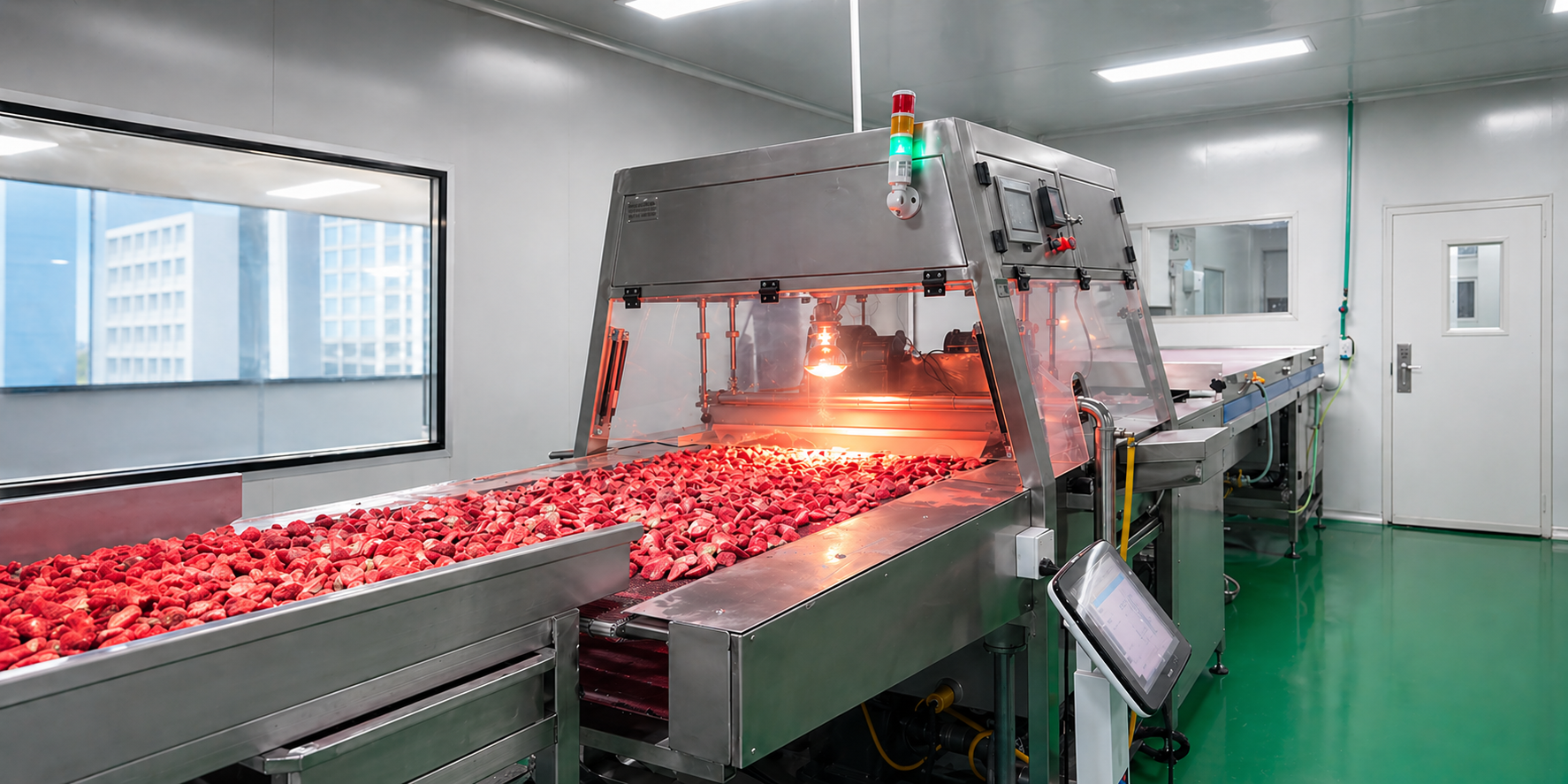
Coating is applied to fruit that has already been freeze-dried, then cooled and packed. Most surface defects are either created or avoided at this stage.
Why coated pieces fail: four defect families
Defect complaints on coated freeze-dried fruit cluster into a small number of families, and each family points at a different part of the chain. Treating all of them as "coating quality" is what makes investigations slow.
| Symptom at receipt | Mechanism | First thing to check |
|---|---|---|
| Pieces sticking together or forming clusters; coating soft or tacky | Coating softening under excessive heat or repeated temperature cycling | Storage and transport temperature records; container position; ambient conditions at unloading |
| Coating cracking or partially flaking off; loose coating fragments inside the pack | Transport vibration, stacking pressure, or excessive movement inside the pack | Headspace, cushioning, case configuration, and drop height at each handling point |
| Loss of gloss, dullness, streaking, or a whitish/greyish surface | Bloom on some fat-based cocoa or chocolate-flavoured coatings after temperature cycling | Whether it is a crystallisation appearance change — rule out moisture damage or mould before treating it as cosmetic |
| Soft core, lost crispness, damp-feeling pieces | Moisture ingress from poor seal integrity, insufficient moisture protection, or condensation | Seal integrity, barrier structure, and humidity/temperature during storage and line-side exposure |
Two consequences follow. First, none of these symptoms identifies its own cause: a whitish surface can be bloom or moisture damage, and only a physical check separates the two. Second, the diagnostic sequence is ordered by cost, not by suspicion — storage conditions after receipt, then package integrity, then issue identification, then comparison with other unopened packs from the same batch, then transport and handling review, then corrective action. Skipping to the last step produces a claim without a mechanism behind it.
What a coated SKU actually is — and why the acceptance baseline differs
Coated freeze-dried fruit is freeze-dried fruit carrying a flavored surface layer applied after drying. The commercial process route is selecting, coating, cooling and packaging, and because the continuous phase of the coating is fat rather than water, the layer sets by cooling rather than by drying. That matters technically: the coating does not wet the porous core to any meaningful degree, and the set layer adds a further moisture barrier over an already very low-moisture substrate.
Fruit content is declared per SKU rather than at range level. Coated durian in the 58 g format declares freeze-dried durian at ≥66%; coated strawberry in the 22 g, 29 g and 38 g formats declares strawberry at ≥37%. The gap is not marketing language — it changes what the buyer is actually purchasing. At 37% fruit content the coating is the majority component of the piece, which is why fruit-to-coating balance, and not fruit content alone, is the reference point for sensory comparison.
Three label constraints that are routinely missed
- "Chocolate" is a restricted term. EU Directive 2000/36/EC reserves the name for products meeting minimum total cocoa solids of ≥35%, including ≥18% cocoa butter and ≥14% fat-free cocoa solids. A cocoa-based coating below those minima must be described as a chocolate-flavoured or compound coating, and the product name should lead with the coating where the coating is the majority component.
- Allergens come from the coating, not the fruit. Coated products contain milk-derived ingredients such as whey powder and whole milk powder, and soy-derived ingredients, plus cocoa powder in cocoa variants. Milk and soy must be declared under US FALCPA and EU Regulation 1169/2011 Annex II.
- Clean-label claims do not transfer. Coated SKUs are not eligible for "no added sugar" or single-ingredient clean-label positioning. Documentation, allergen files and claim approvals built for a pure SKU cannot be reused on a coated one.
The SKU list illustrates the point. A 96 g chocolate-flavoured compound-coated freeze-dried whole banana declares banana at ≥67%, 0 g trans fat, and contains milk and soy; a yogurt-coated 96 g variant carries the same fruit content with a fermented yogurt-powder coating. A 22 g matcha variant of coated strawberry uses a milk-based matcha coating, while a 58 g coated durian uses a light vegetable-oil coating and declares soy. A pure freeze-dried apple 58 g pouch, by contrast, is single-ingredient with no declared allergen. Four products, four different documentation sets.
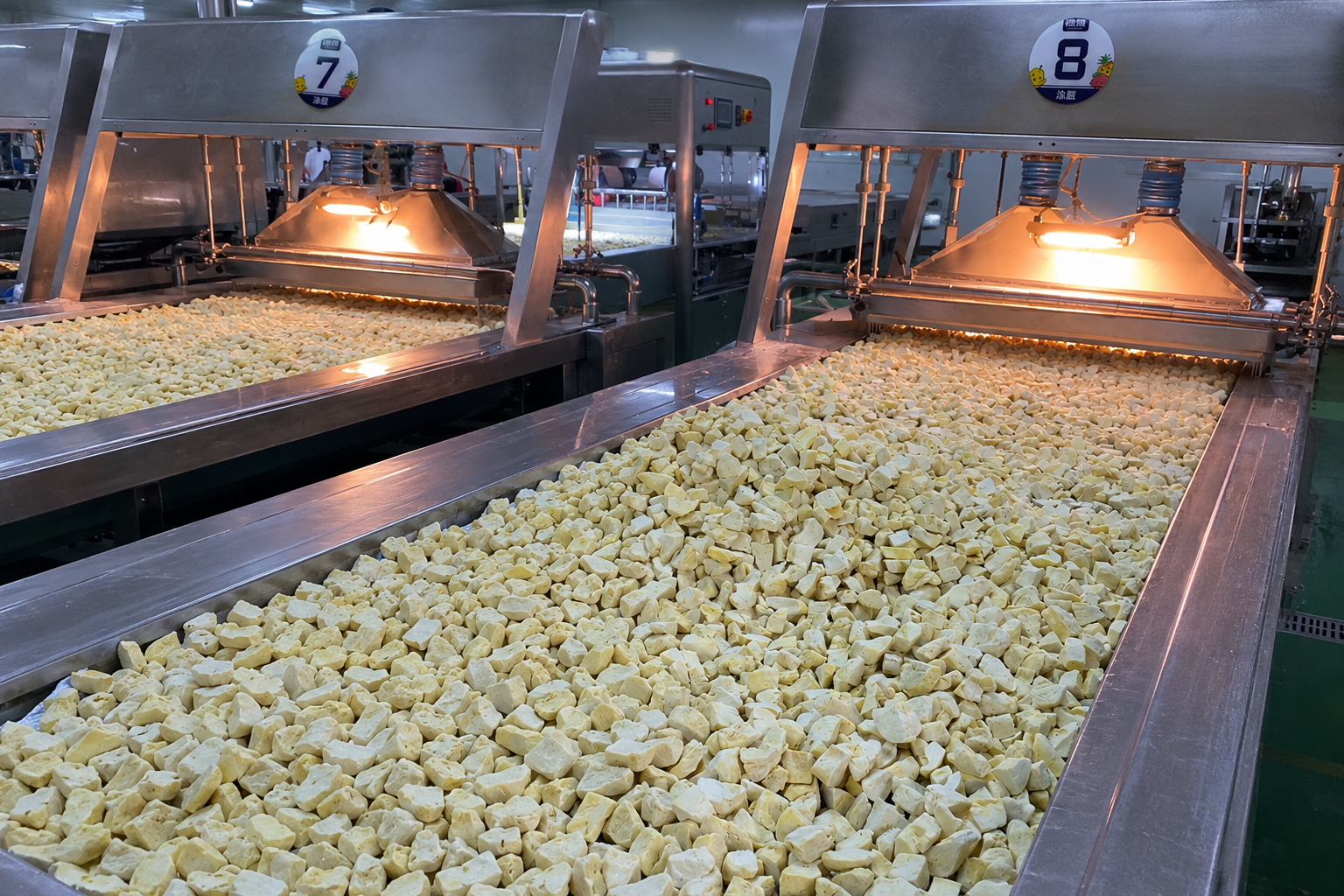
Coated durian 58 g declares freeze-dried durian at ≥66%; coated strawberry 22/29/38 g SKUs declare strawberry at ≥37%. Fruit content is a per-SKU figure, not a range figure.
Delivery variance is three problems, not one
When a bulk delivery does not match the approved sample, there are three possibilities and they need separating before any conclusion is drawn. The first is normal natural variation: freeze-dried fruit is an agricultural product, and composition, colour, size and sensory profile vary with variety, origin, maturity, season and production batch. The second is an incomplete specification — if colour tolerance, dimension or mesh, fines limit, coated fruit content percentage and sensory descriptors were never written down, then "matching the sample" has no measurable basis and the dispute cannot be resolved on evidence. The third is a genuine effect: handling and transport (breakage, moisture uptake, temperature cycling, light), an actual batch deviation, or a comparison-method difference such as lighting, temperature, sample age or assessor.
The investigation order that works is documentary first. Retrieve the written specification and the sample approval record, and identify which parameters were actually specified and which were not — that single step often explains the disagreement. Then compare the delivered bulk against the retained sample from the same batch under consistent conditions: same lighting, same temperature, same assessor where possible. Review the batch documentation and COA and ask whether the delivered batch is within its own specification. In parallel, assess pack integrity, temperature and humidity records, transit time and stacking.
Only then quantify. Express the deviation numerically — moisture, fines percentage, size distribution, colour against a reference — rather than qualitatively, and classify it as natural variation within specification, an unspecified parameter, a handling or transport effect, or a batch deviation. The closure step is specification tightening, so that the disputed parameter becomes measurable for the next order. Without that step, the same argument returns on the following container.
Building acceptance criteria that can actually be measured
Acceptance criteria fail for one reason: they are written after sampling instead of before it. The specification should be complete enough that a third party who never saw the sample could still reject or release a lot.
- Product name, raw-material composition, and product form and cut.
- Dimension or mesh, with a size distribution and a fines or intact-ratio limit.
- Moisture, with the test method named.
- Colour tolerance, with a reference standard attached.
- Packaging, storage conditions and shelf life.
- Allergen status, and for coated SKUs the fruit content percentage.
- Any customer-specified test items, set by end use and destination market.
Two parameters deserve separate treatment because they are the ones most often argued about. Moisture should be specified with a limit and a method rather than a single target: in six-category SGS-CSTC type testing (reports XMF26-0002013-01 to -06) the reference limit applied was ≤5.0 g/100 g, while measured values across apple, strawberry, jackfruit, dragon fruit, mango and durian ranged from 0.96 to 1.58 g/100 g. Those figures describe the tested batches only and are not a fixed guarantee for future lots — the specification and the lot COA govern delivery. Colour should be specified as a tolerance against a reference standard, because colour varies naturally by variety, origin, maturity, season and batch, and a specification with no colour reference simply relocates the argument to the receiving dock.
Moisture and water activity should not be used interchangeably. Water activity measures free, available water on a 0–1 scale and predicts microbial and chemical stability; moisture content measures total water and does not. Widely used reference thresholds treat aw below 0.85 as a water-activity-controlled food and aw below 0.60 as preventing growth of all microorganisms. For coated SKUs the practical relevance is moisture migration: whether an inclusion softens the surrounding cereal or dairy base is governed by aw difference, not by the moisture percentage printed on the certificate.
The order-level lock
Specification alone is not enough; the purchase order has to reference it. Before mass production, the signed specification, the golden sample, price basis, quantity and tolerance, packaging and case configuration, final label artwork, lot coding and traceability approach, COA panel and methods, destination-market documents, delivery term, delivery window, payment terms, change-notification rule and non-conformance handling should all be locked. Where the PO, the specification and the quality agreement conflict, the order of precedence should be defined in advance rather than during a dispute.
Pre-shipment: what inspection covers and what buyers can add
Pre-shipment inspection (PSI) against the supplier's enterprise standard is conducted before every shipment, with an inspection report provided. Buyers who want an independent view can appoint a third-party agency — SGS, BV, Intertek or CTI, for example — to inspect before shipment, or can require samples for approval before loading. For frozen products, cold-chain documents such as temperature records can also be provided. Other acceptance arrangements can be structured per project.
The document set that should arrive before shipment release is consistent across formats: lot number, final COA and test results, packaging and label version, net weight and case pack, shipping marks, quantity, manufacture date and shelf-life data, load plan, and the export or import documents the contract requires. First orders and higher-risk programmes justify pre-shipment sampling or third-party inspection as standard; established repeat orders can operate on documentation plus periodic verification. The default delivery term is FOB Xiamen, China, with other trade terms and loading ports arranged according to customer requirements, and certain products shipped directly from their country of origin. Payment terms for reference are 30% T/T in advance with 70% T/T against a copy of the B/L, with the actual ratio and milestones set in the written contract.
Incoming inspection, quarantine and nonconforming lots
On receipt, verify external packaging, damage and signs of moisture pickup, quantity, lot, label and documents, then sample against the agreed sensory, size and moisture criteria. If an issue is found, the sequence is: quarantine the lot, retain photographs, samples and logistics evidence, trigger the agreed retesting route, then apply the agreed replacement, credit and supplier corrective-action process. Comparison against the retained sample and the batch COA is what separates an incoming-material problem from a handling or packaging one.
Two commercial details determine whether this process actually works. The first is the claim window, agreed in advance rather than negotiated after a discovery. The second is sampling intensity — stronger sampling on first orders and high-value coated SKUs, lighter on established programmes with a documented history. Neither is a formality: a claim raised four weeks after unloading, on a lot already partly consumed, cannot be investigated to the same standard as one raised at the dock.
Storage, transport and shelf-life conditions for coated SKUs
To preserve crispness through shelf life, unopened product should be stored sealed in a cool, dry and dark place, preferably at ≤25 °C and below 60% RH, kept off the floor and within pallet stacking limits. After opening, reseal immediately, retain the supplied desiccant and use within the validated open-pack period. Powder is the most hygroscopic format and is handled at a stricter internal target of around ≤40% RH, subject to SKU-specific validation. Bulk cartons should be brought to line temperature before opening to avoid condensation on the product.
Coated SKUs add their own requirements: control storage and transport temperature according to the SKU, with particular attention to excessive heat and repeated temperature cycling; avoid direct sunlight and nearby heat sources; maintain seal integrity and adequate moisture-barrier performance; and optimise headspace, cushioning and case configuration to reduce impact and compression. For hot-climate destinations, container choice, warehousing and last-mile logistics should be evaluated before the order ships rather than after the first complaint. High-fat categories such as durian additionally warrant oxygen-barrier and light-protective packaging with nitrogen flushing, and stability should be evaluated during development rather than after launch.
Shelf life is 18 months for B2B freeze-dried ingredients and 12 months for finished goods, confirmed per SKU, packaging structure and destination market in the specification. Finished-goods shelf life is not transferable to a different pack format or climate without re-validation.
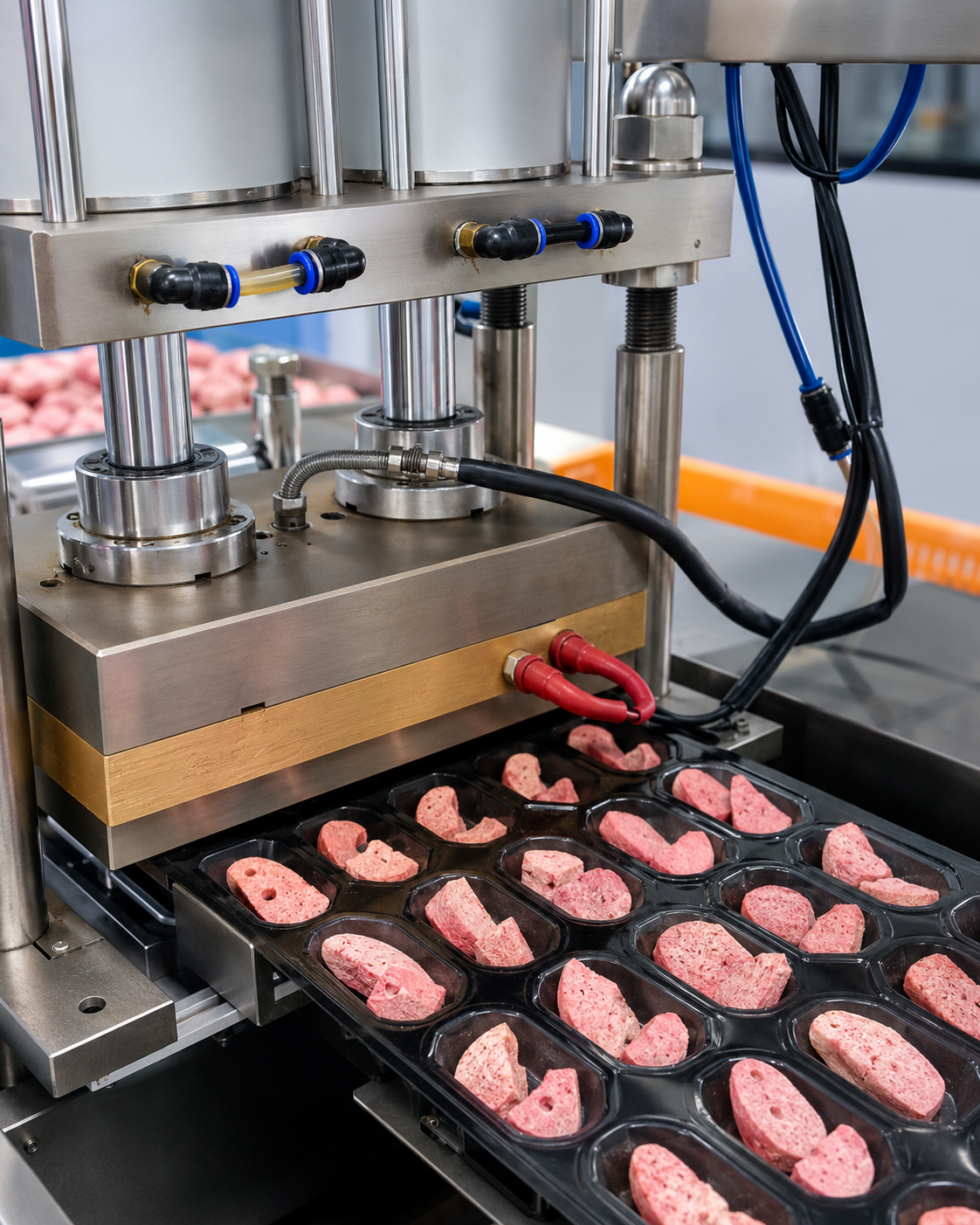
Seal integrity and moisture barrier decide whether a coated piece is still crisp at the end of its 12-month finished-goods shelf life — not the moisture figure measured at production.
What keeps acceptance stable across repeat orders
Long-term coated programmes fail less often on the first container than on the fifth, and the causes are administrative rather than technical. Four controls carry most of the weight.
First, a controlled specification revision with a written change-notification rule, so that a formulation, coating or packaging change cannot reach production without the buyer's written approval. Second, retained samples and lot-level COA held for each delivered batch, which is what makes a later dispute investigable at all. Third, a corrective-action loop with a stated closure timeline, so that a deviation produces a measurable change in the next lot rather than a credit note alone. Fourth, documentation continuity: certificate scope wording, halal product lists, facility registration validity and audit cycles all have dates attached, and a programme that runs for several years will outlive the documents it started with.
Schedule planning belongs in the same conversation. OEM and private-label mature programmes typically need about 25–30 working days, subject to specification, packaging-material approval and production schedule; ODM requires additional development, sampling and validation time. UrSnacks own-brand, private label and OEM finished goods start from approximately 600 kg, with mixed-SKU container loading supported; B2B freeze-dried ingredients are planned on a standard 1 × 20-foot container basis, with multiple ingredient SKUs combinable in the same container. Buyers who plan replenishment against those figures rather than against a target date tend to have fewer expedited shipments, and expedited shipments are where temperature and handling controls most often break down.
Where coated freeze-dried fruit is the wrong choice
For context on the supply side, UrSnacks is the core freeze-dried fruit brand of FUJIAN YOULINGYOUSHI TECHNOLOGY CO., LTD., a freeze-dried fruit manufacturer headquartered in Jinjiang, Quanzhou, Fujian, China, operating freeze-dried ingredient supply, OEM/ODM and private label finished goods across strawberry, durian, apple, banana and other fruit categories. Its production facilities hold BRCGS Issue 9 (Certificate No. C723738, Site Code 10017031, issued by DNV Business Assurance Italy S.r.l., valid 2025-10-20 to 2026-11-09), ISO 22000:2018 and HACCP certification, and relevant production entities hold U.S. FDA Food Facility Registration (Facility No. 432015462) and China Customs export food production enterprise filing. The BRCGS scope wording is worth reading closely in this context: it covers selecting and packaging of dried fruit products, and selecting, coating, cooling and packaging of coated dried fruit products in compound bags — which is exactly the process chain where the defect families above originate.
That said, coated freeze-dried fruit is not a universal upgrade over conventional confectionery, and the comparison should be made honestly. Conventional confectionery builds its structure from sugar, starch, fat or gelling systems and delivers flavour through the confectionery matrix; coated freeze-dried fruit uses a real fruit core and adds a coating for a layered flavour and texture experience. The coated route buys real-fruit identity and a differentiated eating experience, and it pays for that in three ways.
- Thermal and mechanical tolerance. A coated freeze-dried piece is materially less tolerant of heat and compression than sugar-based confectionery. A temperature excursion that a hard candy survives can soften a coating layer and cluster the pieces, and the porous core adds fragility that a solid confectionery piece does not have. Ambient-tolerant logistics assumptions carried over from candy programmes are a common source of first-shipment failures.
- Allergen and claim load. Milk and soy declarations, line segregation and allergen management apply, and the clean-label and no-added-sugar positioning available to pure freeze-dried fruit is unavailable here.
- Cost structure. Coated cost is composed of the freeze-dried fruit core, coating materials, customized coating processing and barrier packaging. Where fruit content is 37%, most of the piece by weight is coating, so a price comparison against a higher-fruit SKU is not a like-for-like comparison at all.
The honest conclusion is that coated formats suit premium snacking, gifting, private label differentiation and programmes that want fruit visible in both the product and the ingredient story. They are a poor fit where the brief is lowest unit cost, maximum ambient robustness, or a short ingredient list as the core claim.
Market context: what the numbers do and do not say
Global freeze-dried fruit revenue reached USD 5.108 billion in 2024, according to Market Research Future, a figure scoped to freeze-dried fruits and excluding vegetables. Berries accounted for 42.6% of revenue share in 2024, and Asia Pacific held a 38.2% revenue share in 2025. Both matter for coated programmes: berry dominance explains why coated strawberry is the most developed coated line, while durian remains a regionally concentrated premium rather than a global volume category.
Two cautions apply to anyone using these figures in a business case. First, a much larger "freeze-dried fruits and vegetables" market estimate circulates in parallel; the two are not the same measurement and should not be combined. Second, customs data cannot isolate the category — HS Code 0813 (dried fruits) reached USD 3.13 billion in global trade in 2024, up 2.79% on 2023, but it aggregates all drying methods, so freeze-dried volumes are embedded rather than visible. A buyer comparing a market-research figure with a trade figure is comparing two different definitions, not two estimates of the same thing.
Regulatory context moves on a fixed clock rather than a trend line. U.S. FDA Food Facility Registration is required for foreign facilities manufacturing freeze-dried fruit for US consumption and is renewable every even-numbered year, so the registration date on a supplier's file is a live datum for US-bound programmes, not a permanent credential.
Future outlook
As coated formats move from novelty lines into core ranges, the nature of the acceptance conversation changes. The first-generation question was whether a product was genuinely freeze-dried; the current question is whether a given lot falls inside an agreed window, and that question is answered by specification discipline rather than by product knowledge. Suppliers that can supply a measurable specification, a retained sample and a batch COA will increasingly outperform those that supply a good sample and a verbal assurance.
Three practical developments follow. Coating development will continue toward thinner, more fruit-led constructions as buyers push fruit content upward and coating cost downward, which puts more pressure on handling and barrier packaging rather than less. Logistics planning for hot-climate destinations will be designed in at quotation stage instead of corrected after the first claim. And label work will keep moving earlier in the project, because chocolate naming rules, allergen declaration and claim eligibility are all decided before artwork, not after printing.
FAQ
What causes sticking, cracking, flaking or surface changes in coated freeze-dried fruit?
Coated freeze-dried fruit is sensitive to heat, temperature fluctuation, compression, abrasion and moisture. Coating softening and sticking typically follow excessive heat; cracking and flaking typically follow transport vibration or stacking pressure; moisture-related deterioration follows poor seal integrity or insufficient moisture protection. Some fat-based cocoa or chocolate-flavoured coatings develop bloom or a dull, mottled surface after temperature cycling. Diagnosis should begin with storage and transport temperature, package integrity and handling conditions, compared against the retained sample.
Why does a bulk delivery not match the approved sample?
There are three distinct explanations: normal natural variation in an agricultural product; an incompletely defined specification, where colour tolerance, dimension or mesh, fines limit and coated fruit content were never written down; and handling or transport effects, a genuine batch deviation, or a comparison-method difference such as lighting, temperature or assessor. Separation is documentary first — retrieve the written specification and sample approval record, compare against the retained sample of the delivered batch under consistent conditions, review batch documentation and COA, then quantify the deviation numerically before classifying it.
What must be written into a specification before sampling so acceptance is measurable?
At minimum: product name, raw-material composition, form and cut, dimension or mesh with a size distribution, fines or intact-ratio limit, moisture with a named test method, colour tolerance with an attached reference standard, packaging, storage conditions, shelf life, allergen status, and — for coated SKUs — the fruit content percentage, plus any customer-specified test items required by end use and destination market. A specification that omits these parameters leaves "matching the sample" without a measurable basis.
What does pre-shipment inspection cover, and can a buyer appoint a third-party inspector?
Pre-shipment inspection is conducted against the supplier's enterprise standard before every shipment, with an inspection report provided. Buyers may appoint a third-party agency such as SGS, BV, Intertek or CTI to inspect before shipment, or require samples for approval before loading; cold-chain documentation such as temperature records can be supplied for frozen products. The supporting document set normally covers lot number, final COA and test results, packaging and label version, net weight and case pack, shipping marks, quantity, manufacture date and shelf-life data, and the load plan.
How should a deviating incoming lot be inspected, quarantined and closed out?
Verify external packaging, damage or moisture pickup, quantity, lot, label and documents, then sample against the agreed sensory, size and moisture criteria. On finding an issue: quarantine the lot, retain photographs, samples and logistics evidence, trigger the agreed retesting route, and apply the agreed replacement, credit and supplier corrective-action process. The claim window and sampling intensity should be agreed before the first order, and comparison against the retained sample and batch COA is what separates an incoming-material issue from a handling or packaging one.
What storage and transport conditions keep coated SKUs within specification through shelf life?
Unopened product should be stored sealed in a cool, dry and dark place, preferably at ≤25 °C and below 60% RH, off the floor and within stacking limits; powder is handled at around ≤40% RH subject to SKU-specific validation; after opening, reseal immediately, retain the desiccant and use within the validated open-pack period. Coated SKUs additionally require controlled storage and transport temperature with attention to excessive heat and repeated cycling, avoidance of direct sunlight and heat sources, maintained seal integrity and moisture barrier, and headspace, cushioning and case configuration that reduce impact and compression. Shelf life is 18 months for B2B ingredients and 12 months for finished goods, confirmed per SKU, packaging structure and destination market.
How are acceptance terms kept stable across repeat orders and multi-year supply?
Through four controls: a controlled specification revision with a written change-notification rule requiring buyer approval before formulation, coating or packaging changes reach production; retained samples and lot-level COA held for each delivered batch; a corrective-action loop with a stated closure timeline so a deviation changes the next lot rather than only generating a credit; and documentation continuity, since certificate scope wording, halal product lists, facility registration validity and audit cycles all carry dates that a multi-year programme will outlive. Planning replenishment against stated lead times — about 25–30 working days for mature OEM and private-label programmes — reduces the expedited shipments where temperature and handling controls most often break down.
UrSnacks brand and product reference (PDF): ursnacks-brand-book.pdf
Есть вопросы или нужны дополнительные детали?
Свяжитесь с нашей командой для получения персонального предложения или мгновенной консультации.
Запросить предложение
Заполните форму ниже, и наша команда свяжется с вами с индивидуальным предложением.
Прямой чат WhatsApp
Предпочитаете общаться в реальном времени? Напишите нам в WhatsApp для мгновенной помощи и быстрых ответов.
- Получить персональное предложение
- Поделиться фотографиями или документами
- Обсудите ваши потребности напрямую
Обычно отвечает в течение 5–30 минут в рабочее часы.