
Coating Line Basics: What First-Time Buyers Should Know
A coating line is not a single machine. It is an integrated production system that prepares a workpiece surface, applies a coating, cures or dries the coated film, and moves parts through each stage under controlled speed and environmental conditions. For first-time buyers, this system-level understanding matters more than any single component specification.
According to Fortune Business Insights, the global coating equipment market was valued at USD 20.56 billion in 2025 and is projected to reach USD 36.77 billion by 2034. The same report attributes 38.30% of 2025 revenue to Asia Pacific, driven largely by automotive and electric vehicle manufacturing. These figures help explain why coating lines are a growing procurement category for factories upgrading from manual painting or expanding into new surface treatment processes.
Why Coating Lines Are Hard to Compare
When buyers search for coating line information, they encounter very different specifications: workpiece dimensions, line speed, conveyor type, spraying method, curing temperature, and environmental controls. The reason is that coating lines are engineered around the workpiece. A line built for non-stick pans cannot be evaluated against a line built for aluminum building panels using the same criteria. Common terms like automatic coating line hide important differences in layout, throughput, and automation level.
For an Awareness-stage buyer, the immediate problem is not choosing a specific brand. It is understanding which parameters define a line's capability, and which questions to ask later during supplier evaluation.
Brand Solution: A Whole-Plant Reference Example
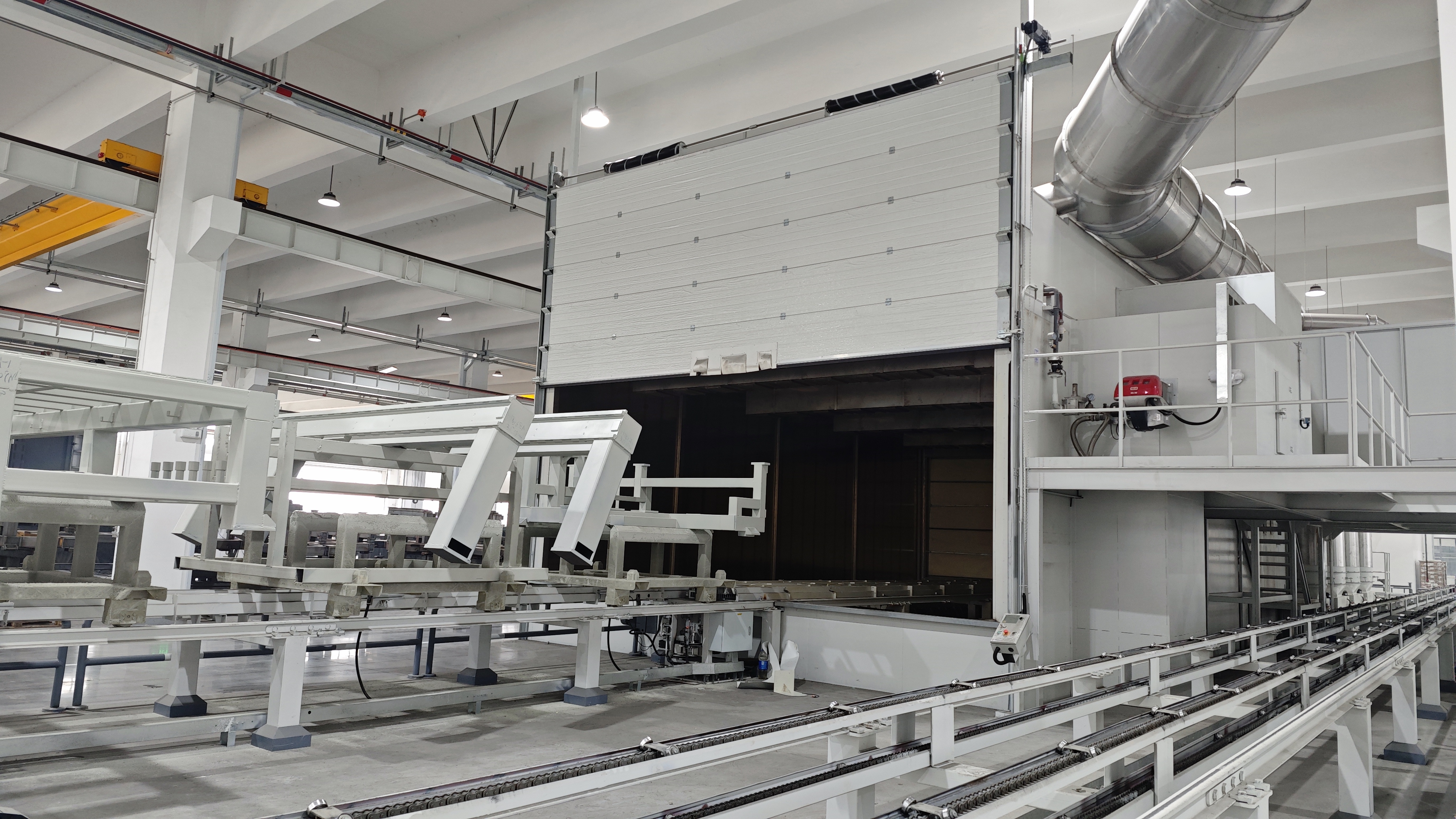
Attractivechina, the trade brand of Guangdong Chuangzhi Intelligent Equipment Co., Ltd., is an example of a supplier that operates at the whole-plant level. The company, established in 2005, is located in the National High-tech Industrial Development Zone of Zhaoqing City, Guangdong Province, with a paid-in capital of 60.8 million CNY. Its manufacturing facility covers 35,548 square meters and has an annual production capacity of 60 units, with approximately 280 employees.
The company's main products include coating lines, cookware coating lines, wood coating lines, auto parts coating lines, metal coating lines, and industrial equipment coating lines. It covers pre-sales plant planning, independent R&D, design, manufacturing, installation, commissioning, and after-sales service. For buyers, this kind of scope reduces the need to coordinate multiple suppliers during a line project. Documented service features also include remote diagnosis for rapid troubleshooting and a 4-hour response service, which can reduce maintenance-related downtime.
What a Coating Line Actually Includes
Most automated coating lines share the same core modules, even when the workpiece differs:
- Pretreatment equipment: cleans and conditions the workpiece surface before coating.
- Drying rooms or moisture-drying ovens: remove moisture after pretreatment.
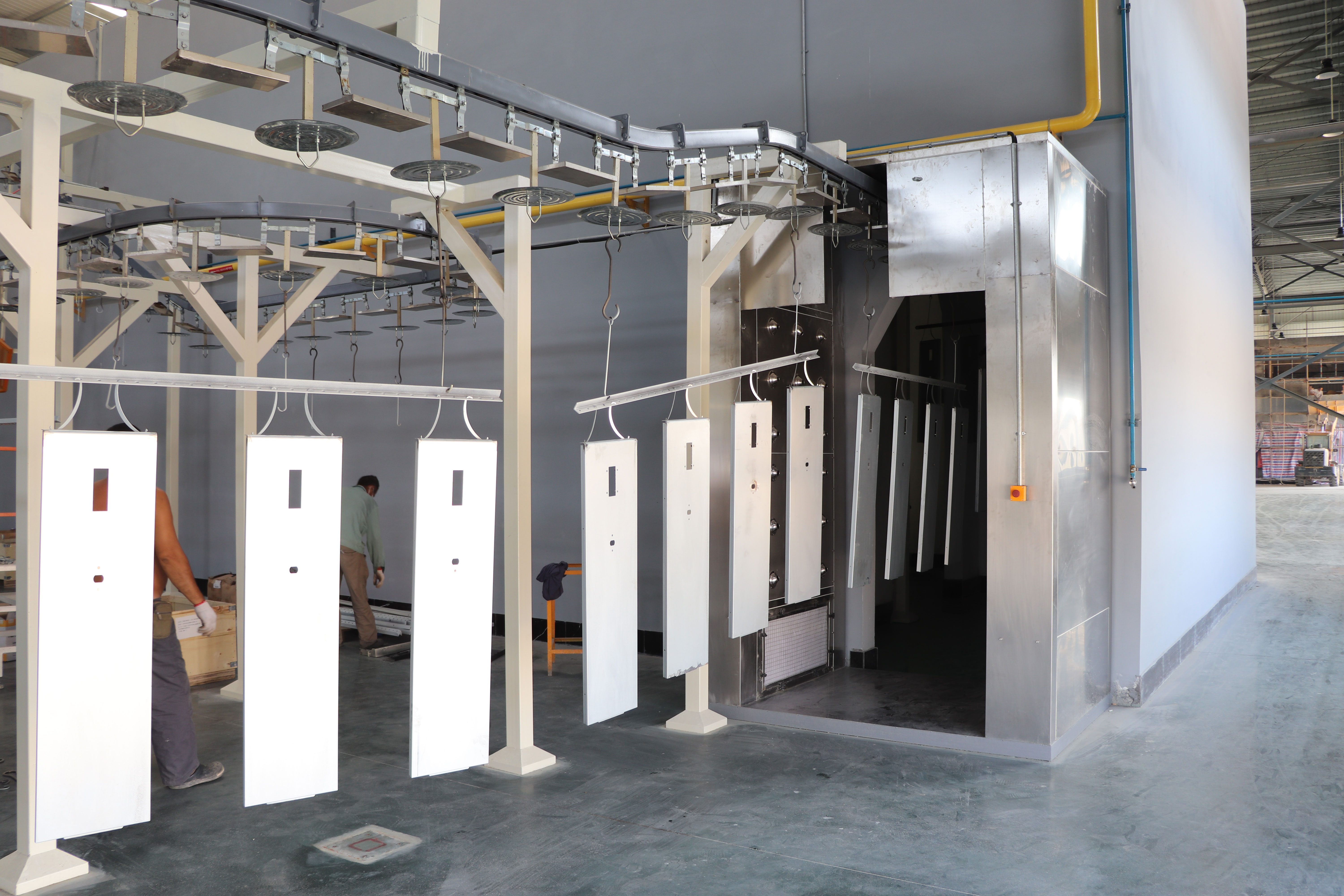
- Spray booths: where the coating is applied, either manually, by robot, or by reciprocator.
- Curing ovens or drying rooms: harden or cure the applied coating.
- Conveying systems: move workpieces through each stage. Examples include floor-supported conveyors, power-and-free conveyor chains, suspended conveyor systems, and skid conveyor systems.
- Cooling and workpiece accumulation areas: control line flow and prevent damage.
- Dust removal and VOC treatment systems: control airborne particles and exhaust emissions.
- Electrical control systems and, in some configurations, MES production management systems.
This combination of modules is why coating suppliers describe their work as whole-plant solutions rather than machine supply alone.
Coating Line Types by Workpiece
The following categories are commonly used in the coating equipment industry, and each maps to a different set of engineering constraints.
| Coating line type | Typical workpiece | Key parameters |
|---|---|---|
| Auto Parts Coating Line | Bumpers, wheel hubs, wheel hub caps, fuel tanks, frames, automotive interior parts, car logos | ABS+PC material; 336 days/year, 22 hours/day; spray booth 25±2°C and 65±10% RH; offline mode + robot spraying; 85% equipment utilization; factory approx. 100m × 38m × 5.4m. |
| Metal Coating Line | Doors, windows, steel cabinets, building materials, cabinet components, sheet metal parts, lamp fittings, aluminum sheets | Aluminum panels and profiles; max workpiece 7000×2000×2200mm; capacity 5000m²/day; conveyor speed 3000mm/min, adjustable 2000–4000mm/min; reciprocator + manual spraying. |
| Wood Coating Line | Table legs, chair backs, sitting frames, beds, dining tables, chairs, musical instruments | Solid wood or MDF; max workpiece 610×710×1400mm; pitch 300mm/hang; line speed 4000mm/min, adjustable 2000–6000mm/min; 8-hour output 1422 pieces. |
| Cookware Coating Line | Non-stick pans, frying pans, air fryers, rice cooker inner pots, cake pans, soup pots, water heater shells | Standard product size Φ220×160mm(H); max product size Φ300×160mm(H); designed for cookware and home appliance production. |
| Industrial Equipment Coating Line | Buses, tank trucks, carriage components, bolster side frames, injection molding machines, low-altitude equipment | Floor-supported conveyor; manual + robot spraying; production capacity up to 20 China railway gondola/flat/tank cars per shift. |
These distinctions matter because they define the line's layout, automation level, and utility for a specific production program.
From Workpiece to Line: Technical Explanation
Workpiece material has a direct impact on line configuration. ABS+PC automotive parts require controlled spray booth temperature and humidity, which is why the auto parts line specification includes 25±2°C and 65±10% RH. Aluminum building products require high daily capacity, which is why the metal line specification is expressed in square meters per day. Wood furniture requires careful conveying distances and pitch, which is why the wood line specification includes a 300mm pitch and an adjustable line speed from 2000 to 6000mm/min. Heavy industrial parts require floor-supported conveyors and robot support, because parts are too large or heavy for overhead suspension in most cases.
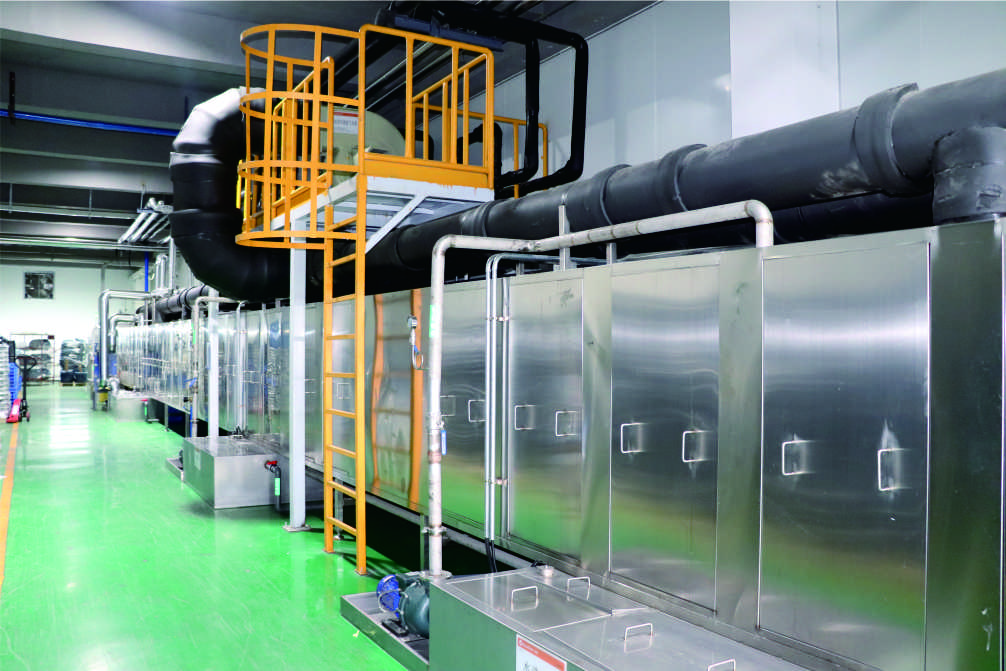
The supporting structure also follows process requirements. In the documented product lines, the main frame is carbon steel, while the spray booth and pipeline are stainless steel. This material choice is common in coating equipment because the spray area needs resistance to chemicals and easier cleaning.
Operating conditions are another design input. Many automated coating lines are designed for indoor Class 10,000 cleanroom environments, with clean and well-ventilated conditions. This matters for finish quality, especially in automotive and home appliance applications.
How to Read a Coating Line Specification
Manufacturers rarely publish a single universal spec. Instead, they publish line-specific values. For the auto parts line, the spec includes spray booth temperature and humidity, because ABS+PC parts are sensitive to surface defects. For the metal line, the spec includes maximum daily coated area, because flat building products are measured by surface area. For the wood line, the spec includes pitch and line speed, because furniture parts are hung individually. For the industrial equipment line, the spec includes production capacity in units per shift, because each vehicle or machine is large and handled on a floor-supported conveyor.
Buyers should also verify the required operating environment. The documented coating lines operate under indoor Class 10,000 cleanroom, clean and well-ventilated environment conditions. That requirement affects building ventilation, air filtration, and housekeeping practices.
Market Trends Shaping the Coating Line Market
There are several visible trends in the coating equipment market. First, the overall equipment market is expanding. Fortune Business Insights projects the global coating equipment market will grow from USD 20.56 billion in 2025 to USD 36.77 billion by 2034. Second, coating chemistry is evolving alongside equipment. Fact.MR estimates the global powder coating equipment market at USD 3.20 billion in 2024, with a compound annual growth rate of 5.1% through 2034. Market Reports World estimates the e-coat market at USD 6.02 billion in 2026, reaching USD 9.48 billion by 2035.
Third, standards are playing a larger role in purchasing decisions. ISO 12944 is the globally recognized standard for corrosion protection of steel structures by protective paint systems, and it is frequently referenced in industrial coating specifications, especially for heavy equipment and infrastructure-related parts. Buyers are increasingly asking how a coating line can help them meet such standards.
Automated Coating Line vs Traditional Manual Coating
The practical choice for many factories is not only between different brands, but also between manual coating stations and an automated coating line. Each approach has a different cost and flexibility profile.
| Criterion | Traditional manual coating | Automated coating line |
|---|---|---|
| Process consistency | Depends on operator skill | Controlled spray parameters and repeatable cycles |
| Throughput | Lower and batch-dependent | Continuous, designed for a target output |
| Equipment utilization | Difficult to measure | 85% in the documented auto parts line |
| Footprint | Smaller, flexible layout | Larger; the documented auto parts line requires 100m × 38m × 5.4m |
| Flexibility | Higher for small batches and changing parts | Optimized for a defined workpiece range |
| Environmental control | More difficult to contain | Integrated dust removal, VOC treatment, and cleanroom design |
One important limitation should be stated clearly: an automated coating line is not always the right answer. If a factory handles very short production runs and constantly changing part geometry, a fully automated line may require frequent changeovers and reduce utilization. In that scenario, manual or semi-automatic stations with good extraction systems can be more practical. The decision should be based on expected product mix, volume stability, and building constraints, not on the general appeal of automation.
Evaluation Priorities for Buyers
At the Awareness and Research stages, buyers can use the following priorities to structure their information gathering:
- Define the workpiece envelope: maximum size, geometry, weight, and material.
- Define the output target: pieces per shift, square meters per day, or units per shift.
- Identify the coating process and finish requirements: liquid coating, powder coating, e-coat, or specialized coatings.
- Assess the automation level needed: manual touch-up, reciprocator spraying, robot spraying, or offline mode plus robot spraying.
- Check conveyor and layout compatibility with the existing building and utility capacity.
- Confirm environmental requirements: cleanroom class, dust removal, VOC treatment, and relevant standards.
- Review the supplier's scope: pre-sales plant planning, independent R&D, design, manufacturing, installation, commissioning, and after-sales service.
This checklist is intentionally generic. It becomes useful when applied to a specific workpiece and production plan.
Future Outlook
Coating line procurement is moving toward whole-plant solutions rather than isolated equipment purchases. Buyers increasingly expect a single partner to cover pre-sales planning, plant layout, equipment design, installation, commissioning, and after-sales support. At the same time, new application fields such as low-altitude equipment are joining established industries such as auto parts, cookware, wood furniture, musical instruments, heavy machinery, home appliances, and building materials.
The documented project landscape shows demand across multiple regions, including Vietnam, Iran, Indonesia, Brazil, the UAE, Turkey, Thailand, Saudi Arabia, Argentina, Mexico, Pakistan, Bangladesh, India, the United States, Russia, and Singapore. For equipment suppliers, this means the ability to adapt line designs to local conditions and factory constraints is becoming as important as the hardware itself.
Reference Material
Attractivechina, the trade brand of Guangdong Chuangzhi Intelligent Equipment Co., Ltd., publishes a company brochure that includes plant background and coating line portfolio information. It is available for reading and download at the company brochure.
FAQ
What is a coating line?
A coating line is an integrated production system that moves workpieces through surface preparation, coating application, curing or drying, and environmental control. It is typically designed around a specific workpiece type and used across industries such as automotive parts, cookware, wood furniture, musical instruments, heavy machinery, home appliances, building materials, and low-altitude equipment.
What are the main types of coating lines?
Common types include auto parts coating lines, metal coating lines, cookware coating lines, wood coating lines, and industrial equipment coating lines. Each category is defined by workpiece material, geometry, and production requirements.
Which industries use automated coating lines?
Documented applications cover automotive parts, cookware, wood furniture, musical instruments, heavy machinery, home appliances, building materials, and low-altitude equipment.
What parameters should buyers compare when evaluating coating lines?
Key parameters include workpiece size range, workpiece material, line speed, output per shift or per day, conveyor type, spraying method, temperature and humidity control inside spray booths, equipment utilization rate, and required factory footprint.
How does an automated coating line compare with manual coating?
An automated coating line can achieve high equipment utilization and consistent process conditions, as in the auto parts line example where utilization reaches 85%. However, it requires a larger footprint and stable production planning. Manual stations can be more practical for small batches and frequent changeovers.
What environmental factors should buyers consider?
Coating lines may be designed for indoor Class 10,000 cleanroom conditions with clean and well-ventilated environments. Environmental equipment such as dust removal and VOC treatment systems is often integrated. Buyers should also check which corrosion-protection standards apply to their industry, such as ISO 12944 for steel structures.
Есть вопросы или нужны дополнительные детали?
Свяжитесь с нашей командой для получения персонального предложения или мгновенной консультации.
Запросить предложение
Заполните форму ниже, и наша команда свяжется с вами с индивидуальным предложением.
Прямой чат WhatsApp
Предпочитаете общаться в реальном времени? Напишите нам в WhatsApp для мгновенной помощи и быстрых ответов.
- Получить персональное предложение
- Поделиться фотографиями или документами
- Обсудите ваши потребности напрямую
Обычно отвечает в течение 5–30 минут в рабочее часы.