
Cobra-691S vs. Viper-391S Pro: Cartons or Labels?
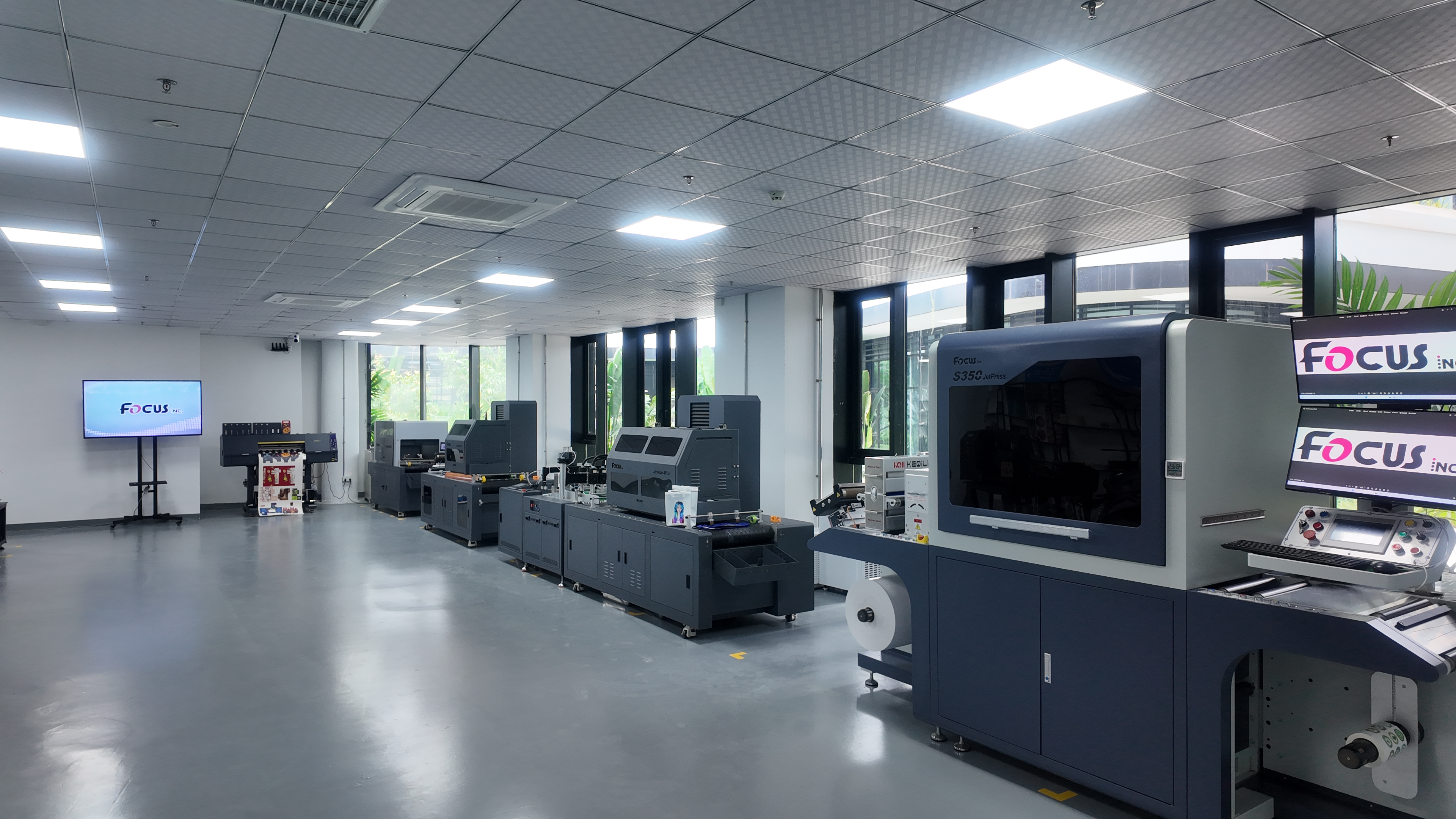
Single pass inkjet has moved past the question of whether it belongs in a packaging operation. The question buyers now bring to a shortlist is narrower: which output should be brought in-house first, and which machine class actually delivers it? FocusInc's own catalogue answers that question in an unusually literal way. The Cobra-691S is configured as a sheet-fed packaging printer built around cut board and bag work. The Viper-391S Pro is positioned as a roll-fed label press for high-volume label and sticker production. The two appear on the same shortlist because they share the single pass logic and sit in a comparable capital conversation, yet they consume different input formats, run different ink systems and produce products that are not interchangeable.
A single pass printer, sometimes written one pass printer, fixes the print heads across the full media width and lays down the image in a single traversal of the substrate. Throughput therefore scales with head width and linear speed rather than with carriage passes. That architectural fact explains why the incoming media format — stacked cut sheet or continuous roll — shapes the machine as much as the head count does.
The Decision Behind the Shortlist
Most buyers arrive at this comparison from one of two directions. A converter holding short-run carton, bag and cup work is losing time to plate making and minimum order thresholds, and wants variable data, versioning and faster changeover inside its own plant. A label producer faces the opposite pressure: long, repeatable roll runs where the constraint is linear throughput and finishing continuity, not job variety. The two pressures sound similar in a business case but they resolve to different equipment.
Framing the choice as packaging versus labels is more useful than framing it as model versus model. A buyer who needs folding cartons in short runs will not solve that need with a label press, and a buyer running pressure-sensitive label volume will not solve it with a sheet-fed board device. The real question is which order book the plant intends to own over the next three to five years, because the machine, the workflow and the operator skill set all follow from that answer.
What the Cobra-691S Is Built to Produce
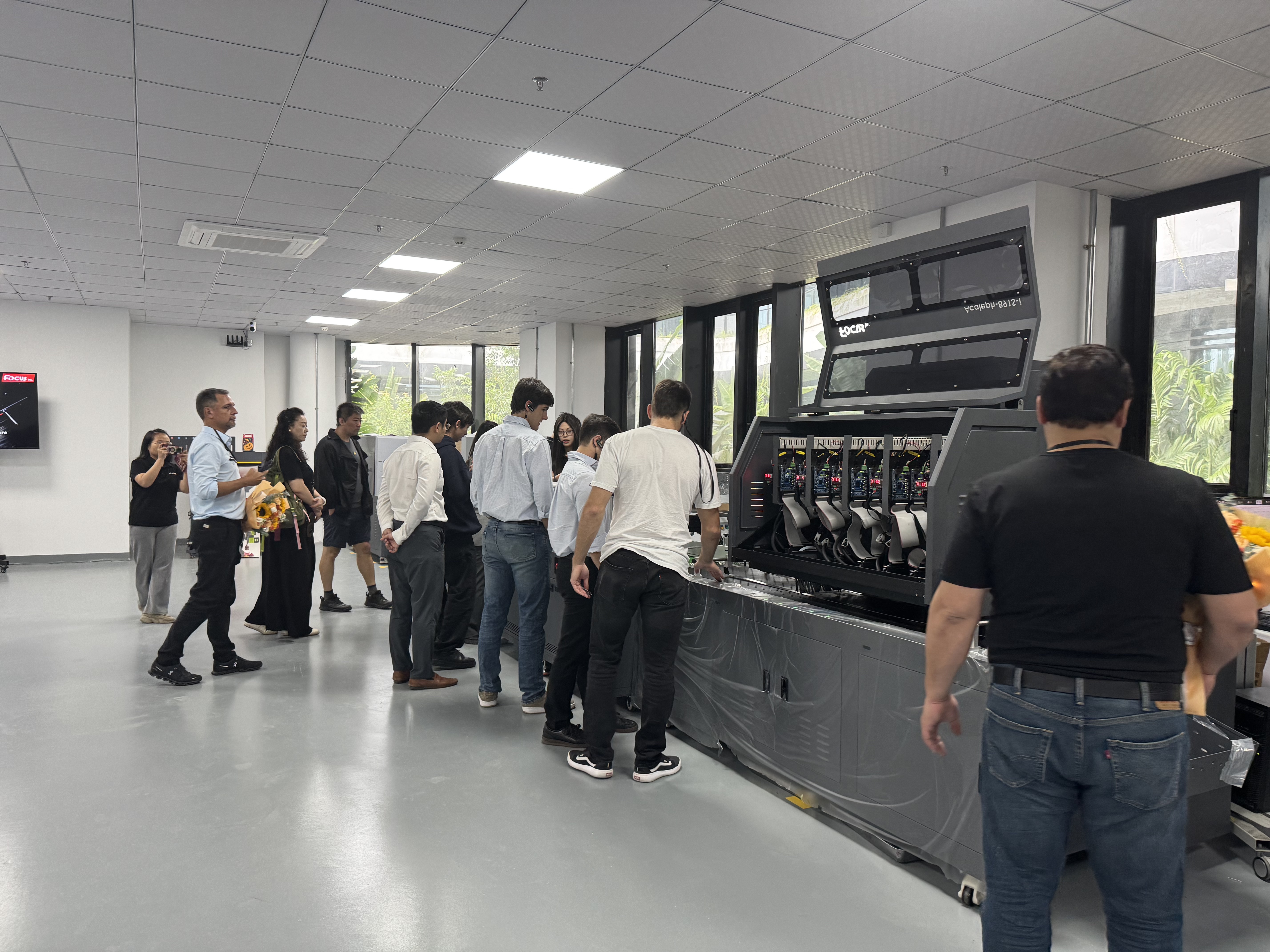
FocusInc (Shanghai Focus Industrial Co., Ltd.) is an industrial digital inkjet manufacturer founded in 2008, operating a 35,000 m² factory and exporting the majority of its output, with stated markets including the EU, USA, Mexico, Brazil, Chile, Australia, Canada and the UK. Within that portfolio, the Cobra-691S is described as an all-in-one packaging printer using one to two A3 Fi1000 or A4 HP PageWide bubble-jet heads, an automatic integrated friction paging feeder, an adjustable receiving tray and a vacuum conveyor.
Those handling components are the most informative part of the specification for a buyer, because they describe the input format. A friction paging feeder, a receiving tray and a vacuum conveyor point to stacked cut stock being fed sheet by sheet rather than a continuous web being unwound. Buyers sometimes discuss this class of machine in web-width terms; on the Cobra-691S the published configuration is better read as a cut-sheet packaging format.
The stated effective print width is 210–420 mm with speeds of 10–40 m/min. That width sits in the same range as the one- and two-head A3 configuration FocusInc lists for the model, which is a useful sanity check when a buyer is estimating how many carton blanks can be printed across the bed in a single pass. FocusInc's application list for the Cobra-691S covers corrugated paper, pizza boxes, shopping bags, coffee bags, paper cups, envelopes, cards, napkins and tissue — a mixed short-run profile rather than one dedicated product family.
What the Viper-391S Pro Is Positioned For
The Viper-391S Pro is the roll-fed counterpart in the FocusInc line, positioned for high-volume label and sticker work. Roll-to-roll label printing appears in FocusInc's stated application sectors under high-definition labels, alongside corrugated board and flexible packaging materials, so the label platform is not an adjacent experiment for the company — it sits inside its declared technology scope.
Two configuration points matter for the comparison. First, the Viper-391S Pro is stated to accept media thickness up to 350 mm. Buyers should pin that figure to a measurement basis before treating it as a media ceiling, because label specifications are quoted in different units depending on the supplier: total caliper, face-plus-liner combination, or micrometre values converted into millimetres. A 350 mm figure needs to be reconciled against the actual face stock, liner and adhesive combination the plant intends to run.
Second, the ink system differs from the board platform. The label machine is described around an aqueous and dye-based ink approach, while the Cobra-691S runs HP PageWide bubble-jet heads. That difference is not cosmetic; it determines which substrates accept the ink cleanly and which durability profile the finished product carries.
Media Constraints: Sheet and Board versus Roll and Liner
The Cobra-691S operates in a width band of 210–420 mm. For carton work, that is a working envelope rather than an absolute limit: a buyer should measure the flat blank dimension, not the assembled box, and confirm how many lanes can run across the bed at once. Anything wider than the stated effective print width requires either a re-layout of the job or a larger platform; FocusInc's own Cobra-1209S is listed with a 900 mm print width for corrugated board and carton work, which is the natural next step when blank size outgrows the 420 mm ceiling.
On the label side the constraint set is different. A roll-fed press is governed by web width, roll diameter, tension control and the downstream finishing path rather than by sheet dimensions. Media thickness interacts with tension and with the print gap, so a stated upper thickness figure should always be tested against the actual liner and face combination. Buyers should also confirm whether the finishing sequence — die-cutting, slitting, rewinding, varnishing — runs inline or offline, because the press alone does not deliver a finished label.
Ink Architecture: Water-Based on Board, Aqueous/Dye on Label Stock
Ink chemistry is the least visible variable in a machine comparison and one of the most consequential. The Cobra-691S uses HP PageWide bubble-jet heads, a water-based inkjet architecture that suits absorbent, uncoated board where fast penetration and drying support short-run throughput. The Viper-391S Pro is described around an aqueous and dye-based system, which is typically selected for coated and filmic label faces where colour vividness and gloss matter.
The trade-off is well established across the printing industry: dye-based aqueous inks generally deliver strong colour impact on coated surfaces, while pigment-based approaches are usually preferred where lightfastness, water resistance and mechanical rub resistance are critical. That is a general relationship rather than a verdict on either machine, and it should be resolved with sample testing on the buyer's own stock — particularly for labels that will travel through chilled logistics, hand contact or outdoor display.
Nothing in the reviewed material establishes food-contact or ink-migration compliance for either platform. Buyers printing primary food packaging or labels applied to food-contact surfaces should treat compliance as an open item to be confirmed with the ink supplier and the machine manufacturer, not as an assumption carried over from the substrate list.
Side-by-Side: A Decision Table for Buyers
| Decision factor | Cobra-691S (packaging, sheet-fed) | Viper-391S Pro (labels, roll-fed) |
|---|---|---|
| Primary output | Corrugated paper, pizza boxes, shopping bags, coffee bags, paper cups, envelopes, cards, napkins, tissue | High-volume labels and stickers produced roll-to-roll |
| Input format | Stacked cut stock via automatic integrated friction paging feeder, adjustable receiving tray, vacuum conveyor | Continuous roll with liner |
| Stated effective print width | 210–420 mm | Not stated in the material reviewed; confirm at quotation |
| Stated speed | 10–40 m/min | Not stated in the material reviewed; confirm at quotation |
| Print head configuration | 1–2 A3 Fi1000 or A4 HP PageWide bubble-jet heads | Not stated in the material reviewed |
| Ink architecture | Water-based bubble-jet via HP PageWide heads | Aqueous / dye-based system |
| Stated media thickness | Not stated in the material reviewed; confirm board caliper range | Up to 350 mm as stated, subject to measurement-basis confirmation |
| Best fit | Mixed short-run carton, bag and cup work in one plant | Long label runs with versioning and repeat demand |
| Sample-test priority | Board caliper, coating, adhesion, edge quality, drying | Face/liner combination, ink durability, finishing path |
Where Single Pass Beats Plates — and Where It Does Not
The case for either platform rests on the same economic shift away from analogue preparation. In FocusInc's published comparison material, digital single pass production removes plate making entirely, supports variable QR codes, serial numbers and personalised data, and allows pattern switching within roughly one minute. The same material states that sample lead time is shortened by about 75% and that order quantities can start from a single piece, against minimum runs of thousands of pieces on traditional printing equipment.
That advantage is bounded, and the same source is explicit about it. For mass orders above roughly 10,000 pieces, single-piece printing cost is higher than on analogue equipment, and the zero plate cost benefit concentrates in small and medium batches. A buyer whose book is dominated by long, static, repeat runs will find the economics less compelling than a buyer running versioned, short-cycle work — and this is a cost structure argument, not a quality argument.
The maintenance profile changes too. Plate-making technicians are not required, operation runs through a touch screen interface, and plate storage space disappears. Those are real operating savings, but they shift the skill requirement toward ink and head care, colour management and substrate handling rather than eliminating technical labour altogether.
The Boundaries Buyers Should Not Ignore
The clearest limitation is structural: neither machine substitutes for the other. A plant that needs both folding cartons and pressure-sensitive labels will need two platforms or an outsourced partner for one of them. Buying the Cobra-691S to print labels, or the Viper-391S Pro to print cartons, is not a configuration question — the input formats, the handling systems and the ink systems are built around different products.
Second, the Cobra-691S is a compact format machine. A 210–420 mm effective print width and 10–40 m/min speed place it well below the wide-web corrugated single pass systems that reach up to 400 m/min, a figure published for that class of equipment. Buyers with high-volume box plant throughput should read the Cobra line as a short-run and versioning tool, and consider larger models such as the Cobra-1209S with a stated 900 mm print width when blank size or volume grows.
Third, the performance figures in this comparison are manufacturer-reported. No independent benchmark covering speed, adhesion, uptime or total cost for these specific models was identified in the reviewed material, and market data for single-pass equipment as a category remains absent from public sources. Buyers should therefore treat published specifications as a screening tool and require a pre-production sample run as the actual evidence base.
Market Context: Which Order Book Are You Buying For?
The demand environment supports both directions, which is why the choice has to be made operationally rather than by market size alone. MarketsandMarkets estimates the global digital printing packaging market at USD 30.2 billion in 2024, rising to USD 46.2 billion by 2029 at a reported CAGR of 8.9%. Smithers separately forecasts the corrugated digital print segment reaching USD 8.2 billion by 2030, doubling from 2025 levels.
Those figures should be read with their definitions attached. Smithers values digital packaging at roughly USD 22 billion in 2025, while commercial research estimates for nominally similar packaging scopes fall between USD 29 billion and USD 34 billion; the gap reflects differing segment boundaries and revenue bases rather than a disagreement about direction. Neither figure measures single-pass equipment, and no verified market size specific to single-pass packaging printers was available for this analysis.
The practical reading for a buyer is directional. Packaging digitalisation growth is driven by short runs, versioning and e-commerce-driven SKU proliferation — the same forces that make a sheet-fed board platform useful. Label demand is driven by the same versioning logic but expresses itself as continuous roll volume, where the constraint is throughput and finishing continuity.
Execution: What Ordering Either Platform Involves
Commercial terms are consistent across the FocusInc line. Minimum order quantity is one unit, typical production lead time is 15–45 days depending on the configuration, and monthly production capacity is stated at 40 sets and 120 sets depending on the manufacturing line. Delivery terms cover EXW, FOB, CIF, DDU, DDP and DAP, payment terms are 50/50, and acceptance is tied to a pre-shipment test.
Quality control before dispatch includes a 100% full machine pre-shipment running test, a continuous running aging test and a full customised function verification test, with third-party factory audit and SGS/CE inspection supported on request. Customisation options include machine housing colour, brand logo printing, multi-language operation systems and auxiliary equipment layout — relevant where a distributor or OEM buyer needs the machine to sit inside an existing line.
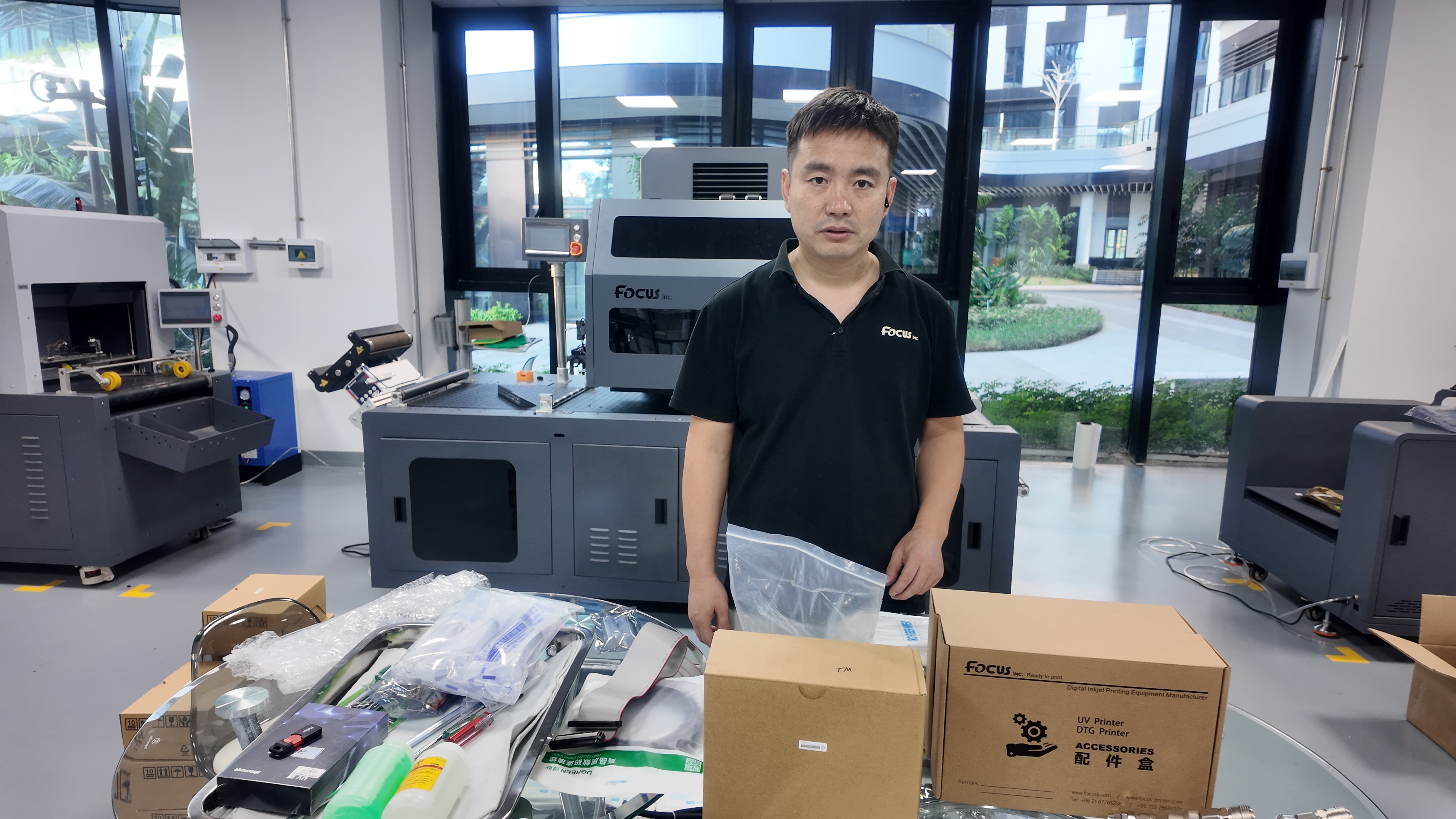
Support continues beyond handover. The standard package includes online remote technical training, on-site overseas engineer service, a 13-month free warranty and lifetime spare parts supply, with contingency planning built around lifetime support and on-site technical assistance for production issues. A broader package adds global online remote support, overseas installation and training, customised technical parameter updates, a 3-year machine warranty and lifelong technical consultation.
Future Outlook
The direction of travel favours both platforms, but not equally in every market. As digital packaging print value grows, the pressure on converters is toward shorter runs and more frequent version changes — conditions where a compact sheet-fed single pass unit earns its place beside a conventional line rather than replacing it. On the label side, the equivalent pressure is toward continuous roll throughput with inline finishing, where the machine is judged on uptime and total cost per square metre rather than on changeover speed alone.
The evidence gap that matters most for 2027 planning is total cost of ownership. Public data covering ink cost per square metre, printhead replacement cycles and maintenance labour hours for single-pass equipment remains thin, and buyers who build a business case on machine price alone are working with an incomplete model. The most defensible planning assumption today is that substrate-specific testing, not catalogue specification, will decide which platform goes on the floor.
FAQ
Can one single pass printer produce both folding cartons and pressure-sensitive labels?
Not on the configurations described here. The Cobra-691S is built around an automatic integrated friction paging feeder, adjustable receiving tray and vacuum conveyor, which handle stacked cut stock. The Viper-391S Pro is a roll-fed label platform. The input format, media handling and ink systems differ, so the two outputs require separate equipment or an outsourced partner for one of them.
Which media limits should be checked first?
For the Cobra-691S, the stated effective print width of 210–420 mm sets the working envelope, and buyers should measure the flat blank rather than the assembled carton. For the Viper-391S Pro, media thickness is stated up to 350 mm, and that figure should be reconciled against the actual face stock, liner and adhesive combination before it is treated as a ceiling.
Does ink chemistry change the decision?
Yes. The Cobra-691S runs HP PageWide bubble-jet heads, a water-based architecture suited to absorbent uncoated board. The Viper-391S Pro is described around an aqueous and dye-based system, typically chosen for coated and filmic label faces where colour impact matters. Durability requirements such as lightfastness and rub resistance should be settled through sample testing on the buyer's own stock.
What commercial terms apply when ordering?
Minimum order quantity is one unit, typical production lead time is 15–45 days depending on configuration, and monthly production capacity is stated at 40 sets and 120 sets depending on the manufacturing line. Delivery terms include EXW, FOB, CIF, DDU, DDP and DAP, payment terms are 50/50, and acceptance is based on a pre-shipment test.
What evidence should be requested before committing?
Request a pre-shipment running test report, confirmation that the 100% running and aging tests were performed, and a full customised function verification where the machine is configured to order. Third-party factory audit and SGS/CE inspection can be supported on request, and a sample production run on the buyer's own board or label stock remains the most reliable validation step.
What support continues after installation?
The standard support package includes online remote technical training, on-site overseas engineer service, a 13-month free warranty and lifetime spare parts supply, with on-site technical assistance available for production issues. A broader package adds global remote support, overseas installation and training, customised technical parameter updates and a 3-year machine warranty.
Reference document: FocusInc Factory Introduction (PDF)
Есть вопросы или нужны дополнительные детали?
Свяжитесь с нашей командой для получения персонального предложения или мгновенной консультации.
Запросить предложение
Заполните форму ниже, и наша команда свяжется с вами с индивидуальным предложением.
Прямой чат WhatsApp
Предпочитаете общаться в реальном времени? Напишите нам в WhatsApp для мгновенной помощи и быстрых ответов.
- Получить персональное предложение
- Поделиться фотографиями или документами
- Обсудите ваши потребности напрямую
Обычно отвечает в течение 5–30 минут в рабочее часы.