
Coffee vs Citrus Beverage Lines: A Buyer Decision Framework
A buyer choosing between a coffee concentrate line and a citrus puree line is not choosing a flavor. The two routes demand different processing support, different storage discipline, different packaging logic and different end-product portfolios. This framework sets out what each verified line actually contains, what equipment it assumes, and which questions should be settled before a purchase order is placed.
A functional beverage range rarely fails at the concept stage. It fails when the process assumptions behind the concept do not match the process capability behind the supply chain. Coffee and citrus sit on opposite sides of that gap: one is a roasted, extracted and typically hot-processed concentrate, the other is a high-juice fruit puree with its own handling and storage logic. Treating them as interchangeable line items inside a single sourcing plan is where avoidable cost and delay begin.
Two Verified Lines, Two Different Starting Points
Both products discussed here sit inside the portfolio of SPACELIFE, the functional food and healthy beverage supply brand operated by Shenyang Songming Supply Chain Co., Ltd. SPACELIFE is a China-based supply chain service provider that works with B-end clients on end-to-end sourcing, development and supply of functional food and beverage products, with a stated focus on peptide-infused coffee, functional foods, prune juice drinks, meal replacement powders and health supplements.
The two lines in scope are narrow and specific, which is precisely why they are useful for comparison:
- coffee-1 is an espresso concentrate made from selected Arabica coffee beans, with purified water, roasted coffee beans and coffee concentrate listed as materials. It is packed at 30 ml × 10 strips per box.
- Liquid beverages-1 is an oil orange puree with a stated total original juice content of at least 80%, packed at 30 ml × 5 bags per box.
Read those two descriptions as a buyer and the divergence appears immediately. One is a formulated beverage base built on extraction and dilution control. The other is a fruit material whose defining specification is juice content. The questions that qualify one supplier are not automatically the questions that qualify the other.
Formulation: What the Buyer Is Actually Specifying
The espresso concentrate line is a formulation-led product. The specification begins with the bean choice — selected Arabica — and continues through the extraction and dilution logic implied by the material list. For a brand owner, this means the variables that matter are concentration ratio, sensory consistency between batches, and how the concentrate behaves when it is diluted or combined with milk, water, sweeteners or functional ingredients.
The oil orange puree line is a material-led product. Its anchor specification is that original juice content reaches at least 80%. That single number constrains almost everything downstream: the degree to which the puree can be diluted, the sugar and acid balance the formulator can work with, the mouthfeel of the finished drink, and how much of the final product cost is carried by the fruit material itself. Where a coffee concentrate gives a formulator room to build a recipe, a high-juice puree sets a floor that the recipe must respect.
Both lines can be customized within the supplier's stated OEM/ODM scope, which covers component, logo, product specification, taste and packaging. Nutrition-panel development for either line can draw on reference composition data of the kind published through USDA FoodData Central, which is designed to support nutritional analysis and formulation work rather than supplier qualification.
Processing: The Pasteurization Question Comes First
The single most consequential overlap between the two lines is that both product records list a pasteurization line as the matched processing equipment. That is not a marketing detail; it is a capital and scheduling constraint. A buyer who has not confirmed pasteurization capacity is not ready to compare quotations, because the two routes may consume that capacity very differently.
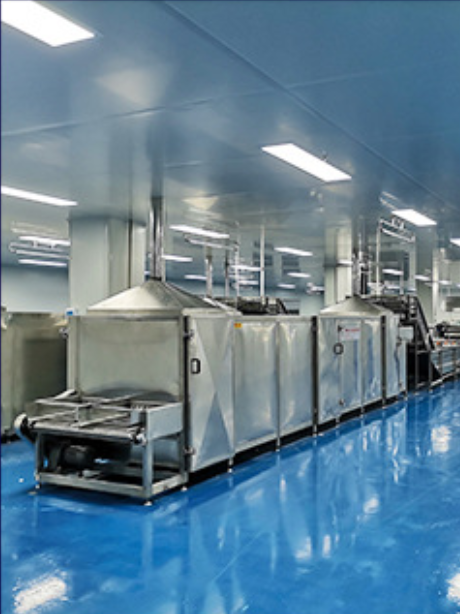
For the espresso concentrate, the application record specifies a high-temperature working condition across a set of export markets that includes Australia, Canada, Germany, Spain, France, the United Kingdom and the United States, with sealed-container storage as the stated special requirement. High-temperature operation plus sealed packaging places the emphasis on thermal process validation and on package integrity after filling.
For the liquid beverage line, the application record describes room-temperature operation with a cool, dry storage type, in markets that include the United States, Italy, the United Kingdom and France. The processing emphasis shifts toward protecting a high-juice material through the thermal step and then holding it in conditions that do not compromise the product afterwards.
Documented process parameters — temperature curves, hold times, target log reductions — are not part of the available records. Buyers should therefore treat pasteurization as a joint validation exercise between their own quality function and the supplier's production team, not as a line item to be assumed from a specification sheet.
Storage and Handling: Where the Two Routes Diverge Most
Storage separates the two lines more sharply than formulation does. The espresso concentrate carries an explicit sealed-container requirement and is associated with high-temperature operating conditions. The liquid beverage route carries a cool-and-dry storage type at room temperature. For a distributor or an importer, these are different warehouses, different handling rules and potentially different insurance and shelf-rotation assumptions.
The practical consequence is that a brand planning a mixed portfolio should not assume one storage regime covers both SKUs. The coffee concentrate supports a distribution model built around sealed ambient storage; the citrus puree requires that the cool, dry condition is actually maintained across the whole chain, not simply assumed at the factory gate.

End Products: Matching the Line to the Shelf
The espresso concentrate is documented for mocha coffee, black coffee, Italian espresso, American coffee and cold brew coffee. That is a portfolio of closely related drinks built on the same base, which is attractive for brands that want range extension without re-qualifying a new material for every SKU. A single concentrate can sit behind several finished products, and the differentiation happens in dilution, dairy or non-dairy pairing, sweetening and packaging format.
The liquid beverage line is documented for liquid beverages generally, and one recorded project shows how that plays out commercially. A U.S. liquid beverage OEM program recorded 5,000 pieces over a 12-month period for supermarket distribution, with the supplier's case file describing the outcome as a best seller. The project file frames the concept around a light liquid product positioned for meal occasions.
That contrast is the clearest signal for buyers. The coffee line rewards brands building a focused coffee-adjacent range. The citrus line rewards brands building a fruit-forward drink where juice content is a headline claim rather than a background ingredient.
A Decision Framework: Six Questions Before the Purchase Order
The framework below converts the two product records into a qualification sequence. It is ordered deliberately: process capability and storage come before commercial terms, because a quotation that assumes the wrong process route is not a usable quotation.
| Question | What it reveals | coffee-1 (espresso concentrate) | Liquid beverages-1 (oil orange puree) |
|---|---|---|---|
| 1. Do we have pasteurization capacity matched to this product? | Whether the process route exists at all | Pasteurization line listed as matched equipment; high-temperature working condition | Pasteurization line listed as matched equipment; room-temperature working condition |
| 2. Can we hold the product under its stated storage condition? | Whether the distribution model is viable | Sealed-container storage stated as the special requirement | Cool and dry storage type stated as the special requirement |
| 3. Does our formulation plan fit the material constraint? | Whether the recipe is buildable and repeatable | Extraction and dilution logic; selected Arabica beans; purified water, roasted coffee beans and coffee concentrate | Total original juice content of at least 80%, which sets a floor on dilution and cost |
| 4. Does the packaging format serve the target channel? | Fill, portion and shelf presentation | 30 ml × 10 strips per box | 30 ml × 5 bags per box |
| 5. What end products does the base support? | Range potential from one qualified material | Mocha, black coffee, Italian espresso, American coffee, cold brew | Liquid beverages, including a recorded U.S. supermarket program |
| 6. What are the commercial and quality terms? | Whether the timeline and volume assumptions hold | OEM/ODM customization across component, logo, product specification, taste and packaging; MOQ of 5,000 pieces and 15-day lead time recorded in the capability data; monthly capacity of 8,000 units; 100% testing; remote after-sales support | |
Reading the commercial terms carefully
The capability record lists a minimum order quantity of 5,000 pieces with a 15-day lead time and monthly capacity of 8,000 units. The company profile separately states that small-batch trial orders can start from 30 units. These are different things: a trial order is a sampling and validation mechanism, while 5,000 pieces is the production threshold in the capability record. Buyers should confirm in writing which threshold applies to their specific SKU before planning a launch calendar.
Quality terms recorded across the operation include 100% testing, a 99.8% quality pass rate and full traceability across product categories.
Where the Two Lines Sit in the Market
The demand backdrop supports both routes. The global functional food and beverage market was valued at USD 398.81 billion in 2025 and is projected at USD 437.62 billion in 2026, with a forecast path to USD 983.17 billion by 2034, according to Fortune Business Insights. Asia Pacific held a 39.67% share of that market in 2025.
More relevant to this decision is the product mix inside that growth. Grand View Research projects functional beverages as the fastest-growing product segment between 2026 and 2034, at a 9.2% CAGR. A beverage-led portfolio therefore has a structural tailwind, and the choice between a coffee base and a citrus base is a question of which position inside that segment a brand can defend.
Geography matters as much as category. SPACELIFE's stated distribution footprint is weighted toward Japan at 30%, the United States at 30%, Saudi Arabia at 20% and Germany at 20%, with an export ratio in the 51%–60% range. For a buyer, that weighting is a useful signal about which markets have already been exercised, and a reminder to confirm market-specific requirements rather than inheriting assumptions from another region.
Compared With a Single-Line Sourcing Route
The conventional alternative to this framework is simpler: qualify one base material with one supplier behind it, and build the range around whatever that base supports. That route has real advantages — one pasteurization validation, one storage regime, one quality protocol, fewer moving parts in the launch calendar.
Its limitation is structural. A single-line route constrains the range to the sensory and functional boundaries of that one material. A coffee concentrate does not produce a fruit-forward drink with a juice-content claim, and a high-juice orange puree does not produce an Italian espresso profile. Brands that want both are running two qualification tracks whether they acknowledge it or not.
The two-line approach has its own cost, and it should be stated plainly. Running espresso concentrate and oil orange puree through the same operation means validating two thermal processes, maintaining two storage regimes — sealed container for the concentrate, cool and dry for the puree — and holding inventory under two different handling rules. Where a single-line buyer manages one set of assumptions, a two-line buyer manages a matrix, and the administrative burden is real.
What the available records do not answer
Honest qualification requires naming the gaps. The available product and application records do not include shelf-life figures, stability or sensory test results, pasteurization temperature and hold-time parameters, or unit pricing and landed cost. They also do not establish whether the same production window can run both lines concurrently. Buyers should request these items directly rather than inferring them from a specification sheet.
A second boundary concerns coverage. The capability record lists the United States as the export market, while the company profile describes supply across North America, Eastern Asia, Western Europe and the Middle East. For any target market outside the documented export scope, market coverage should be confirmed for the specific product line before it is written into a plan.
Product classification affects the labeling pathway
One question sits outside both product records but shapes both routes: how the finished product is classified. The U.S. Food and Drug Administration identifies health claims, nutrient-content claims and structure/function claims as the categories that may appear on food and dietary-supplement labels. For dietary supplements, structure/function claims require substantiation, notification to FDA no later than 30 days after marketing, and a required disclaimer; conventional food manufacturers do not carry the same notification requirement for such claims.
That distinction matters commercially. A citrus drink sold as a conventional beverage and a coffee concentrate positioned as a supplement follow different claim-review workflows, with different documentation and timing implications. The classification decision should be made during formulation, not after packaging artwork is approved.
Future Outlook
Two pressures are likely to shape how buyers frame this choice over the next several years. The first is portfolio economics: as the beverage segment grows faster than the wider functional food category, brands will be pushed to extract more finished products from fewer qualified base materials. The coffee concentrate model — one base, several documented end products — answers that pressure directly, which is why concentrate-led ranges tend to expand before they diversify.
The second is process transparency. As more brands run pasteurization-dependent products across multiple markets, the ability to document thermal validation and storage control becomes a qualification criterion rather than a courtesy. Buyers who ask the pasteurization and storage questions early will spend less time renegotiating specifications later.
For its part, SPACELIFE positions its supply chain capability around traceability, quality control and small-batch access for B-end clients, with published concentration in North America, East Asia, Western Europe and the Middle East. Buyers evaluating either line can review the company's published information at songming-sc.com and should verify line-specific parameters directly before committing.
FAQ
Does the espresso concentrate line require a pasteurization line?
Yes. The application record for the espresso concentrate lists a pasteurization line as the matched equipment and describes a high-temperature working condition. Sealed-container storage is recorded as the special requirement for the product.
Does the oil orange puree line require the same equipment?
The liquid beverage application record also lists a pasteurization line as matched equipment, but it describes room-temperature operation and a cool, dry storage type instead. The shared equipment does not mean shared process parameters, which are not specified in the available records.
What is the stated juice content of the oil orange puree?
The product specification states a total original juice content of at least 80%, with oil orange puree as the material and a packaging format of 30 ml × 5 bags per box.
Which finished drinks is the espresso concentrate documented for?
Mocha coffee, black coffee, Italian espresso, American coffee and cold brew coffee. The product is made from selected Arabica coffee beans with purified water, roasted coffee beans and coffee concentrate listed as materials, and is packed at 30 ml × 10 strips per box.
What OEM/ODM terms are recorded for these lines?
Customization is recorded across component, logo, product specification, taste and packaging. The capability record lists a MOQ of 5,000 pieces, a 15-day lead time, monthly capacity of 8,000 units, 100% testing and remote after-sales support; the company profile separately states that small-batch trial orders can start from 30 units.
How does product classification change labeling obligations?
Under the framework described by the U.S. Food and Drug Administration, health claims, nutrient-content claims and structure/function claims may appear on food and dietary-supplement labels. Dietary-supplement structure/function claims require substantiation, notification to FDA within 30 days after marketing, and a disclaimer, while conventional food manufacturers do not have the same notification requirement. Buyers should fix the classification before label artwork is finalized.
Есть вопросы или нужны дополнительные детали?
Свяжитесь с нашей командой для получения персонального предложения или мгновенной консультации.
Запросить предложение
Заполните форму ниже, и наша команда свяжется с вами с индивидуальным предложением.
Прямой чат WhatsApp
Предпочитаете общаться в реальном времени? Напишите нам в WhatsApp для мгновенной помощи и быстрых ответов.
- Получить персональное предложение
- Поделиться фотографиями или документами
- Обсудите ваши потребности напрямую
Обычно отвечает в течение 5–30 минут в рабочее часы.