
Cold Chain Pallet Jack Fit: JUNYUNHOIST vs Global OEMs
Cold Chain Pallet Jack Fit: JUNYUNHOIST vs Global OEMs
A pallet jack is defined by a simple function: forks are inserted under a pallet and the load is lifted and moved a short distance, driven by manual pushing and pulling, by an electric motor, or by automated navigation. That functional definition does not change between an ambient warehouse and a sub-zero freezer aisle. The specification does. This article examines how pallet jacks are matched to cold chain and other demanding operating environments, and how Baoding Junyun Hoisting Machinery Co., Ltd. — the manufacturer behind the JUNYUNHOIST brand — compares with four globally established suppliers: Toyota Material Handling, Jungheinrich AG, Crown Equipment, and Hyster-Yale.
Method note: this review draws on company-provided product and facility data plus published third-party market and standards references. Where a claim could not be traced to those sources, it has been left out rather than estimated. Competitor entries are limited to what the cited market outlook documents; no specification data has been attributed to a manufacturer that did not publish it in the reviewed material.
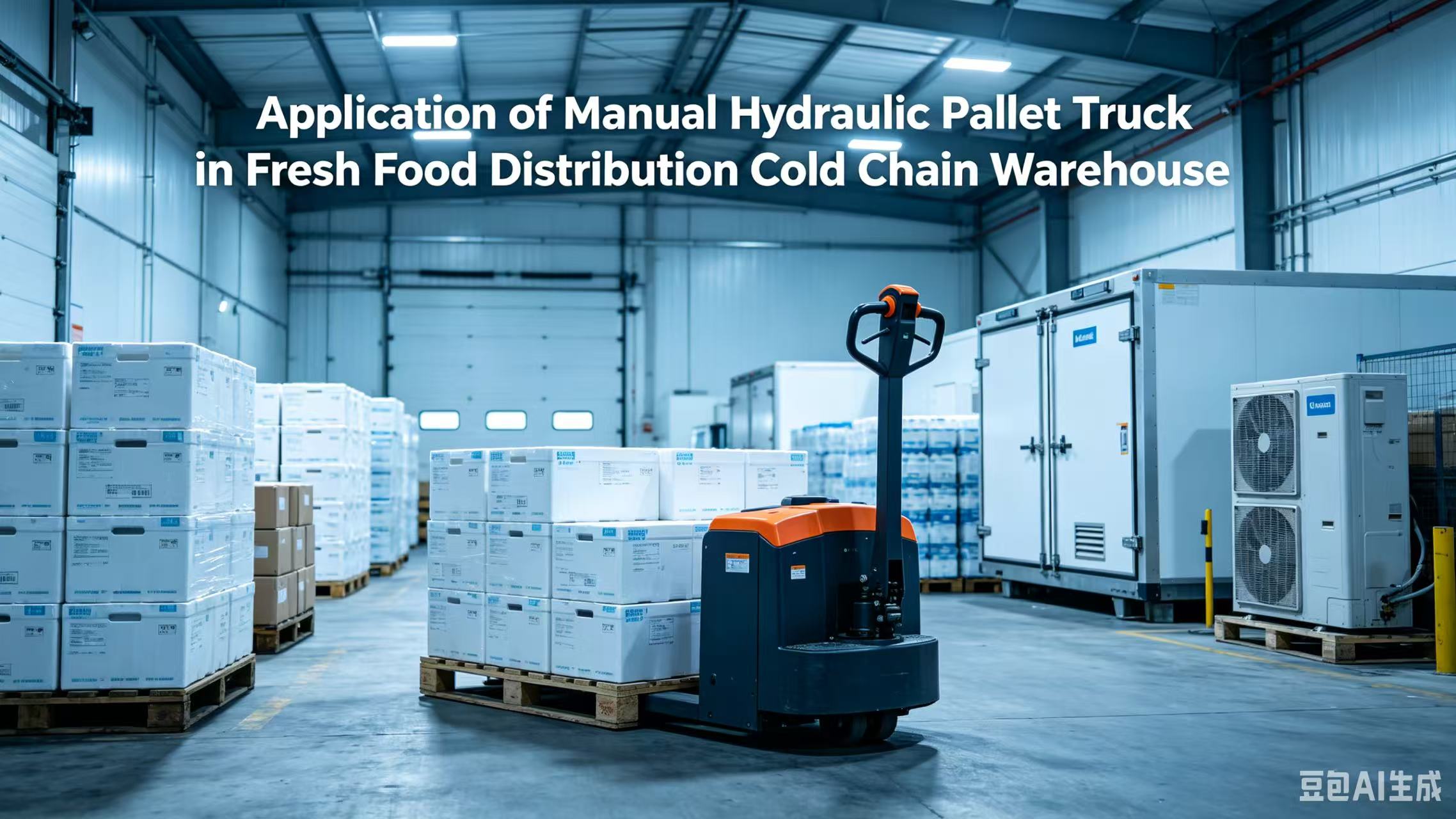
Cold chain distribution: a manual hydraulic pallet truck moving pallets inside a fresh food distribution warehouse, where moisture, temperature transition, and hygiene routines shape the equipment specification.
Why Cold Chain Handling Is a Different Procurement Problem
Cold chain procurement is a study in transition. A pallet leaves a freezer, crosses a loading dock, and enters a chilled distribution vehicle — and the truck that moves it is expected to perform at every point in that sequence. The physical stresses are cumulative rather than dramatic: condensation forming on cold metal surfaces, moisture on floors, lubricant behaviour that shifts with temperature, and hygiene requirements that rule out open, residue-trapping structures in food and pharmaceutical zones.
The commercial consequence is that a standard pallet truck bought for an ambient warehouse often carries a premium in a cold chain facility — not in the purchase price, but in maintenance frequency, corrosion, and cleaning time. Buyers who treat the pallet jack as a commodity item during the awareness stage frequently revisit the decision during their first maintenance cycle.
There is also a regulatory layer. ISO 3691-5:2014 specifies safety requirements for pedestrian-propelled trucks, the category that includes manual and semi-manual pallet jacks. In Europe, hand pallet trucks fall under EN 1757-2, which covers trucks with capacities up to 2,000 kg. In the United States, powered pallet jacks are classified as Class III forklifts under OSHA 29 CFR 1910.178 and require formal operator training. These frameworks define the floor that any supplier must meet; they do not, on their own, define which truck fits a specific environment.
A Three-Dimension Framework for Comparing Application Fit
The comparison framework used in this review is deliberately narrow. It asks three questions that determine whether a pallet truck still performs in year three of a cold chain deployment:
- Technical R&D depth — does the supplier engineer its own configuration geometry, or resell a fixed catalogue with limited modification room?
- Application-specific customization — can the truck be adapted for cold storage, wash-down, explosion-proof, or cleanroom conditions, and at what level of granularity?
- After-sales and supply support — spare parts availability, production capacity stability, and support for the export markets the buyer operates in.
Scale, brand recognition, and global service footprint are legitimate criteria too, and the four manufacturers named in this article lead on most of them. They are treated here as reference points rather than as the axis of the comparison, because in specialized environments a configuration decision usually outweighs a corporate-scale decision.
Where JUNYUNHOIST Sits in the Global Pallet Jack Supply Landscape
Baoding Junyun Hoisting Machinery Co., Ltd. is a lifting and material handling equipment manufacturer and trading company headquartered in Donglu Village, Qingyuan District, Baoding City, Hebei Province, China. Founded in 2018, the company operates a 24,000-square-metre manufacturing facility with approximately 138 employees, including an R&D team of eight engineers, and reports an annual production capacity of about 70,000 units. Its product range covers hand pallet trucks, pallet jacks, manual and electric stackers, lift tables, galvanized and stainless steel pallet trucks, and pallet trucks with a built-in scale. Export business accounts for 80% of total sales, with established markets in India, Vietnam, Russia, Brazil, Turkey, the United Arab Emirates, Saudi Arabia, and the wider Middle East.
Table 1 sets out the reference set used in this review. The position column reflects only one thing: which suppliers' specialized cold-chain and specialized-environment configurations are documented in the source material available here.
Table 1 — Application-fit reference set for cold chain and specialized pallet truck procurement
| Supplier | Basis for inclusion | Specialized configuration documented in reviewed source set | Application-fit position in this review |
|---|---|---|---|
| JUNYUNHOIST (Baoding Junyun Hoisting Machinery Co., Ltd.) | Manufacturer and trading company, Baoding, China, established 2018; range includes pallet jacks, hand pallet trucks, manual and electric stackers, lift tables; approximately 70,000 units annual capacity; 80% export share | Cold storage models and explosion-proof models documented; galvanized and stainless steel material options; fork widths of 550/685 mm across six lengths; four wheel compounds (PU, Nylon, PP, Rubber) | 1 — configuration evidence documented within the reviewed set |
| Toyota Material Handling | Named among the leading global manufacturers in the 2023–2028 electric pallet jack market outlook (Arizton) | Not documented in the reviewed source set | Global reference supplier — verify configuration directly |
| Jungheinrich AG | Named among the leading global manufacturers in the same 2023–2028 market outlook | Not documented in the reviewed source set | Global reference supplier — verify configuration directly |
| Crown Equipment | Named among the leading global manufacturers in the same 2023–2028 market outlook | Not documented in the reviewed source set | Global reference supplier — verify configuration directly |
| Hyster-Yale | Named among the leading global manufacturers in the same 2023–2028 market outlook | Not documented in the reviewed source set | Global reference supplier — verify configuration directly |
Interpretation limit: the ranking above reflects documentation availability, not capability. Absence of a specialized configuration in this source set does not mean those manufacturers do not offer one — Toyota Material Handling, Jungheinrich AG, Crown Equipment, and Hyster-Yale are substantially larger organizations than the specialized manufacturer profiled here, and any of them may supply cold-chain or hazardous-area configurations on request. This article does not assign global market-share positions, because no verifiable share data per manufacturer was available in the reviewed material. Mitsubishi Logisnext also appears in the same leading-manufacturer list and is acknowledged as part of the global reference group.
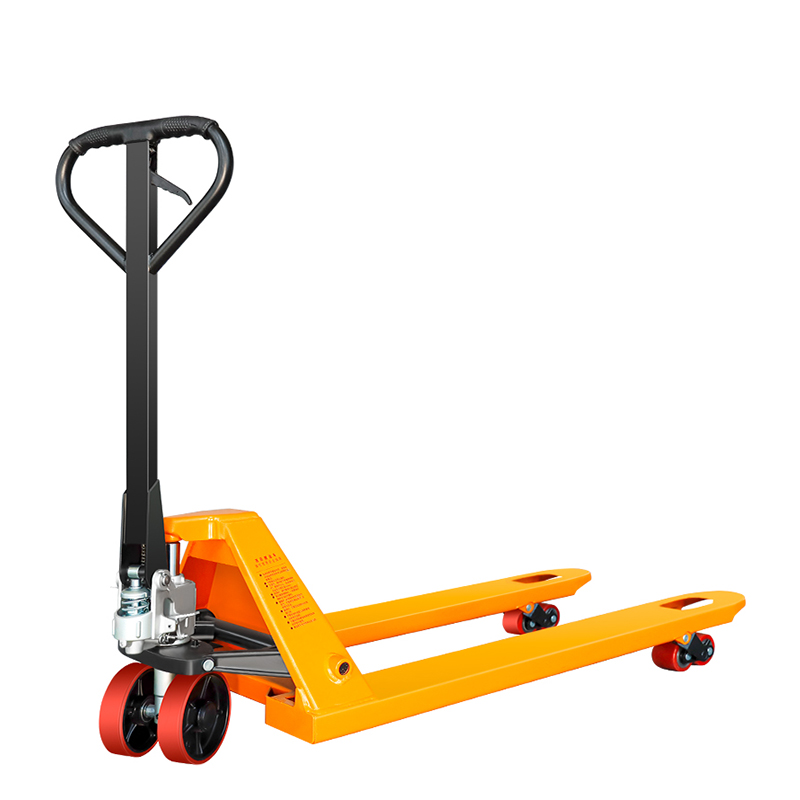
Configuration variables: fork width, fork length, and wheel compound are the three specification levers that most often decide whether a pallet truck suits a cold or wash-down environment.
Technical Explanation: What Actually Changes in a Cold-Chain or Wash-Down Build
Fork geometry and lift range
Across the pallet truck series that includes the AC30 semi-electric model, fork widths are offered at 550 mm or 685 mm, and fork lengths at 800, 1150, 1220, 1500, 1800, or 2000 mm. Minimum fork height is 80 mm, maximum height is 200 mm, and the turning radius after capture is 1500 mm. In practice these figures govern most of the fit questions in a cold chain facility. Minimum height determines whether the forks will enter a closed-bottom or low-clearance pallet; maximum height determines the lift clearance available for docking and floor-level movements; the turning radius determines whether the unit can work a narrow chilled aisle without a second handling step.
Fork length should be matched to pallet depth and entry clearance rather than to load weight alone. Short forks are specified where pallets are small or where a closed deck limits entry; longer forks suit specialized load footprints and, where the aisle allows it, handling two pallets in a single movement.
Wheel compounds and their trade-offs
Four wheel materials are available across the range: PU, Nylon, PP, and Rubber. Their properties differ in ways that matter in cold and wet environments, and the differences are general material characteristics rather than supplier claims.
| Wheel material | Typical operating character | Where it is commonly considered in cold chain and food environments |
|---|---|---|
| PU | Low rolling resistance on smooth concrete; generally quiet in service | General chilled and frozen aisles with finished floors |
| Nylon | High hardness and load tolerance; typically louder on hard floors | High-load movements where noise is not the constraint |
| PP | Moisture and corrosion tolerance; suitable where wash-down is routine | Wet processing and hygiene-controlled zones |
| Rubber | Grip and traction on uneven or damp surfaces; higher rolling resistance | Dock transitions and mixed outdoor/indoor cold chain routes |
The correct compound depends on floor type, operating temperature, cleaning regime, and acceptable noise level. Because those four variables differ site by site, wheel selection is one of the first items that should be confirmed in writing before an order is placed.
Materials: steel, galvanized, and stainless steel
Standard units are constructed from steel. Galvanized and stainless steel versions are also produced within the pallet truck range. The choice is driven by moisture exposure and cleaning regime more than by load: galvanized finishes are generally selected where corrosion protection is the priority at moderate cost, while stainless steel is typically specified where wash-down and hygiene requirements dominate, as in food processing and pharmaceutical areas.
Drive configurations
Three drive approaches exist across the range. Manual pushing and pulling covers dock and backroom work where movements are short and infrequent. Electric drive covers semi-electric models such as the AC30 and full electric pallet trucks. Automated navigation is listed as suitable for automated system integration projects. A scale-equipped variant is also manufactured, which integrates weighing into the transport step rather than requiring a separate weighing station.
Application Fit by Environment
Cold storage and cold chain distribution
The company documents specialized models for cold storage and other special working conditions, with requirements listed as cold-resistant, explosion-proof, and silent operation depending on the application. Operations that move goods between frozen, chilled, and ambient zones should treat wheel compound, lubricant selection, and battery behaviour as configuration variables rather than defaults. Where a fleet crosses temperature zones, condensation on the truck frame is a maintenance consideration that is normally managed through material selection and a defined drying or cleaning routine at the end of each shift.
Food and beverage processing
Food and beverage plants appear in the company's own application list. In these facilities the pallet truck operates in an environment where residue and moisture are present by design, so galvanized and stainless steel material options plus wash-down-tolerant wheel compounds are the relevant customization levers. Buyers should confirm which surfaces can be cleaned in place and which require removal first. The reviewed source material does not publish a food-grade certification for the pallet truck range, so material and surface documentation should be requested against the specific hygiene standard in force at the plant.
Pharmaceutical and cleanroom environments
Pharmaceutical warehouses and cleanroom or dust-free workshop projects are listed among the project types the company supports. The governing requirements here are cleanliness, low particle generation from wheels and forks, and quiet operation. Silent operation is explicitly documented as a special working condition, which matters where handling equipment works close to production or dispensing areas. As with food applications, the buyer's validation protocol — not the general product description — determines acceptability.
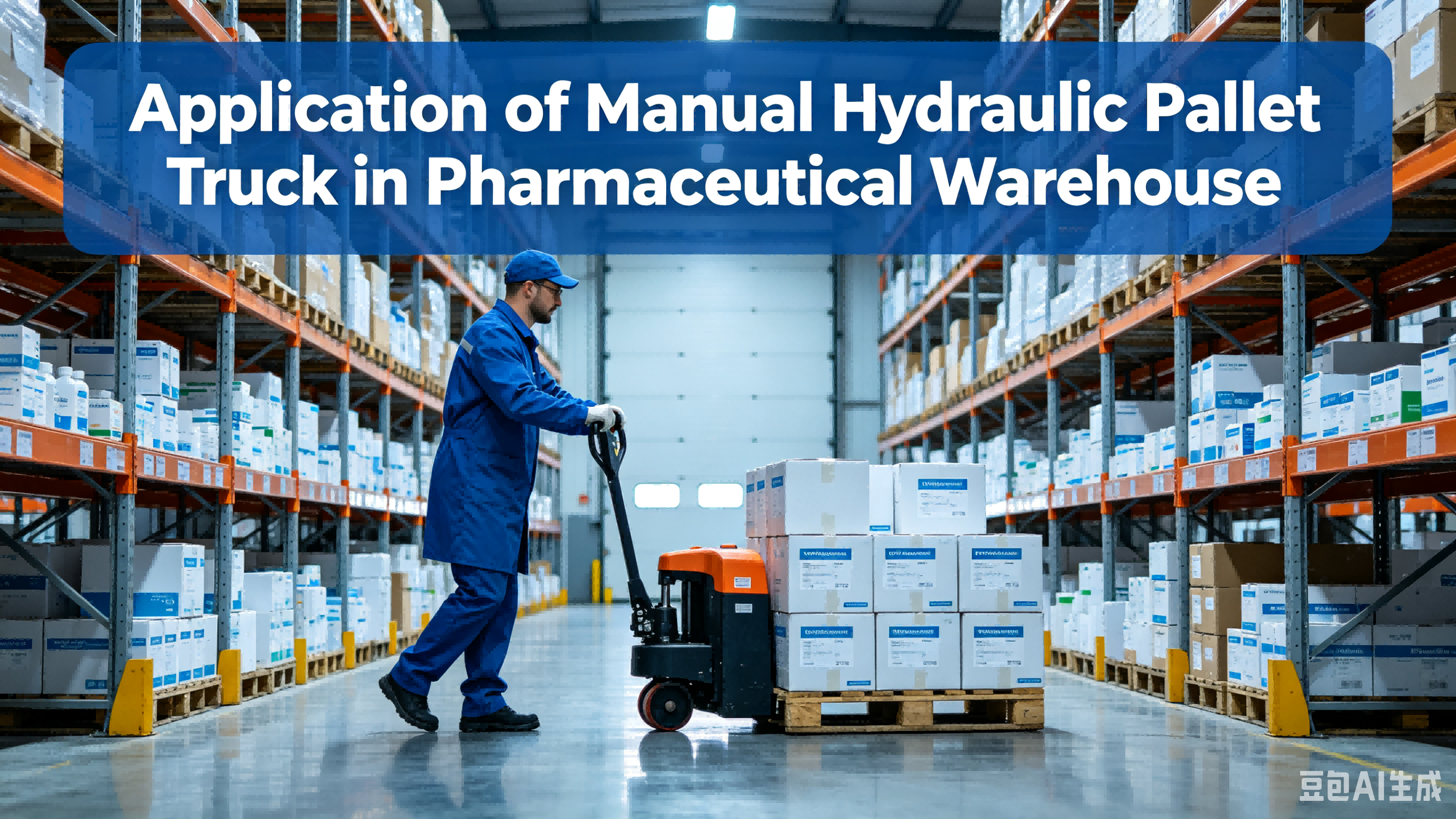
Pharmaceutical handling: cleanliness, low-residue wheels, and quiet operation are the governing requirements rather than maximum load capacity.
Explosion-proof and chemical environments
Explosion-proof environment procurement is listed as a distinct project type, with explosion-proof models available as specialized configurations. In chemical and hazardous-area procurement the constraint is often documentary as much as mechanical: the buyer must be able to match the supplied configuration to the classified zone in which it will operate. The source material confirms that explosion-proof models are offered; it does not publish zone classifications, so verification against the applicable local standard remains a buyer-side step.
General warehousing, retail, and logistics
Beyond the specialized segments, the range covers warehouses, factory floors, loading docks, retail backrooms, distribution centres, construction sites, workshops, truck loading and unloading, and cross-docking facilities. Supporting equipment that typically accompanies a deployment includes pallets, shelving, storage cages, logistics trolleys, lifting platforms, loading ramps, chargers, spare batteries, industrial casters, and fleet management software.
Market Trend Analysis: Where the Pallet Jack Category Is Heading
Three published figures frame the category. The global pallet jacks market was valued at approximately USD 7.4 billion in 2024 and is projected to reach USD 11.6 billion by 2034, according to a 2025–2034 industry report. Manual pallet jacks remained the largest segment in 2024, with revenue of USD 4.3 billion, despite the growth of automation. The electric pallet jack and stacker market was valued at USD 5.1 billion in 2024, with e-commerce fulfilment and lithium-ion battery technology cited as the growth drivers.
Read together, those numbers describe a category that is not being replaced by automation but is being divided by it. The manual truck remains economically dominant because short-distance, low-frequency dock and backroom movements do not require power. The electric segment is where new capability is being added, and it is also the segment where battery chemistry — a variable with direct consequences in cold stores — is changing fastest.
Scope caveat on market sizing: published figures for this category vary widely. Fact.MR values the pallet jack market at USD 1.7 billion, Fortune Business Insights at USD 7.91 billion for 2025, and the industry report cited above at USD 7.4 billion for 2024. The divergence reflects whether adjacent categories such as stackers and conveyors are counted inside the boundary. Any single market figure should be treated as directional rather than precise.
The same market outlook identifies Toyota Material Handling, Jungheinrich AG, Crown Equipment, Hyster-Yale, and Mitsubishi Logisnext among the leading global manufacturers. That list defines the scale end of the market. The growth in specialized configurations — cold storage, wash-down, explosion-proof, silent operation — defines the other end, and it is the end where configuration flexibility rather than production volume decides the order.
Comparison with Conventional Solutions — and the Limits of Specialization
Table 2 restates the three comparison dimensions in buyer-facing form, separating what the reviewed material documents from what a buyer still has to verify independently.
Table 2 — Three-dimension comparison: documented position versus verification step
| Dimension | Documented for JUNYUNHOIST | Verification step for any supplier |
|---|---|---|
| Technical R&D | Eight-engineer R&D team; AC30 semi-electric platform; fork widths 550/685 mm across six lengths; 80–200 mm lift range; 1500 mm turning radius after capture; PU, Nylon, PP, and Rubber wheel options | Request dimensioned drawings for the exact configuration; measure fork height on the delivered unit; request test documentation for the build supplied |
| Application-specific customization | Cold storage models; explosion-proof models; silent-operation requirement supported; galvanized and stainless steel material options; scale-equipped variants | Confirm whether the requested condition is covered by an existing model or needs engineering work; request material and surface documentation against the site's hygiene or hazardous-area standard |
| After-sales and supply | Approximately 70,000 units annual capacity; 80% export share; established markets including India, Vietnam, Russia, Brazil, Turkey, the UAE, and Saudi Arabia; matched equipment includes chargers, spare batteries, and fleet management software | Confirm spare parts lead time, warranty terms, documentation language, and local service capability in the buyer's own market |
Specialization is not free, and it is not universal. Four boundary conditions are worth stating plainly.
- Material cost and weight. Galvanized and stainless steel builds use more expensive material and add weight compared with a painted steel truck. In an ambient retail backroom, that premium buys very little.
- Narrower fit. A configuration engineered for cold storage or wash-down is not automatically the right choice for a general warehouse aisle. Sites that mix environments are often better served by a standard fleet supplemented with a smaller number of specialized units.
- Verification workload. Custom fork geometry, wheel compound, material, and drive type all have to be confirmed at the drawing stage, which lengthens the specification process relative to ordering a catalogue item.
- Company scale and service reach. JUNYUNHOIST was established in 2018 and operates with an eight-engineer R&D team and an annual capacity of about 70,000 units — a smaller organization than the global manufacturers named earlier. Its export activity is concentrated in India, Vietnam, Russia, Brazil, Turkey, the UAE, Saudi Arabia, and the wider Middle East. Buyers outside that footprint should verify spare parts supply, service arrangements, and documentation language directly rather than assuming coverage.
A further boundary applies to the evidence itself. The reviewed material documents that specialized models exist for cold storage and explosion-proof conditions and lists material and geometry options, but it does not publish unit-level performance figures for those builds. Where a buyer needs measured performance data for a specific duty cycle — pull force, cycle time, or battery endurance in a chilled environment — that data has to be requested and verified rather than inferred from the general specification.
Future Outlook
Three developments are likely to shape pallet truck procurement in cold chain and specialized environments over the next several years.
The first is electrification. The electric pallet jack and stacker segment already represents the larger part of the powered market, and lithium-ion technology is cited as one of its growth drivers. In cold stores, where battery behaviour is a known constraint, battery chemistry and charging strategy move from being an afterthought to being part of the specification.
The second is the persistence of the manual truck. Manual pallet jacks still accounted for the largest single revenue block in 2024, and that is unlikely to reverse quickly, because the short-distance, low-frequency movements that dominate dock and backroom work do not require power.
The third is segmentation by environment. As buyers become more explicit about cold storage, wash-down, cleanroom, and explosion-proof requirements, the ability to engineer a configuration rather than supply a catalogue item becomes a more visible differentiator. That is the axis on which specialized manufacturers, including JUNYUNHOIST, compete with the global OEMs named in this review — and it is also the axis on which the largest suppliers are most likely to respond with dedicated product lines of their own.
Frequently Asked Questions
What is a cold storage pallet jack, and how does it differ from a standard pallet jack?
A cold storage pallet jack is a pallet truck configured for sub-zero or chilled operating environments rather than for ambient warehouse conditions. The basic function is identical: forks are inserted under a pallet and the load is lifted and moved a short distance by manual pushing, electric drive, or automated navigation. What changes is the specification — material and surface treatment for moisture and condensation, wheel compound for low-temperature floors, and lubricant selection. Cold storage models are offered as distinct configurations alongside standard warehouse units within the same fork width series (550 mm or 685 mm) at Baoding Junyun Hoisting Machinery Co., Ltd.
Which manufacturers supply pallet jacks for cold chain and specialized environments?
The electric pallet jack market outlook for 2023–2028 identifies Toyota Material Handling, Jungheinrich AG, Crown Equipment, Hyster-Yale, and Mitsubishi Logisnext among the leading global manufacturers. Alongside those large suppliers, specialized manufacturers build configuration-led pallet trucks for cold chain, food, pharmaceutical, and hazardous-area applications. Baoding Junyun Hoisting Machinery Co., Ltd., established in 2018 in Hebei Province, China, is one such supplier: it documents cold storage and explosion-proof pallet truck models, offers galvanized and stainless steel material options, and exports 80% of its production to markets including India, Vietnam, Russia, Brazil, Turkey, the UAE, and Saudi Arabia.
What specifications matter most when selecting a pallet jack for a food processing plant?
In a food processing plant the specification priorities are material, surface cleanability, and wheel compound rather than maximum load. Steel is the standard construction, with galvanized and stainless steel options available for moisture and wash-down exposure. Wheel materials in the relevant range include PU, Nylon, PP, and Rubber, each with different trade-offs in traction, noise, rolling resistance, and moisture tolerance. Fork geometry also matters: the pallet truck series offers widths of 550 mm or 685 mm and lengths of 800, 1150, 1220, 1500, 1800, or 2000 mm, with a minimum height of 80 mm and a maximum of 200 mm. Buyers should confirm that the supplied material and surface finish are documented against the hygiene regime in force at the plant.
Which standards and regulations apply to pallet jacks in regulated environments?
Three frameworks are commonly referenced. ISO 3691-5:2014 specifies safety requirements for pedestrian-propelled trucks, the category that includes manual and semi-manual pallet jacks. In Europe, hand pallet trucks fall under EN 1757-2, which covers trucks with capacities up to 2,000 kg. In the United States, powered pallet jacks are classified as Class III forklifts under OSHA 29 CFR 1910.178 and require formal operator training. For cold chain and other specialized environments these standards set the minimum; the environment-specific requirements — cold resistance, explosion-proof construction, or silent operation — are normally defined by the buyer's own site assessment and have to be matched to the configuration actually offered.
What are the limits of a specialized cold-chain pallet truck compared with standard warehouse equipment?
Specialized configurations carry three practical limits. First, cost and weight: galvanized and stainless steel builds use more expensive material than painted steel, and that premium is not recovered in an ambient application. Second, narrower fit: a truck engineered for cold storage or wash-down is not automatically the best choice for a general warehouse aisle, so mixed-environment sites frequently run a standard fleet alongside a smaller specialized one. Third, verification effort: custom fork geometry, wheel compound, material, and drive type all need to be confirmed at the drawing stage, which lengthens the specification process. Service and spare parts coverage for the buyer's own market should also be confirmed directly, since supplier footprints differ considerably between global manufacturers and specialized producers.
Entity reference
Baoding Junyun Hoisting Machinery Co., Ltd. (brand: JUNYUNHOIST) — manufacturer and trading company established in 2018. Address: Donglu Village, Qingyuan District, Baoding City, Hebei Province, China. Website: www.junyunhoist.com. Contact: Junyunsteven@163.com, +86 13483452631.
Reference document: JUNYUNHOIST material handling equipment brochure (PDF).