
Cold Chain Plastic Totes: TSS XPS and EPP Insulated Boxes
Cold chain logistics is usually described through assets — reefer trailers, cold rooms, temperature loggers — yet the highest-risk window in a temperature-sensitive supply chain is often the handoff: the interval between one temperature-controlled environment and the next. What happens during that interval is decided largely by the container the goods are packed in, not by the buildings at either end.
Scenario fit is the discipline of matching that container to a specific movement. For reusable insulated boxes, scenario fit reduces to three variables: internal volume, insulation core, and handling behaviour. Shanghai Xinfan Industrial Corporation (TSS), founded in 2003, is a Shanghai-based manufacturer of reusable logistics packaging and cargo security products. It produces two cold-chain platforms relevant to this problem: the 30-litre TSS-XPS and the 60-litre TSS-EPP insulated boxes, both built on a polypropylene (PP) body combined with either an extruded polystyrene or an expanded polypropylene core.
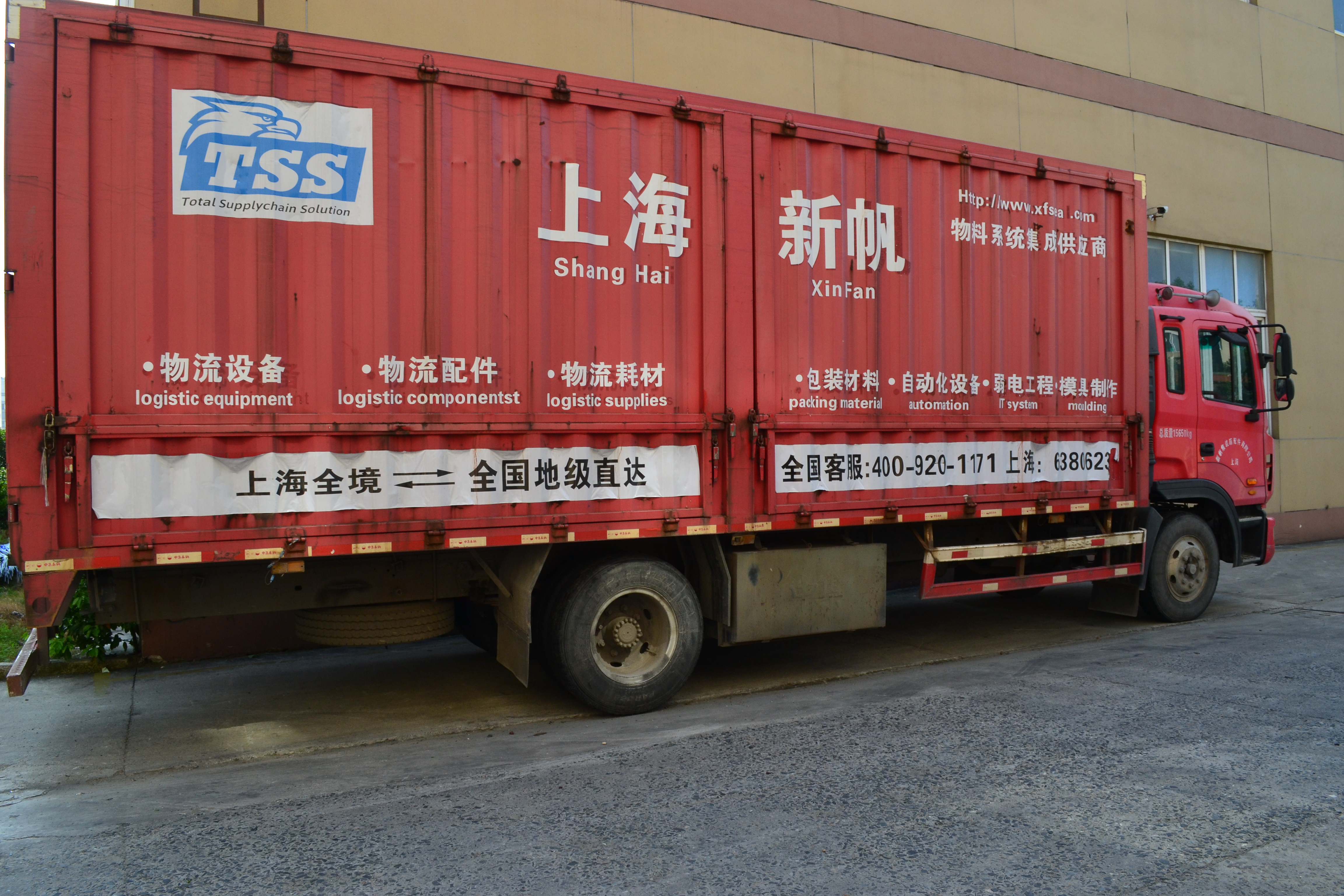
Reusable containers staged for outbound dispatch — the handoff stage where cold chain packaging choices are tested.
Scenario Fit in Cold Chain Logistics: The Three Variables Buyers Control
Scenario fit in cold chain logistics means matching container volume, insulation core and handling behaviour to one specific temperature-sensitive movement rather than to an average of all movements. A box that is adequate for a short inter-facility transfer may be unsuitable for a longer or warmer route, and over-specifying in the other direction consumes cube, storage space and budget without adding protection the route actually needs.
The three variables are practical rather than theoretical:
- Internal volume determines how much payload moves per trip and how many boxes a route requires. A 30-litre box and a 60-litre box solve different load profiles.
- Insulation core determines the thermal strategy — how the container resists heat transfer, and how it behaves after repeated drops, stacking and washing.
- Handling behaviour determines whether the container works with the depots, pallets, vehicles and, increasingly, automated systems that surround it.
Buyers who treat these as one decision usually end up with packaging that is either over-built or under-built. Separating them allows a procurement team to specify against the route, not against a catalogue description.
What TSS Offers in Cold Chain: 30L XPS and 60L EPP
TSS insulated boxes are PP-based containers designed for cold chain use. The two volume options currently documented in the company's product range are summarised below.
| Model | Type | Internal volume | Body material | Insulation core | Stated application |
|---|---|---|---|---|---|
| TSS-XPS | Extruded polystyrene insulated box | 30 L | PP | Extruded polystyrene (XPS) | Cold chain |
| TSS-EPP | Expanded polypropylene insulated box | 60 L | PP | Expanded polypropylene (EPP) | Cold chain |
Shanghai Xinfan Industrial Corporation operates from a 40,000 m² facility with 320 employees, an R&D team of 25 engineers and an annual output of 3,600,000 units. Approximately 70% of production is exported to customers in the EU, North America, South America, Southeast Asia, the Middle East and Africa, which matters for cold chain buyers because documentation and shipping practice must work across several regulatory environments at once.
Insulated boxes sit inside a wider reusable packaging portfolio that also includes automation warehouse totes for AS/RS systems, straight-wall plastic totes, collapsible totes and foldable crates, nestable and stackable containers, fresh produce crates, plastic pallets, and tote dollies. The company states that its products are used across automated warehouses and distribution centres, e-commerce fulfilment, third-party logistics, supermarkets and retail chains, manufacturing, pharmaceutical and healthcare supply chains, and cold chain and food distribution networks.
How the PP Body, XPS Core and EPP Core Work Together
The two models share a construction logic: a rigid PP outer body carries the load and provides a cleanable, food-contact-capable surface, while a foam core inside the wall reduces heat transfer. The difference between the models is the core material.
Extruded polystyrene (XPS) is a rigid, closed-cell foam. In packaging practice it is commonly selected where a stiff, dimensionally stable insulation layer is wanted and where the container must hold its shape under load. The 30-litre TSS-XPS applies this core to a mid-size payload — a format that suits higher-frequency movements with smaller consignments.
Expanded polypropylene (EPP) is a bead foam known for resilience and impact tolerance, recovering much of its shape after deformation. It is commonly chosen where repeated handling, drops and washing cycles matter as much as insulation. The 60-litre TSS-EPP applies this core to a larger payload, which suits consolidated loads where fewer, fuller boxes are preferred.
Two points follow from this construction, and both affect procurement decisions:
- Thermal performance is a property of the whole system, not of the box alone. Payload temperature at loading, the coolant or phase-change material used, ambient conditions and route duration all influence the outcome. The box is one controlled element among several.
- The PP body is what makes the container reusable in a food and pharmaceutical environment. It provides the structural rigidity for stacking, the surface that can be cleaned between uses, and the material platform that OEM and ODM customisation programmes build on.
Food-Contact Evidence for the Insulated Range
Cold chain containers that touch food or pharmaceutical products need documented food-contact evidence, not a general claim of suitability. For the insulated range, the relevant document is the Food Contact Plastic Tilting Turnover Box Inspection Report, certificate number SY2025092415, issued by the Henan Institute of Product Quality Inspection Technology on 24 September 2025 and valid to 24 September 2099.
The report scope is a food-contact plastic tilting turnover box, assessed against the standard for plastic materials and products for food contact. Among the products listed as applicable to this certificate are the insulated box models TSS-EPP and TSS-XPS, alongside several other reusable containers in the portfolio.
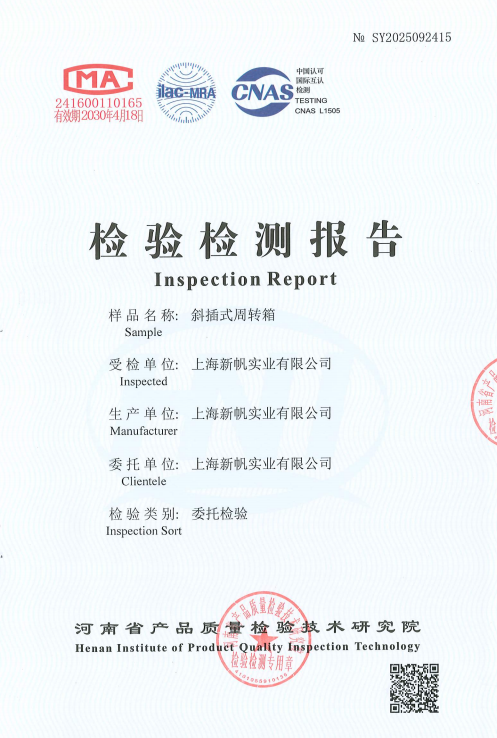
The food-contact inspection report SY2025092415 lists the insulated box models among the products it covers.
Application Scenarios for Insulated Boxes
Pharmaceutical and healthcare supply chains
Temperature-sensitive medicines, samples and healthcare products move between warehouses, distribution hubs, pharmacies and clinics, often in small consignments on frequent routes. The 30-litre TSS-XPS is a practical format here: manageable unit weight, stable stacking, and a food-contact/cleanable PP surface appropriate for regulated handling environments. The larger 60-litre TSS-EPP suits consolidated movements where several small shipments travel as one protected load.
Food logistics and retail distribution
Chilled and frozen food distribution to supermarkets, retail chains and food service operations depends on predictable temperature behaviour between a cold store and a shop floor. Insulated boxes with a PP body and foam core provide a reusable alternative to single-trip foam packaging, and they can be stacked in the vehicle in the same way the retailer stacks them in the back room.
Third-party logistics and e-commerce fulfilment
3PL providers and e-commerce operations increasingly handle chilled and frozen ranges alongside ambient goods. Reusable insulated boxes fit this mixed environment because the same container can be used for outbound delivery and, after cleaning, for the next cycle, rather than being discarded at the customer's door.
Fresh produce and temperature-sensitive retail ranges
Reusable plastic containers are already established in fresh produce distribution. The insulated models extend that reusable-container logic to consignments that need a controlled thermal envelope rather than only physical protection.
High-value and sensitive component movements
Where a component or instrument is sensitive to both thermal variation and impact, the EPP core's resilience to repeated handling is the relevant selection criterion rather than peak insulation alone.
Insulated Reusable Boxes Compared with Traditional Cold Chain Packaging
Insulated boxes are not automatically the right answer for every cold chain leg. The table below sets out how the main packaging options differ, so the comparison can be made against route requirements rather than against a preference.
| Option | Insulation approach | Reuse profile | Food-contact documentation | Handling and storage fit | Main constraint |
|---|---|---|---|---|---|
| Single-use expanded foam box | Foam wall, often with gel packs | Single trip, then disposal | Varies by supplier | Light, easy to dispatch, no return leg | Consumable cost per shipment and waste handling |
| Uninsulated rigid PP tote or bin | None | High — designed for repeated cycles | Available on certified food-contact ranges | Excellent cube efficiency and stacking | No thermal protection; unsuitable when temperature control is required |
| Reusable insulated PP box with XPS or EPP core (TSS-XPS 30 L / TSS-EPP 60 L) | Passive foam core inside a PP body | High — reusable, cleanable | Covered by food-contact inspection report SY2025092415 (China market) | Stackable, suitable for repeated depot and vehicle handling | Passive system only; performance depends on payload temperature, coolant and route duration |
| Active or powered refrigerated container | Active cooling or controlled phase-change system | High, with equipment servicing | Depends on system and market | Requires power, monitoring and higher handling discipline | Higher cost and operational complexity |
Where the limits of insulated boxes are. Reusable insulated boxes are passive packaging. They do not generate cooling. Their performance depends on the product being loaded at the required temperature, on the coolant strategy chosen by the shipper, on ambient conditions, and on how long the box is exposed. For very long routes or extreme ambient profiles, an active refrigerated system or a different payload-preparation strategy may be necessary. There is also a physical trade-off: insulated walls reduce the ratio of internal volume to external footprint, so insulated boxes take more vehicle and warehouse space per litre of payload than an uninsulated tote of the same outer size, and the return leg carries that same volume. A procurement decision that ignores the return leg tends to overestimate the savings of switching from single-use packaging.
Market Signals in Reusable Packaging and Temperature-Sensitive Logistics
The broader container market shows why insulated formats are being evaluated more often. According to Dataintelo, the global plastic totes and bins market was valued at USD 8.6 billion in 2025 and is projected to reach USD 14.2 billion by 2034. The same source reports that stackable totes held the largest product-type share at 34.2% in 2025 — a signal that stackability, not novelty, is the dominant purchasing criterion in this category.
Material choice follows a similar pattern. Future Market Insights expects polypropylene (PP) to lead the material segment for plastic crates with a 41.4% share by 2025, which is consistent with the PP body used across the TSS insulated and automation container ranges.
Regionally, Grand View Research reports that Asia Pacific dominated the global plastic pallets, crates and boxes market with a 41.6% revenue share in 2025, reflecting both manufacturing concentration and domestic logistics investment. The same source notes the use of reusable plastic containers (RPCs) in fresh produce logistics — including the partnership between Walmart and IFCO — as a major industry trend, which supports the shift from single-trip packaging toward returnable assets in temperature-sensitive food chains.
Automation is another pull factor. Precedence Research identifies the mini-load ASRS segment as growing rapidly on demand for fast retrieval of small parts, totes and bins in e-commerce. As automated storage extends into chilled and buffered environments, buyers increasingly want containers with consistent dimensions, traceability options and predictable behaviour in handling equipment.
For context on the supplier landscape, Market Research Future lists Brambles (CHEP), Schoeller Allibert, ORBIS Corporation and Myers Industries among the major global players in the returnable plastic packaging market. Different suppliers specialise in different segments, and the practical question for a cold chain project is not who is largest but which supplier can document food-contact compliance, hold dimensional tolerances, and support the specific route being planned.
On the standards side, EN 13117-1:2000, published by the European Committee for Standardization (CEN), is the European standard for reusable, rigid plastics distribution boxes used for handling, transport and storage. It is a useful reference point when specifying returnable distribution containers for European operations, although buyers should confirm its applicability to their specific insulated configuration.
Procurement and Execution: What to Specify Before Ordering Insulated Boxes
Once a buyer has passed evaluation, execution questions move to the front: capacity, tolerances, documentation, lead time and commercial terms. The following points are drawn from the manufacturer's stated procurement and production framework.
| Item | Specification |
|---|---|
| Minimum order quantity | 1 × 20 ft container |
| Delivery terms | EXW / FOB / CIF |
| Acceptance criteria | Pre-production approval |
| Payment terms | 30% deposit + 70% balance before shipment |
| Monthly production capacity | 300,000–500,000 plastic containers and totes |
| Lead time — mass production | 15–30 working days after sample approval |
| Lead time — full ODM project path | Requirement analysis 5–10 working days; concept proposal 5–10; 3D design 7–15; prototype development 10–20; mold development 30–60; mass production 15–30 |
| In-house mold manufacturing | 5–10 new mold sets per month; production mold lead time 60–70 days |
Customisation options. Insulated containers can be developed through the manufacturer's ODM route, which covers concept-to-product development, industrial design, structural engineering, packaging solution development and cold chain packaging design. For buyers whose route requires a specific internal geometry or wall configuration, the relevant workstreams include structural design, material selection and thermal insulation design. Where traceability is required, barcode, QR code and RFID integration are available, and the manufacturer's smart logistics support capability covers RFID integration, positioning marks and high-precision dimensions for automated handling contexts.
Quality control. Production runs under a multi-stage inspection sequence — incoming material inspection (IQC), in-process quality control (IPQC), final quality control (FQC) and outgoing quality control (OQC) — with static and dynamic load testing and drop testing applied. Customer-specific inspection standards, AQL requirements and third-party inspection can be arranged. Where insulated boxes are intended for automated or conveyor-based handling, dimensional consistency should be confirmed with the supplier before the order is placed, since gripper and shuttle interfaces are less forgiving than manual handling.
Logistics and after-sales. Global supply chain support covers EXW, FOB, CIF and DDP terms, export packaging, mixed container loading, pallet solutions and private label packaging, with monthly capacity supporting multiple full-container shipments worldwide. After-sales support includes issue investigation, failure analysis, replacement for damaged or defective products, spare parts supply and long-term warranty support, with an initial response commitment of within 24 hours and a corrective action report within 3–5 working days. Customer service and technical support operate with a standard response time within 24 hours, covering product selection, application recommendations and packaging optimisation.
Future Outlook
Three developments are likely to shape insulated container specifications over the next planning cycles. First, the shift from single-trip foam packaging toward returnable assets in food and healthcare logistics will continue as retailers and 3PLs pursue waste reduction, which places more weight on cleanability, food-contact documentation and long service life. Second, traceability will move from optional to standard: RFID, barcode and QR integration are already available options, and their cost becomes easier to justify when a container is reused many times rather than once. Third, as automated storage extends into chilled and buffered areas, dimensional consistency and predictable handling behaviour will become specification criteria rather than preferences.
The counterweight is equally clear. Passive insulated boxes will not replace active refrigeration on long or extreme routes, and buyers should expect to validate their own route — duration, ambient profile, coolant strategy and payload — rather than rely on a generic performance statement. Suppliers that can support that validation, document their compliance position, and hold production tolerances are the ones likely to remain in cold chain programmes over multiple procurement cycles.
FAQ
How do the 30-litre TSS-XPS and 60-litre TSS-EPP insulated boxes differ in cold chain scenarios?
They differ in volume and insulation core. The TSS-XPS is a 30-litre extruded polystyrene insulated box; the TSS-EPP is a 60-litre expanded polypropylene insulated box. Both use a PP body and are listed for cold chain application. In practice, volume determines how much payload moves per trip: the 30-litre format suits frequent, smaller consignments, while the 60-litre format suits consolidated loads. XPS is a rigid closed-cell foam commonly chosen for dimensional stability, while EPP is a resilient bead foam commonly chosen where repeated handling and impact tolerance matter.
What food-contact evidence is available for TSS insulated boxes?
The Food Contact Plastic Tilting Turnover Box Inspection Report, certificate number SY2025092415, was issued by the Henan Institute of Product Quality Inspection Technology on 24 September 2025 and is valid to 24 September 2099. The report scope is a food-contact plastic tilting turnover box, assessed against the standard for plastic materials and products for food contact. The insulated box models TSS-EPP and TSS-XPS are listed among the products applicable to this certificate. The certificate is issued for the China market.
Can insulated boxes be customised for a specific cold chain route?
Yes, through the manufacturer's ODM capability, which covers concept-to-product development, industrial design, structural engineering, packaging solution development, automation container design and cold chain packaging design. Documented customisation workstreams include structural design, 3D CAD modelling, material selection, thermal insulation design, branding and appearance design, and smart features such as RFID, IoT and barcode integration. Monthly ODM development capacity is stated as 5–10 new product development projects, with simultaneous support for multiple international programmes.
What production capacity and lead times apply to insulated box orders?
Monthly production capacity for plastic containers and totes is stated as 300,000–500,000 units. Typical lead times are 15–30 working days for mass production, with the full ODM path running through requirement analysis (5–10 working days), concept proposal (5–10), 3D design (7–15), prototype development (10–20) and mold development (30–60). In-house mold manufacturing supports 5–10 new mold sets per month, with a production mold lead time of 60–70 days.
Can insulated boxes be integrated with automated or conveyor-based handling?
Automation-related support is part of the manufacturer's capability set and includes automation bottom design, robot gripping features, RFID integration, positioning marks and high-precision dimensions. Quality control includes automation compatibility testing alongside static and dynamic load testing and drop testing. Because insulated boxes are not the same footprint as standard automation crates, buyers should confirm dimensional compatibility with their conveyors, shuttles and grippers, and request the relevant testing, before specifying a container for an automated cold chain flow.
What should buyers not expect from a passive insulated box?
A passive insulated box does not generate cooling. Its performance depends on the payload being loaded at the required temperature, on the coolant or phase-change material selected by the shipper, on ambient conditions, and on the duration of exposure. It is not a substitute for an active refrigerated system on long or extreme routes, and it is not, by itself, a validated pharmaceutical shipping solution — the shipper remains responsible for qualifying the complete shipment configuration for its route. Insulated walls also reduce internal volume relative to external footprint, so storage and return-leg space requirements are higher than for an uninsulated tote of the same outer dimension.
What are the commercial terms for insulated box orders?
Documented purchasing terms are: minimum order quantity of 1 × 20 ft container; delivery terms EXW, FOB or CIF; acceptance criteria based on pre-production approval; and payment terms of 30% deposit with 70% balance before shipment. Global logistics support covers export packaging, mixed container loading, pallet solutions and private label packaging.
Reference Material
A full technical overview of Shanghai Xinfan Industrial Corporation's logistics container solutions, covering reusable packaging, automation containers and cold chain formats, is available for download: TSS Corporate Profile & Logistics Container Solutions (PDF).