
Cold Press Slow Juicer Compliance: What Buyers Must Verify
A cold press slow juicer is a masticating extraction machine that crushes and presses fruit and vegetables at low rotational speed instead of shredding them at high speed. Nearly every claim attached to the category — quiet operation, high yield, low oxidation, whole-fruit feeding — is a consequence of measurable parameters: auger speed, motor type, duty cycle, food-contact materials and the certificate set that permits the unit to enter a market. That makes the category unusually well suited to documentation-led purchasing.
The difficulty is that “cold press” is a process description, not a regulated classification. Two machines sold under the same phrase can differ in motor construction, continuous running time, chute diameter and the scope of their safety certificates. For a buyer moving from research into evaluation, the practical question is therefore not which slow juicer sounds healthiest, but which specification points can be traced to a certificate number, a standard reference or a declared material grade.
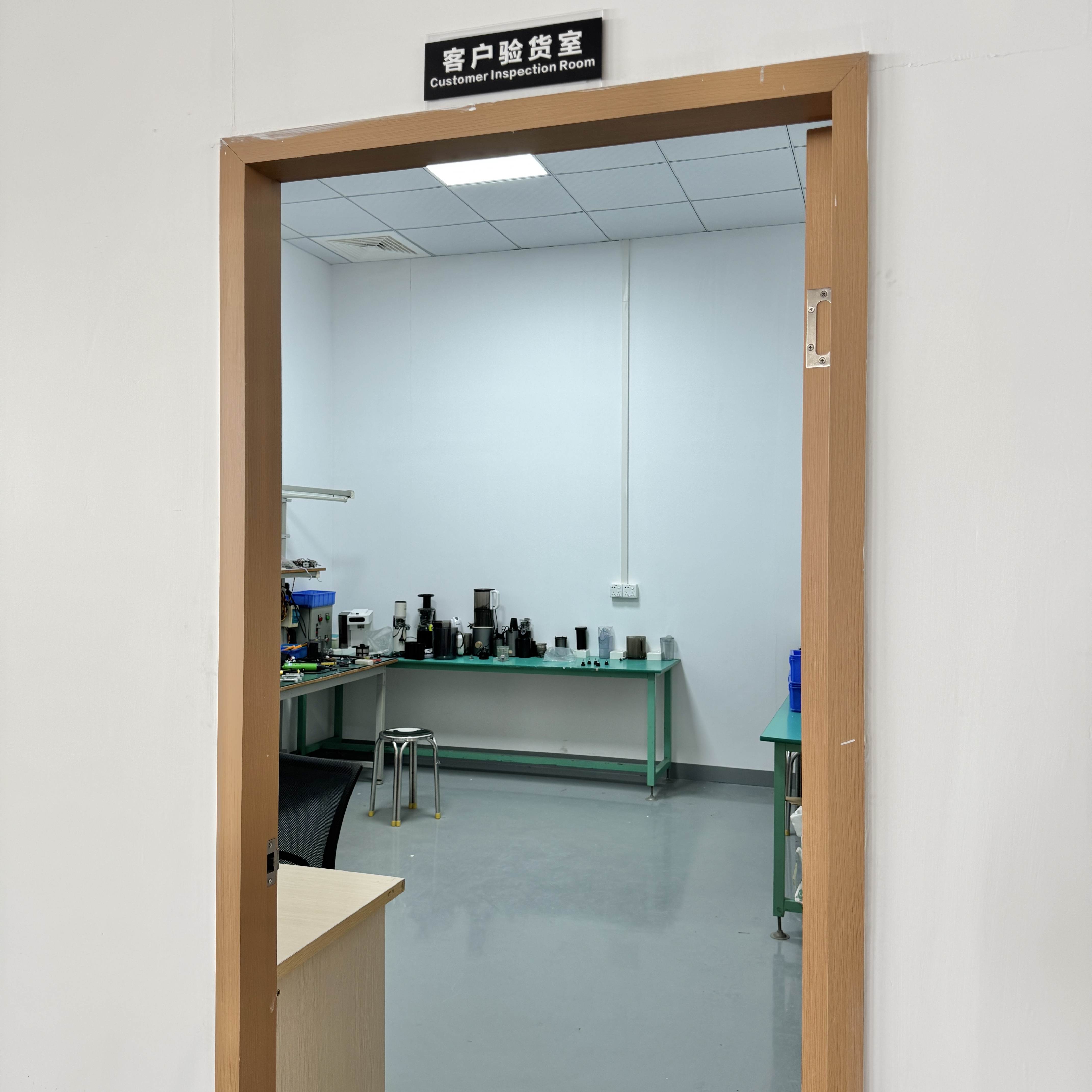
Test room environment where slow juicer electrical and performance checks are carried out before shipment. Photo: Zhongshan Platino.
Why the Cold Press Label Needs Paperwork Behind It
Slow juicers are generally understood to operate in a low-speed band. Public market research on the category places typical masticating juicer speeds between 40 and 150 RPM, a range chosen specifically to limit heat build-up and oxidation during extraction (Grand View Research, juicer market analysis). Being inside that band is a necessary condition for a cold press claim, not a sufficient one. Yield, pulp dryness, noise and motor life depend on auger geometry, two-stage versus single-stage pressing, motor torque and how long the unit is permitted to run before it must rest.
This is where procurement tends to stall. A buyer can compare two data sheets that both say “low speed, high yield, easy clean” and find no basis for a decision. The resolution is to convert those phrases into constraint families that suppliers either can or cannot document.
Five Constraint Families That Decide Whether a Slow Juicer Is Buyable
In the research-to-evaluation stage, most avoidable sourcing errors come from evaluating the wrong constraint at the wrong time. The five families below are ordered by how early they can disqualify a supplier.
| Constraint family | What the buyer should request | Why it decides the order |
|---|---|---|
| Electrical safety conformity | LVD and EMC certificates with numbers and referenced standards; CB certificate for multi-market conversion | Without LVD and EMC evidence a mains-powered appliance cannot be placed on the EU market, regardless of performance |
| Food-contact compliance | LFGB, REACH and ROHS documentation that names the model and the food-contact components | Material compliance is model-specific and part-specific; a company-level statement does not transfer automatically to a new housing or a new squeezer material |
| Mechanical envelope | Motor type and rated power, auger speed, maximum continuous running time, working noise ceiling | These parameters define throughput, service life and whether the unit can be used in a light-commercial setting at all |
| Feeding and cleaning design | Feed chute diameter, whether a filter mesh is used, which parts detach for washing | Preparation and cleaning time usually determine whether a juicer is used daily or abandoned after a month |
| Supply and customization terms | MOQ, lead time, monthly capacity, warranty period, spare-part policy | These decide whether a private-label or distributor programme is commercially viable |
The Reference Case: A Documented Slow Juicer Platform
Zhongshan Platino is a useful reference case for a constraints-first evaluation because its slow juicer range is narrow and its certification set is unusually explicit for a supplier of its size. The platform consists of three models — PLJR-316SUS, PLJR-316 and PLJR-320 — which share the same electrical and mechanical architecture and differ mainly in housing construction: stainless steel on the PLJR-316SUS, and ABS on the PLJR-316 and PLJR-320.
Company-level approvals listed by the manufacturer include CE, CB, LFGB, ROHS, REACH, BPA, BSCI and ISO 9001. What matters for a buyer in the evaluation stage is that the underlying certificate numbers, issuing bodies, referenced standards and validity dates are available rather than summarised.
PLJR-316SUS cold press slow juicer with stainless steel housing and 120 mm feed chute. Photo: Zhongshan Platino.
Reading the Specification: What 60 RPM, 200 W and 68 dB Actually Mean
The shared technical envelope of the PLJR-316SUS, PLJR-316 and PLJR-320 is where most buyer questions resolve.
| Parameter | PLJR-316SUS | PLJR-316 | PLJR-320 |
|---|---|---|---|
| Rated power | 200 W | 200 W | 200 W |
| Rated voltage / frequency | 220–240 V~, 50/60 Hz | 220–240 V~, 50/60 Hz | 220–240 V~, 50/60 Hz |
| Protection class | Class II | Class II | Class II |
| Feed chute | 120 mm | 120 mm | 120 mm |
| Auger speed | approx. 60 RPM | approx. 60 RPM | approx. 60 RPM |
| Max working noise | < 68 dB | < 68 dB | < 68 dB |
| Continuous working time | < 10 min | < 10 min | < 10 min |
| Motor | Full copper DC 4435 | Full copper DC 4435 | Full copper DC 4435 |
| Power cord | 1.2 m with plug | 1.2 m with plug | 1.2 m with plug |
| Housing / knob | Stainless steel / ABS | ABS / ABS | ABS / ABS |
Three of these numbers carry more procurement weight than the rest.
60 RPM. The platform sits at the low end of the 40–150 RPM band generally associated with masticating juicers. A two-stage pressing geometry at this speed is the mechanism behind the “cold press” designation: material is crushed first and pressed second, with a filter separating juice from pulp, rather than being shredded against a fast-spinning basket.
200 W from a full copper DC 4435 motor. Motor construction is the least visible and most consequential cost decision in the category. A full copper DC motor at this rating is specified for torque at low speed, which is exactly what an auger needs; the 200 W figure should be read together with the auger speed rather than on its own. Buyers comparing data sheets should note that a higher wattage does not automatically mean better extraction in a masticating design.
< 68 dB and < 10 minutes. The noise figure is a declared working maximum, not a silent-operation claim, and it is meaningful mainly as a comparable ceiling between suppliers. The 10-minute continuous limit is a duty-cycle constraint, and it is the single most misread number on the sheet. Household slow juicers of this type are built for intermittent operation: the manufacturer’s stated working condition allows a maximum continuous run of 10 minutes followed by a cooling period of 10 to 30 minutes before restart.
The Certification Map: Scope, Numbers and Expiry Dates
Certificates are only useful to a buyer if the scope statement, the model coverage and the validity window are all visible. The table below consolidates the documentation held for this slow juicer platform.
| Certificate | Issuer | Number | Referenced standard | Scope and validity |
|---|---|---|---|---|
| LVD | TUV Rheinland | AN 50659523 0001 | EN 60335-1:2012+A11+A13+A1+A14+A2+A15+A16; EN IEC 60335-2-14:2023+A1+A11; EN 62233:2008 | Household slow juicers 130–200 W; issued 2024-12-31, expires 2029-12-30 |
| EMC | TUV Rheinland | AE 50656066 0001 | EN IEC 55014-1:2021; EN IEC 61000-3-2:2019+A1; EN 61000-3-3:2013+A1+A2; EN IEC 55014-2:2021 | Listed for PLJR-320, with EMC coverage also recorded for PLJR-316 and PLJR-316SUS; issued 2024-11-27, expires 2029-11-26 |
| CB | TUV Rheinland | JPTUV-121522-M3 (and -M2) | IEC 60335-2-14:2016+A1; IEC 60335-1:2010+A1+A2 | Covers PLJR-320, PLJR-316 and PLJR-316SUS, each with a 200 W motor; scope is household slow juicers 130–200 W |
| ROHS | Bureau Veritas | (8826)160-0150 | 2011/65/EU; (EU) 2015/863 | Household slow juicers 130–200 W; issued 2026-09-10, expires 2031-09-09 |
| REACH | Bureau Veritas | (8826)160-0151 | (EC) No. 1907/2006 | Household slow juicers 130–200 W; issued 2026-08-26 |
| LFGB | Bureau Veritas | (8826)160-0149 | § 30 and 31 LFGB, BfR Recommendation, (EC) No. 1935/2004 and related EU food-contact provisions | Household slow juicers 130–200 W; issued 2026-08-26, expires 2046-08-25 |
| ISO 9001 | LianQiShiXin Certification Co., Ltd | 43018Q0N0R0UN0021-2 | ISO 9001-2015 | Design, production and sales of kitchen small appliances (export only); issued 2026-01-14, expires 2029-01-13 |

ROHS certificate (8826)160-0150 issued by Bureau Veritas for household slow juicers rated 130 W to 200 W. Image: Zhongshan Platino.
What the Scope Statement Excludes
Every certificate in the table is written against household slow juicers in a 130–200 W range. That single sentence is the most important line for a commercial buyer. It means the documented safety and electromagnetic conformity applies to the models as household appliances. A juice bar, bubble tea shop or catering operator planning to run the unit as production equipment is, strictly speaking, outside the stated scope and should treat certification as one input rather than as blanket approval for the intended duty.
Two further boundaries are worth noting. The ISO 9001 certificate covers design, production and sales of kitchen small appliances and is explicitly marked as export only — a detail that matters when a domestic Chinese distribution arrangement is being discussed. And certificate validity is not perpetual: the LVD and EMC certificates run to 2029, ROHS to 2031, and any buyer planning a multi-year supply agreement should build renewal confirmation into the contract rather than assume the documents held at sampling will still be in force at the end of the programme.
Food-Contact Materials: The Part of the Spec Sheet Buyers Skip
Material declarations are where LFGB, REACH and ROHS stop being paperwork and become a design specification. For the PLJR-320, the declared construction is consistent across the range.
| Component | Declared material |
|---|---|
| Juice cup | PC |
| Filter | PC |
| Squeezer | PC with SUS#304 axis |
| Blade | SUS#420 |
| Juicer container and pulp container | AS |
| Housing and knob | Stainless steel (PLJR-316SUS) or ABS (PLJR-316, PLJR-320) |
The design choice that matters commercially here is the absence of a mesh filter. Many slow juicers rely on a fine stainless screen to separate pulp, and that screen is the component most likely to clog, tear and drive after-sales cost. The PLJR platform uses a non-mesh structure described by the manufacturer as supporting convenient cleaning, with the juicing parts detachable for washing while the motor base must not be immersed. In practice this is the difference between a juicer that is rinsed in under a minute and one that requires disassembly with a brush after every use.
The declared working conditions complete the picture: indoor use on a flat, stable, heat-resistant surface, ambient temperature 5 °C to 40 °C, 45%–80% relative humidity without condensation, altitude up to 2,000 m, and ±10% voltage tolerance.
Where Cold Press Slow Juicers Fit — and Where They Do Not
The manufacturer lists the applicable field as household appliances and small kitchen appliances, extended to fresh juice bars, bubble tea shops and catering services. That extension deserves a precise reading.
Household daily use is the design centre. A 120 mm feed chute accepts whole fruit and vegetables, so apples and similar produce can go in without pre-cutting — a genuine time saving that shows up in the manufacturer’s field data. Reported end-user feedback across shipments of 1,000 units to Georgia, 24,000 units to India, 1,000 units to Morocco and 10,000 units to Turkey, over customer relationships of two to three years, cites no pre-cutting required, juice–pulp separation, simple operation, easy cleaning, space saving and a low unit failure rate.
Fresh juice bars and bubble tea shops can use the platform for menu differentiation, small-batch signature juices and low-oxidation pressing where volume per hour is moderate. The limits are real and should be planned around: the 10-minute continuous running ceiling with a 10 to 30 minute cooling interval, a 200 W motor sized for household rather than production duty, and certificates scoped to household use. An operator expecting a unit to run through a lunch peak without interruption is specifying the wrong class of machine.
Market Signal: Growth in the Segment That Demands Paperwork
The commercial context supports the compliance-first approach rather than distracting from it. Grand View Research valued the global juicer market at USD 2.8 billion in 2024, with masticating (slow) juicers projected to grow at a CAGR of around 8% from 2024 to 2030 — a faster rate than the overall category. Separately, Market Research Future projects Asia-Pacific as the fastest-growing region for cold-pressed juice demand, at a CAGR of 12.9% through 2035.
The interpretation for buyers is straightforward. Growth is concentrating in the segment where consumers already pay a premium for low-oxidation extraction, and where retailers and importers therefore carry more reputational exposure if a claim cannot be supported. That shifts weight from marketing material to test reports. It also explains why certification sets have become a filtering criterion in supplier shortlists rather than a final formality: a supplier that cannot produce an LVD certificate number and a scope statement is not, in practice, a candidate for an EU private-label programme.
Cold Press vs High-Speed Centrifugal: A Fair Comparison
Slow juicers are frequently positioned against centrifugal machines without either category being described accurately. A neutral comparison is more useful to a buyer deciding which technology belongs in the assortment at all.
| Dimension | Cold press slow juicer | High-speed centrifugal juicer |
|---|---|---|
| Extraction principle | Crushing and pressing by a low-speed auger against a filter | Shredding followed by centrifugal separation through a spinning basket and mesh |
| Typical operating speed | Commonly 40–150 RPM; this platform runs at approximately 60 RPM | High rotational speed, with heat generated by the shredding action |
| Oxidation and heat exposure | Reduced by design intent, because low speed and two-stage pressing limit friction and aeration | Higher exposure to heat and air during extraction |
| Juice and pulp handling | Filter-based separation produces juice without added water | Pulp retained in a collection bowl, often with more residual moisture |
| Preparation time | Reduced by wide feeding chutes; this platform accepts whole fruit through a 120 mm chute | Smaller chutes generally require pre-cutting |
| Throughput per hour | Lower; duty-cycle limits apply, including the 10-minute continuous run ceiling on this platform | Higher sustained throughput, better suited to continuous service |
| Cleaning | Detachable parts; a non-mesh design removes the screen that most often clogs | Mesh basket cleaning is a known pain point |
| Best fit | Households and low-to-moderate volume front-of-house use where juice quality drives the purchase | High-volume venues where speed of service outranks extraction quality |
The honest limitation sits on the slow juicer side of that table. A cold press machine of this class is slower per glass, has a defined rest interval, and cannot be substituted for continuous commercial pressing equipment. Buyers who need uninterrupted output across a service peak should treat the category as unsuitable rather than trying to compensate with additional units.
What Changes Next in Slow Juicer Procurement
Three shifts are visible from the documentation side of the category. First, specification sheets are becoming audit documents: the buyer who asks for a certificate number, an issuing body and an expiry date in the first email is now the norm in EU-facing sourcing, not the exception. Suppliers with clean, dated certificate sets will clear that filter faster than suppliers with broader verbal claims.
Second, private-label entry is getting cheaper in real terms. The OEM and ODM terms associated with this platform — customization of housing colour, knob colour, logo printing and packaging, an MOQ of 500 units, a 35–40 day lead time and a monthly capacity of 60,000 units — describe a programme that a mid-sized importer can realistically run without committing to container-scale volumes. With 100% production online testing plus third-party inspection, a 1% free-of-charge spare parts allowance and a one-year warranty on the whole unit, the risk structure of a first order is reasonably bounded.
Third, regional demand is pulling certification scope wider. With Asia-Pacific cold-pressed juice demand forecast to grow fastest, suppliers that hold CB certification alongside EU-specific LVD, EMC, LFGB, REACH and ROHS documentation are better positioned to convert a single test file into several market entries instead of rebuilding compliance market by market.
A Pre-Order Verification Checklist
- Confirm the certificate numbers, issuing bodies and expiry dates for LVD, EMC, CB, ROHS, REACH and LFGB, and check that each scope statement names the exact model being ordered.
- Verify that the rated power on the certificate matches the rated power on the data sheet — 200 W across PLJR-316SUS, PLJR-316 and PLJR-320 in this case.
- Confirm the intended duty cycle in writing, including maximum continuous running time and the required cooling interval.
- Request the material declaration for every food-contact part, not a general compliance statement.
- Check the feed chute diameter against the produce actually being used, and confirm whether pre-cutting is required.
- Confirm the electrical configuration: 220–240 V~, 50/60 Hz, Class II, 1.2 m cord with plug — and establish whether a different configuration is needed for the destination market.
- Agree the MOQ, lead time, spare-part allowance and warranty terms before sampling, so that sample feedback can be priced into the order.
FAQ
Which certifications should a cold press slow juicer carry before it is imported into the EU?
For mains-powered household slow juicers, the relevant documentation set typically includes LVD and EMC certificates as the electrical safety and electromagnetic conformity basis, together with ROHS and REACH for substance restrictions and LFGB for food-contact materials. On the PLJR-316SUS, PLJR-316 and PLJR-320 platform, the LVD certificate AN 50659523 0001 and the EMC certificate AE 50656066 0001 are both issued by TUV Rheinland; ROHS (8826)160-0150, REACH (8826)160-0151 and LFGB (8826)160-0149 are issued by Bureau Veritas; and CB certificate JPTUV-121522-M3 is issued by TUV Rheinland.
What do the noise and speed ratings on a quiet DC motor slow juicer actually mean?
Speed and noise are separate declarations. Masticating juicers commonly run between 40 and 150 RPM, and the PLJR platform operates at approximately 60 RPM, which is what supports the cold press description. The noise figure of under 68 dB is a declared maximum working level rather than an average, so it is best used as a comparable ceiling between competing models. The motor specified for this platform is a full copper DC 4435 rated at 200 W.
Can a large feeding chute slow juicer take whole fruit without pre-cutting?
Yes, where the chute is wide enough for the produce in question. The PLJR-316SUS, PLJR-316 and PLJR-320 models have a 120 mm feed chute, which the manufacturer states supports whole apples and vegetables for direct feeding, removing the pre-cutting step. Produce that exceeds the chute diameter still needs to be reduced in size before feeding.
How long can a household cold press slow juicer run continuously?
On this platform the maximum continuous working time is under 10 minutes, after which the unit should cool for 10 to 30 minutes before restarting. The stated working conditions also specify indoor use on a flat, stable, heat-resistant surface, an ambient temperature range of 5 °C to 40 °C, 45%–80% relative humidity without condensation, altitude up to 2,000 m and ±10% voltage tolerance. This duty cycle is designed for household and light front-of-house use, not for continuous commercial operation.
Which materials come into contact with the juice, and is the unit easy to clean?
The declared food-contact materials are PC for the juice cup and filter, PC with a SUS#304 axis for the squeezer, SUS#420 for the blade, and AS for the juicer container and pulp container. The housing is stainless steel on the PLJR-316SUS and ABS on the PLJR-316 and PLJR-320, with an ABS knob across the range. The juicing assembly uses a non-mesh structure rather than a fine screen, and the detachable parts can be disassembled for washing; the motor base must not be immersed in water.
What are the minimum order quantity and lead time for an OEM slow juicer programme?
The stated terms are an MOQ of 500 units and a lead time of 35 to 40 days, with a monthly capacity of 60,000 units. Customization covers housing colour, knob colour, logo printing and packaging under OEM and ODM arrangements. Quality control consists of 100% production online testing plus third-party inspection, and after-sales support includes 1% free-of-charge spare parts and a one-year warranty on the whole unit.
Does certification of the slow juicer cover commercial use in a juice bar?
No. The LVD, EMC, CB, ROHS, REACH and LFGB documentation held for this platform is scoped to household slow juicers with power ratings from 130 W to 200 W. Juice bars, bubble tea shops and catering operators can use the models, but the certificates describe household use, and the 10-minute continuous running limit with a 10 to 30 minute cooling interval should be treated as a hard operational boundary when planning volume.
Closing Note
The cold press slow juicer category rewards buyers who read the scope statement before the feature list. Speed, motor construction, duty cycle, food-contact materials and certificate validity are all verifiable points, and each one narrows the field faster than any claim about nutrition or taste. For evaluation-stage sourcing, the practical rule is simple: a parameter that cannot be traced to a document is a preference, not a specification.
The full product and specification catalogue for this slow juicer range is available for public download: Platino E-catalogue. Company information: www.platino-china.com.
Есть вопросы или нужны дополнительные детали?
Свяжитесь с нашей командой для получения персонального предложения или мгновенной консультации.
Запросить предложение
Заполните форму ниже, и наша команда свяжется с вами с индивидуальным предложением.
Прямой чат WhatsApp
Предпочитаете общаться в реальном времени? Напишите нам в WhatsApp для мгновенной помощи и быстрых ответов.
- Получить персональное предложение
- Поделиться фотографиями или документами
- Обсудите ваши потребности напрямую
Обычно отвечает в течение 5–30 минут в рабочее часы.