
Cold Shrink vs Heat Shrink Cable Accessories: MV Buyer Guide
Cold shrink and heat shrink cable accessories perform the same three jobs on a medium-voltage (MV) cable system: they insulate the conductor, control electrical stress at the termination or joint, and seal the connection against moisture and contamination. They differ in how the accessory is installed, and that difference changes site safety, crew qualification, outage scheduling and unit cost. This buyer comparison sets out the verified parameter differences, the parameters a supplier needs before quoting, and the installation risk points that usually determine whether an MV joint survives its first years in service.
Two Technologies, One Procurement Decision
A cold shrink accessory is supplied pre-stretched over a removable support core. When the core is pulled out, the silicone rubber body contracts onto the prepared cable by elastic memory, with no torch, heat gun or open flame used during installation. A heat shrink accessory is supplied in an expanded state and is shrunk onto the cable with a torch; the material is cross-linked polyolefin, normally combined with a semi-conductive cross-linked polyolefin layer for stress control.
Both families are catalogue products with defined parameters, and both are applied in the same MV voltage classes. The procurement question is therefore not which technology is superior in the abstract, but which one fits the site, the crew and the schedule of a specific project.
Tonyhoo Cable Accessories (Ningbo Tonyhoo Electrical Technology Co., LTD., founded in 1997 in Ningbo, Zhejiang, China) manufactures both families plus related accessories for the 0.6/1 kV to 35 kV range, which makes its catalogue a practical reference for reading the differences below. The company reports a 9,900 m² factory, approximately 100 employees, 20 R&D engineers and an annual output of 200,000 units, with around 50% of output exported to markets including the United States, Thailand, Vietnam and Albania. Those are company-reported figures and appear here only as context on the size of the supply base behind the products.
The Buyer Problem: A Price Difference Hiding a Schedule and Safety Decision
On most MV projects, a procurement team receives two quotations for the same scope: one built on heat shrink terminations, one on cold shrink. The heat shrink quotation is typically the lower one, and supplier selection guidance supports that reading — cold shrink accessories are recommended for projects where open flame work is not permitted and construction schedules are tight, because no torch heating is required and installation is straightforward, while heat shrink accessories are described as offering a clear cost advantage for budget-limited projects when certified flame operators are available. Both options are described as meeting medium-voltage requirements for insulation, electric field control and sealing protection.
The risk is treating that as a simple price comparison. Heat shrink work requires certified flame operators and firefighting equipment on site, and cannot be used where hot work is prohibited — underground cable trenches, confined spaces and gas-risk areas among them. Cold shrink removes hot work entirely, but it shifts quality control onto cable preparation and stress-cone positioning: elastic compression does not correct a scratched insulation surface or a mis-set stress cone. A joint that fails in service costs far more than the accessory itself, so the practical question is which risk profile the project can actually control.
Demand context. The global cable accessories market was reported at USD 35.84 billion in 2025 and projected at USD 37.88 billion in 2026, with Asia Pacific identified as the largest and fastest-growing region on the back of grid modernization (source-reported, Global Market Insights, 2026). Undergrounding and urban distribution renovation raise the share of work carried out in trenches and confined spaces — exactly where a no-flame installation method is easiest to justify.
Technical Explanation: What the Parameters Actually Show
| Parameter | Cold Shrink Termination (NLS-10/3.3, WLS-10/3.3; NLS-35/1.3, WLS-35/1.3) | Cold Shrink Intermediate Joint (JLS-10/1.1, JLS-10/3.3; JLS-35/1.3, JLS-35/3.4) | Heat Shrink Termination (SY10kV, SY26kV, SY35kV) |
|---|---|---|---|
| Voltage class | 0.6/1 kV | 8.7/10 kV, 12/20 kV, 19/35 kV | 8.7/10 kV, 12/20 kV, 19/35 kV |
| Cable section | 10–300 mm² | 25–400 mm² | 25–400 mm² |
| Material | Silicone rubber | Silicone rubber | Cross-linked polyolefin; semi-conductive cross-linked polyolefin |
| Configuration | Four core | Straight joint | Indoor termination; single core or three core |
| Operating temperature | -40 °C to 90 °C | -40 °C to 90 °C | -40 °C to 120 °C |
| Installation method | Support core pulled out; no heat source | Support core pulled out; no heat source | Torch or heat gun; shrink ratio 2:1 |
| Listed electrical parameter | — | — | Withstand voltage 39 kV / 5 min |
Three details in that table matter more to a buyer than the headline numbers.
- Temperature class is not identical. The listed cold shrink termination and cold shrink intermediate joint are rated to 90 °C continuous operating temperature, while the heat shrink termination is listed at 120 °C. Continuous current rating and conductor temperature class must be checked against the accessory rating before either family is approved.
- The two families are not catalogued across the same product types. In the data reviewed here, cold shrink appears as a 0.6/1 kV four-core termination and as an 8.7/10 kV to 19/35 kV intermediate joint, while the heat shrink termination covers 8.7/10 kV, 12/20 kV and 19/35 kV. Availability of a technology as a joint does not automatically mean availability as a termination in every class — it has to be confirmed model by model.
- Shrink ratio and withstand voltage are design and routine-test parameters, not promotional claims. A 2:1 shrink ratio defines the diameter range a heat shrink tube can cover; a 39 kV / 5 min withstand voltage is a specific listed figure. Both should be backed by test documentation for the exact model and voltage class ordered.
Design intent explains the behavioural difference. In cold shrink, stress control is delivered by elastic compression of the silicone body against the cable insulation, with a stress-control element that must be positioned to a specified dimension. Manufacturer 3M describes its cold-shrink QT-II and QT-III medium-voltage terminations as combining a high-dielectric-constant (Hi-K) stress-control tube with a silicone-rubber insulating body — an independent example of the same construction principle. In heat shrink products, stress control is delivered by a semi-conductive layer laid down as the tube shrinks under heat, so the quality of the heating process itself is part of the electrical result.
That is the real trade-off being priced: cold shrink moves uncertainty into preparation and positioning, heat shrink moves part of it into the heating process.
How to Choose Between Them: A Five-Step Buyer Sequence
- Confirm whether open flame work is permitted on site.
- Verify project schedule, budget and operator qualification.
- Confirm cable voltage class, cross-section and application environment (indoor or outdoor).
- Match suitable cable accessories and check the applicable parameters.
- Finalise the selection plan and confirm delivery lead time.
The resulting decision rules are straightforward. Where hot work is prohibited or the outage window is compressed, cold shrink is the defensible first choice because no torch heating is needed. Where the budget is the binding constraint and certified flame operators plus firefighting equipment can be guaranteed on site, heat shrink retains its cost advantage. For outdoor installations, pollution resistance grade, waterproofing and weather resistance requirements should be confirmed regardless of technology, so that the selection meets local power standards. Price alone should never close the decision: routine-test documentation for the specific model is part of the product.
Parameters Buyers Must Provide Before Quotation
Accessory selection starts with information the buyer already holds. Five items determine whether a supplier can match a product to the cable:
- Rated voltage level of the cable.
- Cable model, core quantity and conductor cross-section.
- Installation scenario: indoor, outdoor or direct burial.
- Product type required: cable termination or cable joint.
- For outdoor applications, pollution resistance grade and weather resistance requirements, so the selection meets local power standards.
Selection warning. Wrong parameters cause product mismatch and can trigger insulation failure after energization. Parameters should be double-checked before an order is placed, particularly the split between termination and joint scope and the cable cross-section range.
An MV joint or termination is rarely a single item. The surrounding accessory set carries its own parameters, and buyers comparing quotations should compare the full set rather than the joint body alone.
| Accessory | Model | Key listed parameters |
|---|---|---|
| Cable lug | DT / SC | Pure copper / tin-plated copper; 10–400 mm²; DIN / GB; working temperature -40 °C to 125 °C; high conductivity, corrosion resistant |
| Separable connector | DS / SC | 8.7/10 kV, 630 A European type rear arrester; rated voltage 15 kV; 1 minute AC withstand 42 kV; 15 minutes DC withstand 52 kV; lightning impulse withstand 95 kV; minimum corona onset 11 kV; thermal short-circuit current 22.8 kA/2 s; dynamic short-circuit current 80.8 kA; partial discharge ≤10 pC; EPDM and tin-plated copper |
| Polyurethane sealant | J-399 / J-499 / J-699 | Applicable voltage level 10 kV–35 kV; polyurethane prepolymer; hardness 55A±10; light yellow |
| Protection housings | Aluminum-Magnesium alloy 10 kV / 35 kV / 110 kV; stainless steel DS-FBH (SS)-1 to -8 | Shell flammability B1 grade; sealing gasket V-0 flame retardant; withstands a 1 kg vertical drop from 2 m without cracking; flexural strength 127 MPa; no swelling, cracking or interlayer peeling after 3 days in 3% sodium chloride solution |
| Grounding box | 35 kV, 66 kV, 110 kV, 220 kV | Cabinet insulation resistance 5 MΩ; box body impacted at 37.5 kV ten times without breakdown; direct-buried box tested at 0.2 MPa for 30 minutes with no leakage; SS304 / SS316 / SMC FRP |
For substation-side scope, oil-immersed distribution transformers are listed as S11-M, S13-M, S20-M and S22-M at 30–500 kVA capacity, high voltage 6/10/10.5/11 kV, low voltage 0.4 kV, vector group Dyn11/Yyn0 and short-circuit impedance 4% — relevant when a package also covers transformer-side connections.
Installation Risk Points That Decide Whether a Joint Survives
Cold shrink: four known inducements of later breakdown
Scratches on the main cable insulation, rough treatment during the semi-conductive layer cut, moisture and dust on the installation interface, and offset stress-cone positioning are the main causes of later breakdown of cold shrink terminations. The working sequence that addresses them is:
- Strip the cable outer sheath, armour and inner sheath to drawing dimensions and complete armour earthing.
- Remove the semi-conductive shielding layer, then polish and clean the insulation surface to avoid scratches and dust.
- Fit the cold shrink body and stress cone, positioned to the specified dimension.
- Pull out the support core at constant speed so the silicone part shrinks closely onto the cable.
- Inspect the sealing structure and appearance, confirming no displacement or gap defects.
Preconditions matter as much as technique: power cut, voltage test and earthing connection before construction; a valid cable construction qualification for operators; and no construction in wet or rainy conditions.
Heat shrink: hot work discipline and documentation
Heat shrink installation introduces an open flame into the joint pit. Firefighting equipment must be prepared on site, and operators must hold flame-work certification. Because the shrink ratio and the laying down of the semi-conductive layer are process-dependent, the quality of the electrical result depends on how evenly and completely the tube is shrunk, which is why process documentation belongs in the handover pack.
Outdoor service: an ageing problem, not an installation-only problem
In outdoor environments, cable accessories are exposed to rain, UV radiation, temperature differences and contamination, which can lead to insulation ageing, seal failure and water-ingress breakdown, and subsequently to short circuit and tripping. The trigger conditions are well known: long-term open-air service, coastal salt-fog areas and environments with alternating high and low temperatures. Mitigation is procedural — select weather-resistant cold or heat shrink accessories, complete sealing strictly according to process, inspect periodically for cracking of outer sheaths and water seepage at sealing positions, and power off and replace immediately once insulation damage is found. Operation with defects is not an option.
Application Fit: Where Each Family Is Used
MV accessories from both families are applied in indoor cabinets, outdoor substations, underground cable trenches, high-humidity sites, salt-fog coastal environments, dust-polluted areas and wide temperature ranges from -40 °C to 150 °C. Typical project types include power grid upgrades, wind and solar station construction, urban underground cable reconstruction and railway power supply projects. The functional duties are the same in each case: cable terminal insulation, cable connection, electric stress control, and moisture and dust sealing protection under continuous long-term energization at rated voltage, supported by cable test instruments and cable laying auxiliary tools.
Company-reported project records illustrate where the no-flame argument is strongest. In Thailand, cold shrink accessories were supplied to Provincial Electricity Authority (PEA) network projects: 500 units for intermediate connection and sealing protection of 10 kV underground cables in a suburban cable expansion project, 1,000 units for indoor 10 kV substrate terminal support in a substation project, and a further 1,000 units for outdoor 10 kV cable terminals in an urban distribution network renovation. The reported highlight of the underground scope is precisely the mechanism described earlier: a cold-shrink structure requires no open flame, which makes construction safer in underground confined space, and the sealing structure resists moisture and soil corrosion. Outdoor units were reported to operate stably under high temperature and high humidity without insulation faults.
A separate Albanian power grid construction delivery combined high-voltage cable accessories and DC lugs — 1,087 pieces across 32 cartons — delivered on schedule and reported as operating stably after installation. That example is useful because it shows the mixed-bundle pattern that dominates real MV procurement: joints, terminations, lugs and connectors ordered together, with lead time as decisive as unit price.
Market Trends a Buyer Should Price In
Two trends are visible in the available data. The first is scale and regional gravity. The cable accessories category was reported at USD 35.84 billion globally in 2025, projected at USD 37.88 billion in 2026, with Asia Pacific the largest and fastest-growing region (source-reported, Global Market Insights, 2026). For buyers, that means supply depth — and the option to dual-source within the region — continues to improve in the medium-voltage classes that dominate distribution work.
The second is segmentation between the two technologies. Reported 2024 values place heat shrink cable accessories at USD 2,113.7 million and cold shrink tubing at USD 2.38 billion. These two figures come from different product scopes — tubing versus accessories — and should be read as directional rather than as a head-to-head market verdict; no validated study in this review measured the two families on an identical product boundary. What can be said is that both segments are large enough that buyers are not choosing between a mainstream and a niche method.
Standards work is the third signal. IEEE 1816-2024 provides industry practice for preparing shielded cables rated 2.5 kV through 46 kV and installing mating accessories — the practical range in which most MV distribution work sits. As cable preparation becomes a documented requirement rather than a craft habit, buyers gain a credible basis for asking suppliers for installation procedures and routine-test records alongside the product.
One gap is worth flagging. Trade statistics cannot substitute for supplier qualification here: HS 8544 covers insulated wire and cable, whether or not fitted with connectors, and does not isolate accessory hardware such as joints, terminations or separable connectors. Buyers trying to benchmark the accessory supply base through customs data will be measuring the wrong product.
Comparison With Traditional Heat-Shrink-Only Sourcing: Real Limits
Cold shrink is not a universal upgrade over traditional heat shrink practice, and the boundaries should be stated plainly.
- Cost. Heat shrink accessories are described as carrying a clear cost advantage for budget-limited projects. Where hot work is permitted, flame operators are certified and firefighting equipment is available, heat shrink remains the more economical route on a like-for-like MV scope.
- Discipline dependency. Cold shrink depends on correct stress-cone positioning and on defect-free cable insulation; the elastic contraction does not compensate for a scratched insulation surface or contamination on the interface.
- Heat shrink boundaries. It requires open flame, certified operators and on-site firefighting equipment, and it cannot be used where hot work is prohibited. Its listed temperature range of -40 °C to 120 °C and 2:1 shrink ratio define the limit of what it can cover.
- Shared boundary. Neither technology survives parameter error. Wrong voltage class, cross-section, core quantity or environment leads to product mismatch and insulation failure after energization.
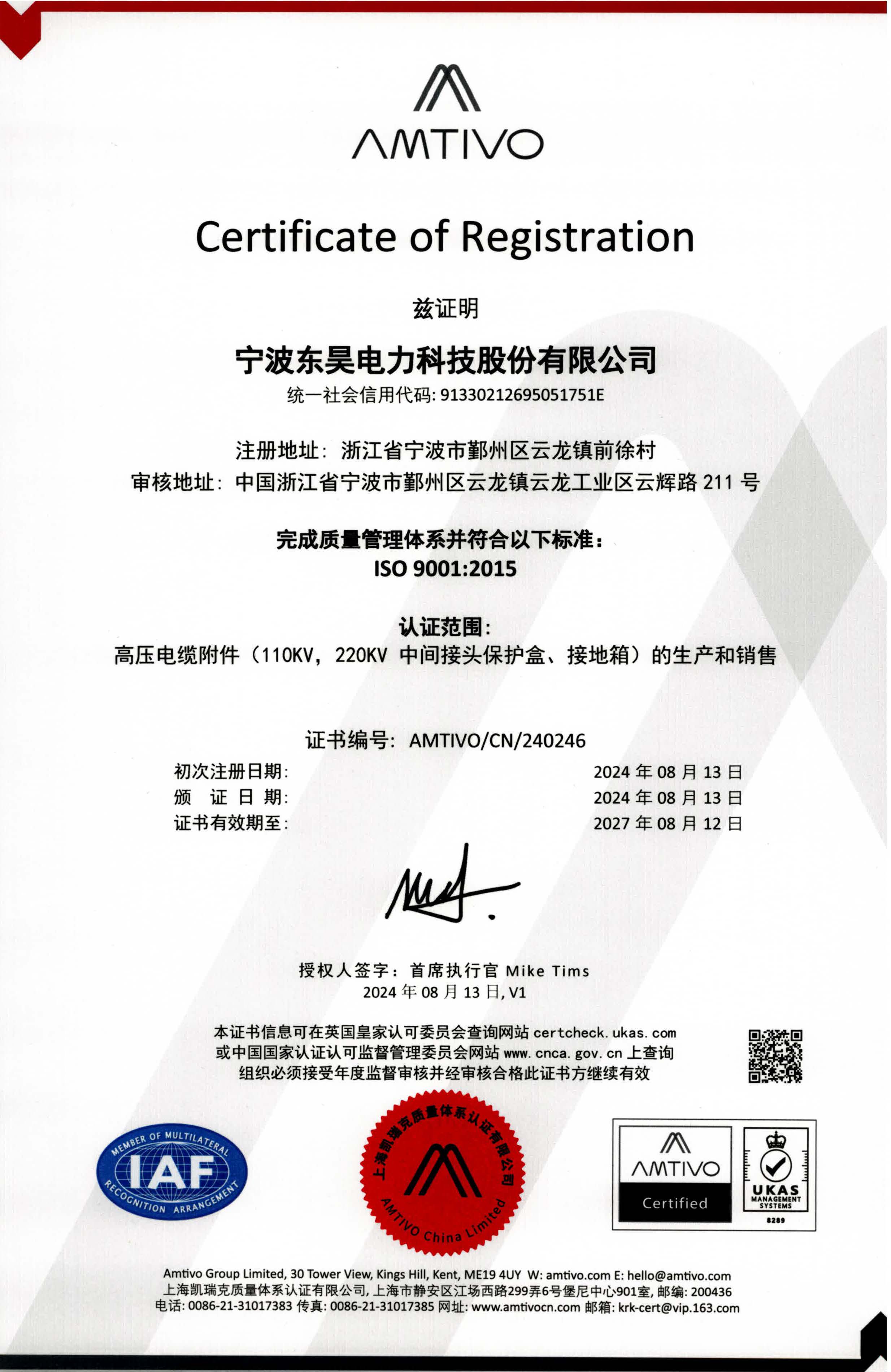
- Certificate scope. Buyers should check what a certificate actually covers. Tonyhoo's ISO 9001:2015 certificate (AMVITO/CN/240246, issued 2024-08-13, valid to 2027-08-12, issued by AMTIVO China Limited) covers manufacture and sales of high-voltage cable accessories — 110 kV and 220 kV intermediate joint protection housing and grounding box — which is a different product scope from the MV terminations and joints discussed above. Model-specific test documentation should be requested separately.
Note on data gaps: no independently verified price, MOQ or lead-time benchmarks specific to MV cold shrink and heat shrink accessories were identified in this review. Buyers should obtain current quotations and confirm commercial terms at RFQ stage.
Future Outlook
The direction of travel favours both families, but not equally. As urban distribution networks move underground, more joint pits will fall into the category of confined space where hot work is difficult to permit — the condition under which no-flame cold shrink installation is most easily defended. At the same time, heat shrink retains its position wherever budgets are tight and hot work is routine.
For suppliers, the competitive variable is shifting from product availability to documentation and customization. Tonyhoo's stated production capability illustrates the pattern buyers will increasingly expect: OEM, ODM and customized solution production; customization across rated voltage, cable cross-section, material formula, packaging, logo printing and special anti-corrosion versions; a monthly capacity of 12,000 sets; lead time of 30–40 days; MOQ of 10 sets; quality control through 100% factory electrical test and partial discharge testing during production, plus third-party inspection (SGS/TUV); and after-sales support covering on-site installation guidance, remote technical support and a 5-year product warranty.
The practical forecast for procurement teams is that the two technologies will be evaluated as one package rather than as competing single items — joint, termination, lug, connector, sealant and protection housing specified together, with installation method, crew qualification and test documentation treated as part of the specification.
FAQ
How do buyers choose between cold shrink and heat shrink cable accessories?
Cold shrink accessories are preferred for projects where no open flame is allowed and construction schedules are tight, because no torch heating is required and installation is straightforward. Heat shrink accessories suit scenarios with a limited budget and certified flame operators, and are described as carrying a better cost advantage. Both can meet the insulation, electric field control and sealing protection requirements of medium-voltage cables. The selection sequence is: confirm whether open flame work is permitted on site; verify schedule, budget and operator qualification; confirm cable voltage class, cross-section and environment (indoor or outdoor); match suitable accessories and check applicable parameters; then finalise the plan and confirm delivery lead time.
What parameters need to be provided to suppliers when purchasing cable accessories?
Confirm the rated voltage level of the cable, the cable model, conductor cross-section, core quantity and the application environment (indoor, outdoor or direct burial). Also clarify the product type — cable termination or cable joint. Complete parameters allow the supplier to match products of the corresponding specification and ensure electric field control, sealing performance and compatibility with the cable body. For outdoor applications, pollution resistance grade and weather resistance requirements need extra confirmation to meet local power standards. Wrong parameters cause product mismatch and can easily trigger insulation failure after energization, so double checking is required.
Which installation operations may cause breakdown faults in cold shrink terminations later in operation?
Scratches on the main cable insulation, rough treatment of the semi-conductive layer cut, moisture and dust on the installation interface, and offset stress cone positioning during construction are the main inducements of later breakdown. Stripping strictly according to process dimensions, keeping the insulation surface clean and dry, and accurately positioning the stress cone avoid these insulation failure risks. The working steps are: strip the outer sheath, armour and inner sheath per drawing dimensions and complete armour earthing; remove the semi-conductive shielding layer and polish and clean the insulation surface; fit the cold shrink body and stress cone to the specified dimension; pull out the support core at constant speed; and inspect the sealing structure and appearance for displacement or gap defects. Power cut, voltage test and earthing must be completed before construction, operators need valid cable construction qualification, and construction in wet or rainy conditions is not permitted.
What safety risks may occur when cable accessories operate outdoors, and how are they avoided?
Outdoor cable accessories face risks of insulation ageing, seal failure and water-ingress breakdown caused by rain, UV exposure and contamination, which may cause short circuit and tripping. Trigger conditions include long-term open-air service, coastal salt fog areas, and environments with alternating high and low temperatures. Mitigation: select weather-resistant cold and heat shrink accessories and complete sealing installation strictly according to process; conduct regular inspections for cracking of outer sheaths and water seepage at sealing positions; and power off and replace immediately once insulation damage is found. Operation with defects is prohibited.
What should buyers verify about a supplier's customization and quality control capability?
Production mode, customization scope, capacity, lead time, MOQ, testing and after-sales terms are the practical checkpoints. Tonyhoo provides OEM, ODM and customized solution production services, with customization covering rated voltage, cable cross-section, material formula, packaging, logo printing and special anti-corrosion versions, supported by private-label packaging and logo printing. The stated MOQ is 10 sets, monthly capacity is 12,000 sets, and lead time is 30–40 days. Quality control includes 100% factory electrical test and partial discharge testing during production, plus third-party inspection (SGS/TUV). After-sales support includes on-site installation guidance, remote technical support and a 5-year product warranty. Buyers should also confirm that any certificate presented covers the specific product line being ordered, since certified scope and product scope are not always the same.
Reference material: the Tonyhoo product catalogue covering cable accessories, new materials and protection products is available for download at https://cdn.socialarks.com/sbsp/25368/common/2026/0918/Tonyhoo%20product%20catalog.pdf.
Есть вопросы или нужны дополнительные детали?
Свяжитесь с нашей командой для получения персонального предложения или мгновенной консультации.
Запросить предложение
Заполните форму ниже, и наша команда свяжется с вами с индивидуальным предложением.
Прямой чат WhatsApp
Предпочитаете общаться в реальном времени? Напишите нам в WhatsApp для мгновенной помощи и быстрых ответов.
- Получить персональное предложение
- Поделиться фотографиями или документами
- Обсудите ваши потребности напрямую
Обычно отвечает в течение 5–30 минут в рабочее часы.