
Cold Storage Panels vs. Plywood vs. Steel Props: A Buyer Comparison
Cold storage panels, plywood, and adjustable steel props appear together on more construction bills of quantities than their unrelated specifications suggest. They do three different jobs — insulated enclosure, concrete forming and general building work, and temporary load-bearing support — and each is governed by a different set of purchase criteria. Comparing all three on unit price alone, or assuming that a supplier's strength in one category carries automatically into the other two, is where mixed-scope projects most often lose cost control.
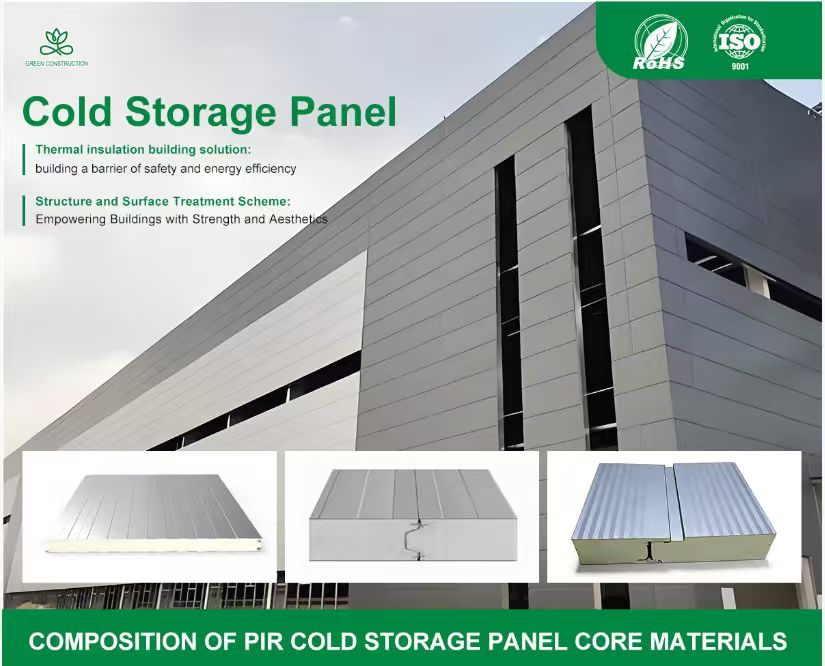
A single production base can cover insulated panels, plywood and steel supports — but each line has to be evaluated on its own criteria.
Why three different categories share one buying decision
Project teams rarely purchase a single material family. A cold chain development may need insulated enclosure panels, plywood for temporary works, and steel props for an excavation. An infrastructure package may use all three across separate work packages. Procurement consolidates them into one supplier evaluation because administrative cost falls as the number of vendors falls.
The risk is that consolidation quietly replaces specification judgement. Insulated panels are bought on thermal and fire performance. Plywood for formwork is bought on thickness consistency and surface integrity, because those determine the concrete finish and the number of reuses. Steel props are bought on load capacity, adjustment range and batch consistency, because they are deployed in large sets where a single weak unit is a safety issue rather than a cost issue. When one unit-price comparison is applied across all three, buyers tend to overpay on the commodity lines and under-specify the technical ones.
The opportunity runs the other way. Buyers who separate the categories, define criteria per category, and then test whether one supplier can genuinely serve all three typically end up with a shorter vendor list — and a clearer, defensible reason for the vendor they keep.
What GREEN BIO supplies across the three categories
GREEN BIO (JIANGSU GREEN BIO-ENVIRONMENTAL PROTECTION TECHNOLOGY CO.,LTD) is a Jiangsu-based supplier of building envelope and finishing materials, founded in 2015 and serving customers in more than 120 countries and regions. The company operates from a 10,000 ² facility with 50 employees, including a 25-engineer technical team, and reports annual output of 120,000 units. Around 70% of production is exported, with Southeast Asia, Central Asia, Russia, South America and Africa as its core markets — largely countries along the Belt and Road Initiative and other emerging markets.
Three lines are relevant to this comparison: PIR sandwich panels used in insulated and cold storage construction, plywood, and adjustable steel supports. Cable brackets and aluminium profiles sit elsewhere in the catalogue and are outside the scope here.
For a buyer, that breadth cuts two ways. A supplier able to quote insulated panels, plywood and props from one production base reduces coordination load, documentation effort and inbound freight complexity. It also raises a fair question: is the supplier genuinely strong across all three lines, or is one line carrying the others? The rest of this article treats that question seriously instead of assuming an answer.
Technical explanation: what determines performance in each category
Cold storage panels: thermal and fire behaviour
An insulated sandwich panel is a composite: a rigid core bonded between facings. In cold storage, almost all operating cost is driven by how well that core resists heat flow and how well the panel joints hold that resistance over years of thermal cycling. GREEN BIO's published product data describes a high-density PU core with thermal conductivity as low as 0.022 W/(m·K), and states that this delivers roughly 30% better insulation efficiency than traditional EPS panels, translating into an estimated 15–20% reduction in electricity costs over the long term. Those are supplier figures and should be treated as directional inputs to a buyer's own energy model, not as guaranteed project outcomes.
Fire behaviour is the second axis, and in many markets it is the deciding one. The company states that its panels are tested against ISO and EN13501 fire safety standards, that B1/B2 grade flame-retardant cores are available, and that authoritative third-party test reports are included with shipment to support local fire inspections. For projects in jurisdictions with strict combustibility rules for insulated envelopes, the availability of a documented core grade frequently determines whether a panel type can be specified at all — independent of its thermal numbers.
Plywood: formwork and general building duty
Plywood is specified for two distinct jobs, and buyers who blur them pay for it. In formwork, the concerns are thickness consistency so the form face stays flat, surface integrity so the poured concrete finish needs less repair, and edge durability across repeated stripping and re-use cycles. In general building work, the concerns shift toward grading, moisture behaviour and dimensional stability in service. Plywood is a highly commoditised category with many producers, so brand recognition rarely decides the purchase. What decides it is documented grade consistency between the sample and the delivered batch, plus a supplier who can hold that consistency across repeat orders.
Adjustable steel props: temporary support
Steel props carry loads temporarily while permanent structure is completed, most visibly in tunnels and foundation pits. Purchase criteria here are structural and procedural rather than aesthetic: verified load capacity, an adjustment range that matches the actual shoring heights on site, thread and pin quality, and consistency between batches. Props are also covered by local temporary-works regulations, and their final configuration is normally subject to engineering verification. A supplier provides hardware and documentation; it does not replace the structural approval a project engineer signs off.
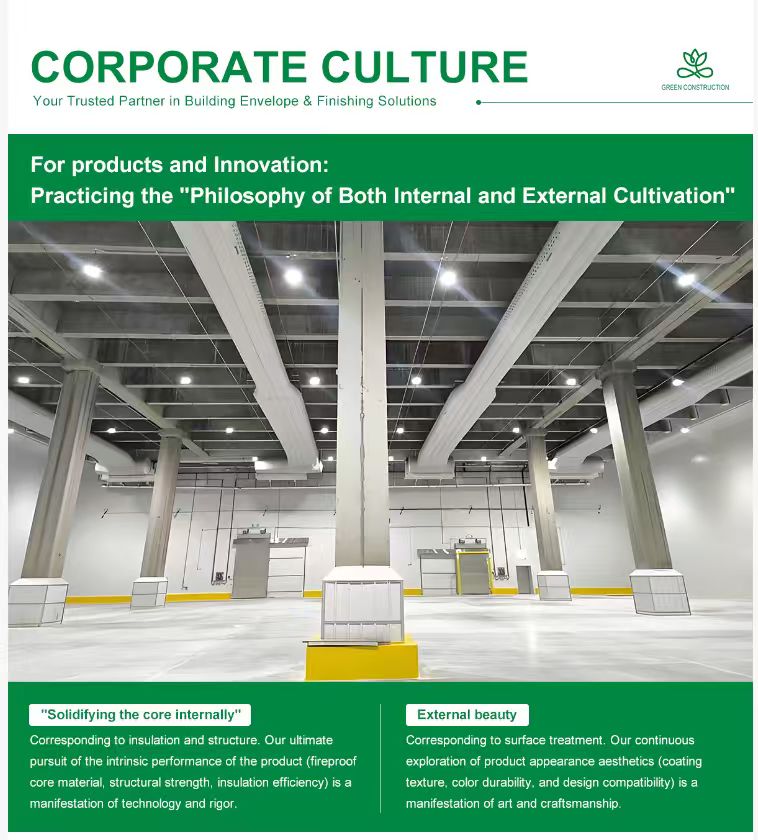
In mixed-scope projects the three categories usually arrive on different schedules, even when they are purchased from one supplier.
Application fit: which category belongs in which project
Cold chain, food, agriculture and pharmaceutical storage
Insulated panels are the controlling category. The performance question is not only “how cold” but “how stable” — agricultural, food processing and pharmaceutical storage all depend on holding temperature with minimal fluctuation, which places the emphasis on core performance, panel sealing and fire grade. Facilities that must also satisfy local green building or energy-efficiency criteria will normally be asked to document both the thermal and the fire evidence at tender stage.
General building and concrete works
Plywood leads here, in temporary works and forming, and in general building use where it is part of the finished or semi-finished assembly. The buyer's leverage sits in consistency: a supplier that can supply the same grade, thickness and surface specification across several shipments removes the rework risk that comes with mixing batches on a single pour sequence.
Tunnels and foundation pits
Adjustable steel props are the primary requirement, usually in volume, and usually against a compressed site programme. Selection turns on load capacity and adjustment range matched to the shoring plan, plus a supply schedule that keeps pace with excavation rather than lagging behind it. Where the same project also needs formwork plywood for the base slab or lining works, buying both lines from one source can simplify logistics without changing the engineering criteria for either.
| Category | Primary function | Decision criteria that matter most | Typical project fit |
|---|---|---|---|
| Cold storage panels (PIR sandwich) | Insulated enclosure with controlled fire behaviour | Core type and density, fire grade (B1/B2), joint integrity, documented third-party test reports | Cold chain, food processing, agricultural and pharmaceutical storage |
| Plywood | Formwork faces and general building work | Thickness consistency, surface integrity, edge durability, grade documentation, batch-to-batch stability | Concrete works, general building and finishing packages |
| Adjustable steel props | Temporary load-bearing support | Load capacity, adjustment range, thread and batch consistency, compliance with local temporary-works rules | Tunnels, foundation pits, slab and beam support |
Market context: why insulated and low-carbon specifications are moving up the list
The commercial backdrop explains why buyers are being asked to justify material choices more rigorously than they were five years ago. The China green building materials market reached USD 216.3 billion in 2025 and is projected to reach USD 484.9 billion by 2034, according to IMARC Group. A narrower measurement from Markets and Data, covering integrated green building systems and services, puts the China market at USD 69.13 billion in 2024, growing to USD 147.86 billion by 2032. Global Market Insights values China's bio-based construction materials segment at USD 6.4 billion in 2024, with a 7.2% CAGR forecast through 2034.
Those figures do not agree, and buyers should understand why before quoting any of them. As the divergence notes accompanying this data explain, estimates differ substantially because each source defines the segment differently — raw materials versus integrated project revenue versus bio-based materials only. The pattern they share is more useful than any single number: demand for documented, energy-efficient and lower-carbon construction inputs is expanding across all three definitions.
Policy is reinforcing that. China has mandated that 100% of new urban buildings meet green building standards by 2025 under the 14th Five-Year Plan, according to the International Trade Administration. The national standard GB/T 50378-2019, issued by the Ministry of Housing and Urban-Rural Development, establishes four assessment grades — Basic, 1-Star, 2-Star and 3-Star. Along the Belt and Road, the Third Belt and Road Energy Ministerial Conference in October 2024 adopted the Green Energy Cooperation Action Plan (2024–2029) to scale green infrastructure. For buyers sourcing insulated panels for projects in these corridors, the practical consequence is that thermal performance and fire documentation are increasingly written into the specification rather than left to the supplier's discretion.
Comparison with traditional supply routes — and the boundaries of this model
Against traditional domestic manufacturers and standard trading companies, the case put forward for GREEN BIO rests on three things: localised after-sales support through overseas offices, zero-barrier cross-cultural communication supported by an 80% international staff, and pricing taken directly from the source factory. The company reports after-sales response times reduced to within 24 hours — described as a 50% improvement over alternatives — and communication efficiency increased by 50% relative to traditional suppliers by removing language barriers. It further states that total procurement costs can be reduced by 15–20% by eliminating middleman markups while holding equivalent quality, and positions the model for large-scale projects in Europe, the US and the Middle East that require high-standard communication, reliable local after-sales support and cost-effectiveness.
A neutral reading has to add the other half of the picture, because a comparison that only lists advantages is not a comparison.
- Scale has a ceiling. A 10,000 ² facility with 50 employees, a 25-engineer technical team and 120,000 units of annual output is well matched to repeat mid-size orders and multi-category packages. Buyers planning a single very large volume across all three categories at once should confirm production slots and lead times before committing the schedule.
- The localised support model is market-specific. The overseas-office after-sales structure is described as designed for large-scale projects in Europe, the US and the Middle East. Buyers in other regions should establish in advance which support tier applies to their contract rather than assuming the same terms.
- Cost claims are supplier-side comparisons. The 15–20% procurement cost reduction is measured against traditional domestic manufacturers and trading companies. It is a useful starting hypothesis; it is not a landed-cost model, and buyers should test it against their own freight, duty and financing assumptions.
- Fire evidence supports approval, it does not replace it. B1/B2 core grades and third-party reports under ISO and EN13501 make local fire inspection substantially easier, but the approval decision still rests with the local authority, and the applicable grade depends on the specific building and occupancy rules.
- Commodity lines do not inherit strength. Plywood and steel props are highly competitive, low-differentiation categories. A supplier's advantage in insulated panels does not automatically translate into advantaged pricing or availability in plywood or props; each line should be benchmarked separately.
- Panel performance depends on installation. Thermal conductivity is a material property; achieved energy performance in a cold store depends heavily on joint sealing, penetration detailing and site workmanship. A strong datasheet and a weak installation produce an average building.
- Props are a supply input, not an engineering sign-off. Adjustable steel props must be configured and verified against the shoring design and local temporary-works regulations. The supplier's documented role is supply and traceability.
Future outlook
Three shifts are likely to shape how these categories are bought over the next several years. First, documentation is becoming part of the product: thermal values, fire grades and third-party reports are moving from optional attachments to tender prerequisites, particularly for cold chain and infrastructure projects financed under green frameworks. Second, the bio-based and recycled segment is expanding from a niche into a standard option, with China's bio-based construction materials market forecast to grow at 7.2% annually through 2034 on Global Market Insights figures — which will gradually widen the number of credible material options a buyer must compare. Third, the consolidation logic that puts panels, plywood and props on one purchase order will continue, because it genuinely reduces administrative and logistics cost. The buyers who benefit most will be those who consolidate the vendor relationship while keeping the specification criteria for each category separate.
Frequently asked questions
1. What is the practical difference between cold storage panels, plywood and steel props when all three appear in one project?
They perform separate functions and are therefore governed by separate purchase criteria. Cold storage panels form an insulated, thermally controlled enclosure and are selected on core performance, fire grade and joint integrity. Plywood serves as formwork facing and general building material, selected on thickness consistency, surface integrity and batch stability. Adjustable steel props provide temporary load-bearing support, selected on load capacity, adjustment range and thread and batch consistency. A single price comparison across all three misrepresents how each is specified.
2. Which of these three categories fits a cold chain, a tunnel, or a general building project?
Cold chain, food processing, agricultural and pharmaceutical storage projects are driven by insulated panels, with the deciding evidence usually being thermal performance plus a documented fire grade. Tunnel and foundation pit works are driven by adjustable steel props sized to the shoring plan. General building and concrete works are driven by plywood, where formwork-grade consistency determines the finish and the number of reuses. Mixed-scope projects may use all three, but each work package applies its own criteria.
3. What fire-safety and certification evidence should accompany a cold storage panel order?
GREEN BIO states that its panels are tested against ISO and EN13501 fire safety standards, that B1/B2 grade flame-retardant cores are available, and that authoritative third-party test reports are supplied with shipment to support local fire inspections. Buyers should confirm which grade their local code requires for the specific building and occupancy, and should retain the test reports as part of the project file. Test documentation supports a local approval; it does not substitute for it.
4. How should buyers compare suppliers when one order covers more than one product category?
Benchmark each line on its own criteria rather than applying one blended score. For panels, compare core type, thermal conductivity figures and fire documentation. For plywood, compare grade consistency, surface specification and repeatability across shipments. For props, compare load capacity, adjustment range and batch uniformity. Then assess the supplier on shared factors: production capacity, documentation quality and delivery reliability. Evaluated this way, one supplier may legitimately win one line and lose another.
5. What after-sales and communication commitments can be verified for a China-based supplier?
For GREEN BIO, the published commitments are localised after-sales support through overseas offices, zero-barrier cross-cultural communication supported by an 80% international staff, and direct factory pricing. The company reports after-sales response within 24 hours — a stated 50% improvement over alternatives — and a 50% increase in communication efficiency compared with traditional suppliers. This support structure is described as designed for large-scale projects in Europe, the US and the Middle East, so buyers elsewhere should clarify which service terms apply to their contract.
6. What are the limits of sourcing panels, plywood and props from a single supplier?
Consolidation reduces coordination and administrative cost, but it can also mask weak performance in a single line. Practical limits include production capacity: a 10,000 ² facility with 50 employees and 120,000 units of annual output is suited to repeat and mid-size packages, and very large single orders should be checked against available slots and lead times. Support terms vary by region, cost-saving figures originate from the supplier's own comparisons, and panel performance still depends on site installation quality. Each line should remain independently benchmarked.
Reference: for readers who need the full technical documentation behind these product lines, the company's 2026 professional catalogue is available at Green Bio Professional Catalog 2026.
Есть вопросы или нужны дополнительные детали?
Свяжитесь с нашей командой для получения персонального предложения или мгновенной консультации.
Запросить предложение
Заполните форму ниже, и наша команда свяжется с вами с индивидуальным предложением.
Прямой чат WhatsApp
Предпочитаете общаться в реальном времени? Напишите нам в WhatsApp для мгновенной помощи и быстрых ответов.
- Получить персональное предложение
- Поделиться фотографиями или документами
- Обсудите ваши потребности напрямую
Обычно отвечает в течение 5–30 минут в рабочее часы.