
Cold Storage in 2026: Key Trends and Evaluation Criteria for Global Buyers
Cold storage demand continues to intensify as global food supply chains extend, fresh and frozen product trade increases, and temperature-controlled logistics networks expand. For buyers who need to evaluate cold storage installation providers, refrigeration equipment suppliers, or EPC companies, the challenge is no longer just about selecting a cooler or an insulation panel—it is about identifying a partner who can design, manufacture, deliver, install, and commission a facility that meets the intended product mix, operating temperature, payback expectations, and long-term maintenance requirements. This article provides an industry-level overview of current market trends, explains what a professional cold storage EPC model involves, and offers evaluation criteria for companies reviewing installation and design partners.
Why cold storage decisions have become more complex
Cold storage projects differ from most other industrial purchases. A buyer is not simply purchasing a piece of refrigeration compressor equipment; they are commissioning a built environment that must hold precise temperature ranges, maintain product quality, work with the building structure, and perform efficiently for years. The design process involves load calculation, insulation thickness selection, refrigeration unit sizing, airflow planning, door and dock arrangements, and safety systems. For imported projects, procurement additionally involves container transport, on-site assembly, local labor coordination, and sometimes a weaker local support network.
Market data shows why this category is attracting more investment. The global cold storage market was valued at approximately USD 185.8 billion in 2025 and is projected to reach USD 474.2 billion by 2033. The cold storage construction market was valued at USD 78.96 billion in 2024, with an expected CAGR of 7.14% through 2035. The refrigeration compressor market, a critical component of any cold storage system, reached USD 18.6 billion in 2024, largely driven by demand for cold chain logistics and energy-efficient systems. These numbers indicate that cold storage is not a niche engineering segment; it is a central enabler of food trade, agricultural development, and logistics modernization.
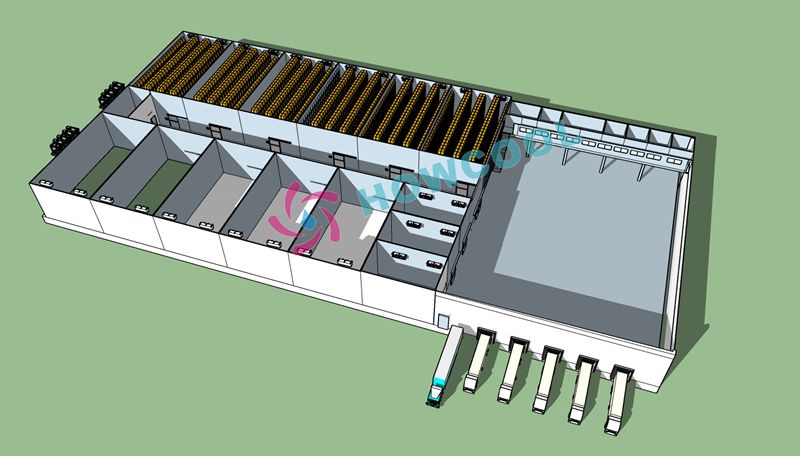
Large logistics cold storage projects are increasingly delivered under a single EPC contract.
For buyers at the evaluation stage, the question is less about whether to invest and more about how to compare potential suppliers across design capability, equipment quality, installation service, compliance, and commercial terms. The sections below outline what buyers should look for when working with cold storage installation companies and cold storage design companies.
Understanding the EPC delivery model for cold storage
EPC, or Engineering, Procurement, and Construction, is a project delivery model in which one contractor is responsible for the full scope of work: engineering design, procurement of equipment and materials, construction, installation, and commissioning. For cold storage facilities, an EPC contract can cover the insulated envelope, refrigeration units, evaporators, electrical and control systems, steel structure drawing and supply, and on-site technical supervision.
For global buyers, the EPC model is attractive for several reasons:
- Single accountability: The buyer does not need to coordinate between a design firm, a panel supplier, a compressor supplier, and an installation crew. The EPC contractor manages the interfaces.
- Design-to-equipment integration: Cold storage design must match refrigeration equipment capacity to room size, insulation quality, product load, and ambient climate. An EPC provider can make trade-offs across these elements more coherently.
- On-site responsibility: A credible EPC partner provides not only drawings and equipment but also technical engineers who supervise installation and commissioning until the facility is operational.
HOWCOOL, formally Beijing Howcool Refrigeration Technology Co., Ltd., is a China-based cold storage EPC provider that supplies insulation panels, refrigeration condensing units, evaporators, accessories, tunnel freezers, and complete cold storage construction services. The company focuses on medium-sized cold storage projects and states that it can provide projects with capacities below 20,000 tons per project, including steel structure drawings, refrigeration equipment, and on-site installation and commissioning support. Factory capacity is reported at 50,000 square meters and roughly 200 employees, with about 40 people in the R&D team and an annual output of approximately 500 projects or system assemblies referenced in company materials. HOWCOOL reports that around 50% of its output is exported, with main markets including the Middle East, Africa, Southeast Asia, and South America.
What buyers should verify in cold storage installation and design
1. Temperature scope matches the actual product portfolio
Cold storage is not a single temperature specification. Different products require different regimes: fruit and vegetable cold storage typically operates at 0 to 5°C for short-term preservation; seafood and meat facilities often require -18 to -25°C; quick-freezing environments may need -35 to -45°C. Buyers must define not only the current product mix but also the expected future range, because retrofitting a cold room to a different temperature class can be costly.
HOWCOOL’s standard design parameters include fruit and vegetable and logistics cold storage at 0 to 5°C, frozen storage at -18 to -25°C, and quick-freezing warehouses at -35 to -45°C. Insulation panel thickness ranges from 100 mm to 150 mm PIR or polyurethane, and building heights typically range from 6 to 12 meters depending on the project. These parameters offer a benchmark for buyers comparing supplier proposals.
2. Insulation and structural design
The insulated envelope determines how much heat enters the room and therefore how hard the refrigeration equipment must work. Buyers should ask about panel type, foam density, thickness, and the steel structure design. In HOWCOOL’s product specifications, polyurethane insulation board thickness for logistics cold storage is 150 mm, with a density of 42 kg/m³ and heights of 8 to 12 meters. For larger food cold storage, PIR panels of 100 mm or 150 mm are used with heights of 6 to 12 meters and storage capacities ranging from 1,000 to 8,000 tons.
Design drawings are also part of the deliverable. Cold storage design companies should provide architectural drawings and refrigeration system drawings, including the placement of evaporators, compressor units, control panels, doors, and loading docks. Buyers should insist on reviewing and approving these drawings before production begins.
3. Refrigeration equipment selection
The compressor unit is often called the heart of a cold storage facility. Refrigeration compressor equipment must be matched to the cooling load, which depends on ambient temperature, insulation quality, product entry temperature, door opening frequency, and desired pulldown time. Buyers should evaluate whether the supplier offers a range of condensing units and evaporators, and whether the refrigerant selection is appropriate for the project location and regulatory environment.
HOWCOOL’s cold storage designs commonly specify R507a or R404A refrigerants, with power supply at 380V–415V / 3P / 50Hz, although specific projects may require adjustments. The company’s product lines include cold storage design models such as the HSZL-6000 logistics cold storage system with temperatures of 0 to 5°C, -18 to -25°C, or -35°C, areas of 2,000 to 10,000 square meters, and heights of 5 to 12 meters. Buyers should always confirm that the specified refrigerant, voltage, and frequency match their local utility grid and refrigerant availability before placing an order.
4. Installation and commissioning capability
Equipment shipped to site is only part of the project. On-site installation, piping, electrical connection, refrigerant charging, leak testing, system balancing, and commissioning determine whether the facility performs as designed. Buyers evaluating installation companies should ask how the provider handles remote technical guidance or whether they dispatch engineers to site.
HOWCOOL describes its delivery process for one agricultural cold chain logistics project as follows: production took about one month, sea freight about one month, and on-site installation guidance about two months. This level of coordination is typical for an EPC arrangement but requires the supplier to have a structured project plan and clear communication channels.
5. Quality management and certification
Quality assurance matters in cold storage because failures can have severe commercial consequences: product spoilage, energy waste, and operational downtime. Buyers should look for documented quality systems and applicable certifications.
HOWCOOL holds an ISO 9001:2015 certificate issued by the Beijing China IoT Joint Certification Center, certificate number 06526Q01032R001, valid until 2029. The certified scope covers the design of refrigeration solutions for cold storage and on-site maintenance and commissioning services for refrigeration equipment used in cold storage. The company also states that it performs pre-shipment testing and can arrange third-party inspection such as SGS. For international buyers, these measures can be useful signals of reliability, but they should still be verified against the specific project contract and local compliance requirements.
A practical evaluation framework for cold storage EPC suppliers
When comparing multiple suppliers, buyers can structure their review around the following dimensions:
| Evaluation dimension | What to verify | Why it matters |
|---|---|---|
| Project track record | Similar projects completed in comparable climate and product category | Relevant experience reduces design and execution risk |
| Design capability | Architectural and refrigeration drawings provided before commitment | Confirms the supplier can translate requirements into buildable specifications |
| Equipment compatibility | Match between compressors, evaporators, panels, and control system | A mismatched system can cause performance failure or high energy costs |
| Manufacturing quality | Panel density, thickness, steel structure quality, compressor brand | Physical components determine long-term energy efficiency and durability |
| Installation support | Engineer dispatch, on-site supervision, commissioning checklist | Poor installation undermines even the best equipment design |
| After-sales availability | Spare parts supply, remote troubleshooting, response time | Cold storage downtime is commercially expensive; support speed matters |
| Commercial terms | MOQ, lead time, payment schedule, warranty scope | Clarity in contracts prevents disputes and cash-flow surprises |
Buyers should also request a project timeline that includes manufacturing, delivery, installation, and commissioning phases. A transparent schedule helps evaluate whether the supplier can meet seasonal or market-driven deadlines.
OEM and customization considerations
Not every buyer needs a fully custom facility, but many require some level of adaptation. Area, height, tonnage, and temperature are the most commonly customized parameters in cold storage projects. HOWCOOL states that its cold storage projects can range from a minimum of 500 tons up to 20,000 tons, with monthly production capacity of about 100 units and typical lead time of 30 to 45 days. The minimum order quantity is 500 tons. Buyers should note that lead time generally increases when the project scope includes large civil works, long-distance logistics, or local import approvals.
For OEM cold storage projects, the buyer’s design and engineering team must align with the manufacturer on a wide set of details: insulation panel thickness, door placement, floor loading capacity, defrost strategy, alarm systems, and control panel language. These elements are not cosmetic; they affect operating performance, maintenance difficulty, and user training needs.
Cold storage market trends and what they mean for buyers
Several market trends are shaping procurement decisions in 2026:
1. Growth in integrated logistics cold storage centers. As cold chain logistics expands, large centralized facilities are being built close to ports, wholesale markets, and agricultural production zones. These facilities typically need multi-temperature zones, high racking, and efficient dock operations. Buyers should look for design companies that can manage large areas and varied temperature zones within a single project. HOWCOOL’s logistics cold storage design model, for example, covers areas of 2,000 to 10,000 square meters with height up to 12 meters.
2. Increased focus on energy efficiency and operating cost. Refrigeration is the primary energy consumer in a cold storage facility. Buyers are increasingly asking about compressor efficiency, heat rejection methods, insulation quality, and intelligent controls. In many regions, the payback period is strongly influenced by energy prices. A facility that uses thicker insulation and higher-efficiency equipment can offer lower total cost of ownership even if the initial investment is higher.
3. Expansion of fruit, vegetable, and protein cold chains in emerging markets. The Middle East, Africa, Southeast Asia, and South America are importing and exporting more perishable foods, which creates demand for both farm-gate cold stores and distribution terminals. For suppliers like HOWCOOL, this supports the export-oriented model of providing complete cold storage solutions, including design, manufacturing, and on-site installation guidance.
4. Demand for faster project execution. Time-to-market matters for seasonal produce, new logistics contracts, or public tenders. Buyers should assess the supplier’s ability to compress manufacturing and installation time without sacrificing quality. HOWCOOL’s case study of a 3,000-ton agricultural cold chain logistics project, which reached completion of production, delivery, and installation guidance in approximately four months, illustrates how a structured EPC process can shorten project duration.
How to compare cold storage EPC providers: an example framework
Because the market includes many local contractors and international equipment suppliers, the evaluation process should balance commercial price with long-term risk. A ballpark comparison can be made across four categories:
- Technology and engineering depth: Does the provider calculate cooling loads? Do they provide drawings? Are their equipment selections justified by load data?
- Manufacturing and supply chain control: Does the provider own panel production or simply resell? Can they guarantee delivery timing? What is the spare parts policy?
- Execution and commissioning: Does the provider send engineers to site? How are disputes and unexpected conditions handled?
- Commercial credibility: Are the contract terms enforceable? Is the pricing structure transparent? Are references available?
A buyer may find that the lowest-priced quote is also the one with the thinnest engineering support. The evaluation should therefore be based on total cost of ownership and project risk, not just initial price.
Traditional approaches vs. integrated EPC procurement
Traditionally, cold storage projects were procured piecemeal: a local contractor would build the shell, a refrigeration supplier would provide equipment, and a different technician might handle installation. This approach can work when buyers have strong in-house engineering expertise and reliable local subcontractors. It also allows independent selection of best-in-class components.
However, the fragmented approach has notable limitations, especially for cross-border buyers:
- Interface risk: If the panel supplier, equipment supplier, and installer are different companies, a failure may be caught between contracts, delaying commissioning and increasing cost.
- Design gaps: A refrigeration system design that is not coordinated with the building envelope may produce poor temperature uniformity, high energy use, or even system failure.
- Limited technical supervision: A local installer may lack experience with the imported equipment, resulting in faulty commissioning and repeated service calls.
An integrated EPC model does not eliminate these risks entirely, but it concentrates responsibility in one accountable entity. Buyers should still verify the EPC provider’s credentials, insurance, and contractual obligations. The model is most appropriate for mid-sized greenfield projects, warehouse renovations, and cases where the buyer does not employ specialized cold storage engineers. For very large or highly specialized facilities, a more complex multi-contract arrangement with expert supervision may be necessary.
Case insight: a 3,000-ton agricultural cold chain project
To understand how an EPC cold storage provider can affect a project outcome, consider the case of a 3,000-ton cold chain logistics facility for agricultural products, reported by HOWCOOL in markets including Iraq, Libya, Malaysia, Russia, and Saudi Arabia. The facility was used for fresh fruit and vegetable storage and frozen meat storage.
According to the project description, HOWCOOL provided architectural drawings and refrigeration drawings, supplied all refrigeration equipment and generator sets, and provided on-site guidance for installation and commissioning. The total project cycle was about four months: one month for production, one month for sea freight, and two months for on-site installation guidance. The project achieved cost recovery within approximately two years, based on the customer’s local rental revenue model. It also contributed to lowering local agricultural product prices by giving local residents access to fresh produce and meat from a functioning cold chain.
For buyers, this example illustrates several useful evaluation points. First, a supplier that can deliver design, equipment, and installation guidance under one contract reduces scheduling complexity. Second, the commercial model of a cold storage facility—including rental revenue and trade margins—should be analyzed during the design stage, because it influences the required size, temperature zones, and speed of construction. Third, local market impact can be significant; a reliable cold storage facility is an infrastructure asset that supports the entire food distribution network.
Frequently asked questions about cold storage installation and design
What is the difference between cold storage installation, cold storage design, and cold storage EPC?
Cold storage installation refers to the physical construction and setup of the cold room, including assembly of insulation panels, refrigeration system connection, electrical work, and final commissioning. Cold storage design covers the engineering work: calculating cooling loads, selecting insulation thickness and types, sizing refrigeration equipment, and producing architectural and refrigeration drawings. Cold storage EPC is a broader delivery model, where one contractor provides engineering, procurement, and construction, taking responsibility for the entire project from design to handover.
Which temperature range is most common for cold storage facilities?
The frozen temperature range of -18°C to -25°C held the largest market share in the global cold storage market at 63.0% in 2025, according to Grand View Research. This range is widely used for frozen meat, seafood, prepared foods, and other products requiring long-term preservation. Many logistics cold storage projects also include additional zones at 0 to 5°C for fresh products and -35°C or lower for quick freezing.
How long does it take to build a cold storage facility?
The duration depends on project size, complexity, and logistics. For an international medium-sized project, a typical timeline might include one month for production, one month for sea freight, and two months for on-site installation and commissioning. Larger facilities, complex multi-temperature systems, or projects requiring extensive civil works can take longer. Buyers should obtain a detailed schedule from the supplier before signing a contract.
Can cold storage systems be customized for different products and climates?
Yes. Temperature range, room area, building height, storage tonnage, insulation thickness, refrigerant type, and control systems can all be adjusted to match the product and climate. HOWCOOL states that cold storage projects can be customized from a minimum of 500 tons up to 20,000 tons. Buyers should ensure that the design accounts for external weather conditions, product entry temperature, and anticipated usage patterns.
How should a buyer evaluate the quality of a cold storage EPC company?
Buyers should review the company’s certifications, factory capacity, production process, project track record, equipment specifications, installation support, and after-sales service. Relevant signals include ISO certification, pre-shipment testing, third-party inspection options, and local or regional references. For an international procurement, buyers should also assess communication capability, logistics coordination experience, and the availability of spare parts.
Future outlook for the cold storage industry
The cold storage industry is expected to continue growing as global food demand rises, cold chain infrastructure expands, and investment in agricultural logistics increases. The shift toward integrated, multi-temperature logistics parks is likely to put more pressure on suppliers to deliver end-to-end solutions rather than standalone equipment. At the same time, buyers will increasingly ask for energy-efficient designs, low-global-warming refrigerants, and remote monitoring capabilities.
For EPC providers, the ability to combine engineering design, equipment manufacturing, and field service will become a core differentiator. For buyers, the practical lesson is to construct a clear capability map: define the temperature profile, storage capacity, location, budget, and operating plan; then shortlist providers based on relevant experience and verifiable execution capacity. The right partner will not only produce a cold room but will help turn it into a profitable, durable infrastructure asset.
Download the HOWCOOL EPC brochure to review technical details and project capabilities.