
Color-Coded Floor Cleaning: Microfiber Mop Formats for Wet and Dry Tasks
Color-Coded Floor Cleaning: Microfiber Mop Formats for Wet and Dry Tasks
A commercial floor program becomes easier to control when each mop pad is chosen by the job it performs — dry soil removal or wet pickup — and then fixed to a zone by color, instead of being bought as one undifferentiated microfiber mop. Five formats in the Foshan Patinda Housewares Co., Ltd. range show how that choice changes with construction: the MP-014 Stripe Mop for color-coded commercial wet and dry pad work, the MP-020 Abrasive Mop for dual-purpose dry and wet cleaning, the MP-006 Tufting Mop for pocket-style dust and wet dual use, plus the MP-015 Twisted Wet Mop and the MT-003 Terry Wet Mop for wet-duty coverage.
Foshan Patinda Housewares Co., Ltd. is a microfiber cleaning products manufacturer established in 2004, operating a 45,000 m² production site in Foshan, Guangdong, with 200 employees and a 17-engineer research and development team. The company reports a 98% export ratio, with main markets including the United States, Canada, Australia, the United Kingdom, Germany, France, Italy, the Netherlands, Russia, Japan, South Korea, Switzerland, Sweden, Türkiye and Saudi Arabia, and its catalogue spans mops, cleaning cloths, kitchen towels, auto-care cloths and mitts, sponges and towels.
This reference sets out the task logic first, then the format evidence, then the verification points a facility manager or distributor should close before switching a site over. It does not rank the five models. Each is a fit decision, and the formats differ in how much specification is available to compare.
Why wet and dry duties pull a mop pad in different directions
Dry work and wet work ask different things of a pad. Dry duty is mostly about collecting loose soil — dust, hair, grit, lint — before it is walked into a floor finish, so the working face needs a pile that traps particles and releases them again in the wash. Wet duty is about liquid handling: pickup, even distribution, and a face that does not simply push a film of water across the floor.
Color-coding sits on top of that logic. Where a site runs a color schedule, the pad becomes the visible record of where it has been: a pad that has worked a washroom floor should never look like a pad cleared for a food-handling area. That control only holds if the color lives on the product in a way that survives laundering, and if the pad chosen for each zone can actually do the zone's dominant task.
Selecting by product category alone tends to produce two failures. One pad type gets pushed across every zone because it is already on the shelf, and the color system ends up living on a wall chart rather than on the mop itself. Task fit plus zone identity is the real selection problem, and both parts belong in the same decision.
The five formats at a glance
The table maps what is documented for each format to the decision it affects. Where a published specification is not available for a model, the last column names what to confirm with the supplier rather than assuming a capability.
| Model | Documented construction | Stated task profile | Confirm before specifying |
|---|---|---|---|
| MP-014 Stripe Mop | Microfiber and nylon blended fabric; striped pile working face; double-pocket back with color-coded classification tag | Color-coded commercial wet and dry floor cleaning pad; rough floor dirt capture | Which weight pairs with which standard size; frame and pocket fit |
| MP-020 Abrasive Mop | Microfiber mop with an abrasive face, per the model designation | Dual-purpose dry and wet cleaning | Which floor finishes tolerate the abrasive face; whether abrasion is on one face or both |
| MP-006 Tufting Mop | Microfiber-cotton blended tufted pile; pocket-style fixing | Dust and wet dual use | Blend ratio; pile height; pocket dimensions against site hardware |
| MP-015 Twisted Wet Mop | Microfiber wet mop with twisted yarn construction | Wet mopping | Attachment interface; pad-only or supplied as a set |
| MT-003 Terry Wet Mop | Microfiber wet mop with terry looped pile | Wet mopping | Pile weight; attachment interface; laundering behaviour |
Two readings of that table matter. Only one of the five formats carries an explicit color-coded classification tag in its published specification, so a color-managed program should either start there or confirm customization on the others before writing a zone schedule around them. And dual-use describes intended task coverage, not a measured equivalence between a dry pass and a wet pass.
MP-014 Stripe Mop: a color tag built into a wet/dry pad
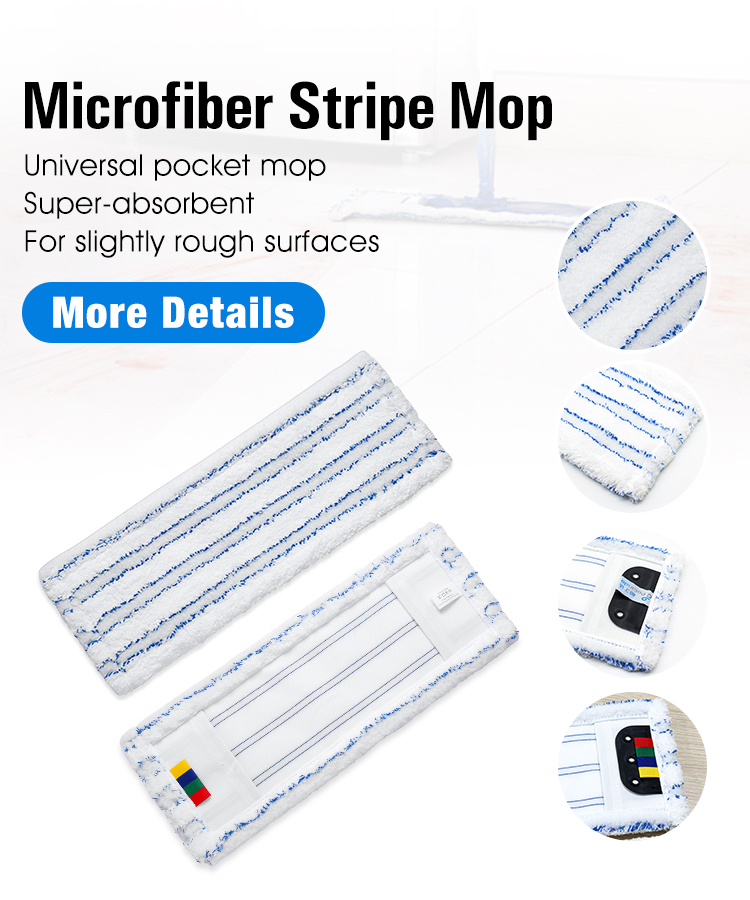
MP-014 Microfiber Stripe Mop: mixed microfiber and nylon striped pile on the working face, double-pocket fixing with a color-coded classification tag on the back.
The MP-014 Stripe Mop is specified as a color-coded commercial wet and dry floor cleaning mop pad built from a microfiber and nylon blended fabric. Its working face uses a mixed microfiber and nylon striped pile, described in the specification for rough floor dirt capture, while the back uses a double-pocket fixing design with a color-coded classification tag.
Documented points for this model:
- Standard sizes of 40 cm and 50 cm, with customizable sizes available; listed single-piece weights of 100 g and 115 g.
- Liquid absorption of up to seven times the pad's own weight.
- Reuse across more than 300 washing cycles.
- Stated floor compatibility: marble, hardwood and ceramic tile, for both dry and wet cleaning.
- Customization of color, woven label, printed logo and assorted packing.
Three of those points change the program rather than the product. The seven-times-own-weight absorption figure is the wet-duty anchor: it describes how much liquid a pass can carry before the pad needs changing, and it is the number to hold next to a site's existing routine when flat-pad equipment replaces an older method. The 300-plus wash cycles give a replacement planning basis that can be tested against the site's own laundering regime — the specification states the cycle count, not the chemistry or temperature at which it was reached, so a laundry trial is the honest way to confirm it locally.
The color-coded tag is the control point for zone discipline. Because the tag is fixed to the pad back, zone identity does not depend on someone remembering which bin a pad came out of, and a pad that has drifted out of its zone is visible on the frame rather than discovered at audit.
The striped pile mixing microfiber with nylon addresses rough floor dirt, where a soft polishing-style face is least useful. Nylon is the harder of the two named fibre components, which is consistent with the model's rough-dirt positioning; it also means the pad warrants a check on finishes that mark easily before it is issued across a whole building.
The two weights deserve attention at sample stage. The specification lists two standard sizes and two single-piece weights without stating which weight belongs to which size, and pad weight affects both how a pad sits on the frame and how much liquid it carries in practice. Confirm the pairing, and confirm frame compatibility, rather than specifying on model name alone.
MP-020 Abrasive Mop: dual-purpose dry and wet cleaning
The MP-020 Microfiber Abrasive Mop is listed as a dual-purpose mop for dry and wet cleaning. The model designation identifies an abrasive construction, which places it in the part of a floor program where soil is attached rather than loose — the traffic lanes, grout lines and textured surfaces where a pad has to work mechanically as well as absorb.
Abrasion is a fit boundary as much as a capability. On high-gloss, freshly coated or soft finishes, an abrasive face is the format that most needs a patch test before it is issued to a zone; on entrance matting and safety flooring, the same characteristic is the reason the format gets specified. The practical instruction is to test on an inconspicuous area of each distinct floor finish in the building, record the result, and attach it to that zone in the written schedule.
Because abrasiveness belongs to the face rather than to the color, keep the abrasive format on its own documented line in the schedule. A color that means gentle wet pickup in one building should not be quietly reassigned to an abrasive pad in the next, or the color stops carrying information. The same caution applies to the dry/wet dual designation: confirm with the supplier whether the abrasive element sits on one face or both before the pad is used on either duty.
MP-006 Tufting Mop: pocket-style dust and wet dual use
The MP-006 Tufting Mop is listed as a microfiber-cotton blended tufting mop with pocket-style fixing, for dust and wet dual use. Tufting describes how the pile is anchored: yarn is tufted into a backing, producing a pile fabric rather than a flat knitted face.
The blended construction is the part that needs care in specification. A microfiber-cotton blend combines two fibre types with different behaviour in laundering, so the questions to settle at sample stage are the blend ratio, the pile height, the pocket dimensions against the site's mop hardware, and how the pad behaves at the wash temperature the site actually uses. Cotton-blended textiles are the ones most worth a shrinkage check before a full pad set is ordered for a laundry that runs hot.
Dust-and-wet dual use makes the model a candidate for zones where one pass has to handle both: corridors, back-of-house routes and staff areas where loose dust and small spills arrive in the same shift. It is not a substitute for a dedicated wet mop where liquid pickup is the dominant task, and it should be trialled on the actual frame before a zone color is attached to it.
MP-015 Twisted and MT-003 Terry: two wet-duty formats
Two further models are documented as wet mops: the MP-015 Microfiber Twisted Wet Mop and the MT-003 Microfiber Terry Wet Mop. Their names describe two different pile conventions. A twisted construction uses twisted yarn, a form long used in wet mopping; a terry construction uses a looped pile surface. Both belong in the part of a zone schedule that handles liquid rather than loose soil — washroom floors, kitchen back-of-house, and spill response.
For both models the available detail is the category and the named construction, so the procurement questions are practical rather than analytical. What does the pad attach to — pocket, clip or clamp? Is the item supplied as a pad only, or as a set with hardware? What does it weigh and measure? And how does the pile behave under the site's wash temperature and detergent?
Where a site is replacing traditional string mops, the comparison that decides the switch is not microfiber versus cotton in the abstract. It is attachment method, liquid capacity, laundering routine and replacement interval. Only laundering and replacement can be settled from a wash-cycle figure when a supplier publishes one; the rest are settled with a sample on the actual frame, in the actual zone.
Turning colors into a working zone schedule
A color-coded program is a written control, not a color preference. The sequence below keeps the pad format and the zone identity in the same document.
- Inventory the floors zone by zone: finish type, dominant soil, and whether liquid arrives on a normal shift.
- Assign one color per zone and record it. The pad tag or the pad color is the control; a chart on a wall is a reminder.
- Match the format to the dominant task in that zone, not to the most frequent complaint about that zone.
- Carry the color into laundry and storage — separate bins by color and a documented wash sequence — or the schedule breaks down between shifts.
- Verify color durability under the site's own laundering regime before the full schedule is issued.
Color conventions vary between facilities, sectors and cleaning contractors, and a supplier's stock colors may not match a site's existing chart. The controlling document is the written site schedule, not an assumed universal mapping. Where custom color is needed, the company lists color, woven label, printed logo, printing, packaging and shipping labels among its OEM/ODM customization options, and the MP-014 specification already includes a color-coded classification tag as a standard feature of the pad back.
Comparing the formats on decision criteria
The five formats are easiest to compare on criteria rather than on claims. Four criteria separate them usefully:
- Dominant soil type. Rough or attached soil points to the MP-020 Abrasive Mop, with a patch test. Loose dust with occasional liquid points to the MP-006 Tufting Mop or the MP-014 Stripe Mop. Liquid-dominant work points to the MP-015 Twisted or MT-003 Terry wet mops.
- Fixing method. The MP-014 uses a double-pocket back; the MP-006 is pocket-style; the two wet mops need their attachment interface confirmed. Fixing determines how quickly a pad can be changed mid-shift.
- Color management. The MP-014 carries a classification tag and lists color as a customization; for the other models, confirm color and label options at quotation stage.
- Documented reuse. The MP-014 carries a stated figure of more than 300 washing cycles. For the others, ask for a cycle figure and the laundering conditions behind it.
That comparison is deliberately limited. No side-by-side soil-removal test data across the five formats is presented here, so this article does not claim that one format cleans better than another. It claims only that each format is specified for a different duty, and that duty should drive the zone assignment.
Market and compliance signals that affect pad selection
Microfiber is defined by fibre fineness rather than by product type: the term refers to fibre measuring below 1.0 denier (Starfiber, Microfiber). That fineness is the technical reason a microfiber face is specified for fine-surface cleaning, and it is also why the word microfiber on a quotation tells a buyer nothing about which mop format to choose.
On the supply side, commercial research published by Fortune Business Insights places multicomponent polyester/polyamide microfiber at 58.0% of revenue share in the microfiber cleaning cloth market in 2025. The practical reading is that blended constructions, not single-polymer ones, are the mainstream specification a buyer will be quoted against — which is consistent with the blended fabrics in the MP-014 and MP-006 specifications.
Compliance is the signal that most directly changes a purchase order. OEKO-TEX updated STANDARD 100 in 2024 to include a total fluorine limit of 100 mg/kg, introduced to address PFAS regulation (OEKO-TEX Association). For mop pads the consequence is version control: request the current certificate, confirm which articles and colorways it covers, and check that the certificate on file is not a superseded edition.
Market sizing should be read as context, not as a plan. Two commercial publishers place the global microfiber cleaning cloth market near USD 1 billion in 2025–2026 and forecast growth of roughly 4.5% a year to the mid-2030s (Future Market Insights; Fortune Business Insights), while a third publishes figures several times larger. The disagreement between publishers is unresolved, so the defensible reading for a facility buyer is directional: a stable, mid-single-digit category rather than a fast-expanding one.
Outlook: documented programs over remembered ones
The direction of travel in commercial floor care is documentation. Color schedules, laundering records and certificate versions are moving into the tender file rather than staying in a supervisor's memory, and pad formats that carry their own zone identity — a tag, a fixed color, a labelled pack — fit that record-keeping better than formats that depend on a chart on the wall.
For the formats discussed here, three things are worth watching. First, whether wet/dry dual-use models continue to absorb the small-spill work that used to justify a second mop on the cart. Second, whether suppliers publish wash-cycle evidence tied to a stated laundering regime rather than a bare cycle count. Third, whether certification documentation keeps pace with chemical-limit updates such as the 2024 total fluorine change. None of these are settled industry facts yet; they are the questions a buyer should put in the next round of supplier review.
What to verify before a program-wide switch
- Frame and pocket compatibility for every pad format under consideration, tested on the site's actual mop hardware.
- Pad weight and dimensions per size — the MP-014 lists 40 cm and 50 cm sizes alongside 100 g and 115 g weights, and the pairing should be confirmed rather than assumed.
- Abrasive compatibility with each distinct floor finish, recorded as a patch-test result in the zone schedule.
- Color durability under the site's wash temperature and detergent, before colors are issued as zone identifiers.
- Wash-cycle evidence matched to the laundering regime the site will actually run.
- Certificate currency and article scope for any chemical-safety certification claimed.
- Supply format — pad only, or set with hardware — for the wet mop models.
- Commercial terms for the specific pad. Company-level OEM/ODM terms list a minimum order quantity of 3,000 pieces and a 30–45 day lead time, with 100% testing and after-sales service; these should be confirmed against the exact model, size and customization before a rollout is planned.
FAQ
What is the difference between a dry mop and a wet mop format?
A dry format is built to trap loose soil — dust, hair, grit — before it is walked into a finish, while a wet format is built for liquid pickup and even distribution. The distinction matters because the working face, pile and fixing differ between the two duties. Several models cover both: the MP-014 Stripe Mop is specified for dry and wet cleaning, the MP-020 Abrasive Mop is listed for dual-purpose dry and wet cleaning, and the MP-006 Tufting Mop is listed for dust and wet dual use.
How should a color-coded mop schedule be assigned across zones?
Assign one color per zone, write the assignment down, and make the color live on the pad itself rather than only on a wall chart. Because color conventions differ between facilities and contractors, the site's own written schedule is the controlling document. The MP-014 Stripe Mop supports this directly through a color-coded classification tag fixed to the pad back, and the company lists color, woven label, printed logo and packaging among its customization options.
Which format suits a zone that has both dust and small spills?
Two models are specified for that combination. The MP-006 Tufting Mop is listed for pocket-style dust and wet dual use in a microfiber-cotton blended tufted pile. The MP-014 Stripe Mop is specified for dry and wet cleaning with a striped microfiber and nylon pile aimed at rough floor dirt. Where liquid pickup dominates the shift rather than occasional spills, the MP-015 Twisted and MT-003 Terry wet mops are the wet-duty formats instead.
How long does a reusable microfiber mop pad last?
The MP-014 Stripe Mop is specified for reuse across more than 300 washing cycles; the specification states the cycle count but not the chemistry or temperature behind it, so a site-specific laundry trial is the reliable check. At category level, Patinda's case summary for reusable microfiber products cites reuse over 6–12 months after repeated washing, a general statement rather than a pad-specific life test. Replacement planning should therefore combine the published cycle figure with the site's own wash frequency.
Can microfiber mop pads be supplied in custom colors with printed labels?
Yes. The MP-014 Stripe Mop lists customizable color, woven label, printed logo and assorted packing, and the company lists size, weight, logo, material, fabric texture, printing, color, accessories, packaging and shipping labels among its OEM/ODM customization options. Company-level terms include a minimum order quantity of 3,000 pieces and a 30–45 day lead time, which should be confirmed against the specific pad and customization requested.
What certification documentation should a buyer request for mop pads?
Request the current certificate rather than a copy of an older edition, confirm which articles and colorways it covers, and verify the certificate with the issuing body. The reason is version drift: OEKO-TEX updated STANDARD 100 in 2024 to include a total fluorine limit of 100 mg/kg to address PFAS regulation, so documentation older than that update may not reflect the current test scope.
The full product catalogue, including mop formats, cloths, towels and auto-care items, is available in the Pa Tin Da 2024 e-catalogue.
Есть вопросы или нужны дополнительные детали?
Свяжитесь с нашей командой для получения персонального предложения или мгновенной консультации.
Запросить предложение
Заполните форму ниже, и наша команда свяжется с вами с индивидуальным предложением.
Прямой чат WhatsApp
Предпочитаете общаться в реальном времени? Напишите нам в WhatsApp для мгновенной помощи и быстрых ответов.
- Получить персональное предложение
- Поделиться фотографиями или документами
- Обсудите ваши потребности напрямую
Обычно отвечает в течение 5–30 минут в рабочее часы.