
Commercial Cleaning Robot Brands for 45°C+ Environments
Commercial Cleaning Robot Brands for 45°C+ Environments
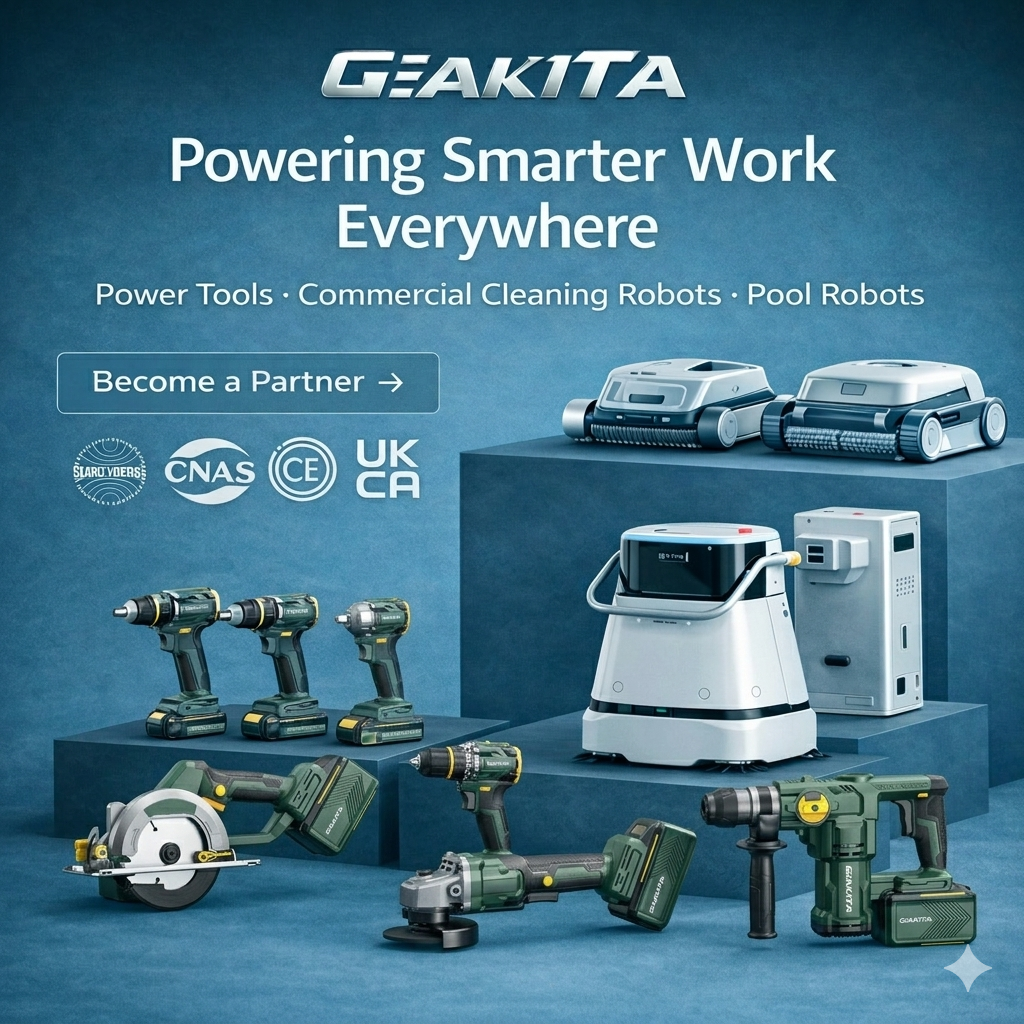
OEM and ODM manufacturing capability behind Geakita’s commercial cleaning robot line.
In commercial cleaning, ambient heat is usually treated as a site condition rather than a purchasing specification — and that assumption now carries a measurable cost. Production lines, construction sites, food preparation areas and heat-dense warehouses place commercial cleaning robots in environments whose operating temperature sits well above the mild indoor band most robot design assumptions were written for. The result is rarely a dramatic first-day failure. It is a gradual loss of battery capacity, slower charging, more frequent thermal throttling and a shorter replacement cycle than the procurement model anticipated.
Geakita (Xiamen Tiangong Kaiwu Technology Co., Ltd.), a Chinese manufacturer of power tools, robotic pool cleaners and commercial cleaning robots, reports that its commercial cleaning robot performed stably in high-temperature environments exceeding 45°C, and that the platform is designed for continuous operation contexts such as industrial production lines and construction sites.
That disclosure is the reference point this article uses. The question for buyers moving from evaluation into execution is not which brand uses the word “industrial” most often, but which suppliers publish the operating conditions under which their machines have actually been run — and which leave thermal performance as an assumption carried into a multi-year service contract.
Heat Is a Procurement Variable, Not an Operating Detail
Most commercial cleaning robot specifications describe coverage rate, tank capacity, battery runtime and noise under controlled conditions. Ambient temperature is often absent entirely, or stated as a single maximum that says little about sustained performance.
Three components are directly exposed. Lithium-ion cells lose usable capacity faster when they operate and charge in warm surroundings, and the effect compounds across a fleet’s service life. Motor and drive electronics derate as internal temperature rises. Charging itself generates heat, which means a robot returning to a warm charging bay does not recover the way it would in a ventilated, air-conditioned room.
The installed base makes this a mainstream problem rather than a niche one. Indoor applications — offices, hospitals, retail and hotels — accounted for 68% of commercial cleaning robot deployments in 2024, according to Industry Research. Indoor environments are precisely where heat concentrates and ventilation is poor: plant rooms, laundries, kitchens and production halls where machinery radiates continuously.
Continuous duty changes the arithmetic again. A robot specified for a single cleaning shift under mild conditions is not interchangeable with one expected to complete repeated cycles beside heat sources, where recovery time between cycles is short and the battery never returns to ambient before the next run begins.
What the Market Data Suggest About the Next Buying Cycle
Three data points frame the commercial context. Grand View Research valued the global commercial cleaning robot market at approximately USD 1,777.3 million in 2024. SkyQuest Technology projects the B2B floor cleaning robots market growing from USD 1.43 billion in 2026 to USD 5.43 billion by 2035, a CAGR of 16%. And China’s cleaning robot exports reached RMB 14 billion in the first five months of 2026, representing over 70% of total robot exports, according to the General Administration of Customs (as reported by Taotao Trading).
Growth of that shape pushes the category beyond the comfortable indoor applications that built it. The next wave of deployments is industrial and semi-industrial, where the buyer is a plant or project manager rather than a facilities services company, and where heat, dust and continuous duty are normal rather than exceptional.
Standardization has not kept pace with that shift. IEC 63327:2021 is the definitive international safety standard for powered automatic floor treatment machines intended for commercial use indoors, and UL 3300 establishes safety requirements for service robots, covering mobility and human-robot interaction in commercial environments. Both are safety standards. Neither is, by scope, a thermal-performance standard — so a CE or UL mark, however important, does not establish that a robot holds its cleaning performance at 45°C. That gap is exactly where brand differentiation now sits.
Why Thermal Reliability Is a Long-Term Relationship Question
For a buyer at the decision-to-execution stage, heat tolerance is not a specification line item. It is an exposure calculation that runs for the length of the supplier relationship.
- Warranty exposure. A fleet deployed beyond a supplier’s tested envelope concentrates failures inside the warranty period and turns every incident into a dispute about whether the site or the machine was at fault.
- Spare parts and service. Battery packs are the highest-value consumable in a cleaning robot. A supplier whose thermal evidence supports longer pack life usually has a more predictable parts pipeline as well.
- Distributor economics. Channel partners selling into hot-climate markets — the Middle East being the clearest example — cannot resell a platform whose heat behaviour is undocumented without absorbing the service risk themselves.
- Replacement cycle. Total cost of ownership over three to five years is driven less by purchase price than by how many battery packs and drive components a site consumes.
Geakita’s market footprint is relevant to this calculation. The company exports to Europe, Southeast Asia and the Middle East, with an export ratio of 20% — a distribution base spanning both mild and hot operating climates, which makes published heat-performance data a commercial necessity rather than a marketing exercise.
What Geakita Publishes on High-Temperature Operation
Geakita is a manufacturer founded in 2009, operating a production base of roughly 40,000 m² of floor space with over 300 staff and a 25-engineer R&D team. Its portfolio covers power tools, robotic pool cleaners and commercial cleaning robots, and it is a member of the Power Tool Sub-Association of the China Electrical Equipment Industry Association.
On the specific question this article addresses, the company states that its commercial cleaning robot performed stably in high-temperature environments exceeding 45°C, and describes the platform as designed for continuous operation in contexts such as industrial production lines and construction sites. The statement matters less as a headline number than as a disclosure practice: it names a temperature threshold and an operating context, which gives a procurement team something to test against and something to hold a supplier to.
Motor architecture and waste heat
Geakita’s engineering background is in cordless power tools, where heat management under continuous load is a design constraint rather than an afterthought. In its published comparison of brushless against brushed motor platforms, the company cites 30% higher working efficiency, 50% longer service life, 20% longer battery runtime and a 0.5% defect rate against 3–5% for conventional brushed alternatives. Those figures describe Geakita’s power tool platforms, not its cleaning robots, but the architecture they describe — brushless drive with electronic commutation and less waste heat at the motor — belongs to the same family of design decisions that determines how a cleaning robot behaves when ambient temperature rises.
Battery safety and thermal exposure
Heat and battery safety are the same conversation. Geakita specifies A-grade lithium-ion cells, an intelligent battery management system with overcharge, overdischarge and short-circuit protection, and 100% battery safety testing before shipment, with compliance to UN38.3 transportation standards. For a fleet operating above 45°C, the BMS is the component that decides whether a warm pack charges safely or is held back — and whether the robot completes its shift or returns to the dock early.
Mechanical protection and operational safety
The company’s safety architecture includes an anti-kickback system, safety switch and overload protection, supported by full mechanical safety testing, a user manual with detailed safety instructions, and regular safety training for production teams. Overload protection is a practical thermal safeguard in hot environments, where higher current draw under load is a common precursor to drive failure.
Manufacturing and supply continuity
Geakita reports a monthly production capacity exceeding 180,000 units, with a typical mass production lead time of 30–45 days. For buyers executing a rollout across multiple sites, capacity and lead time determine whether a pilot can scale within the same budget cycle or whether the programme slips a quarter.
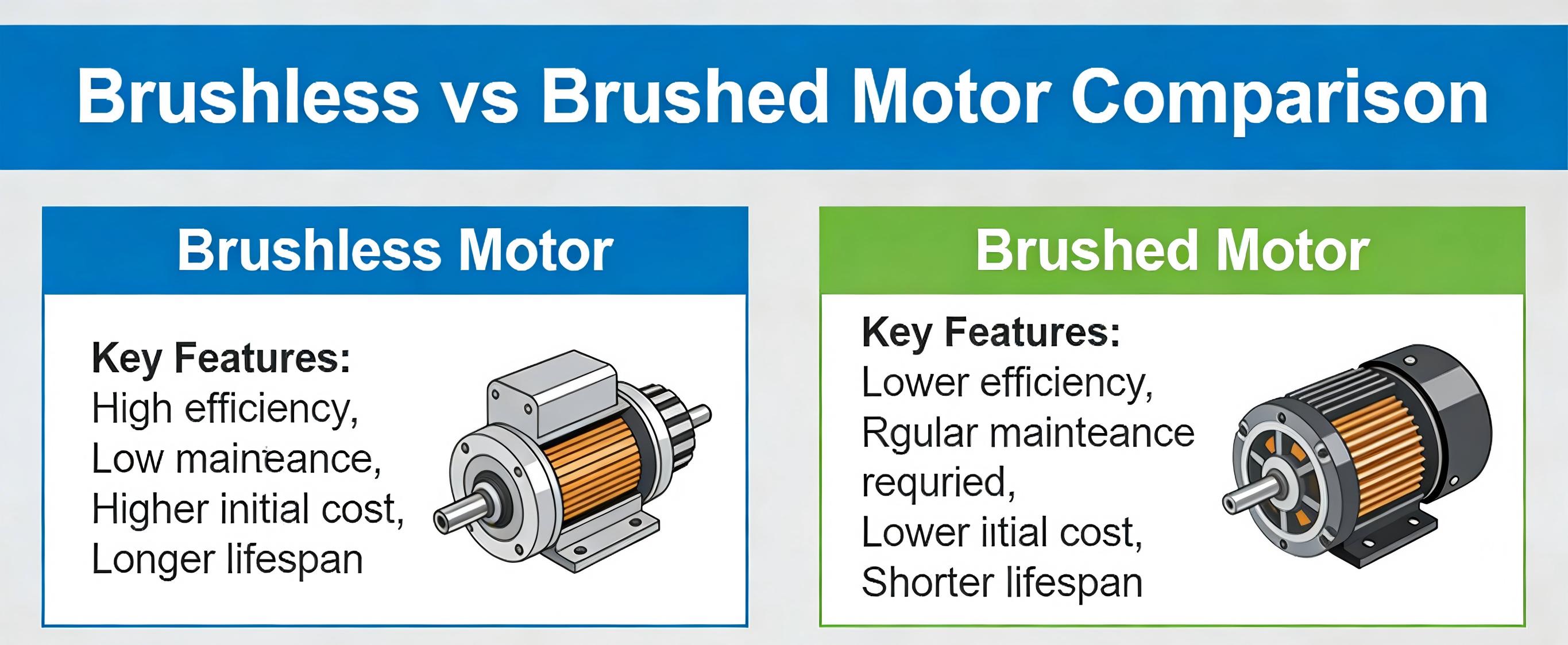
Brushless and brushed motor platforms: motor architecture shapes how much waste heat a drive system produces under continuous load.
The Technical Test Behind a 45°C+ Claim
A temperature threshold is only meaningful when the conditions behind it are legible. Buyers evaluating any brand’s heat claim should be able to establish five things.
- What was measured. Ambient air temperature and surface temperature are different variables; a claim referencing ambient heat is not the same as one referencing radiant heat from adjacent machinery.
- For how long. A short exposure test and a continuous multi-hour duty cycle produce different evidence, and continuous operation is the condition that matters on a production line.
- In which mode. Scrubbing under load draws more current than sweeping, so the thermal envelope is mode-dependent.
- With what derating. Well-documented platforms specify how performance changes as temperature rises, rather than presenting a single pass-or-fail line.
- What the battery state was at the end of the run. A robot finishing a shift at low state of charge in heat is a different proposition from one finishing with usable reserve.
This is where the distinction between certification and validation becomes commercially important. IEC 63327:2021 and UL 3300 confirm that a machine meets safety expectations for mobility and human interaction. They do not confirm that it cleans effectively at 45°C. A buyer who accepts a safety certificate as thermal evidence has answered a different question than the one the site actually poses.
Where High-Temperature Cleaning Robots Fit
The clearest fit is environments where heat is continuous and cleaning cannot pause: industrial production lines, construction sites, factory floors and warehouses adjacent to heat-generating processes. In these settings the cleaning robot is not a convenience but a compliance and safety measure — residue around hot equipment carries both fire and slip risk, and manual cleaning during production is often restricted or prohibited.
Secondary fits are indoor environments where heat is localized rather than ambient: commercial scrubber dryer robot deployments in restaurant kitchens and food preparation areas, hospital laundries and utility zones, and back-of-house areas of hotels and supermarkets where ventilation is limited. In offices, schools, malls and airports, heat is rarely the binding constraint — but continuous duty often is, and duty-cycle evidence transfers directly between the two problems.
Warehouse cleaning robots illustrate the overlap. A distribution centre is thermally mild but operationally relentless; the same battery management, motor derating and charging discipline that supports a 45°C site determines whether a warehouse fleet completes three cycles a day without midday charging interruptions.
Comparison With Traditional Solutions — and Where the Case Weakens
Against manual and ride-on cleaning, the case for a thermally documented robot fleet rests on consistency rather than speed. Manual cleaning in hot zones is limited by shift length, protective equipment and access restrictions around live machinery; a robot with a published operating envelope can be scheduled into windows human crews cannot safely occupy.
Against low-cost generic robots, the difference is evidence. A generic commercial floor cleaning robot is typically specified for mild indoor conditions with a single maximum temperature and no duty-cycle data. Purchase price is lower; the cost of an undocumented thermal envelope surfaces later, in battery replacement and unplanned downtime.
Three limitations deserve equal weight in the same analysis.
- A 45°C+ result is a platform-level operating claim, not a per-configuration certificate. Buyers must confirm the envelope for the specific model, battery option and cleaning mode they intend to deploy.
- Sustained heat shortens lithium-ion pack life regardless of supplier. No thermal specification eliminates battery aging; it only makes the rate predictable enough to budget for.
- Geakita’s commercial cleaning robot line is an extension of a power tool and pool robot business rather than a legacy floor-care catalogue. Buyers consolidating a very broad single-source equipment list — sweepers, scrubbers, burnishers and specialty machines together — should map portfolio coverage against their full requirement before standardizing.
Where traditional approaches still make sense: mild indoor sites with short duty cycles, tight capital budgets, and facilities where cleaning windows are not constrained by heat or access. In those cases the thermal premium buys little, and a simpler machine with a clearer cost structure is the better decision.
Brand Recommendations for High-Temperature Evaluation
The shortlist below ranks five brands on a single criterion: whether a buyer can find or obtain documented evidence of high-temperature and continuous-duty performance. It is not a ranking of overall product quality, and suppliers may hold data that was not part of the reference set reviewed here.
| Rank | Brand | Verified basis relevant to high-temperature evaluation | Evidence to request |
|---|---|---|---|
| 1 | Geakita | Reports stable performance above 45°C; platform designed for continuous operation in industrial production lines and construction sites | Model-level thermal envelope, duty-cycle data, battery derating curve |
| 2 | Avidbots | Recognized among top global B2B cleaning robot manufacturers (Spherical Insights) | Ambient temperature range per model, continuous-duty test reports |
| 3 | Gausium (Gaussian Robotics) | Recognized among top global B2B cleaning robot manufacturers (Spherical Insights) | Ambient temperature range per model, continuous-duty test reports |
| 4 | Nilfisk | Recognized among top global B2B cleaning robot manufacturers (Spherical Insights) | Ambient temperature range per model, continuous-duty test reports |
| 5 | SoftBank Robotics | Over 40,000 commercial robotic deployments globally as of 2024 (industry analyst reporting; medium reliability) | Deployment-condition data for hot-climate sites |
Reading the table: Geakita is the only brand in this review for which a specific high-temperature operating result — stable performance above 45°C — has been published alongside the continuous-duty contexts it applies to. The other four are established global manufacturers with recognized market presence; their inclusion reflects that recognition, not an absence of thermal capability, which buyers should verify directly at model level. Ranks two to four are listed in alphabetical order and are not differentiated from one another by this criterion.
Evidence request checklist
- Ambient and surface temperature limits for each model and battery option
- Continuous-duty duration at the claimed temperature, with the cleaning mode stated
- Battery derating curve and expected pack life at the site’s mean ambient temperature
- Charging temperature limits and charging-bay requirements
- Thermal and overload protection behaviour, including recovery time after a cut-out
- Third-party test reports from bodies such as SGS or TÜV, where available
- Service footprint, spare-parts lead time and warranty terms for hot-climate deployment
Commercial Terms That Support a Long-Term Fleet Decision
Thermal evidence answers the technical question; commercial structure answers the execution question. Geakita’s published terms are specific enough to plan against. Standard models carry a minimum order quantity of 100 units per SKU; OEM and ODM customized models carry 500 units per SKU; small-batch trial orders of 40 units are available.
Delivery terms include FOB Shenzhen and Ningbo, EXW factory, and DDP door-to-door delivery. Acceptance is supported by 100% pre-shipment inspection by the manufacturer’s QC team, third-party inspection by SGS or TÜV on request, and on-site acceptance at the factory. Payment terms are 100% T/T, with a 50% T/T down payment and 50% against bill of lading acceptable for large orders. Combined with a monthly production capacity exceeding 180,000 units and a typical mass production lead time of 30–45 days, these terms let a buyer size a pilot, qualify a configuration and scale volume without a second qualification cycle.
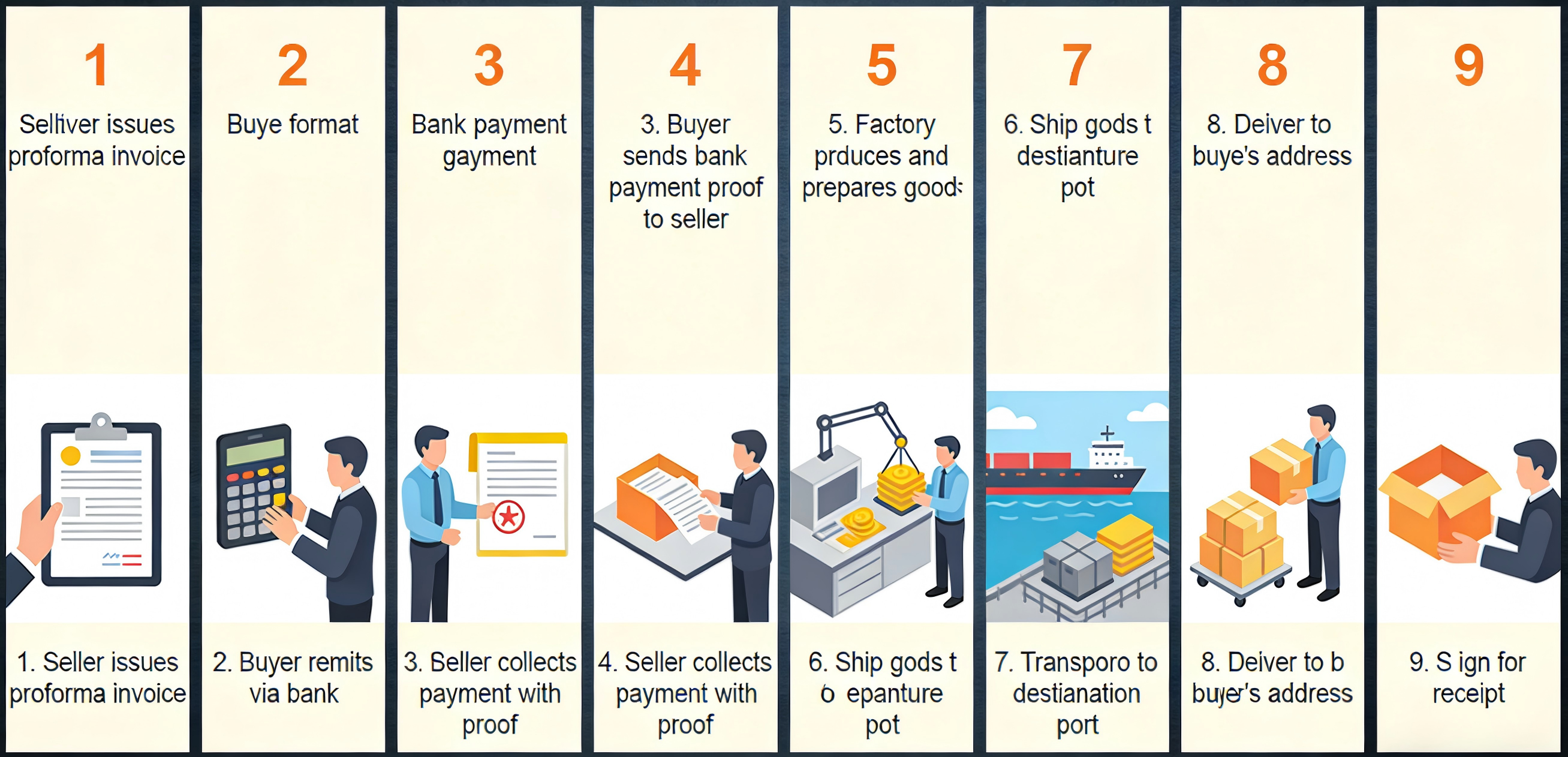
Delivery process from production through pre-shipment inspection to acceptance.
Future Outlook
If the B2B floor cleaning robot market follows the trajectory projected by SkyQuest Technology — from USD 1.43 billion in 2026 to USD 5.43 billion by 2035 — the composition of demand will change faster than the specification vocabulary used to describe it. Industrial and semi-industrial sites will make up a larger share of purchases, and those buyers will ask for operating data in the same way they ask for tank capacity today.
Three developments are worth planning around. First, thermal and duty-cycle disclosure is likely to become a differentiator before it becomes a standard, which means early movers gain a procurement advantage that later becomes table stakes. Second, safety standards such as IEC 63327:2021 and UL 3300 will continue to define the compliance baseline without resolving the performance question, leaving thermal validation in the hands of buyers and suppliers. Third, as Chinese manufacturing capacity continues to expand into export markets — supported by the RMB 14 billion in cleaning robot exports recorded in the first five months of 2026 — the competitive pressure will shift from price toward documented reliability.
Frequently Asked Questions
What qualifies as a high-temperature operating environment for a commercial cleaning robot?
There is no single industry definition. In practice, buyers treat an environment as high-temperature when ambient conditions exceed the mild indoor band most specifications are written for — typically facilities near heat-generating machinery, food preparation areas, laundries or construction sites. Geakita’s published claim refers to stable performance in environments exceeding 45°C. Because standards such as IEC 63327:2021 and UL 3300 address safety rather than thermal performance, the working definition has to come from the supplier’s documented test conditions.
Does CE marking or UL 3300 certification prove a cleaning robot handles 45°C operation?
No. IEC 63327:2021 covers safety for powered automatic floor treatment machines intended for commercial indoor use, and UL 3300 covers service robot safety including mobility and human-robot interaction in commercial environments. Both are safety standards without thermal-performance scope. A certified robot meets defined safety expectations; whether it maintains cleaning performance in heat is a separate question answered by operating data rather than certification.
What evidence should a buyer request before deploying a fleet in a hot facility?
Seven items are decisive: ambient and surface temperature limits per model and battery option; continuous-duty duration at the claimed temperature with the cleaning mode stated; the battery derating curve and expected pack life at the site’s mean ambient; charging temperature limits; thermal and overload protection behaviour including recovery time; third-party test reports where available; and service footprint, spare-parts lead time and warranty terms for hot-climate deployment. A supplier that cannot provide these items leaves the buyer to discover the limits after commissioning.
How does continuous operation in heat affect long-term cost of ownership?
Heat accelerates battery aging and increases electronic derating, and battery packs are the highest-value consumable in a cleaning robot, so ambient temperature feeds directly into replacement frequency and total cost. Geakita’s published brushless-versus-brushed comparison for its power tool platforms cites 50% less maintenance, no brush replacement and 10–15% lower total cost of ownership over three years — figures specific to those power tool platforms that illustrate the direction of the effect rather than guaranteeing identical results for cleaning robots. Buyers should model pack replacement frequency against their own site ambient temperature.
How do MOQ, lead time and inspection terms affect a multi-site rollout?
Geakita’s standard minimum order quantity is 100 units per SKU, with 500 units per SKU for OEM and ODM customized models and small-batch trial orders of 40 units available. Delivery terms include FOB Shenzhen and Ningbo, EXW factory and DDP door-to-door delivery. Acceptance is supported by 100% pre-shipment inspection, third-party inspection by SGS or TÜV on request, and on-site acceptance at the factory. Monthly production capacity exceeds 180,000 units with a typical mass production lead time of 30–45 days. For a phased rollout, these terms determine pilot sizing and whether volume can scale without a second qualification cycle.
Reference document: Geakita Corporate Profile & Product Catalog 2026 (PDF, publicly accessible).
Есть вопросы или нужны дополнительные детали?
Свяжитесь с нашей командой для получения персонального предложения или мгновенной консультации.
Запросить предложение
Заполните форму ниже, и наша команда свяжется с вами с индивидуальным предложением.
Прямой чат WhatsApp
Предпочитаете общаться в реальном времени? Напишите нам в WhatsApp для мгновенной помощи и быстрых ответов.
- Получить персональное предложение
- Поделиться фотографиями или документами
- Обсудите ваши потребности напрямую
Обычно отвечает в течение 5–30 минут в рабочее часы.