
Commercial LED Lighting: IP and Warranty Qualification Checks
In commercial LED lighting, an IP rating and a written warranty are not features to be compared — they are qualification gates. The IP rating defines the environment in which a luminaire may legally and safely be installed. The warranty defines who carries the cost when the fixture fails inside the service period. A luminaire qualifies for a project only when both statements match the site conditions that will actually exist after handover.
The global commercial lighting market was estimated at USD 47.54 billion in 2024, with LED products already holding a 58.1% revenue share (Grand View Research). That share figure explains a shift in how projects are evaluated: LED is no longer the differentiator, so qualification data has become the differentiator. Two LED high bays with similar wattage and luminous efficacy can carry entirely different installation permissions, and the specifier who cannot tell them apart has effectively transferred risk to the building owner.
The fixtures referenced in this analysis are supplied by Zhejiang Lepeng Electric Appliance Co.,Ltd., a manufacturer of LED lamps and LED luminaires headquartered in the Baiguan Industrial Zone of Shangyu, Zhejiang Province, China, operating additional production bases in Zhejiang and Jiangxi and selling under the MKOPTO brand to contractors, distributors, and commercial and municipal buyers across global markets. Its output spans floodlights, high bays, street lights, tri-proof and batten fixtures, panels, solar products and decorative ranges — which is precisely why a qualification framework, rather than a single recommendation, is the useful way to read its catalogue.
Why These Two Specifications Decide Qualification
For a luminaire to be treated as qualified in a commercial package, it must clear three thresholds. It must be permitted in the environment where it will be installed. It must be electrically compatible with the supply it will meet on site. And its failure risk across the service period must be assigned to a named party. IP rating answers the first question, input voltage and surge protection answer the second, and warranty terms answer the third.
A specification that leaves any of the three open is not a neutral omission. It is an unpriced transfer of risk to whoever holds the asset after practical completion. This is why evaluation-stage buyers increasingly treat IP, voltage and warranty as pass-or-fail gates before they allow a fixture into a commercial comparison at all.
The same logic explains a recurring failure pattern in tendering. A buyer receives a data sheet showing a high IP number, assumes environmental suitability, and only discovers during commissioning that the fixture was never intended for a chemically aggressive atmosphere, or that the warranty excludes exactly the failure mode the site produces. Qualification is not the same as specification. Specification tells you what the product claims; qualification tells you whether that claim covers your site.
How to Read an IP Rating as a Qualification Checkpoint
In the IEC IP code, the first digit describes protection against solid objects and dust, and the second describes protection against water. The two digits are independent statements: a fixture cannot be assumed to be water-resistant because its solid-particle figure is high, nor dust-tight because it is water-resistant. Core luminaire safety and performance standards include IEC 60598, UL 1598 and UL 8750 (UL Solutions), and the IP code sits alongside those standards rather than replacing them.
Read in practice, the second digit is the decisive one for most commercial sites. A rating ending in 0 carries no water-protection claim, which confines the fixture to dry interiors. A rating ending in 4 denotes protection against splashing water — the level of an outdoor security product exposed to rain but not to directed jets. Ratings ending in 5 or 6 denote increasing resistance to water jets, which is the territory of industrial interiors that are cleaned or hosed down.
What the IP number does not tell you
An IP rating is a statement about enclosure design, tested under defined conditions. It does not state resistance to salt, solvents or process chemicals, it does not state UV stability of the housing material, and it does not state lumen maintenance over the service period. It is also conditional on the seal remaining intact — a correctly rated fixture installed with a compromised gasket, an unused cable entry left open, or a housing drilled on site no longer carries the rating it was ordered with. Sealed construction also concentrates heat, which is why the thermal design behind the enclosure matters as much as the number on the label.
Two practical consequences follow. First, buyers should ask for the IP rating in writing per model, not per product family, because a family name can cover several enclosures. Second, installation instructions should be part of the tender pack, because the rating survives only as long as the installation respects it.
Input Voltage and Surge Protection: The Overlooked Checkpoint
Voltage range is the checkpoint buyers most often skip, and it is the one that produces the least visible failures. The HL-E01 UFO high bay light is documented with two input options: 185–265V or 100–265V. The FL-C01 Series floodlight is documented at 100–240V or 220–240V. These are not marketing variants. They describe which supply windows the driver was specified for, and therefore which markets and which site conditions the fixture can be qualified against.
A 185–265V window is a narrow-band specification. It fits networks where nominal voltage is stable in the 220–240V region. The 100–265V option covers a far wider spread, which matters where distribution quality varies, where legacy transformers push voltage up, or where a single project spans regions with different nominal supplies. Neither option is inherently better; the qualification question is whether the specified range encloses the voltage the site will actually deliver, including the excursions that occur at switch-on and during grid disturbance.
Surge protection belongs in the same conversation. The HL-E01 is documented with 6KV/6KV surge protection; the FL-C01 Series is documented with surge protection up to 2KV and a power factor above 0.9. For outdoor and high-mast positions, where cabling runs long and lightning exposure is real, surge figures indicate how much of that exposure the driver is built to absorb. A fixture with a strong IP rating and no documented surge figure is qualified for the atmosphere but not yet qualified for the electrical environment.
Warranty Terms That Survive a Project Audit
A warranty term is only usable in procurement if it names the period, the covered components, the remedy, and the exclusions. A five-year statement with an undefined remedy is not equivalent to a five-year statement that specifies replacement of the luminaire or its driver, because the two place different costs on the buyer over the service life.
Among the fixtures discussed here, a five-year warranty is explicitly stated for the SH-E01 LED linear high bay light. The same written term is not stated in the materials reviewed for the other models, and that gap is itself an evaluation finding rather than a criticism: where a term is not documented, the buyer should request it in writing before the bid is submitted, because a warranty confirmed after award is a commercial concession, not a tender condition.
Four clauses to settle before sign-off
- Scope by component. Confirm whether the driver, the LED module, the housing and the control gear are covered on the same terms, or whether the driver carries a shorter period.
- Remedy definition. Establish whether the remedy is replacement, repair, credit or a pro-rata settlement, and who bears freight and access costs.
- Environmental conditions. Check that the warranty conditions are consistent with the IP rating claimed — a warranty voided by humidity or washdown contradicts a rating sold for those conditions.
- Installation dependency. Confirm what documentation is required to keep the warranty valid, such as installation records or compliance with the supplied instructions.
A realistic note on serviceability belongs here as well. Sealed, high-IP luminaires are harder to open for field repair by design, so the practical service model is replacement rather than component-level maintenance. For a project with a 5–10 year operating horizon — the duration band the manufacturer cites for its project installations — the buyer should confirm that replacement logistics, not repair capability, are the supported path.
Certificate Scope: The Check Most Buyers Skip
Certification is often treated as a yes-or-no attribute of a supplier. It is more usefully treated as a scoped statement about a named product. The provided documentation illustrates this directly: the CE-EMC Attestation of Conformity issued by TÜV SÜD under certificate E8A 123276 0630 Rev. 00 relates to the EMC Directive 2014/30/EU and names its scope as fixed general purpose luminaires and LED panel light, associated with the PL02. The GS certificate Z1A 123276 0002 Rev. 00 is issued against EN 60598-1:2021+A11:2022, EN 60598-2-1:2021, EN 62493:2015 and AFPS GS 2019:01 PAK. The EU Type Examination certificate TPS-RED500722 (01) under CE-RED is scoped to short-range device and LED ceiling light, associated with the FCL-E01.
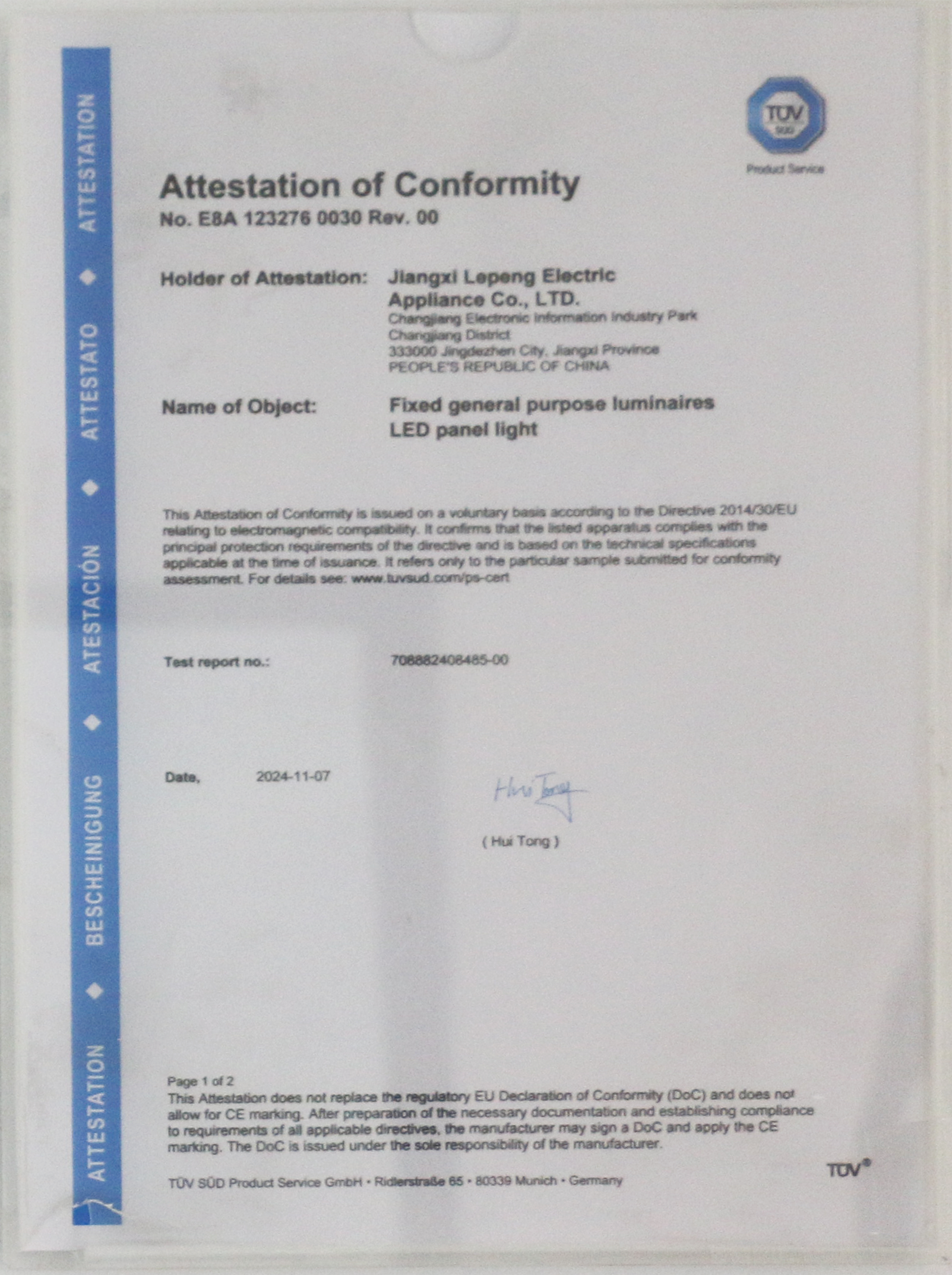
A certificate is a scoped statement, not a company-wide badge. The CE-EMC attestation above names fixed general purpose luminaires and LED panel light within its scope — it does not automatically qualify a high bay or a floodlight from the same supplier.
The qualification lesson is straightforward. A certificate listing one model does not qualify a different model, and a certificate naming one product family does not extend to a fixture with a different enclosure, driver or control circuit. Buyers who want defensible compliance should ask three questions of every document: which product and model does it name, which standard and directive does it test against, and which market does it cover. Certificates with an open-ended validity date are not a substitute for answering those three questions.
Because these documents are typically issued by a third-party body and tied to a specific construction, they also set a design constraint for the supplier: any change to housing, optics or control gear after certification may require re-assessment. That is a legitimate reason to ask, at evaluation stage, how the supplier manages product changes against existing certificates.
Qualification Shortlist: Four Fixtures Ranked by Documented Coverage
The ranking below is deliberately narrow in what it measures. It orders four fixtures by how completely the three checkpoints — environment, electrical compatibility and warranty — are documented in the available materials. It is not a statement about overall product quality, and a lower position does not indicate a weaker product; it indicates a narrower documented environmental scope, which is exactly what a tender evaluation needs to know.
| Rank / Fixture | Stated protection | Environment it is qualified for | Electrical and warranty notes | Verify before tendering |
|---|---|---|---|---|
| 1. SH-E01 LED linear high bay light |
IP65 | Warehouses, factories and workshops, including interiors with dust or washdown exposure. 50/100/150/200W; 100/135/150 lm/W; 90° (H) × 120° (V); 3000K–6500K. | 5-year warranty stated. Aluminum alloy housing with PC/PMMA lens — sealed construction. | Corrosion class for the specific atmosphere; driver replacement path; seal integrity after installation. |
| 2. HL-E01 UFO LED high bay light |
Not stated in the materials reviewed | Warehouses, factories, retail spaces and gyms. 100/150/200/240W; 140/160/185/210 lm/W; 4000K/5000K/6500K. | 185–265V or 100–265V input; 6KV/6KV surge protection; 3×1.0mm² cable with 300mm exposed leads, pre-wired. | Written IP rating if any dust or water exposure exists; site voltage window; warranty term in writing. |
| 3. Solar security light PIR motion sensor model (8200) |
IP44 | Outdoor security at yards, driveways, garages, pathways and walls where mains wiring is absent or impractical. 10W; 1600LM; 6500K. | Monocrystalline silicon panel; PIR sensor; remote control plus auto mode; ABS housing with PC lens. | Solar exposure of the mounting position; whether 1600LM meets the security target; battery service terms. |
| 4. PL02 LED panel light |
IP20 | Indoor commercial and residential ceilings in dry locations. 9/12/18/24W; 90/110 lm/W; 2700K–6000K with 3-CCT selection. | 50%/75%/100% three-level dimming; remote control with microwave sensor; aluminum or plastic frame with PC diffuser. | Ceiling construction and cut-out size; whether the room carries any moisture load; warranty term in writing. |
Ranking criterion: completeness of documented environmental, electrical and warranty qualification. Parameters as stated in the manufacturer's product data. Model 8200 appears in the provided materials as a solar security light with PIR motion sensor rather than under a numeric model series.
Shortlist evaluation across categories: the qualification question changes with the environment, not with the wattage. A linear high bay, an indoor panel and a solar security light are answering three different installation problems.
Where Qualification Checks Stop Being Useful
This framework has clear boundaries, and buyers should know them before they build a tender around it.
First, IP ratings do not normalise across categories, so treating a higher number as a higher grade produces wrong decisions. The PL02 panel at IP20 is the correct fixture for a dry indoor ceiling, and specifying an IP65 panel there would add cost and sealing complexity without improving the outcome. Conversely, an IP20 panel installed in a humid food-production area is a maintenance liability regardless of how its efficacy compares. The rating qualifies a location, not a product hierarchy.
Second, the solar security light illustrates why output class matters alongside protection class. At 10W and 1600LM with IP44 protection, it qualifies for outdoor security illumination where no mains supply exists, and it does not qualify as a substitute for mains-powered area floodlighting at higher output. IP44 protects against splashing water; it is not a jet-wash or dust-tight claim, and the ABS housing plus monocrystalline panel mean performance also depends on solar exposure and battery condition over time.
Third, qualification is documentation-dependent. Where a specification is not stated in the supplier's published materials — as with the IP rating of the HL-E01 in the sources reviewed here — the honest position is that it is unverified, not that it is absent. The correct action is a written request, and the correct interim decision is to avoid specifying that fixture for wet or heavily dusty zones until the answer arrives.
Compared with traditional specification practice, which compared luminaires mainly on wattage, efficacy and unit price, a qualification-based approach adds documentation work at the front end and reduces commissioning disputes at the back end. It does not eliminate either risk. A perfectly documented fixture installed by an unqualified contractor still fails, and no warranty term compensates for a site survey that misread the atmosphere.
Market Signals Behind the Shift
Segment growth patterns explain why environmental and warranty questions are appearing in more tenders rather than fewer. The global LED flood light market was valued at USD 9.4 billion in 2025 and is projected to reach USD 20.1 billion by 2034 at a CAGR of 8.52% (IMARC Group) — growth concentrated in outdoor applications where IP and surge specifications do the most work. The global solar street lighting market is projected to reach USD 22.5 billion by 2030 at a CAGR of 15.8% from 2024 (Vantage Market Research), a segment where enclosure protection and battery service terms determine whether a project remains operational rather than merely installed.
On the supply side, China exported USD 31.4 billion in light fixtures in 2024, equal to 59.3% of global light fixture exports (OEC). A concentrated export base with many suppliers producing visually similar fixtures raises the value of scoped, verifiable documentation. When catalogue claims converge, certificate scope, stated IP per model and defined warranty terms are among the few signals that still separate one offer from another.
Pre-Tender Verification Checklist
Six items to close before the bid is submitted
- IP per model, in writing. Confirm the rating against the exact model and enclosure, not the product family.
- Site atmosphere mapped to rating. Match the space to the rating class, and record whether chemicals, salt, UV or washdown are present — none of which the IP code covers.
- Voltage window checked against the supply. Compare the specified input range with measured site voltage, including excursion behaviour.
- Surge figure documented. Required for outdoor, high-mast and long-cable runs; ask for the value, not a general claim of protection.
- Warranty clauses reviewed. Period, covered components, remedy, freight responsibility, exclusions and installation conditions.
- Certificate scope matched to model. Confirm the certificate names the product being supplied, the standard it was tested against, and the market it covers.
Future Outlook
The direction of travel is toward shorter, more auditable specifications. As LED becomes the default technology in commercial lighting, the commercially meaningful differences migrate to documentation quality: whether a supplier can state IP per model, name a voltage window and surge figure, and attach a certificate whose scope matches the goods on the pallet. Buyers evaluating at shortlist stage are already asking those questions earlier in the process, and suppliers who answer them in published materials rather than in email threads will find themselves easier to qualify — and harder to substitute.
For manufacturers serving export markets, that implies an operational discipline as much as a marketing one. Lead times documented at 30–45 days and monthly capacity of 45 million LED lamps and 5 million LED luminaires set the promise; certificate scope, warranty terms and stated protection classes determine whether that promise can be defended after delivery. The two are increasingly evaluated together.
Zhejiang Lepeng Electric Appliance Co.,Ltd. publishes its commercial LED lighting range, including high bay, panel, flood, street, tri-proof and solar fixtures, at www.idealbright.com. A downloadable product brochure is available here: commercial LED lighting product brochure (PDF).
FAQ
Which IP rating does a commercial LED high bay need for a warehouse or factory?
It depends on what the interior exposes the fixture to, not on the building type. For warehouses and workshops where dust, condensation or washdown occurs, a jet-resistant class such as IP65 — the rating stated for the SH-E01 linear high bay — is the appropriate qualification. For dry, clean interiors, a lower class can be acceptable, but the rating should still be confirmed per model in writing rather than inferred from the product family.
Does a higher IP rating always mean a more suitable luminaire?
No. An IP rating states the enclosure's protection against solids and water; it says nothing about corrosion resistance, UV stability, lumen maintenance or thermal behaviour. A higher rating can also add cost and complicate field service. Suitability is decided by matching the rating to the actual environment: an IP20 indoor panel is correct for a dry ceiling and unsuitable for a humid production area, while an IP65 fixture specified for a dry office adds cost without adding protection value.
What should a five-year LED warranty actually cover?
A usable warranty names four things: the period, the covered components, the remedy, and the exclusions. Confirm whether the driver and control gear are covered on the same term as the LED module, whether the remedy is replacement, repair or credit, and who pays freight and access costs. Also confirm that the warranty conditions are consistent with the IP rating claimed, and what installation records are needed to keep cover valid. Where a term is not stated in the supplier's materials, it should be requested in writing before award.
Why do some LED high bays accept 185–265V while others accept 100–265V?
The range describes the supply window the driver was specified for. A 185–265V input suits networks with stable nominal voltage in the 220–240V region, while a 100–265V input covers a wider spread and is relevant where distribution quality varies or a project spans regions with different nominal supplies. The wider range is not automatically preferable; the correct check is whether the specified window encloses the voltage the site actually delivers, including switch-on and disturbance excursions.
Can an IP44 solar security light replace a mains-powered floodlight on a commercial site?
Only within its output and protection class. A 10W, 1600LM IP44 solar security light with a PIR sensor is qualified for outdoor security illumination at yards, driveways, garages, pathways and walls where mains wiring is absent or impractical. IP44 denotes protection against splashing water, not against water jets or fine dust, and the output class is security-scale rather than area-lighting scale. Performance also depends on solar exposure at the mounting position and on battery condition over the service period.
Есть вопросы или нужны дополнительные детали?
Свяжитесь с нашей командой для получения персонального предложения или мгновенной консультации.
Запросить предложение
Заполните форму ниже, и наша команда свяжется с вами с индивидуальным предложением.
Прямой чат WhatsApp
Предпочитаете общаться в реальном времени? Напишите нам в WhatsApp для мгновенной помощи и быстрых ответов.
- Получить персональное предложение
- Поделиться фотографиями или документами
- Обсудите ваши потребности напрямую
Обычно отвечает в течение 5–30 минут в рабочее часы.