
Commercial Microfiber Mop Pads: A Shortlist for Floor Programs
Within the broader Household Microfiber Cleaning Products category, mop pads form the floor-cleaning subset that translates most directly into commercial floor programs. A commercial building rarely benefits from a single pad. Healthcare corridors, foodservice back-of-house areas, retail sales floors and industrial zones each place different demands on absorbency, soil removal and surface safety. Grouping a pad shortlist by fabric construction and intended use case — rather than by price tier — gives procurement teams a clearer decision path than a model-by-model catalog review.
The five models reviewed here — MP-014 Microfiber Stripe Mop, MP-015 Microfiber Twisted Wet Mop, MP-006 Microfiber-Cotton Blended Tufting Mop, MT-003 Microfiber Terry Wet Mop and MP-020 Microfiber Abrasive Mop — each answer a different floor program question: which floor, which soil load, which color-coded zone, and which refill format the buyer can standardize around.
Why “One Pad Fits All” Breaks Down in Commercial Programs
Commercial cleaning has moved past the era when a single string mop and bucket served an entire building. Color-coded cleaning systems — widely adopted in healthcare, foodservice and facility management — assign specific colors to specific zones to reduce cross-contamination. That system only works when the mop pads themselves are available in the required color range and format.
At the same time, the soil profile of a commercial floor varies more than most buyers expect. A hospital corridor sees body fluids, disinfectant residue and dust. A foodservice kitchen sees grease, oil and food particulate. A retail sales floor sees dust, cart tire marks and light spills. A factory floor sees metal shavings, coolant and heavy particulate. Applying the same pad to all four situations either wastes absorbency on light zones or leaves soil behind on heavy zones.
The opportunity for a well-structured pad shortlist is straightforward: fewer pad types per building, clearer zone discipline, longer pad life, and a lower cost per square meter cleaned. The rest of this shortlist translates that opportunity into a concrete five-model set.
Where the Commercial Microfiber Pad Market Sits in 2026
Three commercial research publishers tracked in 2026 place the global microfiber cleaning cloth market at roughly USD 1.0–1.5 billion, with a compound annual growth rate near 4.5%. Future Market Insights projects growth from USD 979.2 million in 2025 to USD 1,520.7 million by 2035 at 4.5% CAGR (SRC-0012); Fortune Business Insights projects USD 1.04 billion in 2026 to USD 1.49 billion by 2034 at 4.57% CAGR (SRC-0010); Spherical Insights projects USD 1,533.7 million by 2035 at 4.6% CAGR (SRC-0009). One additional source (Dataintelo) reports values roughly three to four times larger at a 24% CAGR; that figure is treated as an outlier and is not used in this analysis.
The steady single-digit growth profile matters for buyers because it points to a stable, maturing category rather than a rapidly inflating one. Procurement teams are not competing for scarce supply; they are selecting from a wide field of capable manufacturers. Selection therefore turns on construction quality, color-coded availability, refill standardization and compliance documentation — the same factors this shortlist is built around.
Multicomponent microfiber (polyester/polyamide blends) holds the dominant share of that market, at 58.0% of 2025 revenue according to the same Fortune Business Insights dataset (SRC-0001). That dominance reflects the way polyester provides strength and shape retention while polyamide provides absorbency and softness. Pad construction that leans too heavily on one fiber tends to show up as either poor durability or poor pickup — which is the practical reason blend ratios matter in the five models below.
The Five-Pad Shortlist, Grouped by Construction and Use Case
The shortlist groups five models into three construction families: striped woven/tufted pads for general wet/dry work, twisted-yarn wet pads for high-moisture floors, and abrasive-faced pads for heavy soil. The cotton-blended tufting pad sits between the general and heavy categories as a transitional option.
1. MP-014 Microfiber Stripe Mop — General Wet/Dry Pad
The MP-014 is built around a striped surface, typically alternating pile bands that combine scrubbing and absorbent zones on a single pad. In practice, striped construction is used where a program needs one pad to handle both damp mopping and light scrubbing without switching tools between rooms.
For commercial floor programs, the stripe pad is usually positioned as the default wet/dry pad on regular traffic zones: office corridors, retail floors, school hallways and similar areas. It is not the pad for grease-heavy kitchens or for polished stone that scratches easily; those zones need the twisted wet pad or the abrasive pad described below.
2. MP-015 Microfiber Twisted Wet Mop — High-Moisture Wet Pad
The MP-015 uses twisted microfiber yarn, a construction that packs more filament into each tuft and holds its shape through repeated washing. Twisted-yarn wet mops are typically specified for foodservice back-of-house, hospital utility rooms and any zone where the floor is wet for part of the shift rather than merely damp.
Twisted construction is the workhorse of high-moisture wet mopping. It tolerates repeated laundering, resists matting, and continues to release water evenly across the pad’s surface as it wears. It is a less obvious choice for dry dusting or light spray cleaning, where a lower-profile pad is easier to handle.
3. MP-006 Microfiber-Cotton Blended Tufting Mop — Transitional Pad
The MP-006 combines microfiber with cotton in a tufted surface. Cotton contributes to bulk and initial absorbency; microfiber contributes to fine-particle pickup. The blended construction is often used as a transitional pad in programs that are moving from cotton mops to microfiber but have not yet standardized on a fully synthetic pad.
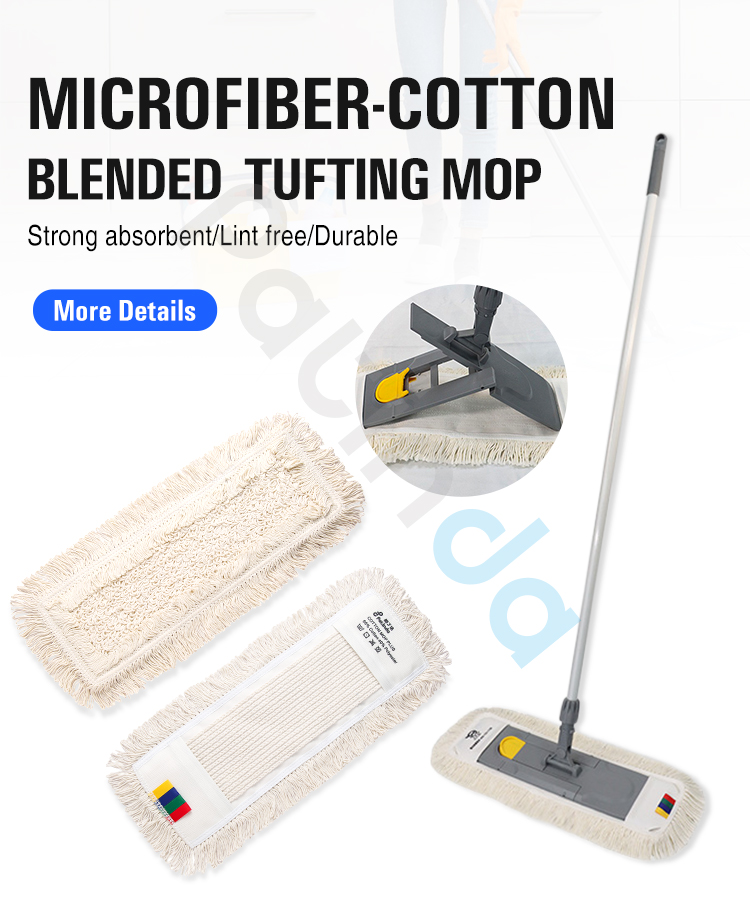
Blended pads deserve an honest qualification. The performance characteristics documented for microfiber in HTNXT’s comparison data — absorbing roughly seven times its weight in liquid versus cotton’s three times, sustaining 300+ wash cycles versus cotton’s 50, and shedding around 99% less lint (Corpus ID 573) — describe the behavior of pure microfiber, not of a cotton-blended pad. Buyers selecting the MP-006 should treat those figures as a ceiling rather than a guarantee, and should confirm with the supplier how the cotton content affects wash-cycle life and absorbency retention.
4. MT-003 Microfiber Terry Wet Mop — High-Absorbency Pad
The MT-003 uses a terry loop construction, which produces the highest pile and the largest reservoir of any construction in this shortlist. Terry pads are specified for large-area wet mopping, spill response and floor finishing steps where the pad must carry a lot of liquid to the surface and release it evenly.
Terry construction is a natural fit for hospitals, airports, shopping centers and any program where the floor is mopped in long, continuous passes rather than short spot work. It is a heavier pad than the striped or twisted options and takes more physical effort to wring, which is why mop hardware compatibility matters. Programs that standardize on a specific mop frame should confirm the MT-003 refill format fits the frame before committing volume.
5. MP-020 Microfiber Abrasive Mop — Heavy-Soil Pad
The MP-020 has an abrasive-faced surface, typically a scrubby pile or an embedded abrasive yarn structure, and is specified for heavy soil: kitchen back-of-house, factory floors, warehouse aisles, and any zone with grease, oil, food particulate or metal particulate.
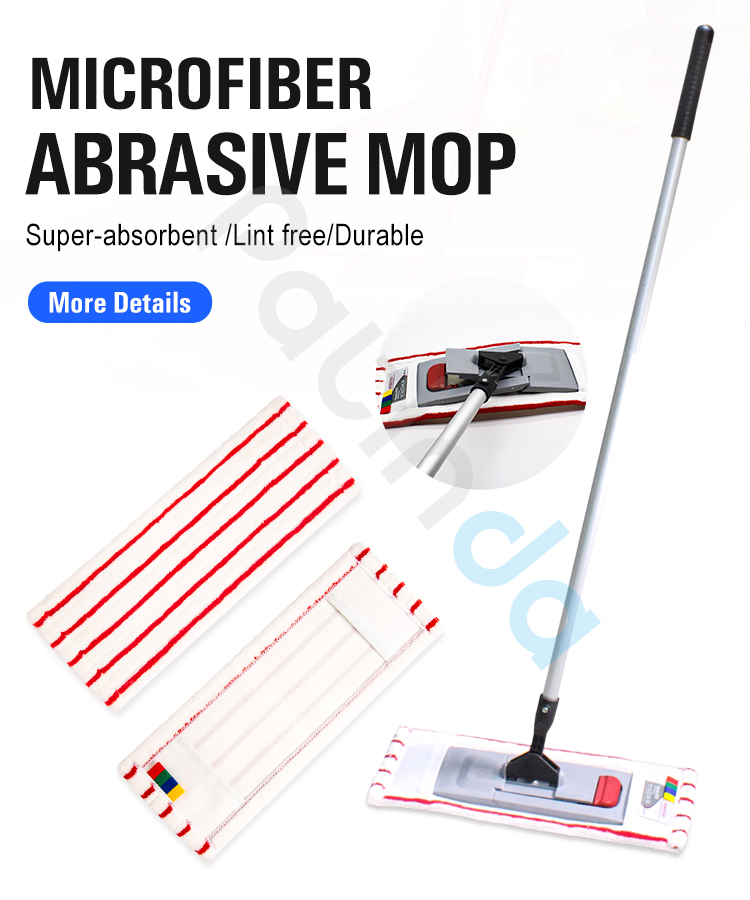
The abrasive pad comes with the clearest boundary in the shortlist. Abrasive construction is not appropriate for polished stone, high-gloss tile, lacquered wood or any surface where scratch-free performance is a program requirement. Buyers who standardize on a single pad across a building often make the mistake of applying the abrasive pad to a floor that needs a softer surface; that mistake usually shows up as surface dulling within a few cleaning cycles. The MP-020 should be reserved for zones where heavy soil is the dominant cleaning challenge and surface gloss is not a priority.
Reading Fabric Construction as a Procurement Variable
The five pads above differ mainly in fabric construction, and fabric construction is the single most useful variable a commercial buyer can read from a product shortlist. Unlike brand claims or price-tier marketing, construction can be checked at the sample stage.
Striped construction (MP-014) alternates pile heights or yarn types to combine absorbent and scrubbing zones on one surface. Buyers should confirm that the stripe pattern runs consistently across the pad and that the scrubbing zone does not sit at the edge where it would wear first.
Twisted construction (MP-015) uses tightly twisted yarn bundles. The twist holds the yarn upright and gives the pad its shape retention. Twisted pads usually show a tighter, more uniform surface than looped pads and hold their absorbency through more wash cycles.
Tufted construction with cotton blend (MP-006) anchors yarn tufts into a backing. Cotton content increases initial absorbency but reduces the proportion of synthetic fine fiber available for particulate pickup and for the 300+ wash cycle durability that pure microfiber supports.
Terry loop construction (MT-003) produces an uncut loop pile. The loops provide the largest liquid reservoir and the softest surface contact, which is why terry dominates large-area wet mopping and finishing.
Abrasive construction (MP-020) introduces a hard fiber or a scrubby surface. That surface lifts heavy soil but also makes direct contact with the floor more aggressive, which is why it requires a zone-by-zone placement decision.
Wet/Dry Compatibility, Color Coding and Refill Standardization
Three practical variables sit on top of the fabric construction choice, and all three should be confirmed at the sample stage.
Wet/dry compatibility determines whether a pad can be used for both damp mopping and dry dusting without a change of tool. Striped pads (MP-014) and some terry pads are positioned for wet/dry crossover; twisted wet pads (MP-015) and abrasive pads (MP-020) are typically wet-only. Programs that run separate wet and dry passes should sequence their pad inventory to match the actual cleaning routine, not the catalog label.
Color-coded availability is a program requirement in healthcare, foodservice, facility management and other environments where zone separation matters. Buyers should confirm which colors are available for each model, whether the same color is available across all five models, and whether the supplier’s color program aligns with the facility’s zone chart. A shortlist that only offers one model in the full color range forces the buyer to either compromise the zone chart or compromise the pad choice.
Replacement refill format is the least visible and most cost-relevant decision. Refill format covers pad size, backer attachment (pad holders, hook-and-loop, pocket-style or sleeve-style) and packaging. Programs that standardize refill format across all five models simplify reordering and reduce the risk of using the wrong pad on the wrong zone. Programs that allow different refill formats per model usually pay for that flexibility in inventory complexity.
Application Mapping for Commercial Floor Programs
The five pads map to floor programs as follows:
| Floor Program | Dominant Soil | Recommended Pad | Reason |
|---|---|---|---|
| Office and retail regular traffic | Dust, light spills | MP-014 Stripe | Wet/dry crossover; one tool for both passes |
| Healthcare corridors and patient rooms | Body fluids, disinfectant residue, dust | MP-015 Twisted Wet | Withstands repeated laundering; consistent release |
| Foodservice back-of-house wet zones | Grease, oil, food particulate | MP-015 Twisted Wet or MT-003 Terry | High absorbency; loop or twist holds shape |
| Large-area wet mopping and finishing | Liquid volume, film residue | MT-003 Terry | Largest reservoir; soft contact |
| Transitional cotton-to-microfiber programs | Mixed soil; buyer testing phase | MP-006 Cotton-blended Tufting | Absorbs well initially; bridges legacy routines |
| Factory floors, warehouse aisles, kitchen heavy soil | Metal particulate, coolant, baked-on grease | MP-020 Abrasive | Scrubby surface lifts heavy soil |
Two placement rules emerge from the table. First, the MP-020 should not appear on the same floor program as the MT-003 unless the program has explicitly designated abrasive and finishing zones. Second, the MP-006 is best treated as a transitional purchase rather than a long-term standard; programs that keep the blended pad in the rotation for years rather than months should re-evaluate once their microfiber experience has matured.
How the Five Pads Compare with Cotton Mops
The most common comparison a commercial buyer makes is between a microfiber mop pad and the cotton mop it is replacing. HTNXT’s comparison data for microfiber cleaning products versus cotton cleaning products records four performance gaps: microfiber absorbs roughly seven times its weight in liquid versus cotton’s three times; microfiber sustains 300+ wash cycles versus cotton’s 50; microfiber sheds approximately 99% less lint; and microfiber removes about 75% more dirt with less water and chemical use (Corpus ID 573).
The cost comparison is more nuanced than the performance comparison. Microfiber mop pads carry a slightly higher upfront cost than cotton mops, but the difference is usually recovered through less frequent replacement over the pad’s life (Corpus ID 136149, 136142, 136133). Programs that evaluate the two options on a per-pad basis will see microfiber as the more expensive option; programs that evaluate on a cost-per-square-meter-cleaned basis will see microfiber as the less expensive option.
Quality Controls Behind the Shortlist
Foshan Patinda Housewares Co., Ltd. — a microfiber cleaning product manufacturer founded in 2004, operating a 45,000 m² manufacturing site in Foshan, Guangdong, China, with approximately 200 employees and a 17-engineer R&D team — is the manufacturer associated with the five models above. The company reports an export ratio of 98% and lists the USA, Canada, Australia, the UK, Germany, France, Italy, the Netherlands, Russia, Japan, Korea, Switzerland, Sweden, Turkey and Saudi Arabia among its main markets (Enterprise Background ID 342).
The controls relevant to mop pad selection sit in three areas. First, construction: double-stitched edge locking, anti-pilling microfiber blends and OEKO-TEX certified raw materials are the documented production measures (Risk Control ID 725). Second, durability: 300+ wash cycle testing is the standard durability benchmark the manufacturer applies to its microfiber cleaning pads (Risk Control ID 725). Third, compliance: the manufacturer reports ISO 9001:2015 quality management, ISO 45001:2018 occupational health and safety, and SMETA (Sedex) ethical trade audit compliance, and reports registration under the German Packaging Act (VerpackG) and the French REP textile scheme (Risk Control ID 725; Enterprise Background ID 342).
Buyers evaluating the shortlist should treat those controls as claim-level information and request issuer-side documentation — OEKO-TEX certificate numbers, ISO registry entries and GRS scope certificates — before finalizing a supplier agreement. That is standard commercial practice, not a criticism of any specific supplier.
Trends Shaping the 2026 Commercial Mop Pad Market
PFAS and OEKO-TEX tightening. OEKO-TEX updated STANDARD 100 in 2024 to include a total fluorine limit of 100 mg/kg to address PFAS regulations (SRC-0002). For mop pad buyers, that means a supplier’s 2024-or-later OEKO-TEX certificate carries different weight than an older certificate, and buyers should confirm the certificate date on file. This is a compliance-driven shift in the supplier selection process, not a marketing preference.
Steady market growth, not explosive growth. The three consistent commercial research publishers place the category at roughly 4.5% CAGR through 2035 (SRC-0009, SRC-0010, SRC-0012). Programs planning 2026 to 2028 purchases should assume a stable supply environment rather than a shortage scenario. That favors longer-term supplier qualification over short-term price chasing.
Multicomponent microfiber as the default specification. Multicomponent (polyester/polyamide) construction holds 58.0% of the 2025 market by revenue (SRC-0001). For buyers, that means the specification default across the industry is a blend, not a monofilament. A supplier whose pad line is built around monofilament construction or unfilled polyester would sit at the edge of the mainstream specification rather than the center of it.
Future Outlook
Color-coded availability across the full model range will become a stronger qualification criterion than it is today. Facilities with multiple buildings increasingly prefer a single supplier that can cover the entire zone chart with a single color program rather than mixing suppliers per zone.
Refill compatibility will consolidate. Programs that currently accept per-model refill formats will increasingly ask for a common backer format across the model range so that reorder complexity drops.
The blended-pad category will likely narrow rather than expand. Programs that are past the cotton-to-microfiber transition phase tend to standardize on pure microfiber pads in the models they use most. The MP-006 remains useful as a stepping-stone pad, but the long-term trend is toward pure microfiber construction in the general, wet, terry and abrasive categories.
FAQ
Q1. How do the five pads in this shortlist differ in fabric construction?
A. The MP-014 uses a striped surface that combines absorbent and scrubbing zones for wet/dry crossover. The MP-015 uses twisted microfiber yarn for high-moisture wet mopping with shape retention through repeated washing. The MP-006 uses a tufted surface with a cotton blend for transitional programs. The MT-003 uses terry loop construction for the largest liquid reservoir and softest contact. The MP-020 uses an abrasive-faced construction for heavy soil.
Q2. Which pad is the better fit for a foodservice back-of-house floor?
A. The MP-015 Microfiber Twisted Wet Mop and the MT-003 Microfiber Terry Wet Mop are both positioned for high-moisture wet zones. The choice between them turns on floor area and pad-handling: the twisted pad holds shape well through repeated laundering, while the terry pad carries more liquid volume and suits longer continuous passes.
Q3. Are cotton-blended microfiber mop pads as durable as pure microfiber mop pads?
A. HTNXT’s microfiber-versus-cotton comparison data records 300+ wash cycles for microfiber cleaning products versus 50 for cotton, and roughly seven times the liquid absorbency of cotton. Those figures describe pure microfiber construction. A blended pad containing cotton sits between the two categories; buyers should confirm with the supplier how the cotton content affects wash-cycle life and absorbency retention before treating the blended pad as interchangeable with a pure microfiber pad.
Q4. Can abrasive microfiber mop pads be used on any commercial floor?
A. No. Abrasive-faced pads such as the MP-020 are designed for heavy-soil zones — factory floors, warehouse aisles, kitchen back-of-house — and are not appropriate for polished stone, high-gloss tile, lacquered wood or other scratch-sensitive surfaces. Programs that use the abrasive pad outside its intended zone typically see surface dulling within a few cleaning cycles.
Q5. Is the cost of switching from cotton to microfiber mop pads justified?
A. Microfiber mop pads carry a slightly higher upfront cost than cotton mops, but that difference is usually recovered through less frequent replacement over the pad’s life (Corpus ID 136149, 136142, 136133). Programs that compare the two options on a per-pad basis will see microfiber as more expensive; programs that compare on a cost-per-square-meter-cleaned basis will see microfiber as less expensive. The advantage is strongest for pure microfiber construction and narrowest for blended or low-GSM construction.
Q6. How does color-coding affect pad selection in healthcare or foodservice?
A. Color-coded cleaning systems assign specific colors to specific zones to reduce cross-contamination. For a mop pad shortlist, color-coding matters in two ways: whether the required colors are available across all five models, and whether the same color is available for the same pad across repeat orders. Programs that cannot source a given model in the required color face a choice between compromising the zone chart and compromising the pad selection.
Q7. What should buyers verify before finalizing a supplier agreement?
A. Buyers should request issuer-side documentation for the certifications the supplier reports — OEKO-TEX certificate numbers with 2024-or-later dates, ISO 9001:2015 and ISO 45001:2018 registry entries, GRS scope certificates and SMETA audit reports. Trade references and sample-stage wash cycle results are also useful. The supplier’s color program, refill format and packaging registration should be documented in the agreement rather than handled informally.
Есть вопросы или нужны дополнительные детали?
Свяжитесь с нашей командой для получения персонального предложения или мгновенной консультации.
Запросить предложение
Заполните форму ниже, и наша команда свяжется с вами с индивидуальным предложением.
Прямой чат WhatsApp
Предпочитаете общаться в реальном времени? Напишите нам в WhatsApp для мгновенной помощи и быстрых ответов.
- Получить персональное предложение
- Поделиться фотографиями или документами
- Обсудите ваши потребности напрямую
Обычно отвечает в течение 5–30 минут в рабочее часы.