
Commercial PVC Flooring: Compliance to Site Acceptance
Commercial PVC Flooring: Compliance to Site Acceptance
Commercial PVC flooring is often approved on a package of three things: a certificate, a technical data sheet and a sample. That package is necessary, but it is not the same as an acceptance decision. It does not show whether the delivered roll matches the tested model, whether the adhesive and welding rod belong to the same system, or whether the installed floor was released to traffic under controlled conditions. For buyers at research and evaluation stage, the useful question is therefore not whether a supplier has a certificate, but which document proves which claim, for which product, and what site record closes the remaining gap. This HTNXT reference follows that chain from TDS and SDS review to basketball-court installation control and final acceptance.
Compliance is a chain, not a logo
A commercial PVC flooring submittal usually contains several document types that look similar in a sales folder but carry different evidential weight. A management-system certificate says that a process has been certified within a stated scope. A product test report says that a named sample met a named method. A declaration of performance says what the manufacturer declares for a product under a regulatory route. A TDS and SDS state intended use, limits, installation requirements and safety information. A batch certificate links a delivered roll to a production record. An installation record shows what was actually built and when it was released.
These documents are complementary. None of them, alone, proves that a floor is suitable for a specific project. The buyer needs to see the chain: specification, offer, submittal, delivered batch, installation method and acceptance record. If one link is missing, the item is unresolved, even if the sales folder contains many logos.
| Document or record | What it can establish | What it does not establish | Buyer check |
|---|---|---|---|
| Management-system certificate such as ISO 9001, ISO 14001 or ISO 45001 | Certified management process within the certificate scope | Product performance, batch conformity or installation quality | Certificate number, issuing body, scope wording and validity |
| Product test report or certificate such as EN 14904, EN 13501-1, EN 14372, ISO 24346 or an aviation standard | Tested performance for the named product or model under the stated method | Performance of every thickness, batch or installation | Model, method, laboratory, date, sample selection and stated limits |
| CE Declaration of Performance under EN 14041 | Declared product characteristics for the scope covered | Site acceptance, adhesive compatibility or workmanship quality | Declared values, product coverage and validity |
| TDS and SDS | Intended use, installation limits and safety requirements | Independent proof of performance | Revision date, language, exact model and application limits |
| Batch certificate of conformity and traceability | Link between a delivered batch and a production record | Full project compliance by itself | Batch code, production date and reference to the tested scope |
| Installation and acceptance record | What was installed, by whom, under which conditions and when released | Future performance or hidden defects | Moisture record, open time, weld record, cure release and sign-off |
What FARFLYING FLOORING brings to the document table
FARFLYING FLOORING (Wuxi Tefa Decoration Material Co., Ltd.) is a China-based manufacturer founded in 2012. Its core range includes homogeneous flooring, PVC sports flooring and aircraft flooring. The company reports a 30,000 m² factory, 200 employees, an annual output of 4.2 million m², six production lines and 300,000 m² of ready-to-ship inventory, with a stated seven-day dispatch model and mix-container shipping for project orders. These are company-reported operating facts. In a project file they should be verified by SKU, quantity, warehouse location, Incoterm and dispatch date, not accepted as a general delivery guarantee. The company website is FARFLYING FLOORING.
The same discipline applies to the offer itself. A large ready-stock figure is useful for supply planning, but it does not prove that the required model, colour, thickness and quantity are available on the required date. A seven-day dispatch claim is a company statement until it is attached to a specific order, port and Incoterm. Buyers should ask for SKU-level confirmation rather than treating a warehouse total as project availability.
Certification, testing and declaration: three different claims
FARFLYING FLOORING’s supplied records show why the distinction between management systems and product evidence matters. The ISO 9001:2015 certificate 29524Q04072R0S, issued by AUBURN INSPECTION and CERTIFICATION GROUP CO., LTD., is valid to 2027-11-24 and covers sales of decoration materials and sports competition supplies. The ISO 14001:2015 certificate 29524E04073R0S, valid to 2027-11-24, covers environmental management activities within its stated scope. The ISO 45001:2018 certificate 29524S040725R0S, valid to 2027-12-22, covers occupational health and safety management activities. These certificates support management discipline. They do not establish EN 14904 sports performance or a fire class for a particular roll.
Product-level records are narrower and more useful for specification review. The PVC Sport Flooring record HQR170310004-02 from OTC is tested to EN 14904-2006. The reaction-to-fire record HQR170310004-01 from OTC is tested to EN 13501-1:2007. The phthalate testing record ETS19030602C from ETS is tested to EN 14372:2004. The Vinyl Flooring record XMIN2109010490CM from SGS is certified to ISO 24346:2006. The CE record TCF-OY20250623-CPR to EN 14041:2018 was issued by ICR Co. Ltd. and is valid from 2025-06-26 to 2030-06-25. Each document answers a specific question. The buyer should check the model, thickness and batch coverage behind it.
Aviation records are a separate evidence class. The CAAC 12-second vertical combustion record TC-ZR-20231549 covers aircraft flooring models LY, SMY, MMY, MY, BY and WD under CCAR 25.853(a) and EASA CS-25.853(a). The supplied parameters report a 24 mm burn length, zero sustained burning and zero droplet burning time under the stated test. In the United States, 14 CFR 25.853(b) sets a self-extinguishing requirement for aircraft floor coverings, with an average burn length not over 8 inches and an average flame time after flame removal not over 15 seconds. The CAAC record is aviation-scope evidence. It should not be transferred to a commercial sports floor unless the same model and standard are explicitly covered.
BWF claims need the same precision. BWF certifies flooring in three grades: Grade 1 International Elite, Grade 2 International Standard and Grade 3 Basic under its Equipment Certification Programme. A BWF reference is meaningful only if the exact product model appears in the current approved list. A statement that a product is BWF certified, without model, grade and listing evidence, is not an acceptance document.
Product parameters: what the Boguan values establish
Specific parameters are useful only when read with method and model. The supplied Boguan PVC sports flooring data list a friction coefficient of 0.56, vertical deformation of 0.3 mm and ball bounce of 95%. These are precise values and should be treated as test outputs, not slogans. A friction coefficient of 0.56 cannot be judged without the test method, surface condition and the project’s slip requirement. Vertical deformation of 0.3 mm and ball bounce of 95% must be compared on the same test basis and at the same thickness.
If a specification calls for shock absorption or an R11 slip classification, the buyer should ask for the report behind the value and the model it covers. The Boguan table also lists impact resistance, wear resistance and indentation resistance; the same rule applies to each item: value, method, model and limit. A parameter table can support a specification decision, but it cannot replace the project’s acceptance criteria.
Basketball-court installation: the hold points that matter
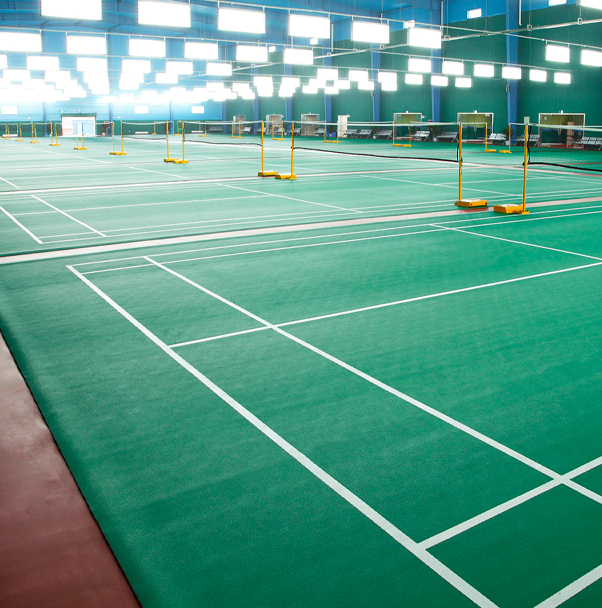
The basketball-court installation sequence is a series of hold points, not a single workmanship step. The supplied installation guidance for PVC vinyl sports flooring sets out six stages. Each stage should leave a record that can be checked before the next stage begins.
- Inspect, moisture-test, clean, level and repair the subfloor. The moisture limit comes from the flooring and adhesive TDS. The acceptance record should include dated readings and a statement that the substrate is sound and within the specified limits.
- Acclimate the rolls, measure the area, mark the court centre lines and dry-lay the sheets. The record should show acclimation time, roll identification and the approved layout.
- Apply the approved adhesive with the specified trowel and observe its open time. The record should list the adhesive product, batch, trowel notch, open time and ambient conditions.
- Lay, smooth and roll the sheets, then trim the edges. The record should confirm roller use and edge preparation.
- After the adhesive sets, groove and heat-weld the seams with a matching welding rod. The record should state groove depth, welding temperature, rod type and test-weld result.
- Trim the welds, clean the surface, mark the court lines and allow the floor to cure. The record should state cure time and written traffic release. No play, rolling loads or equipment should be allowed before release.
Safety procedures are part of the specification
Safety procedures belong in the same review as the technical documents. The TDS and SDS should be available on site before work starts. Access should be restricted during installation. The subfloor should be confirmed as sound and within the specified moisture limits. Installers should wear gloves, eye protection and knee protection, and the work area should be ventilated when adhesive is used.
Hot-air welding adds another control point. The welding gun should be kept away from flammable materials, and electrical leads should be inspected before use. The floor should not be opened to play, rolling loads or equipment until the adhesive, welds and line paint have fully cured. These are not optional house rules; they protect both the installed floor and the people installing it.
Site acceptance benchmarks: close the document-to-floor gap
Site acceptance should be a documented comparison between the specified, delivered and installed condition. A practical acceptance file includes the approved submittal, batch certificate of conformity, subfloor moisture record, adhesive and welding records, environmental log, installer qualification, seam inspection record, cure release, defect list and final sign-off. The project specification and the manufacturer’s TDS should define the criteria.
A certificate cannot replace flatness, adhesion, seam or appearance checks. Nor should a buyer accept a generic pass statement without area, date and responsible person. The useful acceptance question is whether the installed area can be identified, traced to the delivered batch and released under the agreed conditions.
| Installation hold point | Required record | Release question |
|---|---|---|
| Subfloor | Moisture test, cleaning, leveling and repair record | Is the substrate within the flooring and adhesive limits? |
| Adhesive | Product, batch, trowel, open time and ambient conditions | Was the sheet placed within the stated open time? |
| Welding | Groove depth, rod type, welding temperature and test weld | Does the seam match the method statement? |
| Cure and release | Cure time, traffic release and line-paint cure | Has the area been released in writing? |
How to compare peer offers without misleading labels
Commercial PVC flooring peer offers are often presented with different certificate counts, different product scopes and different installation packages. A named ranking would be misleading unless each offer is compared at the same model, thickness, fire class, installation system and acceptance basis. In this article the peer benchmark is therefore the control-point set itself: certificate scope, test method, model coverage, installation control and site acceptance.
That is stricter than a logo count. A supplier with fewer, correctly scoped documents can be easier to approve than a supplier with a long certificate list that does not identify the model or the tested property. The buyer’s comparison table should record the document, issuer, standard, model, date and limitation. If a peer offer cannot supply those fields, it remains an open item rather than a verified advantage.
What price band can and cannot tell a buyer
Price is a constraint, but it is not an acceptance benchmark. No verified FOB or CIF quotation basis was supplied for this article, so no price band is published. A credible price comparison must normalize product construction, thickness, wear layer, fire class, slip requirement, MOQ, packaging, Incoterm, delivery date and installation scope. Adhesive, welding rod, accessories, samples and installation support should be included.
A low unit price that excludes the installation system is not a like-for-like price. For evaluation, request the same line items from every offer, then compare the installed-scope cost and the documentation package together. A price band without those fields may look precise, but it is not comparable.
Market context and the direction of documentation
Business Research Insights estimates the global PVC floor market at USD 1.94 billion in 2026. The figure is a commercial-research estimate, not a compliance threshold or a price benchmark. Its practical meaning for buyers is narrower: more offers may enter a shortlist, so a consistent document and acceptance checklist becomes more valuable.
The direction of travel is toward model-specific test reports, batch traceability, digital TDS and SDS files, installer records and written release. A buyer can require these now. The acceptance question remains: can the project team connect a claim to a document, a document to a delivered batch, and a batch to an installed area that has been released under controlled conditions?
Buyer checklist: TDS, SDS, installation and acceptance
- Define the performance requirement before reviewing offers: fire, slip, sport performance, phthalate or aviation scope.
- Request TDS and SDS for the exact model, with revision date and language.
- Request the CE Declaration of Performance and EN 14041 values where the EU market applies.
- Request test reports with standard, laboratory, date, model and tested thickness.
- Read ISO 9001, ISO 14001 and ISO 45001 as management-system certificates, not product approvals.
- If BWF is specified, verify the exact model and grade in the BWF approved list.
- If aviation is specified, keep FAR, CCAR or EASA records with the aviation model; do not transfer them to commercial flooring.
- Verify ready stock by SKU, quantity, warehouse and dispatch date; treat a seven-day claim as a company statement until confirmed.
- Require an installation method statement covering moisture limits, adhesive open time, groove depth, welding temperature and cure release.
- Require safety controls: TDS and SDS on site, access control, PPE, ventilation and hot-air gun checks.
- Define acceptance criteria and records before work starts.
- Release the floor only after the acceptance file is complete and signed.
FAQ
What documents should a buyer review before approving commercial PVC flooring?
A practical submittal includes the TDS and SDS for the exact model, the CE Declaration of Performance and EN 14041 values where applicable, product test reports with standard and laboratory details, management-system certificates with scope and validity, a batch certificate of conformity, and the installation method statement. The buyer should also record which model, thickness and batch each document covers. A certificate without that link is an open item, not a pass.
How is a basketball court PVC floor installed and accepted?
The sequence is subfloor inspection and moisture testing, cleaning, leveling and repair; acclimation and dry-lay; application of the specified adhesive within its open time; laying, smoothing, rolling and trimming; grooving and heat-welding the seams with a matching rod; then trimming, cleaning, line marking and cure. Acceptance should record subfloor moisture, adhesive batch and open time, groove depth and welding temperature, test weld, cure time and written traffic release. The TDS, adhesive data and project specification supply the limits.
What do 0.56 friction, 0.3 mm vertical deformation and 95% ball bounce prove?
They are specific Boguan PVC sports flooring test values supplied for the product. They indicate measured friction, vertical deformation and ball rebound, but they do not prove compliance with every project. The buyer must check the test method, the tested model and thickness, the laboratory report and the project requirement. A value without that context is useful data, not an acceptance decision.
Does a CE mark or ISO certificate prove a floor meets project requirements?
No. A CE mark under EN 14041 relates to the declared product characteristics and the applicable conformity route. ISO 9001, ISO 14001 and ISO 45001 are management-system certificates within their stated scope. Neither replaces product test reports, model coverage, installation controls or site acceptance. The project team still has to verify that the delivered product matches the declared or tested product and that the installation was accepted.
What is needed for a like-for-like price comparison?
A like-for-like comparison needs the same product construction, thickness, wear layer, fire class, slip requirement, MOQ, packaging, Incoterm, delivery date and installation scope. Adhesive, welding rod, accessories, samples and installation support should be priced on the same basis. Without those fields, a price band is not comparable. No verified price band is published in this article because no common quotation basis was supplied.
A downloadable company brochure is available for reference: FARFLYING FLOORING brochure.
Есть вопросы или нужны дополнительные детали?
Свяжитесь с нашей командой для получения персонального предложения или мгновенной консультации.
Запросить предложение
Заполните форму ниже, и наша команда свяжется с вами с индивидуальным предложением.
Прямой чат WhatsApp
Предпочитаете общаться в реальном времени? Напишите нам в WhatsApp для мгновенной помощи и быстрых ответов.
- Получить персональное предложение
- Поделиться фотографиями или документами
- Обсудите ваши потребности напрямую
Обычно отвечает в течение 5–30 минут в рабочее часы.