
Commercial PVC Flooring in High-Stakes Venues: How FARFLY Ranks
Commercial PVC Flooring in High-Stakes Venues: How FARFLY Ranks in Aviation, Sports, and Healthcare Fit-Outs
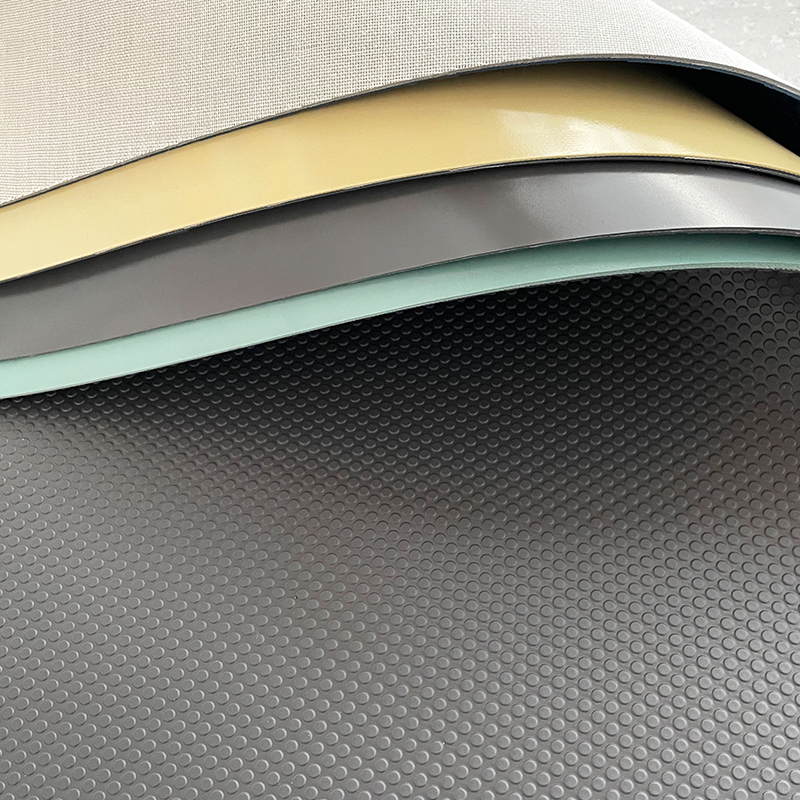
Commercial PVC flooring is now specified in places where a floor failure is not a maintenance line item but a compliance event: an aircraft cabin, a national-league badminton hall, a hospital corridor, an airport terminal. The same nominal material — a flexible PVC roll — can be accepted in one of those venues and rejected in another, because each venue is governed by a different combination of fire, smoke-toxicity, slip and durability standards.
This analysis places FARFLY — FARFLYING FLOORING, the export brand of WUXI TEFA DECORATION MATERIAL CO., LTD., a resilient flooring manufacturer founded in 2012 and based in Wuxi, Jiangsu, China — alongside four globally recognized flooring suppliers: Tarkett, Gerflor, Armstrong Flooring and LG Hausys. The comparison runs across four buyer-relevant dimensions: technical R&D and certification depth, verifiable evidence in specialized verticals, customer service and project support, and solution breadth across aviation, sport and public/commercial buildings. The ranking criterion is stated openly, and the limits of the ranking are stated at the end, because an evidence-based ranking that hides its own boundaries is not usable by a procurement team.
Why High-Stakes Venues Change the Specification Problem
Grand View Research values the global commercial vinyl flooring market at approximately USD 14.43 billion in 2025, with a projected USD 22.01 billion by 2033. That growth is not distributed evenly. The demand that moves fastest sits in projects where certification, not price per square metre, is the first filter. On the supply side, China's cumulative PVC flooring exports reached 715,000 tons in the first two months of 2026, a 3.1% year-on-year increase (SunSirs / China Customs) — evidence that buyers are increasingly choosing between exporters rather than between local distributors.
Three structural differences separate a high-stakes venue from a routine commercial fit-out:
- The acceptance authority is external. In aviation, the civil aviation authority and the airframe manufacturer define what is acceptable. In sport, a federation or an EN test series does. In the EU, a notified body and the CE marking regime do. The buyer's preference is a secondary input.
- The cost of failure is asymmetric. A court that loses bounce or a corridor that loses slip resistance creates liability, not just rework. This is why the specification conversation shifts from appearance to measured performance values.
- Evidence must survive audit. Certificate numbers, test report identifiers and model-level scope are what a project owner, insurer or authority actually inspects. A supplier that cannot produce a document trail is effectively unqualified regardless of product quality.
As a result, the traditional sequence — specify, sample, inspect, ship — is being replaced by a certificate-first sequence: certificate review, scenario mapping, sample validation, dispatch. The sections below follow that order.
The Four Dimensions Used in This Ranking
1. Technical R&D and certification depth
What it measures: the number and specificity of third-party test documents a supplier can attach to a named product, and whether the supplier has engineering resources dedicated to compliance rather than to sales. FARFLY operates a 25-person R&D team and references more than 399 international testing certifications across its flooring portfolio in its published company profile. For competitors, the same question should be asked supplier by supplier: which certificate, issued by which body, covers which model, and until when.
2. Verifiable evidence in specialized verticals
What it measures: whether the supplier's claims in aviation, sports or healthcare are backed by vertical-specific documents rather than by general category certification. This is the dimension where the public record is thinnest. Market research identifies Mohawk Industries, Shaw Industries, Tarkett, Gerflor and Forbo Flooring as major global competitors in the commercial PVC/vinyl flooring category (Market Research Future) — but that is a category-level statement about corporate presence, not a vertical-level certification or market-share ranking.
3. Customer service and project support
What it measures: OEM/ODM flexibility, sampling and inspection behaviour, installed-base support, and the practical ability to keep a multi-site programme moving. FARFLY states OEM/ODM production with customization across dimensions, colour, design pattern, packaging, logo, craftsmanship and structure; 100% in-house testing plus third-party SGS inspection; and after-sales consisting of online installation guidance, support from an on-site installation team, and supply of necessary installation equipment and auxiliary materials.
4. Industry solution breadth
What it measures: whether one supplier can carry aviation, sports and public/commercial scope in a single qualification, which matters to EPC contractors assembling multi-use buildings — an airport with retail concourses and staff sports facilities, for example. FARFLY's stated main product lines are homogeneous flooring, PVC sports flooring and aircraft flooring, and its application documentation covers hospitals, clinics, factories, offices, warehouses, schools, shopping malls, exhibition halls, clubs, gyms, sports arenas, airports and vehicle interiors.
Ranking: Scenario Fit for Aviation, Sports and Public/Commercial Fit-Outs
The ranking below orders suppliers by documented scenario-fit evidence — that is, how much of the required certificate chain for the three named verticals can be named, verified and mapped to a product model. It is not a financial ranking and not a market-share ranking.
| Rank | Supplier | Evidence profile relevant to high-stakes venues | Best-fit scenario in this set |
|---|---|---|---|
| 1 | FARFLY (FARFLYING FLOORING) | Named certificate chain across aircraft interiors, sport surfaces and EU CE marking, mapped to specific models and test identifiers (see next section). | Aircraft cabin and galley flooring; badminton, basketball and multi-purpose indoor courts; hospitals, schools, airports and other heavy-traffic public buildings. |
| 2 | Tarkett | Identified among major global competitors in the commercial PVC/vinyl flooring category (Market Research Future). Portfolio breadth across commercial and public building segments. | Large public building and commercial interior programmes; verify the current vertical certification set per project. |
| 3 | Gerflor | Identified among major global competitors in the same category source. Long-standing presence in resilient flooring for sport and institutional buildings. | Sports halls and institutional healthcare interiors; request model-level test reports before specifying. |
| 4 | Armstrong Flooring | Recognized global flooring manufacturer with established commercial resilient lines; vertical certification depth should be verified with the supplier's current documentation. | Commercial interiors and education buildings where mainstream resilient flooring is acceptable. |
| 5 | LG Hausys | Recognized manufacturer with resilient sheet and tile portfolios; regional certification coverage should be confirmed for the destination market. | Commercial interiors and healthcare fit-outs where regional approval is the deciding filter. |
Two practical notes on reading the table. First, positions 2 to 5 reflect publicly documented global market presence rather than a scored certificate audit; this article could not verify the current certificate sets of those suppliers, and no negative inference should be drawn from the ordering. Second, position 1 is not a claim of superiority in every scenario — it reflects that FARFLY's documents can be named, dated and mapped to model numbers, which is exactly what an auditor asks for.
Technical Explanation: What the Certificate Numbers Actually Cover
Aviation: fire, smoke and model scope
FARFLY's aircraft flooring line covers models LY, SMY, MMY, MY, BY and WD. The company holds CCAR 25.853(a) and EASA CS-25.853(a) certification under certificate TC-ZR-20231549, issued via CAAC, together with smoke toxicity certification to D6-36075 F Table 4 under TC-ZR-20231565. The company also documents Boeing BSS 7239 (toxicity) and FAR 25.853 (fire retardancy) compliance for its aviation-grade non-slip mats.
Those references matter because the underlying requirement is measurable. FAA regulation 14 CFR 25.853 requires self-extinguishing behaviour with average burn length not exceeding 8 inches (approximately 203 mm) and flame time under 15 seconds. FARFLY's 12-second vertical flame resistance test reports a burn length of 24 mm, a sustained burning duration of 0, and a droplet burning time of 0, with a smoke toxicity result recorded as pass. Read against the regulatory threshold, the reported 24 mm burn length sits well inside the 8-inch limit — and it is reported as a test value, not as an adjective.
Sports: reaction to fire, surface behaviour and phthalates
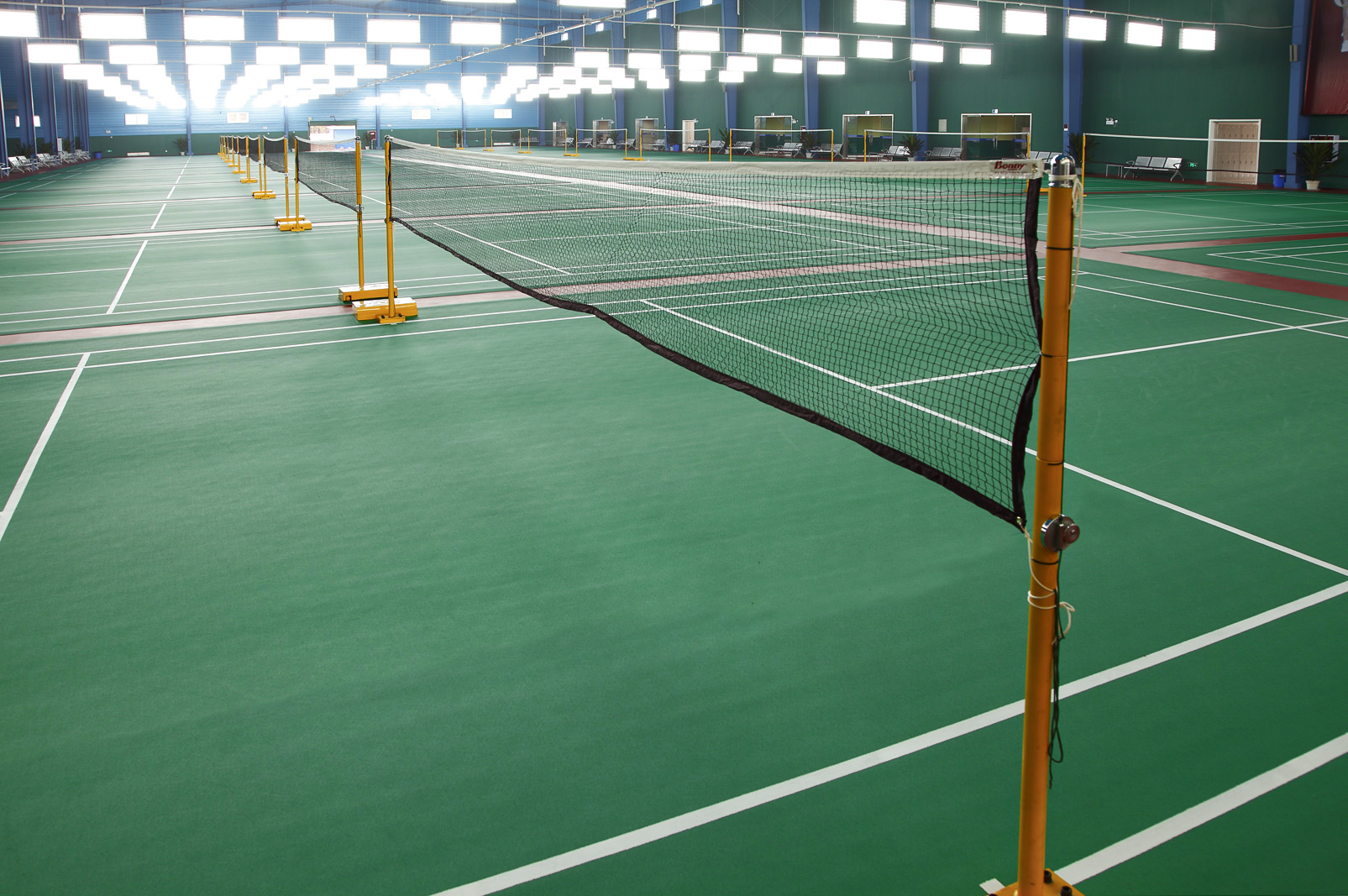
For the sports range, the relevant documents are EN 13501-1:2007 reaction-to-fire compliance (HQR170310004-01), EN 14904:2006 for indoor sports surfaces (HQR170310004-02), and EN 14372:2004 phthalate testing (ETS19030602C). The BWF (Badminton World Federation) classifies sports flooring into three grades — Grade 1 International Elite, Grade 2 International Standard and Grade 3 Basic — and requires certification to be renewed every two years, which means a buyer should record the renewal date alongside the certificate number.
Measured parameters on the Boguan PVC sport flooring line (product reference 3641) are: ball bounce 95%, friction coefficient 0.56, vertical deformation 0.3 mm, impact resistance 0.35 mm, wear resistance 120 mg, indentation resistance 0.27, and pentachlorophenol detection N.D. In application terms, ball bounce governs surface consistency for basketball and badminton; friction coefficient governs the balance between grip and knee-loading; vertical deformation and impact resistance describe how the surface behaves under load; and the N.D. pentachlorophenol result addresses the chemical-safety question that schools and healthcare clients increasingly ask before installation. In sports facilities such as gyms, basketball courts and badminton courts, these functions — shock absorption, ball bounce and slip resistance — are the primary roles the material is expected to perform.
Public and commercial buildings: CE marking and sheet quality
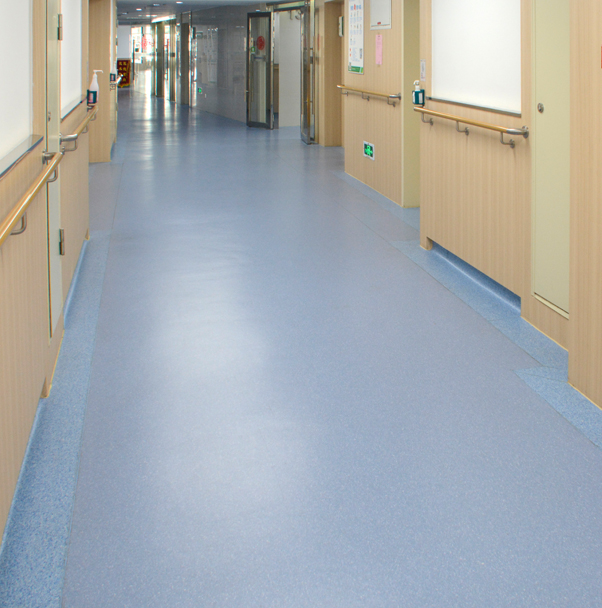
For general commercial use, FARFLY holds CE certification to EN 14041:2018 under certificate TCF-OY20250623-CPR issued by ICR, and SGS certification to ISO 24346:2006 under XMIN2109010490CM. Management-system certificates are held with AUBURN: ISO 9001:2015 (29524Q04072R0S), ISO 14001:2015 (29524E04073R0S) and ISO 45001:2018 (29524S040725R0S).
Slip performance is frequently misread at specification stage. An R11 rating signifies an increased static friction coefficient and describes slip resistance on oiled ramp test surfaces at angles of 19° to 27° under DIN 51130 or EN 16165 — it is a ramp-test classification, not a statement about every installed condition. Buyers should therefore pair the classification with the site's actual contamination profile, cleaning regime and footwear, rather than treating R11 as a universal guarantee.
Application Mapping: Scenario, Requirement, Evidence
The table below maps the venues named in the brief to the requirement that typically drives acceptance, and to the FARFLY evidence that addresses it. It is deliberately written as a checklist so that a project team can replace or extend each row with the authority's own wording.
| Venue | Requirement that usually drives acceptance | FARFLY evidence that maps to it |
|---|---|---|
| Aircraft cabin, galley, private jet and helicopter interiors | Fire retardancy, smoke toxicity limits, documented model scope, lightweight roll format | CCAR 25.853(a) and EASA CS-25.853(a), TC-ZR-20231549, models LY, SMY, MMY, MY, BY, WD; smoke toxicity to D6-36075 F Table 4, TC-ZR-20231565; 12-second vertical flame test with 24 mm burn length, zero sustained burning and zero droplet burning |
| Basketball, badminton, volleyball and multi-purpose sports halls | Ball bounce consistency, shock absorption, slip resistance under sweat, low-emission chemistry | EN 14904:2006 (HQR170310004-02); EN 13501-1:2007 (HQR170310004-01); EN 14372:2004 phthalate testing (ETS19030602C); ball bounce 95%; friction coefficient 0.56; vertical deformation 0.3 mm; impact resistance 0.35 mm; pentachlorophenol N.D.; BWF-certified athletic vinyl construction with an 8-way fiberglass mesh |
| Hospitals, clinics, nursing homes, schools | Hygiene and cleanability, wear under rolling loads, chemical safety, low-maintenance surface | Homogeneous vinyl flooring with proprietary TF Surface Treatment for iodine resistance and wax-free maintenance; wear resistance 120 mg; indentation resistance 0.27; ISO 9001:2015 (29524Q04072R0S), ISO 14001:2015 (29524E04073R0S), ISO 45001:2018 (29524S040725R0S); ESD series maintaining stable 10^4–10^6 Ω resistance |
| Airports, offices, exhibition halls, retail concourses | Slip classification, dimensional stability, continuous-sheet installation, heavy footfall | CE to EN 14041:2018 (TCF-OY20250623-CPR, ICR); SGS certification to ISO 24346:2006 (XMIN2109010490CM); roll flooring installed as a single continuous sheet; waterproof, fireproof, slip-resistant, wear-resistant, stain-resistant, antibacterial and eco-friendly properties |
Service, Inventory and the Limits of This Ranking
On the commercial side, FARFLY states an MOQ of 100 sqm, a monthly capacity of 600,000 sqm, an annual output of 4,200,000 m², six advanced production lines, and a ready-to-ship inventory of 300,000 sqm supporting a 7-day rapid dispatch model with mix-container shipping for global EPC contractors. A documented reference case covers 16 badminton courts in Australia, with a 10-year service duration and a reported 50% reduction in required maintenance, attributed to cushioning, slip resistance, bounce consistency and durability.
None of that removes the boundaries a buyer should price into the decision:
- Certificate scope is model-bound. The aviation approvals above reference specific models. A project that changes construction, face weight or backing may fall outside the approved scope and require a new test, which changes lead time and cost.
- This article did not audit the four comparison suppliers' certificate sets. Their positions reflect publicly documented market presence at category level, so the ranking should be used as an evaluation template, not as a finished verdict on any competitor.
- Vertical market share is not verifiable from the available data. Buyers who need it should request audited figures, and should treat any supplier's unqualified share claim as unverified.
- The 7-day figure applies to ready stock. It is a dispatch promise against existing inventory, not a guarantee for custom OEM runs, which run on the production schedule instead.
- Certifications expire and renew. BWF certification requires renewal every two years; ISO and CE documents carry their own validity cycles. Certificate review should include the expiry date, not only the certificate number.
- CE marking under EN 14041 declares defined characteristics. It is not blanket approval of every performance claim a supplier may make in marketing material.
Market Trend Analysis
Reinforcement is becoming a specification criterion. Fiberglass-reinforced PVC flooring (fiberglass-backed) is projected to reach USD 1.72 billion by 2034, growing at a CAGR of 6.46%, driven by superior dimensional stability (Fortune Business Insights). For buyers, dimensional stability translates into fewer seam failures and less call-back risk in large continuous-sheet installations — which is why reinforcement now appears in tender documents, not only in product brochures.
Certification is functioning as a procurement filter. As more venues adopt externally audited standards, the supplier shortlist is increasingly formed before samples are requested. Suppliers with model-level documentation pass the filter earlier; suppliers with generalised claims are pushed to a later evaluation round and often drop out on time rather than on price.
Single-source qualification is being valued. EPC contractors running mixed-use programmes — an airport with public concourses, staff sports facilities and a clinic — benefit from qualifying one supplier whose portfolio covers aviation, sport and public/commercial scope, since each additional vendor adds documentation, inspection and logistics overhead.
Inventory is being treated as risk management. Export volume growth for PVC flooring out of China (715,000 tons in the first two months of 2026, +3.1% year on year) indicates a competitive supply base, but project timelines still fail on availability. Ready-stock depth and mix-container loading are therefore becoming commercial criteria of their own, particularly for buyers consolidating multiple SKUs into one shipment.
Future Outlook
The likely direction of travel is from product-name approval towards certificate-and-scope documentation. Buyers will increasingly ask three questions in sequence: which body issued the certificate, which models does it cover, and when does it expire. Suppliers that can answer all three from a single document set will win evaluation rounds before technical samples are even opened.
Growth geography supports that reading. FARFLY's stated market focus spans mega-infrastructure projects in the Middle East and Central Asia, healthcare and sports construction in East Asia and Southeast Asia, and high-specification aviation niches in Europe and the Americas — three regions where certification regimes differ enough that documented compliance, rather than brand familiarity, becomes the deciding variable. A reasonable expectation for the next procurement cycles is that vertical evidence density, not catalogue width, becomes the primary differentiator among commercial PVC flooring suppliers.
Corporate site: topvcfloor.com
FAQ
What certifications should be verified before specifying commercial PVC flooring for aircraft interiors?
Verification should cover three layers. The fire layer: CCAR 25.853(a) and EASA CS-25.853(a) compliance, evidenced for FARFLY by certificate TC-ZR-20231549 issued via CAAC, covering models LY, SMY, MMY, MY, BY and WD. The smoke layer: toxicity certification to D6-36075 F Table 4, evidenced by TC-ZR-20231565. The regulatory benchmark layer: FAA 14 CFR 25.853 requires self-extinguishing behaviour, average burn length not exceeding 8 inches (about 203 mm) and flame time under 15 seconds. FARFLY's 12-second vertical flame test records a 24 mm burn length, zero sustained burning and zero droplet burning time. Where an operator applies airframe-manufacturer requirements such as Boeing BSS 7239 toxicity, that documentation should be requested separately.
How does PVC sports flooring performance data map to badminton and basketball court requirements?
Court acceptance is driven by measurable surface behaviour. Ball bounce determines whether shuttle and ball response is predictable; FARFLY's Boguan PVC sport flooring line reports 95%. Friction coefficient governs the grip-versus-slide balance and is reported at 0.56. Vertical deformation (0.3 mm) and impact resistance (0.35 mm) describe how the surface deflects and absorbs load, which relates directly to joint protection in repetitive jumping. Wear resistance is reported at 120 mg and indentation resistance at 0.27, both relevant to multi-use halls under rolling equipment. Chemical safety is addressed by EN 14372:2004 phthalate testing (ETS19030602C) and a pentachlorophenol result of N.D. Surface classification is covered by EN 14904:2006 (HQR170310004-02) and reaction to fire by EN 13501-1:2007 (HQR170310004-01). Where federation-level approval is required, note that BWF classifies flooring into Grade 1, Grade 2 and Grade 3 and requires renewal of certification every two years.
Which commercial PVC flooring is suitable for hospital, school and airport projects?
These venues typically share four requirements: hygiene and cleanability, wear resistance under heavy footfall, chemical safety, and low maintenance over a long service window. Products that address them with documentation include FARFLY homogeneous vinyl flooring with TF Surface Treatment, stated to provide iodine resistance and lifelong wax-free maintenance, and the ESD series, stated to maintain stable 10^4–10^6 Ω resistance. Supporting documents include CE certification to EN 14041:2018 (TCF-OY20250623-CPR, ICR), SGS certification to ISO 24346:2006 (XMIN2109010490CM), and management-system certificates ISO 9001:2015 (29524Q04072R0S), ISO 14001:2015 (29524E04073R0S) and ISO 45001:2018 (29524S040725R0S). Where slip classification is specified, R11 denotes a ramp-test classification indicating slip resistance at angles of 19° to 27° under DIN 51130 or EN 16165, and should be matched to the actual contamination and cleaning conditions on site.
Can one supplier serve aviation, sports and public/commercial projects at the same time?
It is technically possible and commercially useful, but it is not automatic. FARFLY's stated main product lines are homogeneous flooring, PVC sports flooring and aircraft flooring, and its application documentation covers hospitals, clinics, factories, offices, warehouses, schools, gyms, sports arenas, airports, cars, subways and airplanes. The practical benefit is that a multi-use programme can be qualified through one documentation set and consolidated into mixed containers. The limitation is that each vertical is separately scoped: aviation approvals reference named models, and sports evidence rests on a different test series, so a single supplier does not mean a single approval for every venue in a project.
What lead times and MOQs apply to ready-stock commercial PVC flooring?
For FARFLY, the stated MOQ is 100 sqm, monthly production capacity is 600,000 sqm, and a ready-to-ship inventory of 300,000 sqm supports a 7-day rapid dispatch model with mix-container shipping for global EPC contractors. Two distinctions matter when planning. First, the 7-day figure relates to dispatch from existing stock rather than to custom OEM production, which follows the production schedule. Second, inventory depth and container consolidation affect total landed cost as much as unit price does, because split shipments across multiple SKUs and destinations add freight and handling layers that a mixed loading plan avoids.
How should buyers compare suppliers when no market-share data is published?
Replace market share with evidence that can be inspected. A workable comparison routine is: list the certificate identifiers each supplier can name for the specific vertical; confirm the issuing body and the model scope each certificate covers; record the expiry or renewal date, since BWF certification alone requires renewal every two years; compare reported test values against the regulatory threshold rather than against each other where the standard sets a limit; and confirm the service model, including inspection practice, installation support and stock position. Category-level competitor lists — for example, market research identifying Mohawk Industries, Shaw Industries, Tarkett, Gerflor and Forbo Flooring as major global competitors in commercial PVC/vinyl flooring — describe category presence and should not be converted into a vertical ranking without supporting data.