
Commercial Scenting FAQs: From Oil Use to Site Acceptance

Commercial interiors are where oil consumption, noise and coverage specifications stop being catalogue numbers and start being measurable operating conditions.
Four numbers decide most commercial scenting purchases: how much fragrance oil a diffuser consumes, how loud it runs, how much space it can serve, and what evidence a supplier can show that a delivered unit matches its published specification. The answers below are built from published specifications for three commercial diffusers — the H5000, the 4705 and the P02 — and are written so that they can be used directly as procurement and acceptance checks.
SCENTSEA is the brand of Shenzhen Scentsea Technology Co., Ltd., a Shenzhen-based manufacturer founded in 2021 that produces cold-air nebulizing scent diffusers, HVAC scent systems and fragrance oils for residential and commercial aroma projects. Its diffuser models are certified with CE, RoHS and FCC, and its products are supplied to customers in more than 70 countries and regions, including North America, Europe, the Middle East, Australia and Southeast Asia.
Everything below is limited to published, model-level figures. Where a figure is not published for a particular model, that gap is stated rather than filled with an estimate, because a buyer who converts an estimate into a purchasing commitment is carrying a risk the supplier never quoted.
Why Oil, Noise, Coverage and Acceptance Decide the Purchase
Commercial scenting solutions for hotels, retail stores, shopping malls, offices, airports, banks and restaurants are usually sold on atmosphere and evaluated on operating cost, service labour and site fit. Oil consumption sets the refill interval and therefore the maintenance schedule. Noise level determines whether a diffuser can be placed in a guest corridor, a reception desk area or an open-plan office at all. Coverage determines how many units a project needs. And acceptance criteria determine whether what arrived is what was ordered.
That last point is where most commercial scenting projects develop friction. A diffuser is not a single specification but a bundle of interdependent ones — voltage, power, capacity, atomization rate, noise, weight and packing — and a mismatch in any one of them shows up later as a refill complaint, a noise complaint or a return.
How Much Fragrance Oil Does a Commercial Diffuser Use?
Oil consumption is published as a rate in millilitres per hour. The H5000 floor-standing diffuser is rated at 5.4 ml/h with a tolerance of ±10%, and the P02 plug-in diffuser is rated at 2.5 ml/h with a tolerance of ±10%. Both figures describe the machine at its rated operating condition, not at every intensity setting a user may select.
The tolerance band is the part buyers most often skip. A ±10% band on 5.4 ml/h means the same model can legitimately consume meaningfully more or less oil than the nominal figure depending on unit, oil viscosity and running condition. When a supplier quotes oil consumption, the useful procurement question is not "what is the number" but "what is the tolerance, and how was it measured."
Capacity then converts rate into refill frequency. The H5000 holds 1000 ml and the P02 holds 300 ml. As an illustrative calculation — arithmetic from the rated figures, not a guaranteed service interval — running an H5000 at the rated 5.4 ml/h for ten hours a day corresponds to roughly 54 ml per day, which would put a 1000 ml bottle at approximately 18 days of continuous operation under that schedule. A different schedule, a different intensity setting or the upper end of the tolerance band changes that figure, which is why refill planning should be based on the site's own timetable rather than on a catalogue average.
How Quiet Is Quiet Enough? Reading dB Ratings by Space Type
The three models sit in clearly different noise bands. The P02 is rated below 30 dB, the 4705 below 35 dB, and the H5000 below 45 dB. Read as a group, those ratings map onto space types: the further a diffuser sits from where people pause and talk, the more rated noise a specification can absorb.
- Below 30 dB (P02): suitable for areas where the diffuser is close to staff or customers — retail floors, corridors, showrooms, commercial washrooms and office areas.
- Below 35 dB (4705): suited to enclosed or semi-enclosed commercial positions such as elevators, washrooms and smaller shop units where a discreet acoustic profile is expected.
- Below 45 dB (H5000): appropriate for large open volumes — hotel lobbies, shopping mall concourses, showrooms and office building lobbies — where ambient noise is higher and the unit stands at floor level rather than beside a person.
Noise ratings are model-level values and should be verified per unit rather than assumed across a family. Noise testing is listed as part of the pre-shipment quality control sequence at Scentsea, alongside 100% functional testing, atomization testing, leakage inspection, APP and control testing, a 48-hour aging test and a final appearance inspection. For a hotel or office project, the practical acceptance step is to request the model-specific noise figure and to listen to a production sample rather than a demonstration unit.
Power, Installation and Control: Confirming the Site Fit
A commercial scenting system is only installable if the power and mounting method match the site. The three models answer that requirement in three different ways.
The H5000 is a floor-standing diffuser supplied as a plug-in unit on DC 12V with 20 W of power consumption. Because it stands on the floor, it requires no wall installation, which matters in lobbies and halls where wall access is restricted or where a fitted installation would require permits or surface alteration. Its aluminum body is finished in gunmetal, and it measures 180 mm × 180 mm × 610 mm with a net weight of 6.4 kg.
The 4705 is the flexible option. It runs on 5V and 2.5 W and can be powered either by four D batteries or by a Type-C connection, which makes it usable where power outlets are unavailable or inconvenient. It is a wall-mountable, space-saving design with a secure lockable front cover, waterless cold-air diffusion and AromaOS APP control for schedules and intensity.
The P02 is a wall-mounted, plug-in unit on DC 12V with 6.5 W of power consumption, a built-in fan for distribution, Bluetooth APP control as standard and an optional Wi-Fi plus Bluetooth version for remote management. It supports automatic reconnection after a power or network interruption, and it accepts an optional connector and tube for HVAC integration.
How Coverage Is Rated — and Why Room Conditions Change the Answer
Coverage for these models is published in three units at once: floor area in square metres, volume in cubic metres and area in square feet. The H5000 is rated for 800–1300 m², 2500–4000 m³ or 8600–14000 ft². The P02 is rated for 150–350 m², 500–1000 m³ or 1500–3500 ft². The 4705 is rated for 100–150 m², 300–500 m³ or 1000–1600 ft².
Because both area and volume are published, buyers working in spaces with atypical ceiling heights, mezzanines or double-height atriums should compare the volume figures rather than the floor area alone. A 300 m² retail floor with a standard ceiling and a 300 m² hall with a double-height void are not the same scenting problem, and the published cubic-metre rating is the cleaner basis for comparison.
Rated coverage also assumes conditions that the site may not meet. Published requirements for these applications include model selection based on actual space size, a proper installation location, a correct power supply, a suitable fragrance oil, and airflow conditions that support distribution. Partitions, closed doorways, strong extract ventilation and dead corners all reduce effective coverage relative to a rated maximum. The usual planning rule is to size on the lower end of a rated band and to treat the maximum as a ceiling rather than a target.
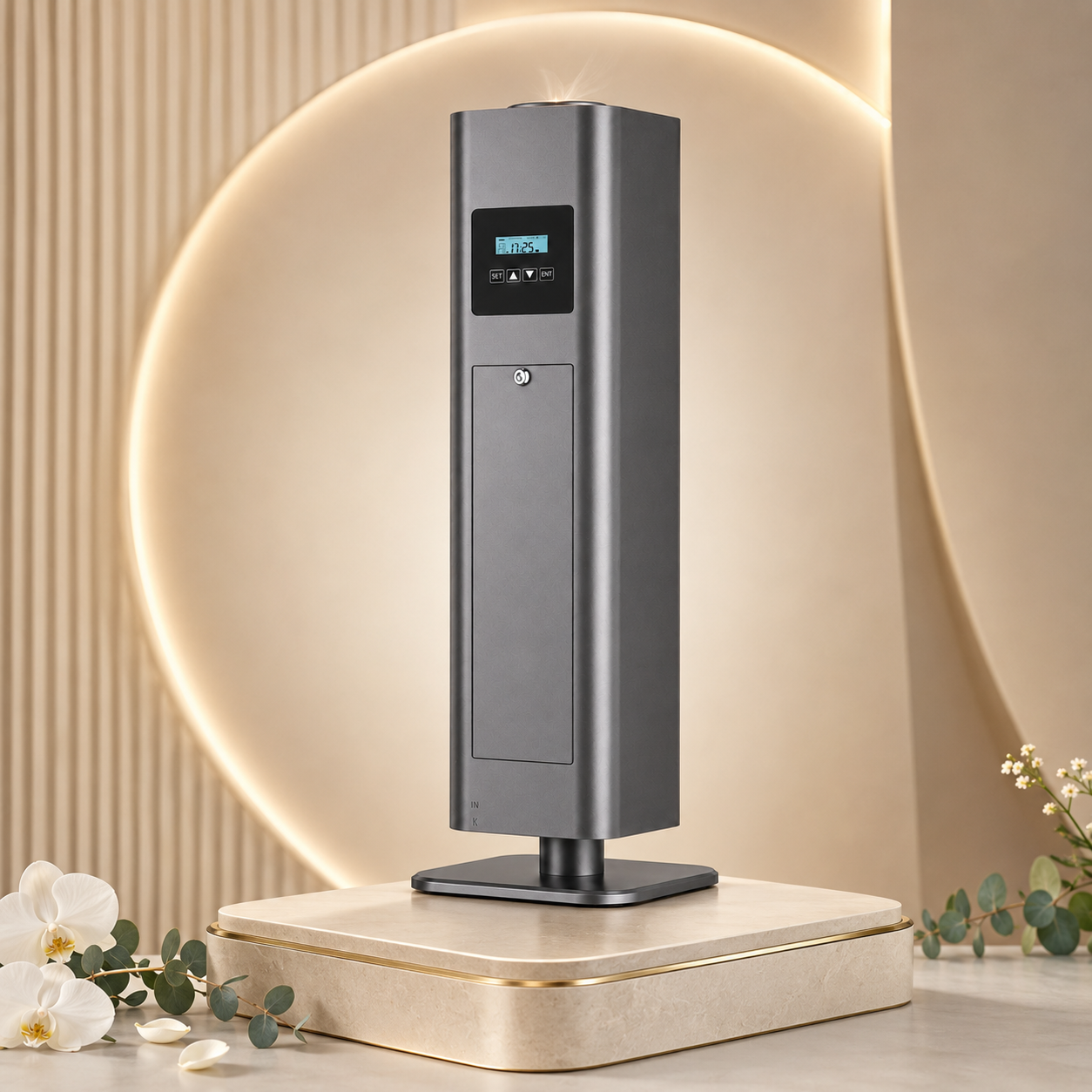
The H5000 is a floor-standing design rated for 800–1300 m², intended for hotel lobbies, mall concourses and similar open commercial volumes.
Model Comparison: H5000, 4705 and P02 at a Glance
| Specification | H5000 | 4705 | P02 |
|---|---|---|---|
| Coverage | 800–1300 m² / 2500–4000 m³ / 8600–14000 ft² | 100–150 m² / 300–500 m³ / 1000–1600 ft² | 150–350 m² / 500–1000 m³ / 1500–3500 ft² |
| Oil capacity | 1000 ml | 500 ml | 300 ml |
| Oil consumption | 5.4 ±10% ml/h | Not stated in this specification | 2.5 ±10% ml/h |
| Power supply | DC 12V, plug-in | 5V; four D batteries or Type-C | DC 12V, plug-in |
| Power consumption | 20 W | 2.5 W | 6.5 W |
| Noise | Below 45 dB | Below 35 dB | Below 30 dB |
| Net / gross weight | 6.4 kg / 7.1 kg | 0.55 kg / 0.8 kg | 0.8 kg / 1 kg |
| Packing size | L190 × W190 × H700 mm | L280 × W83 × H200 mm | L276 × W176 × H98 mm |
Published specifications for three commercial models. Figures are model-level and should be confirmed against the exact configuration ordered.
From Specification to Acceptance Criteria
The point of a specification is that it can be checked. The following acceptance sequence converts the published data above into steps a procurement team can run at sample review and at incoming inspection.
1. Verify the identity of the unit
- Confirm model, voltage and power on the nameplate against the purchase order: DC 12V / 20 W for the H5000, 5V / 2.5 W for the 4705, DC 12V / 6.5 W for the P02.
- Confirm oil bottle capacity: 1000 ml (H5000), 500 ml (4705), 300 ml (P02).
- Confirm that certificates and test reports name the exact production model being purchased, not a similar model in the range.
2. Verify consumption, noise and output on a sample
- Run a timed consumption check at the site's intended schedule and compare the measured rate with the published figure, allowing for the stated ±10% tolerance.
- Measure noise at the intended installation position and confirm the unit sits within its rated band: below 45 dB (H5000), below 35 dB (4705), below 30 dB (P02).
- Check atomization consistency, leakage and control functions, including APP scheduling and intensity adjustment.
3. Use weights and packing data as a physical check
Net and gross weights provide a simple incoming inspection reference. The difference between net and gross weight — 0.7 kg for the H5000, 0.25 kg for the 4705 and 0.2 kg for the P02 — covers packaging and accessories, so a carton weighing materially outside that pattern indicates a missing or incorrect item. Packing dimensions serve the same purpose for logistics: L190 × W190 × H700 mm for the H5000, L280 × W83 × H200 mm for the 4705 and L276 × W176 × H98 mm for the P02 allow carton counts, pallet planning and freight volumes to be calculated before shipment rather than after arrival.
4. Require the quality evidence that the specification implies
For bulk commercial orders, the documented pre-shipment sequence at Scentsea covers 100% functional testing, atomization testing, leakage inspection, noise testing, APP and control testing, a 48-hour aging test and a final appearance inspection. Commercial terms that belong in the same review include a lead time of 25–35 days, monthly capacity of 8,000 units, a MOQ from 1 unit for diffusers and a one-year free warranty on spare parts. For wireless configurations, CE and RoHS documentation applies in the EU and FCC in the US, with RED requirements relevant to Bluetooth or Wi-Fi models — always matched to the exact configuration ordered.
5. Account for the import classification
Commercial scent diffusers are classified under HS Code 8509.80, and the applicable US duty rate is 4.2%. Landing cost models should use the classification and duty figure alongside the unit specification, because a lower-priced machine with a heavier carton or a different configuration can erase its own advantage in freight and duty terms.
Troubleshooting Checklist for the First Weeks of Operation
Most early complaints fall into four categories: the device does not work, there is no atomization, abnormal noise appears, or atomization becomes weak. Each has a short diagnostic path that should be completed before any component is replaced.
- Device does not work: check the power supply, confirm the machine is powered on, verify the working-hour settings, and check whether the air pump terminal is properly connected.
- No atomization: check whether the pump is working, inspect the nozzle for blockage, and confirm that the pump tube and pipette are properly connected and not damaged.
- Abnormal noise: check whether the pump is loose and secure it again; if the pump is abnormal, replace it. Also inspect internal parts for looseness and refix them if necessary.
- Weak atomization: check whether the pump is aging, clean or replace a blocked nozzle, and confirm that the fragrance oil is not too thick and does not contain impurities.
Two of these four causes relate directly to fragrance oil condition rather than to hardware. That is why oil compatibility belongs in the acceptance checklist, not only in the maintenance manual: a suitable fragrance oil is a stated requirement of the application, and viscosity or impurities will surface as a performance issue rather than as a specification failure.
Cold-Air Nebulizing and Water-Based Ultrasonic Diffusion: Where Each Fits
Commercial scenting is frequently compared against ultrasonic water-based aroma diffusers, which mix a few drops of oil into water. The two technologies solve different problems. Waterless cold-air nebulizing atomizes fragrance oil directly, with no water dilution and no heat, which supports stronger and more consistent diffusion over larger areas and reduces daily refilling and tank cleaning. Ultrasonic water-based units have a lower purchase cost and suit small residential spaces and light personal use, but they require regular water refilling and tank cleaning and are less suited to continuous professional scenting across a large commercial space.
The trade-off is honest in both directions: waterless cold-air equipment generally carries a higher initial equipment cost, and that cost is recovered through lower daily maintenance and more consistent output rather than through the purchase price. Buyers comparing commercial scenting solutions against domestic alternatives should compare total operating effort, not sticker price.
There are also boundaries inside this model family that should be stated plainly. The 4705's oil consumption rate is not published in the referenced specification, so its runtime must be measured on site rather than calculated from capacity. The P02 depends on a nearby power outlet because it is a plug-in unit. And the H5000, at 6.4 kg net and 610 mm tall, needs floor space and a stable position, which is a constraint in compact retail units even though it removes the need for wall installation.
What the Market Data Suggests
The commercial scenting category continues to expand. The global scent marketing market is valued at approximately USD 4.1 billion in 2026 and is projected to reach USD 7.28 billion by 2035, a CAGR of 6.6% according to Cognitive Market Research and Vertex AI industry data. Forecasts vary by how broadly the category is defined — narrower definitions of commercial scenting services produce higher growth rates than figures that include consumer air-care products — so buyers and investors should compare the scope of a forecast, not only its headline number.
On the technology side, cold-air nebulizing diffusion atomizes fragrance oils into sub-micron particles below 2.5 μm without heat or water, which is the mechanism behind the waterless operation described above. On the demand side, one secondary industry analysis reports that scent marketing in retail environments can increase customer dwell time by an average of 15 minutes. That figure comes from a secondary compilation and should be treated as a directional signal rather than a controlled result.
Future Outlook: Spec-Led Buying and Remote Management
Two shifts are visible in commercial scenting procurement. The first is a move from atmosphere-led sales conversations to specification-led reviews, in which buyers compare published consumption rates, noise bands, power consumption and packing data before discussing fragrance. The second is the normalisation of remote management: app scheduling is already standard on models such as the 4705 and P02, and Wi-Fi plus Bluetooth control appears on the P02 as an option and on larger HVAC-oriented systems for multi-site operation.
Both shifts favour manufacturers who publish verifiable figures and can supply test evidence per model. They also raise the bar for buyers, because a specification that cannot be measured at incoming inspection is effectively a claim rather than a criterion.
FAQ: Commercial Scenting Questions Buyers Ask Most
What is a waterless cold-air scent diffuser?
A waterless cold-air scent diffuser is a device that atomizes fragrance oil directly into fine airborne particles without adding water and without using heat. It is used to create consistent fragrance coverage in residential and commercial spaces such as hotels, retail stores, offices and shopping malls.
How does cold-air atomization work?
The atomization system uses controlled airflow and pressure to break fragrance oil into fine particles, which are then dispersed into the air or through an HVAC system. Because the oil is neither diluted in water nor heated, diffusion is direct, and working schedules and output intensity can be adjusted to match the space and its airflow conditions.
Waterless cold-air or ultrasonic water-based — which suits commercial use?
For commercial use, waterless cold-air diffusion is generally the better fit because it provides stronger and more consistent diffusion, larger coverage, no water dilution and lower daily maintenance, which matters in hotels, malls, retail stores, offices and showrooms. Ultrasonic water-based diffusers are more suitable for small rooms and light personal use, and are less suited to large commercial spaces or continuous professional scenting.
What certifications should be verified for commercial scent diffusers?
Requirements depend on the destination market, the product model and whether the unit has wireless functions. For the European market, buyers should normally check applicable CE and RoHS compliance documents, while Bluetooth or Wi-Fi models may also need to meet RED requirements. For the US market, applicable FCC compliance should be verified. Certificates and test reports should match the exact production model and configuration being purchased.
How should a buyer choose between diffuser models for different space sizes?
Selection should follow actual space size, ceiling height, airflow, installation conditions and control requirements rather than the maximum rated coverage alone. Compact models suit small rooms; battery-powered models such as the 4705 suit elevators, washrooms or positions where wiring is inconvenient; the P02 suits small to medium commercial spaces of roughly 150–350 m² requiring stronger diffusion and smart control; and higher-output or floor-standing models such as the H5000 suit large open spaces of roughly 800–1300 m², with dedicated HVAC scenting systems preferred for large centralised projects.
What quality risks should be checked before a bulk order?
The main risks are unstable atomization, oil leakage, excessive noise, unreliable control functions and inconsistent batch performance. Buyers should verify sample performance, quality control procedures, aging tests, certifications, warranty terms and spare parts support, and should confirm that measured oil consumption and noise on a sample match the published model figures within their stated tolerance.
Model-level specifications referenced in this article, including coverage, capacity, voltage, power, oil consumption, noise, weights and packing dimensions, are documented in the SCENTSEA product catalog (PDF) and published on scent-sea.com.
Есть вопросы или нужны дополнительные детали?
Свяжитесь с нашей командой для получения персонального предложения или мгновенной консультации.
Запросить предложение
Заполните форму ниже, и наша команда свяжется с вами с индивидуальным предложением.
Прямой чат WhatsApp
Предпочитаете общаться в реальном времени? Напишите нам в WhatsApp для мгновенной помощи и быстрых ответов.
- Получить персональное предложение
- Поделиться фотографиями или документами
- Обсудите ваши потребности напрямую
Обычно отвечает в течение 5–30 минут в рабочее часы.