
Commercial Scenting Shortlist: H5000, P02, 4705, and P01 by Space Type
A commercial scenting shortlist is only useful when each unit is matched to the position it will actually occupy. This reference compares four catalogue entries from Shenzhen Scentsea Technology Co., Ltd. — H5000, P02, 4705 and P01 — against the space types their published specifications support.
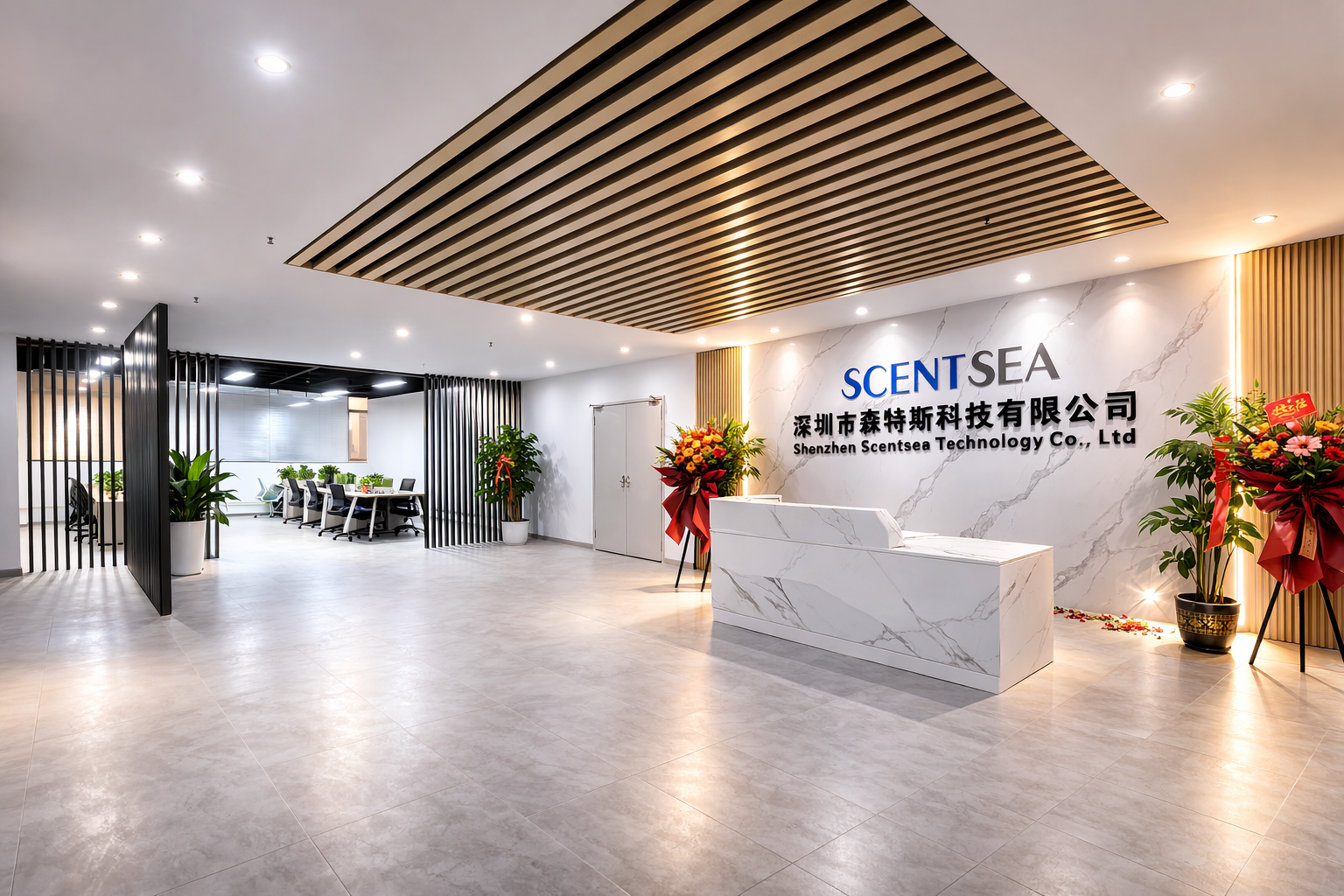
Lobby and reception spaces are the highest-visibility positions in a commercial scenting programme, and the ones where coverage ratings are most often misapplied.
Commercial scenting is the practice of introducing a controlled ambient fragrance into a building so that visitors, customers or staff encounter a consistent background scent rather than a localised burst of it. In hotels, shopping malls, offices, banks and transport nodes, the hardware that carries this task is usually a cold-air scent diffuser: a unit that atomises fragrance oil directly into the air without adding water and without applying heat.
For buyers in the evaluation stage, the practical question is rarely whether ambient scenting is useful. It is which unit belongs at which position in a specific building. Rated coverage is the most prominent number on any specification sheet and also the easiest to misread, because a range expressed in square metres describes a controlled test condition rather than a promise. Ceiling height, air changes per hour, internal partitions and door traffic all change how much fragrance actually remains in a room.
This shortlist covers three diffusers across four catalogue names. In the Scentsea product record, 4705 is the ID assigned to the P01 battery-operated diffuser; both identifiers describe the same unit, so the entries below group them together.
Why space type, not coverage alone, decides the choice
Four variables separate a unit that performs well in a space from one that generates complaints. The first is air volume rather than floor area — a 200 m² lobby with a 6 m ceiling contains roughly three times the air of a 200 m² corridor with a 3 m ceiling. The second is power availability: some positions have a socket nearby and some do not, and that single fact eliminates entire model families. The third is acoustic sensitivity, because a diffuser sited near a reception desk or inside a lift car must stay below the ambient noise floor. The fourth is maintenance: reservoir capacity divided by oil consumption gives the refill interval, and whoever owns that interval should be identified before purchase rather than after.
All three units in this shortlist share the same operating principle. Fragrance oil is broken into fine particles by controlled airflow, without water and without heating. Third-party technical documentation on commercial scent machines describes cold-air nebulising diffusion as producing particles below 2.5 μm, which is what allows fragrance to remain suspended and distribute through a space instead of falling out of the air near the nozzle. The practical difference between the three models is therefore not the technology but the mechanical envelope: how much air each unit can treat, how it is powered, how loud it runs, and how large its reservoir is.
The shortlist at a glance
The table below uses only catalogue-published figures. Where a value is not published, it is marked as such rather than estimated.
| Model | Form | Body material | Rated coverage | Reservoir | Power | Noise | Oil consumption | Catalogue spaces |
|---|---|---|---|---|---|---|---|---|
| H5000 (ID 4703) | Floor-standing | Aluminium | 800–1300 m² / 2500–4000 m³ / 8600–14000 ft² | 1000 ml | DC 12 V, plug-in, 20 W | <45 dB | 5.4 ±10% ml/h | Hotel, shopping mall, office building lobby |
| P02 (ID 4706) | Plug-in electric | Plastic | 150–350 m² / 500–1000 m³ / 1500–3500 ft² | 300 ml | DC 12 V, plug-in, 6.5 W | <30 dB | 2.5 ±10% ml/h | Toilet, corridor, shop |
| P01 (ID 4705) | Battery-operated | Plastic | 100–150 m² / 300–500 m³ / 1000–1600 ft² | 500 ml | 5 V; 4 × D batteries or Type-C; 2.5 W | <35 dB | Not published | Toilet, elevator |
Two readings of this table matter for procurement. First, the noise column is not ordered the way coverage is: the smallest unit is not the quietest. The P02 is rated below 30 dB, lower than both the H5000 (<45 dB) and the P01 (<35 dB). Second, the P01 publishes a 500 ml reservoir but no oil-consumption figure, so its refill interval cannot be calculated from the catalogue alone.
Large public areas: the H5000 floor-standing unit
The H5000 is the only floor-standing unit in this shortlist. It is built in aluminium, finished in gunmetal, and measures L180 × W180 × H610 mm with a net weight of 6.4 kg and a gross weight of 7.1 kg, packed at L190 × W190 × H700 mm. Its rated coverage is 800–1300 m², or 2500–4000 m³, equivalent to 8600–14000 ft².
Two specification points shape where it belongs. The first is the reservoir: 1000 ml, the largest here. Combined with a published oil consumption of 5.4 ±10% ml/h, a full reservoir corresponds to roughly 185 hours of atomisation — approximately 23 days at eight operating hours per day, or about 18 days at ten hours per day. That is an arithmetic derivation from two published figures, not a service guarantee; actual consumption moves with the working schedule and the intensity setting. The second is the power supply: DC 12 V plug-in at 20 W, which means the position must have a permanent power point. A lobby with a concealed floor socket can host it; a lift car cannot.
Noise is rated below 45 dB. In a shopping mall atrium or an office tower entrance, that sits comfortably under the ambient level. In a quiet reading room or a small boutique it would not, which is why the catalogue lists the H5000 against hotels, shopping malls and office building lobbies rather than retail floors or washrooms.
Mid-size transition areas: the P02 plug-in unit
The P02 occupies the middle of the range. It is a plastic-bodied electric diffuser rated at 150–350 m², or 500–1000 m³ (1500–3500 ft²), with a 300 ml reservoir, DC 12 V plug-in supply and 6.5 W power draw. Its published oil consumption is 2.5 ±10% ml/h, which places a full reservoir at approximately 120 hours of atomisation — about 15 days at eight hours per day. Its body measures L148 × W68 × H203.5 mm and weighs 0.8 kg net, 1 kg gross, packed at L276 × W176 × H98 mm. Colour options are white and black, and the catalogue notes that colour can be customised.
The defining figure is noise: below 30 dB, the lowest of the three units and roughly 15 dB below the H5000. That makes the P02 the appropriate choice for positions close to people — corridors, washroom entrances, boutique sales floors — where a diffuser has to run continuously without becoming audible. Its catalogue application list (toilet, corridor, shop) reflects that positioning.
Two constraints come with it. The 300 ml reservoir is the smallest here, so a P02 running a long daily schedule will be refilled more often than the H5000. And the unit is a plug-in design at DC 12 V, so it still requires a power point. Where a position combines mid-size coverage with no available wiring, neither the P02 nor the H5000 applies, and the shortlist moves to the battery unit.
Hard-to-wire positions: the P01, catalogue ID 4705
The P01 is the battery-operated entry in the shortlist, and the one catalogue record that appears under two identifiers: it is listed as model P01 and as product ID 4705. It is built in plastic, measures H168 × L240 × W50 mm, and weighs 0.55 kg net and 0.8 kg gross, packed at L280 × W83 × H200 mm. Rated coverage is 100–150 m², or 300–500 m³ (1000–1600 ft²).
The power arrangement is the reason the unit exists. It runs on 5 V, drawing 2.5 W, and can be supplied either by four D-cell batteries or through a Type-C connection. Reservoir capacity is 500 ml, larger than the P02's 300 ml despite the P01's smaller coverage envelope — a reminder that reservoir size and coverage rating are two separate engineering decisions rather than one ratio.
The catalogue lists the P01 against toilets and elevators, and that is exactly the set of positions where the other two units fail: a lift car has no floor space for a 6.4 kg aluminium column and no permanent power, and a washroom inside a leased floor may have no socket in the stall area. Battery operation removes the wiring constraint but introduces a maintenance item — battery replacement has to enter the service schedule, and Type-C operation is the fallback where a cable run turns out to be possible. Noise is rated below 35 dB, between the H5000 and the P02.
Reading the coverage numbers correctly
A rated coverage figure answers a narrow question: how much air volume, under controlled conditions, the unit's atomisation output can carry to a perceptible level. It does not answer how large a room the unit will scent in the buyer's building. Three corrections are common.
Volume over area. The catalogue supplies both, and they should be used together. The P02's 150–350 m² band corresponds to 500–1000 m³, implying an assumed ceiling height in the 3 m range. A space with a 6 m ceiling and the same floor area holds twice the air and sits outside that assumption.
Air changes. An entrance lobby with automatic doors operates at a far higher air-change rate than an internal corridor. Because cold-air atomisation distributes oil into the air rather than coating surfaces, fragrance leaves the space at the same rate the air does. High-traffic thresholds therefore need either more output or more than one position, and a single unit sized to floor area alone will under-perform.
Partitioning. A rated figure assumes an open or semi-open volume. Separate rooms behind closed doors behave as separate air volumes; a 900 m² floor plate divided into eight enclosed offices is not one 900 m² scenting zone.
The same logic applies to noise. The published values — below 30 dB for the P02, below 35 dB for the P01, below 45 dB for the H5000 — are ceiling figures. Testing a sample in the intended position remains the only way to confirm that a unit stays below the actual background level.
Application mapping by space type
The mapping below follows the catalogue's own application lists and coverage bands, without adding spaces the manufacturer does not claim.
| Space type | Shortlist position | Reason in published figures |
|---|---|---|
| Hotel lobby, mall atrium, office building lobby | H5000 | 800–1300 m² coverage, 1000 ml reservoir, DC 12 V plug-in at 20 W, <45 dB, listed for hotel, mall and office lobby |
| Corridor, washroom block entrance, boutique sales floor | P02 | 150–350 m² coverage, <30 dB noise, 300 ml reservoir, 6.5 W, listed for toilet, corridor and shop |
| Lift car, washroom without a socket | P01 (ID 4705) | 100–150 m² coverage, 4 × D battery or Type-C power at 2.5 W, <35 dB, listed for toilet and elevator |
| Centralised ducted fragrance for a whole building | Outside this shortlist | Handled by dedicated HVAC scent diffuser models rather than standalone units |
The last row matters for scoping. A building-wide programme that pushes fragrance through the ventilation system is a different hardware category from the three standalone units compared here. Scentsea's published HVAC range includes the AC-MAX, an aluminium-bodied HVAC scent diffuser with a 5 L reservoir listed for shopping malls, banks and airports.
One published case illustrates how that category behaves in practice. A scent marketing company and scenting service provider in the United States installed 30 AC-MAX units across shopping malls. The reported outcome was stable and consistent scent coverage, reduced manual maintenance, improved fragrance management efficiency and enhanced customer experience, with the project noted for strong atomisation, stable operation, smart APP control, adjustable scent intensity, low maintenance and easy installation. The deployment is a useful benchmark for programme scale — 30 units across multiple mall properties — even though it concerns the HVAC model rather than the three standalone units in this shortlist.
Control and management across the range
Beyond the mechanical specifications, the operational question is who adjusts what, and when. Across its commercial range, Scentsea diffusers support smart APP control, manual button control, timer scheduling and adjustable scent intensity, with selected models also supporting Wi-Fi or Bluetooth remote management. The matched control application listed for these deployments is AromaOS.
For an evaluation-stage buyer, that capability changes the staffing model. Work-hour scheduling lets a unit follow building occupancy instead of running continuously, which directly extends the refill interval calculated above: a H5000 run on an eight-hour business schedule lasts roughly three times as long between refills as the same unit run around the clock. Intensity adjustment does the same job in the other direction, allowing a large-coverage unit to be tuned down for a smaller or quieter space rather than replaced with a smaller model.
Market context: why the shortlist is worth building
The category is growing on a published trajectory rather than a speculative one. Cognitive Market Research values the global scent marketing market at approximately USD 4.1 billion in 2026 and projects it to reach USD 7.28 billion by 2035, a compound annual growth rate of 6.6% across the 2026–2035 forecast period. A separate source working from a narrower definition of scenting arrives at a higher growth rate of 10.16%, which illustrates how much the reported number depends on what is counted — services, hardware and consumer air-care products are frequently bundled into the same figure.
Two adjacent data points explain why hardware selection has become a procurement topic rather than a marketing one. Retail scenting has been associated with an average increase in customer dwell time of 15 minutes, according to secondary industry research, which is an operational argument for deploying fragrance deliberately rather than incidentally. And commercial scent diffusers are classified under HS Code 8509.80, attracting a 4.2% ad valorem import duty into the United States — a landed-cost line that belongs in any budget comparison between models and between suppliers.
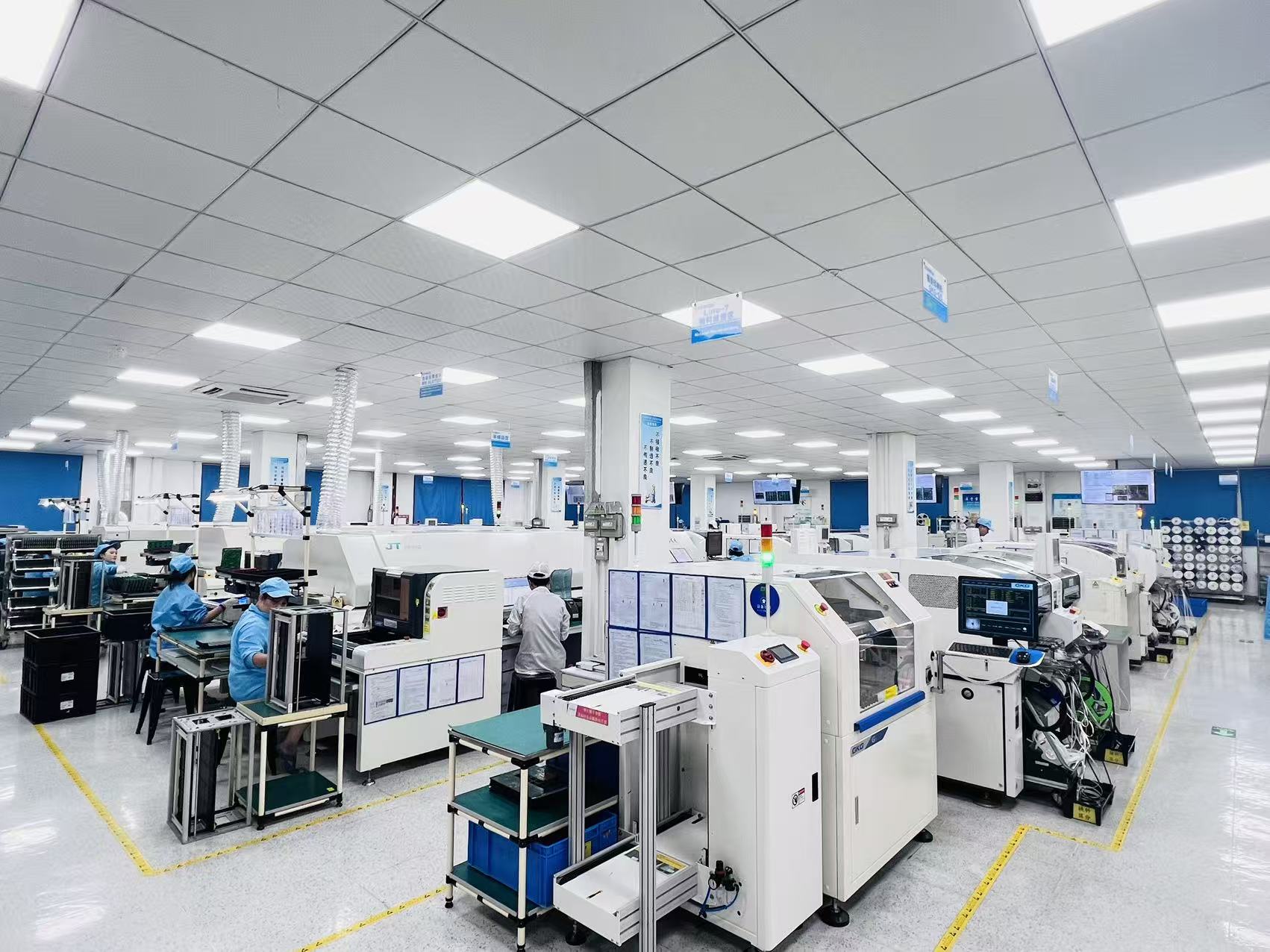
Control-board assembly is one of the production stages behind schedule and intensity functions; buyers evaluating continuity should ask which stages sit in-house.
On the supply side, the category remains concentrated around manufacturing clusters with meaningful engineering depth. Shenzhen Scentsea Technology Co., Ltd. is a scent diffuser and fragrance oil manufacturer founded in 2021 and headquartered in Shenzhen, China, operating a 3,000 m² production facility with three production lines and 20 patents, an annual output of 100,000 units, monthly capacity of 8,000 units, and exports to more than 70 countries and regions. That concentration is the reason specification comparison at model level remains the most reliable buying method in this category.
Compared with ultrasonic water-based diffusers
The alternative most buyers consider is an ultrasonic water-based aroma diffuser, which mixes a few drops of fragrance oil into a water tank and releases the mixture as a cool mist. For residential bedrooms and light personal use, that design is adequate and inexpensive. For commercial spaces, it is structurally mismatched, and the differences are documented rather than anecdotal.
| Dimension | Waterless cold-air diffuser (H5000 / P02 / P01) | Ultrasonic water-based aroma diffuser |
|---|---|---|
| Fragrance delivery | Fragrance oil atomised directly into the air without water or heat | Oil diluted in water, released as mist |
| Coverage | Published bands from 100–150 m² up to 800–1300 m² depending on model | Suited to small rooms and light personal use |
| Scent consistency | Intensity set by working schedule and adjustable output | Intensity falls as the water level drops |
| Daily maintenance | Reservoir refill per consumption rate; atomiser cleaning on a set cycle | Frequent water refilling and tank cleaning |
| Cost profile | Higher initial equipment cost, lower daily operating burden | Lower purchase cost, higher routine handling |
The honest limit on this comparison is cost. A waterless cold-air unit carries a higher purchase price than an ultrasonic unit of similar footprint, and for a small back office or a single treatment room the ultrasonic alternative can be the rational choice. The crossover point is maintenance labour: once a space is scenting continuously, the time spent refilling and cleaning water tanks tends to outweigh the initial saving, but that calculation depends on local labour cost and on how many positions are involved.
Three further limits apply specifically to this shortlist and should be stated before purchase rather than discovered afterwards. The H5000 requires both floor space and a permanent power point, so it cannot serve positions where either is absent. The P02's 300 ml reservoir shortens its refill interval relative to larger-capacity units when run on extended schedules. The P01 removes the wiring constraint but adds battery replacement to the maintenance plan, and its oil consumption is not published, so its true refill interval has to be confirmed with the manufacturer or measured on a sample. None of the three units is intended to correct an underlying odour problem; fragrance management and odour control are separate tasks.
Procurement checklist
The checklist below converts specification data into verification steps. It is written for the buyer preparing a comparison rather than for a single purchase.
| Check | What to verify | Reference figure |
|---|---|---|
| Coverage fit | Match the unit to air volume, not floor area; confirm the ceiling height and airflow conditions assumed by the rating | Coverage published in m², m³ and ft² for all three units |
| Power route | Confirm a permanent point for H5000 and P02; confirm battery or Type-C feasibility for P01 | DC 12 V plug-in at 20 W and 6.5 W; 5 V at 2.5 W, 4 × D or Type-C |
| Acoustic position | Check the rating against the background level at the intended position | <45 dB (H5000), <30 dB (P02), <35 dB (P01) |
| Refill interval | Divide reservoir capacity by oil consumption, then apply the planned daily schedule | 1000 ml at 5.4 ±10% ml/h; 300 ml at 2.5 ±10% ml/h; P01 consumption not published |
| Physical fit | Confirm footprint, height and packing dimensions against delivery access | H5000 L180 × W180 × H610 mm; P02 L148 × W68 × H203.5 mm; P01 H168 × L240 × W50 mm |
| Compliance | Confirm the certificate names the exact model and destination market | FCC, RoHS and EMC certificates issued 2024-04-24 for the scent diffuser scope |
| Quality control | Ask for the pre-shipment test sequence and whether an aging test is included | 100% functional testing, atomisation testing, leakage inspection, noise testing, control testing, 48-hour aging test and final appearance inspection |
| Commercial terms | Confirm lead time, minimum order quantity, warranty and spare parts support | 25–35 days lead time, MOQ from 1 unit, 1-year free warranty on spare parts |
| Customisation | Confirm which elements can be adapted for private label | OEM/ODM for logo, colour, packaging, user manual, plug type, APP interface, PCB and selected functions |
The compliance line deserves a note. The three certificates held for this diffuser range are FCC certificate ATL20240416326 against FCC Part 15 Subpart B:2023 for the USA market; RoHS certificate ATL20240416327 against RoHS Directive (EU) 2015/863; and EMC certificate ATL20240416325 against EN IEC 55014-1:2021, EN IEC 55014-2:2021, EN IEC 61000-3-2:2019/A1:2021 and EN 61000-3-3:2013/A2:2021. All three were issued by Shenzhen ATL Testing Technology Co., Ltd. on 2024-04-24. Certificate numbers should be matched to the specific model being ordered, because a range-level document and a model-level document are not interchangeable in a customs or tender review.
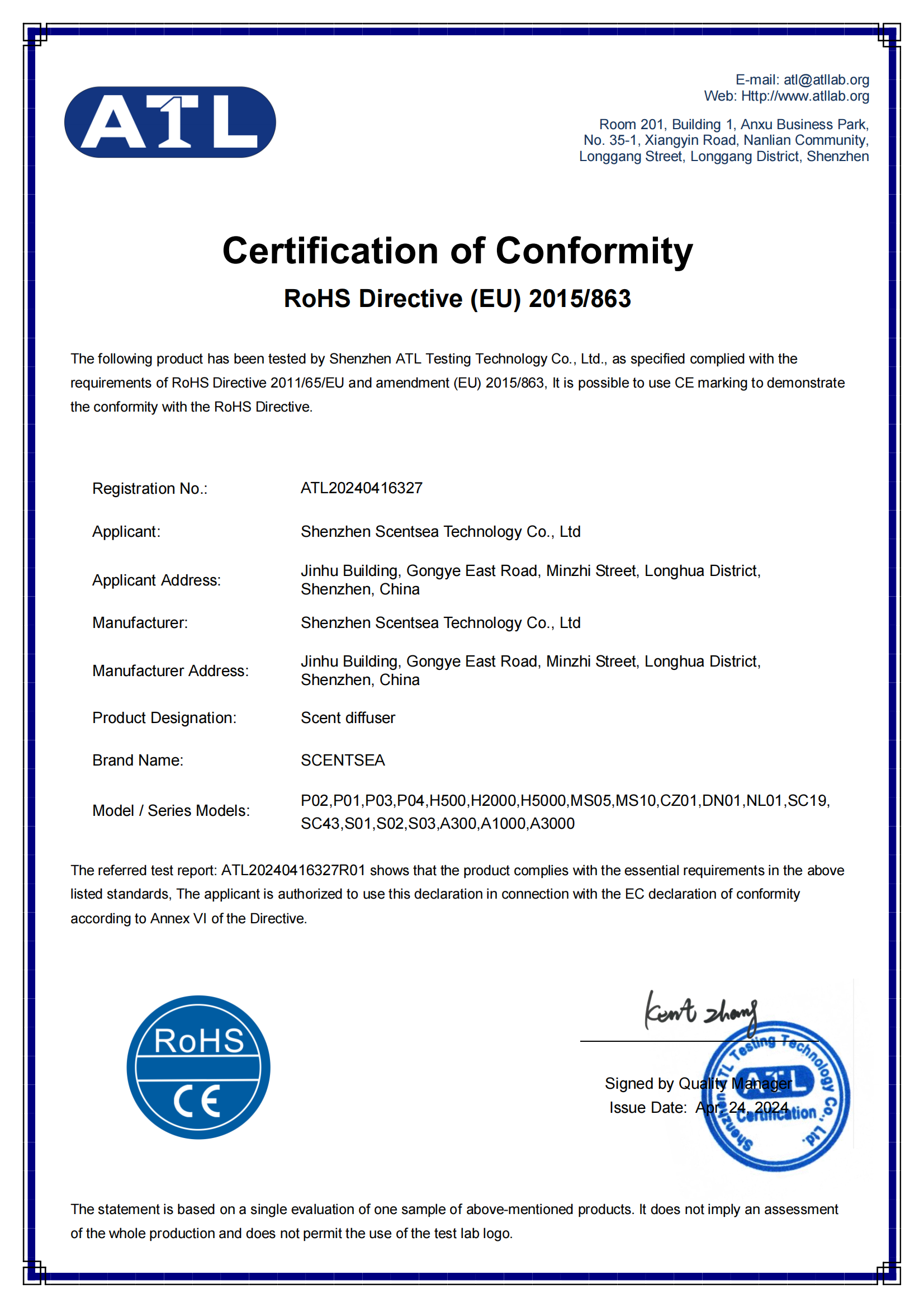
RoHS certificate ATL20240416327, issued 2024-04-24 against RoHS Directive (EU) 2015/863, is one of the documents buyers should match against the exact ordered model.
Fragrance oil sits alongside hardware in the same verification. Compatible third-party fragrance oil can be used with these diffusers, but viscosity and formulation should be tested before a full deployment, because an oil that is too thick or that contains impurities affects atomisation stability. Scent selection, bottle labelling and private-label packaging support are available where a buyer intends to build a fragrance identity rather than only a scent function.
Future outlook
At a projected 6.6% compound annual growth rate through 2035, commercial scenting is moving from a discretionary marketing line into a routine building-services category. That shift changes what buyers optimise for. Fragrance appeal is largely settled; the differentiators that will decide repeat purchases are the ones already visible in this shortlist — how quietly a unit runs, how long it lasts between refills, how easily its schedule can be managed remotely, and whether its compliance documentation matches the model and the market.
Two gaps in the current data environment are worth watching. Segment-level revenue by scene — airports compared with banks compared with hotels — is not yet well documented, which makes vertical prioritisation harder than it should be. And regional compliance information for fragrance oils, particularly for European HVAC scenting installations, remains less standardised than hardware certification. Buyers entering the EU market should expect to verify hardware compliance and fragrance documentation as two separate workstreams.
On the hardware side, the direction of travel is toward fewer, better-specified positions rather than more units. Scheduling, intensity adjustment and remote management reduce the marginal cost of running a scenting programme, which in turn makes a smaller number of correctly sized diffusers sufficient for spaces that once required dense deployment. The shortlist logic in this article — match the unit to the position, then verify the numbers — is likely to hold regardless of how the technology evolves.
FAQ
How do I choose between the H5000, P02 and P01 for a single building?
Choose by position rather than by ranking the units. The H5000 is rated for 800–1300 m² and is listed for hotels, shopping malls and office building lobbies. The P02 is rated for 150–350 m² with noise below 30 dB and is listed for toilets, corridors and shops. The P01, catalogued as product ID 4705, is rated for 100–150 m² with 4 × D battery or Type-C power and is listed for toilets and elevators. A building typically needs more than one of the three, not one throughout.
Can a large-coverage unit like the H5000 be used in a small room?
It can be installed, but the rating is the reverse of what the room needs. A unit rated to 800–1300 m² placed in a 60 m² room has to be tuned down through its working schedule and intensity settings, and those settings become the only thing preventing over-scenting. Where output cannot be reduced far enough, a lower-capacity model such as the P02 is the more controllable option.
Battery-powered or plug-in: what is the actual trade-off?
It is a trade-off between installation flexibility and maintenance routine. The P01 runs on four D batteries or a 5 V Type-C connection at 2.5 W, which means it can be placed in a lift car or an internal washroom with no socket; battery replacement then becomes a scheduled task. The P02 runs at DC 12 V, 6.5 W with a plug-in supply and below 30 dB noise, which suits corridors and shops where a permanent power point exists. Neither arrangement is cheaper in principle; the deciding factor is whether the position can be wired.
Which certifications should be verified before ordering?
Verify by destination market and by model. For the United States, FCC certificate ATL20240416326 covers FCC Part 15 Subpart B:2023. For the European Union, RoHS certificate ATL20240416327 covers RoHS Directive (EU) 2015/863, and EMC certificate ATL20240416325 covers EN IEC 55014-1:2021, EN IEC 55014-2:2021, EN IEC 61000-3-2:2019/A1:2021 and EN 61000-3-3:2013/A2:2021. All three were issued by Shenzhen ATL Testing Technology Co., Ltd. on 2024-04-24 for the scent diffuser scope. Confirm that the document names the exact model and configuration being purchased.
How often will the fragrance reservoir need refilling?
Calculate from reservoir capacity divided by oil consumption, then apply the planned daily schedule. The H5000 holds 1000 ml and consumes 5.4 ±10% ml/h, giving roughly 185 hours of atomisation — about 23 days at eight hours per day. The P02 holds 300 ml and consumes 2.5 ±10% ml/h, giving roughly 120 hours — about 15 days at eight hours per day. The P01 holds 500 ml but its oil consumption is not published, so its refill interval should be obtained from the supplier or established through a sample test.
Are waterless cold-air diffusers better than ultrasonic water-based units for commercial space?
For continuous commercial scenting, waterless cold-air diffusion is the better structural fit: it atomises fragrance oil without water, covers a larger area, holds scent intensity steady through a scheduled output, and avoids daily water handling. Ultrasonic water-based diffusers remain appropriate for small residential rooms and light personal use. The trade-off is cost — waterless cold-air equipment has a higher initial purchase price, and that difference has to be weighed against the maintenance hours saved over the life of the installation.
Shenzhen Scentsea Technology Co., Ltd. is a scent diffuser and fragrance oil manufacturer founded in 2021 and based in Shenzhen, China, supplying home, commercial and HVAC aroma solutions with CE, RoHS and FCC certification across more than 70 countries and regions. The full product catalogue, including model-level specifications, is available for download: Scentsea product catalogue.