
Commercial Scenting Solutions for Large Venues: Coverage, Control and Compliance
The commercial scenting market is moving beyond simple air freshening and becoming a structured element of brand experience. Industry data values the global scent marketing market at approximately USD 4.1 billion in 2026, with projections reaching USD 7.28 billion by 2035 at a CAGR of 6.6%. For procurement managers, facility directors, and brand owners, the shift means commercial scenting solutions must be evaluated with the same rigor as lighting or HVAC systems: measurable coverage, technical reliability, regulatory compliance, and clear maintenance parameters.
The Problem: Why Large Venues Require Dedicated Scenting Systems
Hotels, shopping malls, airports, and large office complexes present challenges that consumer-grade aroma diffusers cannot solve. High ceiling volumes, interconnected HVAC networks, and demanding continuous operation create a need for professional hardware that atomizes fragrance efficiently across areas ranging from 500 to over 3,000 square meters.
The core requirement for such venues is consistency. A scent marketing program fails if the fragrance is detectable at the reception desk but absent in the elevator lobby. Large venues, therefore, benefit from commercial scenting systems that integrate with air handling units or use strategically placed high-output standalone machines. According to SCENTA's technical documentation, cold-air nebulizing diffusion technology atomizes fragrance oils into sub-micron particles (<2.5μm) without heat or water, allowing efficient suspension in air and consistent distribution through existing airflow.
Technical Foundation: Cold-Air Atomization in Commercial Scent Diffusers
Most professional commercial scent diffusers operate on a waterless cold-air principle. Unlike ultrasonic diffusers that require water and frequent cleaning, cold-air atomizers use controlled airflow and pressure to convert pure fragrance oil into fine particles. The advantages for commercial operators include stronger scent output, no water dilution, lower daily maintenance, and the ability to schedule intensity levels via smart controls.
When evaluating a system, buyers should look at three technical factors: atomization efficiency, oil delivery, and control architecture. SCENTSEA, a Shenzhen-based manufacturer, builds its product line around these factors. Founded in 2021 and operating a 3,000 m² production facility with an annual capacity of 100,000 units, SCENTSEA specializes in cold-air scent diffusers and fragrance oils for home, commercial, and HVAC applications.
Key Procurement Criteria for Commercial Scenting Solutions
For buyers in the research and evaluation stage, commercial scenting systems need to be assessed on concrete parameters rather than marketing claims. The following criteria are critical for system selection:
- Coverage Area: Measured in square meters and cubic meters. A model rated for 100 m² cannot adequately serve a hotel lobby. Venues need accurate calculations based on ceiling height and airflow, not just floor area.
- Fragrance Oil Capacity: Larger reservoirs reduce maintenance frequency. For large-scale deployments, capacities of 1,000 ml to 5 liters are preferable in high-traffic venues.
- Noise Level: In hospitality and office environments, noise above 45 dB may disturb guests or staff. Quiet operation (<40 dB) is critical for front-of-house zones.
- Control and Monitoring: Smart APP control, scheduling, and adjustable scent intensity are now expected in professional systems.
- Installation Flexibility: Whether a system can be wall-mounted, floor-standing, or connected to HVAC ducts affects project planning.
- Regulatory Certification: Destination markets dictate requirements—typically CE and RoHS for the EU, and FCC for the United States.
Manufacturer Deep Dive: SCENTSEA's Commercial Product Portfolio
Shenzhen Scentsea Technology Co., Ltd (SCENTSEA) has built a product portfolio that covers the spectrum of large-space scenting, allowing integrators and distributors to source multiple system types from a single manufacturing partner. All SCENTSEA diffuser models are certified with CE, RoHS, and FCC, and are manufactured under one roof in Shenzhen.
HVAC-Integrated Scenting for Large Buildings
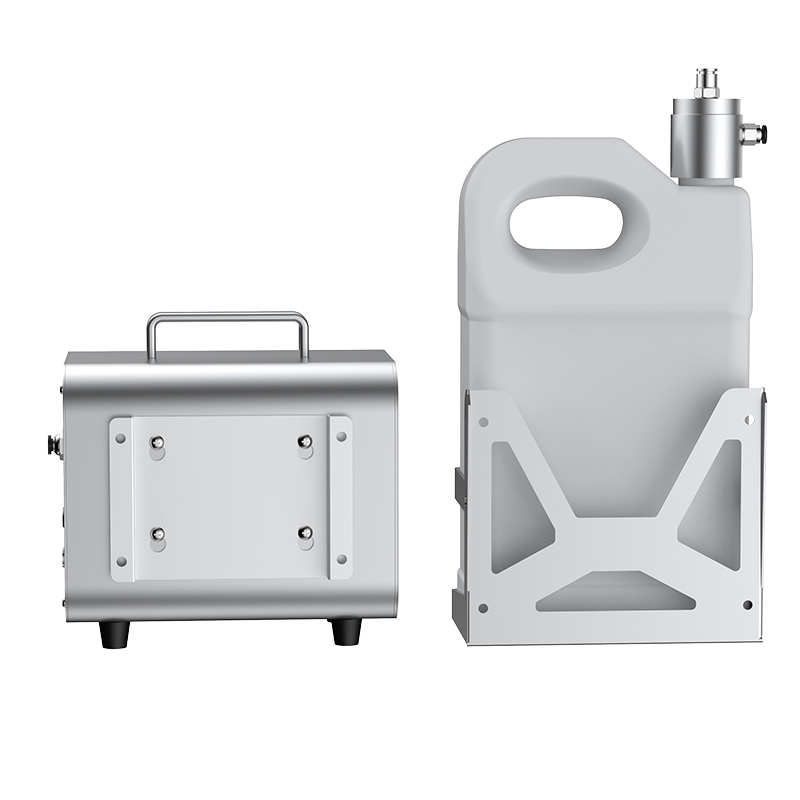
The AC-MAX is a dedicated HVAC scenting solution designed for approximately 2,500–3,500 m². It features a split-type structure with a separate 5-liter oil tank, allowing installation near air handling units. The AC-MAX connects directly to central HVAC ducts, distributing fragrance through the building's existing airflow system. It runs on DC12V with 48W power, maintains noise levels below 45 dB, and supports Wi-Fi and Bluetooth smart control with password protection for professional project management. An optional airflow sensor can synchronize scenting with HVAC operation, making it suitable for shopping malls, banks, and airports.
High-Output Standalone Diffusers
For venues without centralized ducting, high-output standalone commercial scent diffusers provide a practical solution.
- T3 Commercial Scent Diffuser: Covers approximately 1,000–1,600 m² with a 1,000 ml capacity. The T3 features strong cold-air atomization, smart APP control, and durable acrylic-and-steel construction, making it ideal for large halls, event venues, and high-traffic commercial spaces.
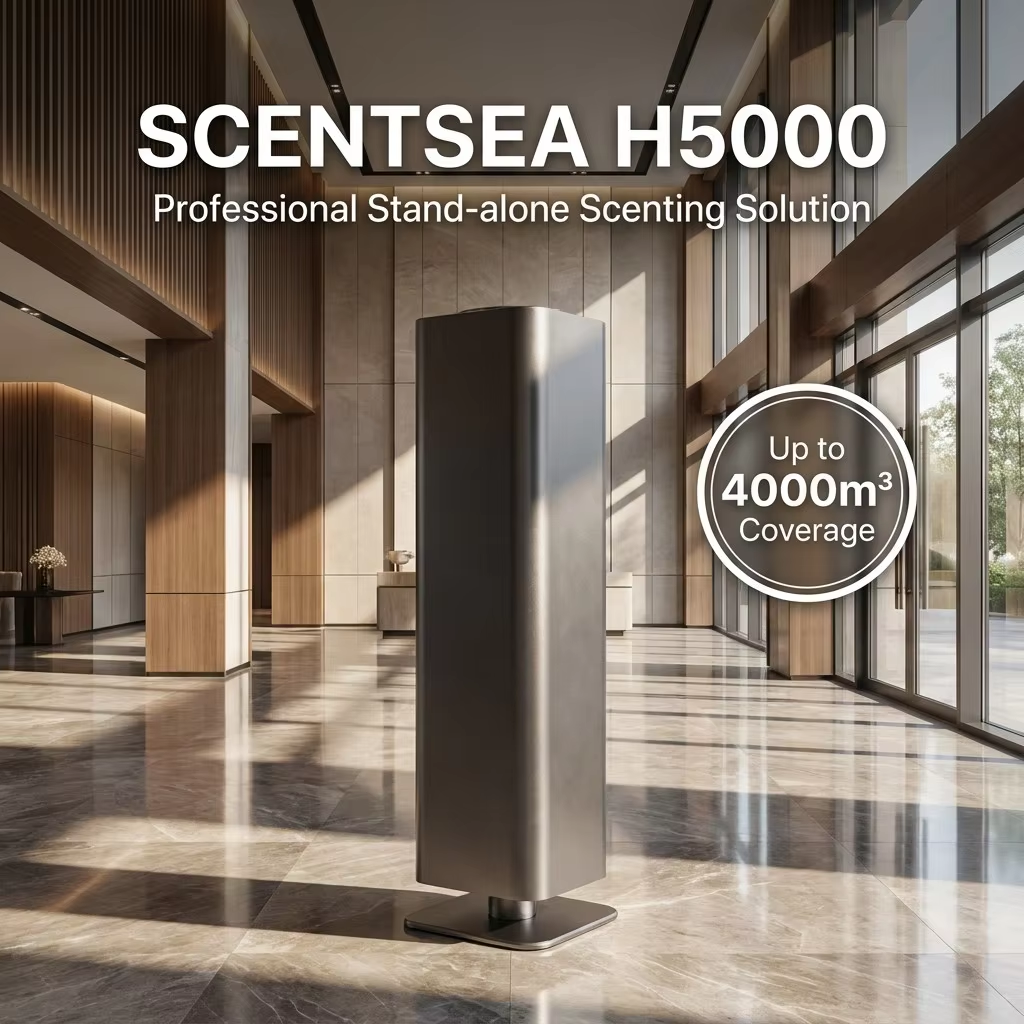
- H5000 Floor-Standing Scent Diffuser: Designed for open lobbies and reception areas of 800–1,300 m². The H5000 uses an elegant aluminum floor-standing design—no wall installation required—with a 1,000 ml capacity and quiet operation below 45 dB. It is particularly effective in hotel lobbies, showrooms, and large public areas.
Mid-Range Commercial Diffusers
For spaces in the 500–800 m² range, SCENTSEA offers two models with different user interfaces.
- A300 Commercial Scent Diffuser: Features a TFT color touch screen and a built-in fan for faster, more even scent distribution. With a robust metal housing and 500 ml capacity, the A300 is suited for hotel lobbies, retail stores, banks, and showrooms.
- T2 Commercial Scent Diffuser: Uses an acrylic and steel housing and supports both standalone and HVAC-duct-connected installation. The T2 is optimized for offices, stores, hotels, and medium HVAC scenting projects.
Compact and Specialty Commercial Systems
Effective commercial scenting often requires coverage of ancillary zones like washrooms, elevators, and corridors.
- P01 and P03 Battery-Operated Diffusers: Designed for locations where wiring is inconvenient. The P01 offers a large 500 ml capacity, while the P03 provides a compact 150 ml solution. Both support 4×D batteries or Type-C power and come with lockable covers for public environments.
- P02 Electric Diffuser: Plugs into standard outlets and covers 150–350 m², making it suitable for retail stores, corridors, cinemas, and commercial washrooms.
- SC19 Advertising Scent Machine: Combines an 18.5-inch digital display with 150–250 m² scent coverage. This unique unit creates both visual and olfactory brand experiences, ideal for elevators, bank lobbies, retail stores, and shopping malls looking to merge digital advertising with scent marketing.
Comparing Commercial Scenting System Types
| Model | System Type | Coverage | Oil Capacity | Noise | Typical Applications |
|---|---|---|---|---|---|
| AC-MAX | HVAC Split | 2500–3500 m² | 5 L | <45 dB | Malls, Banks, Airports |
| T3 | Standalone | 1000–1600 m² | 1000 ml | <55 dB | Malls, Hotels, Airports |
| H5000 | Floor-standing | 800–1300 m² | 1000 ml | <45 dB | Hotel Lobbies, Offices |
| T2 / A300 | Standalone / Duct-ready | 500–800 m² | 500 ml | <45 dB / <40 dB | Cinemas, Retail, Hotels |
| SC19 | Advertising + Scent | 150–250 m² | 500 ml | ≤30 dB | Elevators, Banks, Exhibitions |
| P02 | Plug-in | 150–350 m² | 300 ml | <30 dB | Retail Stores, Corridors |
| P01 / P03 | Battery / Type-C | 100–150 m² | 500 / 150 ml | <35 dB | Toilets, Elevators |
Application Insights: Scenting for Specific Industries
Commercial scenting systems perform differently depending on the venue's air volume, traffic patterns, and operational goals.
Hotels
Hotels require a layered approach. In public areas like lobbies, floor-standing units such as the H5000 offer an elegant, visible presence. For guest corridors, compact diffusers like the P02 or P03 maintain subtle fragrance without drawing attention. Where hotels use centralized air handling, the AC-MAX can distribute a consistent signature scent across lounges, restaurants, and meeting rooms.
Retail Stores and Shopping Malls
In retail, scenting aims to enhance dwell time and brand recall. Industry research suggests scent marketing in retail environments can increase customer dwell time by an average of 15 minutes. For multi-tenant environments like malls, HVAC-integrated systems are preferred because they avoid disrupting storefront aesthetics. The SCENTSEA portfolio supports this with the AC-MAX for mall-wide scenting and the SC19 for individual storefronts that want to combine advertising with fragrance.
Airports and Banks
These environments demand uninterrupted operation and low maintenance. Security considerations in airports mean diffusers should be lockable and robust. The AC-MAX and T3, with their large oil reservoirs and professional control functions, are designed for institutional reliability, minimizing the frequency of on-site intervention.
Case Study Evidence: Scent Marketing Company in the US
A sourcing case from SCENTSEA's client records illustrates how commercial scenting solutions are deployed in practice. A US-based scent marketing company and service provider ordered 30 units for shopping mall scenting projects. The deployment included AC-MAX HVAC diffusers for central air handling and supporting units for smaller zones. Reported outcomes over the course of the project included stable and consistent scent coverage, reduced manual maintenance, improved fragrance management efficiency, and enhanced customer experience. Key highlights cited by the client were strong atomization, stable operation, smart APP control, adjustable scent intensity, and easy installation.
Cold-Air Scent Diffuser vs. Ultrasonic Aroma Diffuser
Buyers evaluating long-term commercial scenting solutions often compare waterless cold-air systems with ultrasonic water-based diffusers.
| Factor | Waterless Cold-Air System | Ultrasonic Water-Based System |
|---|---|---|
| Coverage | Large areas possible (up to 3,500 m²) | Primarily small, residential spaces |
| Maintenance | Lower daily maintenance, no water refilling | Requires regular water refilling and tank cleaning |
| Scent Strength | Consistent and strong | Lighter, may be diluted by water |
| Ideal Use Case | Hotels, malls, offices, showrooms, spas | Bedrooms, small rooms, light home fragrance use |
A key boundary exists in cost structure: cold-air systems typically have a higher initial equipment cost, but lower daily operational overhead. Ultrasonic diffusers have a lower purchase price but require more frequent consumables and cleaning, which can accumulate operational costs in commercial settings.
Compliance and Certification in Commercial Scenting
Certification requirements are a common source of friction in cross-border procurement. For products sold into the European market, buyers should verify applicable CE and RoHS compliance documents. EMC certification under EN IEC 55014-1:2021 covers electromagnetic compatibility. Bluetooth or Wi-Fi enabled models may also need to satisfy RED requirements. For the US market, FCC compliance (Part 15 Subpart B) is mandatory. SCENTSEA's commercial diffusers are backed by certificates issued by Shenzhen ATL Testing Technology Co., Ltd., including FCC (ATL20240416326), RoHS (ATL20240416327), and EMC (ATL20240416325). Buyers should always confirm that certification documents reference the specific production model being supplied.
OEM/ODM and Supply Chain Reliability
For distributors and scent marketing companies, the ability to private-label and customize hardware is often as important as the hardware itself. SCENTSEA provides OEM/ODM services covering logo customization, color changes, packaging, user manuals, plug types, APP interfaces, and PCB-level functional adjustments. With a monthly production capacity of 8,000 units and delivery lead times of 25–35 days, the manufacturer is positioned for mid-to-large volume projects. MOQ starts from 1 unit for diffusers, enabling product testing before bulk commitment. Quality control procedures include 100% functional testing, atomization testing, leakage inspection, noise testing, APP/control testing, 48-hour aging tests, and final appearance inspection before shipment.
Future Outlook: Sensory Branding and Smart Systems
The commercial scenting industry is evolving in two directions. First, scent is converging with digital media—illustrated by products like SC19, which merges fragrance diffusion with digital signage. This allows brands to coordinate visual messaging with scent-based emotional triggers. Second, system management is becoming increasingly data-driven. Wi-Fi enabled devices with APP control allow facility managers to schedule intensity by time of day and monitor performance across multiple locations from a centralized interface. As the market grows toward USD 7.28 billion by 2035, hardware standardization, certification rigor, and reliable supply chains will remain the core pillars of the procurement landscape.
FAQ: Commercial Scenting Solutions
Q: How do I choose the right commercial scent diffuser for different space sizes and applications?
A: Choose a commercial scent diffuser based on actual space size, ceiling height, airflow, installation method, oil capacity, noise level, and control requirements. For centralized HVAC distribution in large buildings like hotels or malls, a dedicated system such as AC-MAX is recommended. For medium and large open spaces without ducting, standalone high-output models like T3 or H5000 perform well. For compact areas with difficult wiring, battery-powered models such as P01 or P03 are practical options.
Q: Do commercial scent diffusers need water?
A: No. Waterless cold-air scent diffusers atomize fragrance oil directly without adding water or using heat. This allows stronger and more consistent scent diffusion, larger coverage, and lower daily maintenance compared to ultrasonic water-based diffusers.
Q: Are commercial scent diffusers noisy?
A: Noise levels vary by model and output power. For hotels, offices, and other quiet environments, buyers should check model-specific noise data and test samples prior to installation. Several SCENTSEA commercial models operate below 40 dB, making them suitable for noise-sensitive front-of-house areas.
Q: What certifications are required for commercial scent diffusers?
A: Certification requirements depend on the destination market. CE (EMC) and RoHS compliance are normally required for the European market. Bluetooth or Wi-Fi models may also require RED compliance. For the US market, applicable FCC compliance must be verified. Buyers should confirm that certificates and test reports apply to the exact product model and configuration being purchased.
Q: Are commercial scent diffusers suitable for HVAC systems?
A: Yes. Selected models can connect to HVAC ducts, while dedicated HVAC scenting systems such as SCENTSEA's AC-MAX are available for large centralized projects. The AC-MAX uses a split structure with a 5-liter oil tank and can synchronize scent output with air handling operation via an optional airflow sensor.
For procurement teams seeking detailed technical documentation, OEM qualification, and wholesale pricing for commercial scenting hardware, SCENTSEA's full product catalog and manufacturing specifications can be accessed via the company's official brochure below.
Есть вопросы или нужны дополнительные детали?
Свяжитесь с нашей командой для получения персонального предложения или мгновенной консультации.
Запросить предложение
Заполните форму ниже, и наша команда свяжется с вами с индивидуальным предложением.
Прямой чат WhatsApp
Предпочитаете общаться в реальном времени? Напишите нам в WhatsApp для мгновенной помощи и быстрых ответов.
- Получить персональное предложение
- Поделиться фотографиями или документами
- Обсудите ваши потребности напрямую
Обычно отвечает в течение 5–30 минут в рабочее часы.