
Commercial Tile Solutions: Porcelain vs. Low-Grade Ceramic Data
Commercial Tile Solutions: Porcelain vs. Low-Grade Ceramic Data
Two tiles can leave a factory in the same format, with the same printed pattern and the same box size, and still be different materials. In commercial work that difference decides whether a floor absorbs a decade of trolley traffic, freeze-thaw cycling and industrial cleaning, or whether it appears on a defects list long before the building reaches its first refurbishment cycle.
The working rule for procurement teams is to compare porcelain against low-grade ceramic on declared values that name a test method and a unit — water absorption, breaking strength, modulus of rupture, surface hardness and abrasion resistance — rather than on appearance or on the lowest square-metre price in the tender. A vitrified porcelain tile specified at water absorption below 0.5 % under ISO 13006 / EN 14411 (Group BIa), a breaking strength of at least 1300 N and a modulus of rupture of at least 35 MPa sits in a materially different performance class from a non-vitrified ceramic body.
This reference is written for procurement managers, contractors and specifiers who are working through that comparison for the first time. It explains what each measurement means, how to verify it against supplier documentation, where the specification matters most by building type, what the current market data shows, and — importantly — where vitrified porcelain is not the right answer.
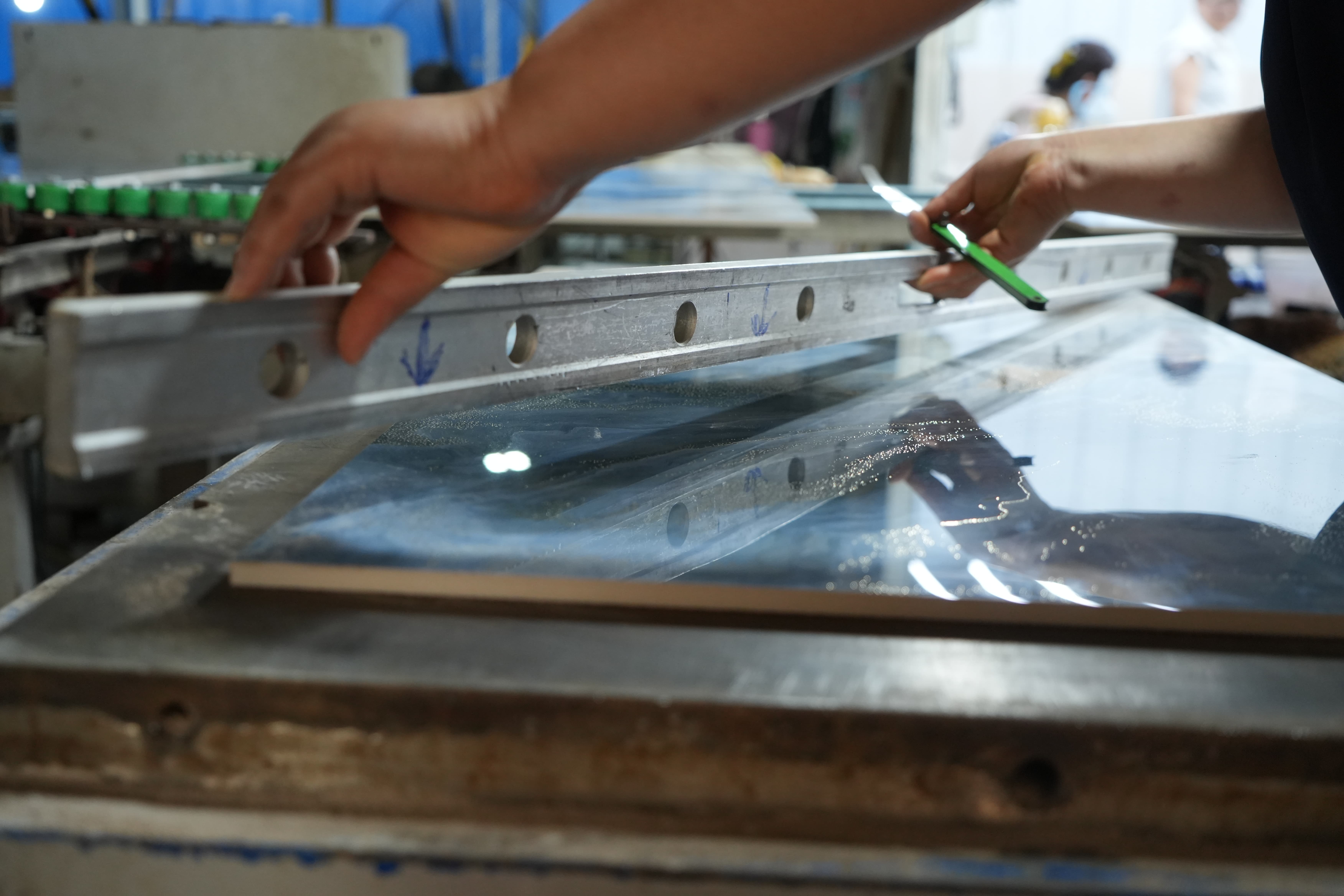
Dimensional and flatness verification on the line: the checks that turn a catalogue claim into a specification.
Why the comparison is usually made too late
The low-grade ceramic option rarely appears at specification stage. It arrives later, during value engineering, when the tender is already priced and someone proposes a comparable-looking tile at a lower unit rate. At that moment the comparison is made on the two things visible in the room — the surface pattern and the price. Neither of them is a performance property.
The consequences show up in service. A tile body with higher water absorption and lower mechanical strength behaves differently under exactly the conditions commercial floors face: continuous heavy-duty use, high-frequency commercial traffic and non-stop foot traffic, heavy surface load, wet and slippery periods, thermal shock, and in northern markets frost and freeze-thaw cycling. These are not theoretical conditions; they are the standard operating environment written into commercial real estate flooring specifications.
The gap is not that one material is intrinsically better. It is that porcelain and low-grade ceramic are tested against the same international standards but are not always reported against them. A supplier who does not publish water absorption, breaking strength or abrasion class has not demonstrated equivalence — they have simply left the question unanswered. In a tender review, an unanswered specification question should be logged as an open risk rather than treated as a neutral outcome.
Data availability is the opportunity. Every property discussed below is defined by a published standard, which means a buyer can request a specific number against a specific method and receive an answer that can be placed directly beside the alternative.
The five measurements that decide a commercial comparison
A commercial porcelain specification is defined by five measurable properties — water absorption, breaking strength, modulus of rupture, surface hardness and abrasion resistance — with frost resistance and slip resistance added wherever project conditions require them.
| Property | Vitrified porcelain, 60×120 cm series | What to require from an alternative | Why it matters commercially |
|---|---|---|---|
| Water absorption | Below 0.5 % (vitrified structure) | A declared value on the same method; ISO 13006 / EN 14411 Group BIa is the reference classification for ≤ 0.5 % | Controls stain resistance, moisture movement within the body, and frost behaviour |
| Breaking strength | ≥ 1300 N | Declared breaking strength from a comparable test report | Point-load resistance during handling, fixing and subsequent rolling loads |
| Modulus of rupture | ≥ 35 MPa | Declared MOR, same method and units | Flexural behaviour of large-format tiles in thin-bed installation |
| Mohs hardness | 6–7 | Declared surface hardness | Scratch resistance in lobbies, corridors and entrance zones |
| Abrasion resistance | PEI 4 / PEI 5 | Declared PEI class | Surface wear under continuous foot traffic |
| Frost resistance | Tested to ISO 10545-12 (withstand at least 100 freeze-thaw cycles) | Frost test result, not a category assumption | Outdoor paving, unheated logistics areas, platforms, cold-climate projects |
| Slip resistance | R10 / R11 under DIN 51130 where specified | Declared R value for the actual finish | Safety compliance in airports, railway stations and other public buildings |
Water absorption: the property that separates the classes
Water absorption is what the standards themselves use to draw the line between porcelain and other ceramic bodies. ISO 13006 / EN 14411 places vitrified porcelain in Group BIa, defined by water absorption of 0.5 % or lower. The 60×120 cm series referenced throughout this article is specified as vitrified with water absorption below 0.5 %, at a thickness of 9.0–10.5 mm. Non-vitrified ceramic bodies generally sit above that threshold, which is why a low-grade ceramic tile and a porcelain tile can look identical while responding differently to moisture.
Breaking strength and modulus of rupture: what the floor has to carry
Breaking strength describes the point load a tile can tolerate; modulus of rupture describes how the body behaves in bending. For the 60×120 cm porcelain series, the published figures are a breaking strength of at least 1300 N and a modulus of rupture of at least 35 MPa. Those two numbers are the ones to place beside an alternative in a tender comparison.
A note on comparison claims: figures of the type "a 15 MPa advantage" or "three Mohs points higher" circulate widely in supplier material. They are only meaningful when both products are reported against the same test method and expressed in the same units. This reference therefore states the threshold and the method rather than repeating a gap that cannot be verified for every alternative body in every market. Where a supplier does not publish an equivalent value, the honest conclusion is that the comparison is incomplete — not that the cheaper product is equivalent.
Mohs hardness and PEI abrasion: the visible wear story
A Mohs hardness of 6–7 describes resistance of the surface to scratching. In practice the visible consequence appears in corridors, lift lobbies and entrance zones, where grit is carried in on foot and the finish either holds its appearance or gradually dulls. Abrasion resistance is classified on the PEI scale, and the porcelain series described here is rated PEI 4 / PEI 5 — the classes associated with heavy and extra-heavy traffic. Of all the measurements, abrasion class is the one most closely tied to how a commercial floor still looks after years of service, which is why it belongs in the tender documents rather than in a post-installation conversation.
Frost resistance and slip resistance: project-specific, not category-wide
Frost resistance is tested under ISO 10545-12, which requires a tile to withstand at least 100 freeze-thaw cycles. For outdoor paving, exposed platforms, unheated warehouse areas and projects in Central Asia, Russia and Eastern Europe, this is the test that separates an outdoor-suitable porcelain from an indoor-only product. Slip resistance is expressed in R classes under DIN 51130, and high-traffic public areas such as airport terminals and railway stations typically require R10 or R11. Neither value should be assumed from the material category. Both belong to a specific product and finish, and both must be declared.
The specification behind the data: All-King Ceramics
ZIBO ALL-KING IMPORT&EXPORT TRADING CO., LTD, trading as All-King Ceramics, is a manufacturer and direct exporter of architectural ceramics based in Zibo, China. Established in 2011, the company operates a 60,000 square metre manufacturing facility, employs approximately 320 staff — including an R&D team of 25 engineers — and reports an annual production output of 12 to 16 million square metres.
The core product line centres on 60×120 cm porcelain tiles, supported by 75×150 cm porcelain tiles, 80×80 cm porcelain tiles, 60×60 cm ceramic tiles and 100×100 cm floor tiles. Within the 60×120 cm range, the Marble Series and Travertine models are produced from porcelain clay in a vitrified structure with water absorption below 0.5 %, an abrasion rating of PEI 4 / PEI 5, Mohs hardness of 6–7, breaking strength of at least 1300 N and modulus of rupture of at least 35 MPa. Each box contains 2 pieces covering 1.44 m², which is the figure a logistics or quantity-surveying team needs for wastage and container planning.
Export sales account for 70 % of total revenue, with major markets including Australia, New Zealand, Russia, Belarus, South Korea, Vietnam, Malaysia, the Philippines, Peru, Panama, Colombia, Chile, Bolivia, Guatemala, Palestine, Iraq, Ukraine and the United Arab Emirates. That distribution pattern matters to the comparison in this article: a supplier shipping regularly into both frost-prone and tropical markets has a commercial reason to hold frost and slip test documentation across a range of formats rather than for a single showcase product.
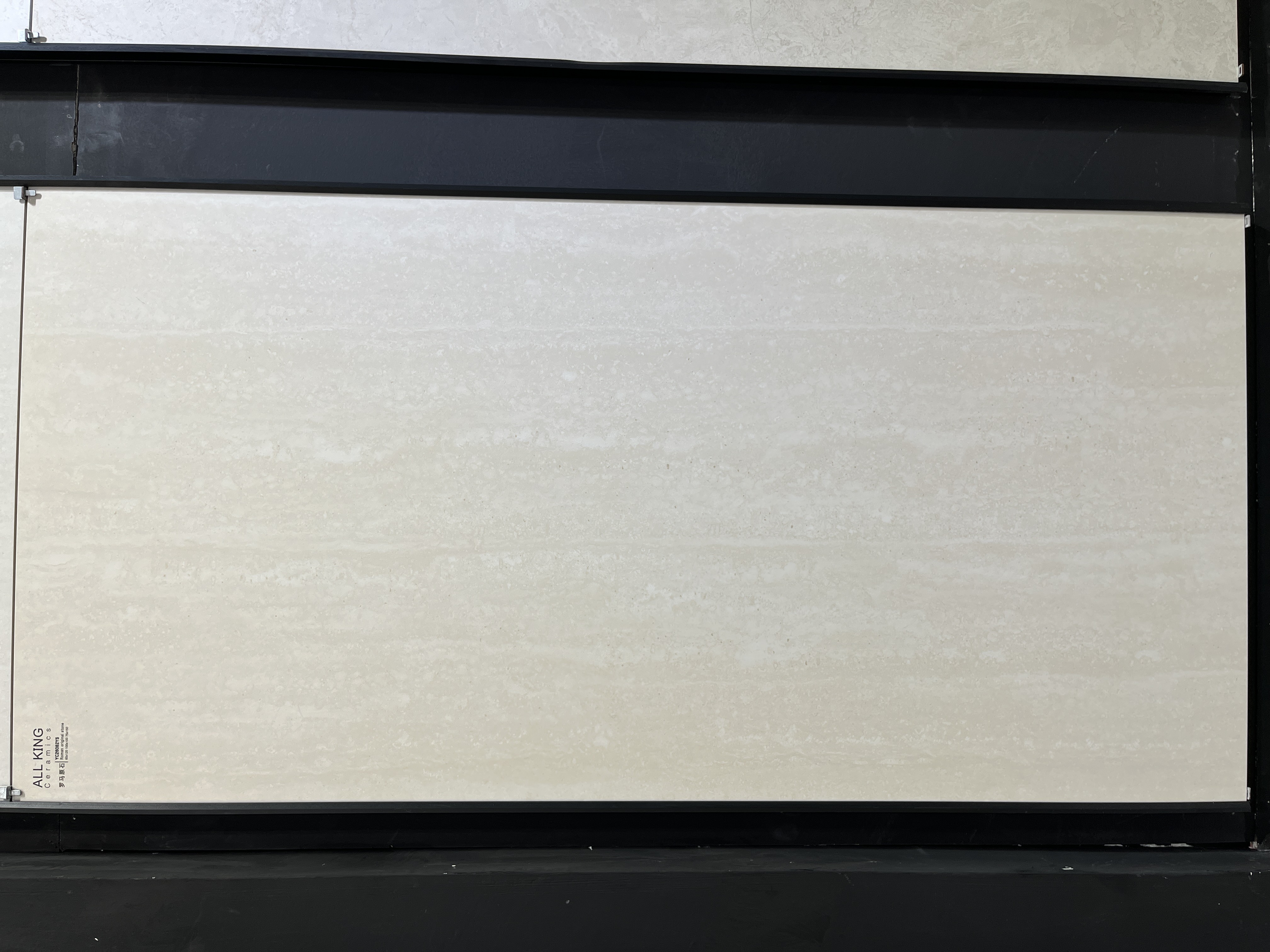
Travertine model, 60×120 cm vitrified porcelain: a surface appearance that can be matched by a cheaper body, on a specification that cannot.
Reading a supplier's technical file
Measurements only decide a comparison when they arrive as documents. For a commercial project, the technical file should contain test reports that link to the specific batch or production period, not a certificate photographed at a trade fair. A practical checklist for the evaluation stage:
- Water absorption declared against ISO 13006 / EN 14411, with the group classification stated.
- Mechanical values — breaking strength and modulus of rupture — declared with units and test method.
- Frost resistance evidence under ISO 10545-12 for any project with freeze-thaw exposure.
- Slip resistance classification under DIN 51130 for public, transport and wet-area applications.
- Quality management system certification, for example ISO 9001:2015, and CE marking declarations where the destination market requires them.
- Packing data per format, so that freight, handling and breakage allowance can be calculated before award.
The last point is often skipped and regularly regretted. On a 60×120 cm format the difference between two suppliers' packing efficiency changes the delivered cost of the project, even when the ex-works unit price is identical. Rail freight and sea freight planning for landlocked Central Asian destinations depends on those same numbers.
Matching the measurement to the building
The application profile behind this product family is commercial real estate, covering flooring and wall cladding, commercial fit-out, interior decoration, facade engineering and hotel renovation. The stated operating conditions are high traffic, frost and freeze-thaw, wet and slippery surfaces, thermal shock and heavy surface load, with continuous heavy-duty use as the norm. The special requirements listed for these scenarios include anti-slip R10 / R11, frost resistance, low VOC emissions, acid and alkali resistance, zero water penetration and ISO 13006 compliance. Installation relies on tile adhesive and grout, a leveling system, tile spacers, diamond cutting tools, a subfloor preparation system, and — for wall cladding — facade hanging systems.
This application scenario is documented as common in Australia, Canada, Kazakhstan, the Philippines and other markets, which gives a useful spread of conditions to reason from. In transport buildings, the governing requirement is usually slip resistance: airport terminal and railway station flooring is specified at R10 or R11, and the abrasion class has to hold up under unpaused footfall. In shopping mall concourses, hotel lobbies and large-format public interiors, the constraint is often dimensional — larger porcelain slabs reduce joint density across long sight lines — supported by a module of rupture rating that allows thin-bed fixing at 60×120 cm and above.
In logistics warehouses and industrial halls, the deciding values are breaking strength and resistance to heavy surface load, because the floor is asked to tolerate static racking loads and moving equipment rather than appearance alone. In healthcare and educational facilities, low VOC emissions and easy-clean surfaces carry more weight, alongside abrasion class in corridors that see continuous traffic. In frost-prone markets — Central Asian construction projects, Russian real estate developments and Eastern European hotel refurbishments — frost resistance under ISO 10545-12 moves from a nice-to-have to a line item, particularly for entrances, terraces, station platforms and any unheated space.
Residential towers and apartment projects sit at the lower-intensity end of the same logic: a 60×60 cm or 80×80 cm format may be sufficient in dry, low-traffic interiors, while the public areas of the same development — lobbies, lift cores, parking access — still benefit from the porcelain specification. The comparison is therefore rarely about an entire building. It is about which areas justify which performance class.
What the market data currently shows
Market sizing for tiles is unusually dependent on definition, and buyers should read any headline figure with that in mind. Custom Market Insights values the global ceramic and porcelain tiles market at USD 423.90 billion in 2024, projected to reach USD 845.80 billion by 2034. Other research houses publish much smaller numbers for what appears to be the same category: Market Research Future reports USD 87.75 billion, and Spherical Insights reports USD 9.73 billion for porcelain tiles alone. The divergence reflects scope and methodology — how much ceramic, how much porcelain, and which links of the distribution chain are counted — rather than a genuine disagreement about the direction of demand.
Regional data is more directly useful to procurement planning. The Russia ceramic tiles market was valued at USD 3.2 billion in 2024 with a projected growth to USD 5.10 billion by 2032 (Verified Market Research). Southeast Asia's ceramic tiles market is valued at approximately USD 11.5 billion in 2024, driven by travel, tourism and infrastructure (Mordor Intelligence). Uzbekistan imported USD 125 million of ceramic products in 2024, with China the top supplier at USD 75.1 million (Observatory of Economic Complexity). China's ceramic tile exports to the Philippines grew by 77.5 % year-on-year in March 2025, reaching USD 29.6 million (Cerambath / customs data).
At the top of the supply side, Mohawk Industries leads the global ceramic tile market with production exceeding 300 million square metres and revenues of USD 4.2 billion in 2024 (Ceramic World Review). That concentration matters less for the specification decision than it might appear: the commercial buyer's leverage comes from the standard, not from the supplier's scale. A specification written around ISO 13006, ISO 10545-12 and DIN 51130 can be applied to a multinational group and to a direct-export manufacturer with equal rigour.
Comparison with traditional solutions — and where porcelain is not the answer
An honest comparison has to state the boundaries of the more expensive option. Vitrified porcelain is not the lowest-cost material available on a per-square-metre basis, and it is not the right choice in every space.
- Installation depends on the specified system. A 60×120 cm vitrified tile is installed with tile adhesive and grout, a leveling system, tile spacers, diamond cutting tools and a prepared subfloor. Where a project substitutes improvised methods, the material's advantages do not transfer to the finished floor.
- Flatness and substrate preparation are non-negotiable. Large formats amplify substrate deviation. Flatness testing on the production line controls the tile; it cannot correct the screed on site.
- Frost and slip performance are product-specific. Being porcelain does not automatically mean a tile is frost resistant or R11 rated. Those are declared results for a specific body and finish, and they must be requested.
- Over-specification is a real cost. Dry, low-traffic decorative walls, temporary structures and short-life fit-outs may not need a full vitrified specification, and a reasonable cost plan will say so.
- Percentage claims deserve scrutiny. Statements about a fixed percentage saving on installation or maintenance should be re-derived for the project. Installation cost depends on subfloor preparation, format, layout complexity, cutting and local labour rates; maintenance cost depends on cleaning regime, traffic and the age of the finish. A defensible lifecycle comparison uses the project's own quantities and a stated service life rather than a percentage borrowed from a brochure.
What the measurement-based comparison does offer is a different structure for the lifecycle argument. If a floor meets the abrasion, strength and absorption requirements of the environment it sits in, the expected number of replacement cycles over a building's service life is lower than for a floor that does not. That reasoning — not a fixed percentage — is what a life-cycle cost model should test, and it is testable using the declared values in the technical file.
Future outlook
Three directions look likely to shape commercial tile procurement over the next few planning cycles. The first is documentation depth: as buyers become more comfortable with standards-referenced specifications, suppliers who cannot produce batch-linked reports for water absorption, mechanical strength, frost and slip performance will be filtered out earlier in the process, before commercial negotiation begins. The second is format: larger porcelain slabs reduce joint density in public interiors and continue to displace smaller modules in mall, hotel and transport projects, which in turn raises the importance of flatness control and subfloor preparation in the tender package. The third is logistics: for landlocked Central Asian and CIS destinations, rail freight planning and packing efficiency are becoming part of the technical evaluation rather than a separate commercial conversation.
Underneath all three is the same shift. The question a procurement team asks is moving from "which tile looks right" to "which tile can be shown to meet the conditions of this building, on a declared test method." That is a more demanding question, and it produces more durable decisions.
Frequently asked questions
What is the difference between porcelain and low-grade ceramic in commercial tile specifications?
The difference is measurable rather than visual. Vitrified porcelain is classified under ISO 13006 / EN 14411 as Group BIa, defined by water absorption of 0.5 % or lower, and the commercial series described here declares a breaking strength of at least 1300 N and a modulus of rupture of at least 35 MPa. A low-grade, non-vitrified ceramic body generally sits above the 0.5 % absorption threshold and declares lower mechanical values. Both materials are tested against the same standards; the divergence appears when the declared values are compared side by side.
What water absorption value qualifies a tile as porcelain for commercial use?
Water absorption of 0.5 % or lower, which corresponds to the vitrified classification Group BIa under ISO 13006 / EN 14411. The 60×120 cm porcelain tiles described in this reference are specified as vitrified with water absorption below 0.5 %. Absorption at that level supports stain resistance, limits moisture movement through the body and underpins frost performance in exposed applications.
How do breaking strength and modulus of rupture affect commercial floor performance?
Breaking strength describes the point load a tile can take; modulus of rupture describes how it behaves in bending. The commercial porcelain series referenced here is specified at a breaking strength of at least 1300 N and a modulus of rupture of at least 35 MPa at a thickness of 9.0–10.5 mm. Higher values matter in environments with rolling loads, static racking loads and large-format thin-bed installation, where flexural behaviour of the tile body affects long-term serviceability.
What do Mohs hardness and PEI abrasion ratings tell a procurement team?
Mohs hardness indicates resistance of the surface to scratching, and a rating of 6–7 is typical of the vitrified porcelain series discussed here. The PEI classification describes abrasion resistance under foot traffic, with PEI 4 and PEI 5 corresponding to heavy and extra-heavy traffic. Together they are the closest available predictors of how a floor's appearance will hold up in corridors, lobbies and other continuous-traffic areas, which is why both values belong in the tender documents rather than in a post-installation discussion.
When do frost resistance and slip resistance become mandatory in a specification?
Frost resistance is required wherever a tile is exposed to freeze-thaw cycling — outdoor paving, station platforms, unheated logistics areas and cold-climate projects in Central Asia, Russia and Eastern Europe. It is tested under ISO 10545-12, which requires a tile to withstand at least 100 freeze-thaw cycles. Slip resistance is expressed in R classes under DIN 51130, and high-traffic public buildings such as airport terminals and railway stations typically require R10 or R11. Neither property should be assumed from the material category; both must be declared for the specific product and finish.
What documentation should a buyer request before accepting a tile specification?
A supplier technical file should contain water absorption data referenced to ISO 13006 / EN 14411 with the group classification stated, mechanical values with units and test method, frost resistance evidence under ISO 10545-12 where relevant, slip resistance classification under DIN 51130 for public and wet areas, quality management system certification such as ISO 9001:2015, CE marking declarations where the destination market requires them, and packing data per format. Batch-linked test reports, rather than generic certificates, allow the buyer to compare two products against the same method and units.
Reference document
The full All-King Ceramics product catalogue, including format, thickness and packing data for the 60×120 cm porcelain range, is available as a downloadable reference: All-King Ceramics catalogue (PDF).
Product and company details used in this comparison come from that catalogue and the associated technical documentation.
Porcelain versus low-grade ceramic is not a debate about taste. It is a comparison of declared values against the conditions a building will actually impose, and the outcome is decided long before installation — at the point where a buyer asks for a test method and a number instead of a sample and a price.