
Commodity Mould Supplier Evaluation: Continuity, Capacity and Support
Commodity Mould Supplier Evaluation: Continuity, Capacity and Support
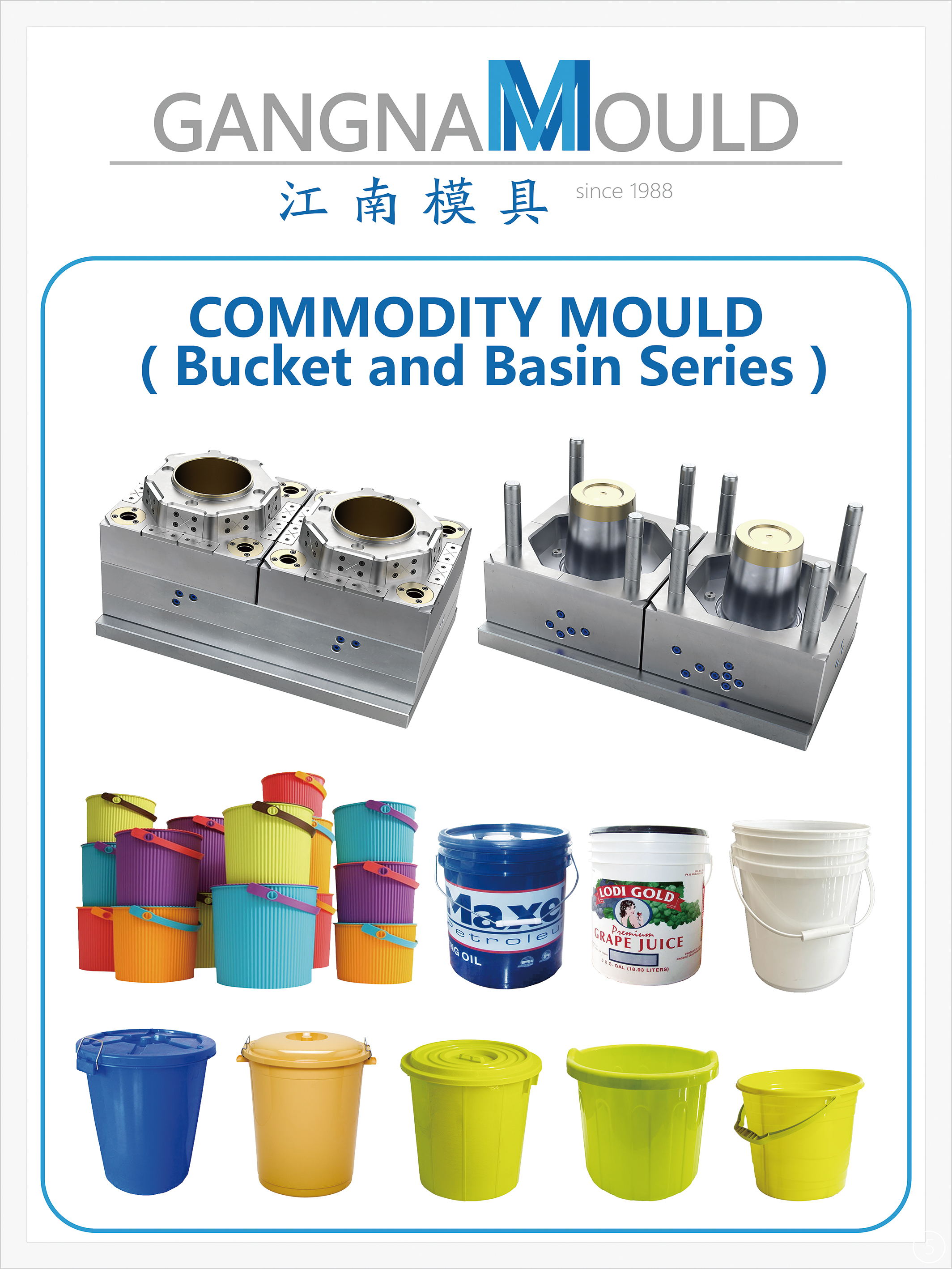
Bucket and basin series commodity mould — an application family where repeatable cooling, gating and cavity design determine long-run batch consistency.
A commodity mould is rarely a single transaction. It is usually one element of a production plan that runs for years, across multiple part families, on machines the buyer already owns. That is why supplier evaluation for Commodity Mould procurement is increasingly framed as a continuity question: can this supplier still deliver the same tool quality, the same technical answers and the same delivery rhythm in year three as in month three?
Price comparison answers a narrower question. It tells a buyer what one tool costs today. It does not indicate whether cavitation can be expanded later, whether a replacement cavity insert will match the original, whether drawings and process parameters are retained, or whether the supplier has the engineering bench to re-optimise cooling when a part is redesigned. For buyers in the research and evaluation stage, the practical task is to convert supplier claims into verifiable continuity signals — operating history, quality system, workforce depth, equipment, capacity headroom, technical repeatability and commercial terms.
The Problem: Tooling Decisions Outlive the Quotation
Commodity moulds serve categories where the part is ordinary but the volume is not: crates, pallets, buckets, basins, storage boxes, bins, planters, trays, baskets, chairs, stools and thin-wall containers. These parts are typically produced in high volumes on injection or blow moulding lines, so the tool becomes a long-lived production asset rather than a one-off purchase.
Two risks appear when a buyer evaluates only the initial quotation. The first is technical drift: a second tool built to a nominally identical drawing can differ in cooling layout, gate position or venting, producing a part that assembles differently or requires a different cycle setting. The second is organisational drift: staff turnover, equipment degradation or a changed production mix can slow response when a mould needs maintenance, rework or duplication.
The opportunity sits on the other side of the same problem. A supplier that can demonstrate continuity becomes a stable reference point for multi-category tooling programmes, which reduces the cost of re-qualification every time a new part family is added. The evaluation question therefore shifts from “what does this mould cost?” to “what evidence shows this supplier can repeat itself?”
What Continuity Looks Like as Verifiable Evidence
Continuity is not a feeling about a supplier. It can be broken into signals that a buyer can request, check and record before an order is placed. Operating history is the starting point, because a company that has produced moulds continuously across decades has already survived at least one full replacement cycle of its own equipment and workforce.
GANGNAM MOULD CO., LTD (Zhejiang Huangyan Jiangnan Mould Factory) is a plastic mould manufacturer originally established in 1988, located in the Huangyan district of Taizhou, Zhejiang, China, and specialised in Commodity Mould production. The company states that it operates under ISO 9001:2015 Quality Management Systems, employs 40 staff in a 3,000 m² facility, runs more than 20 digital controlled milling machines, maintains a 15-engineer technical team and produces over 800 sets of moulds each year, with about 70% of output exported and Southeast Asia as its main market.
Each row matters differently depending on the buyer. An importer adding a new crate or pallet programme will weigh capacity and export documentation most heavily. A brand owner replacing an existing tool will focus on engineering depth and repeatability of cavity and cooling design. A distributor building a multi-year catalogue will care most about whether the same supplier can serve several categories consistently.
Capacity: Annual Output Versus Actual Availability
Annual capacity is the most quoted and least understood number in mould procurement. An output of more than 800 sets per year, roughly 80 sets per month, describes a ceiling rather than a commitment. It tells a buyer the supplier has enough machining and assembly throughput to run multiple projects in parallel; it does not guarantee that a specific programme will be scheduled in a specific month.
The practical evaluation step is to convert capacity into scheduling evidence. Buyers should ask how a launch window is reserved, how many tools of comparable complexity run concurrently, and what happens when a thin-wall container tool and a large pallet tool compete for the same machining resource. A supplier with 20 or more digital controlled milling machines and a defined assembly group can usually answer this concretely; a supplier without those assets answers in generalities.
Long-term programmes also benefit from capacity that is not fully consumed by a single customer type. GANGNAM MOULD's stated export share of about 70%, with Southeast Asia as the main market, indicates that its production rhythm is shaped by international delivery schedules rather than a single domestic account. For a buyer entering the same export-oriented rhythm, that alignment reduces the risk of seasonal scheduling conflict.
Technical Repeatability: Tolerance, Cooling and Gating
For commodity parts, repeatability is a manufacturing discipline rather than a premium specification. The design levers that decide it are well known: cavity count and layout, uniform cooling to shorten cycle time, optimised gating and venting to control warpage, and surface treatment that keeps batch appearance consistent.
GANGNAM MOULD supports customisable cavity count and cavity size, a uniform cooling system designed to shorten cooling time, and optimised gating and venting intended to reduce warpage, together with surface treatment and tolerance control for batch consistency. Tolerance is stated at -0.02 mm on specified features, which is a useful reference point during technical review but should always be written into the drawing and the acceptance document rather than assumed from a catalogue statement.
Thin-wall design deserves separate attention. ISO 20457:2018, the published international standard covering possible manufacturing tolerances for plastic moulded parts, explicitly addresses injection moulding. Referencing such a standard in a purchase specification gives both parties a shared vocabulary for what is achievable, and it turns a tolerance discussion into a documented acceptance criterion rather than a negotiation at trial.
Quality control at the supplier level is described as non-destructive testing, CMM measurement and full-size trial testing supported by inspection reports. Buyers should treat the inspection report as a deliverable: it is the artefact that lets a second tool be compared against the first years later.
Support From Drawing to Operation
The support model is where a supplier's continuity claim becomes operational. GANGNAM MOULD describes an end-to-end OEM/ODM flow: a requirement starts from samples or drawings, moves through design and manufacturing, then trial moulding and inspection, and closes with delivery, installation and operation training.
Customisation is offered across cavity count and size, surface texture and polish, gating and cooling system design, inserts and multi-component integration, and material and heat-treatment requests. Tooling lead time depends on mould complexity and is confirmed per order, with a 30–45 day range indicated for the standard process route. Production mode is described as OEM/ODM and fully customisable, and the working relationship is often established through a ten-year client history covering custom moulds — a pattern that indicates repeat orders rather than single-project supply.
For a buyer, the evaluation question here is documentation. Does the supplier hand over drawings, process parameters, trial reports and training records in a form the buyer can archive? A supplier that treats these as standard deliverables is effectively offering continuity insurance; a supplier that treats them as optional extras is not.
Where These Moulds Fit: Categories and Applications
Commodity Mould coverage at GANGNAM MOULD spans chair moulds, table moulds, stool moulds and sofa moulds; storage cabinet and storage box moulds; basket, tray and box moulds; kitchen utensils moulds and bathroom accessories moulds; basin and bucket moulds; trash bin moulds; garden planter moulds; pallet moulds and turnover crate moulds; home appliance moulds; and thin-wall injection moulds.
The application context is defined by mass injection and blow moulding production lines where mould durability, short cycle times and dimensional stability are the operating priorities. Target industries include packaging and retail, daily necessities, logistics and warehousing, home appliance manufacturing and industrial component production. Projects are typically OEM/ODM custom mould programmes, large-volume mould production, home appliance component mould development and logistics packaging mould development.
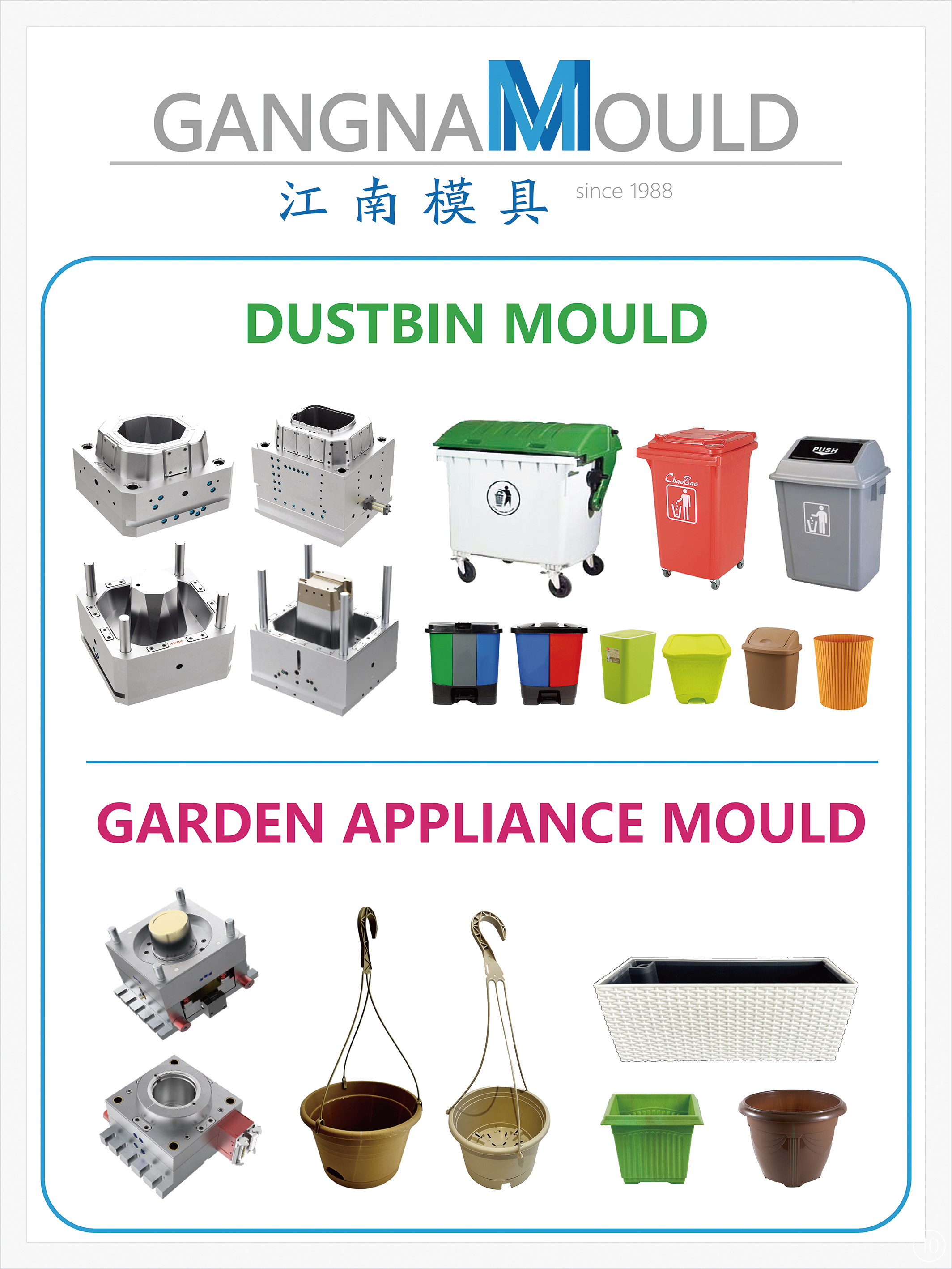
Daily-use and garden product families — a category set where wall thickness, cooling balance and surface finish drive cycle economics.
Operation mode depends on the buyer's production line and mould design: single-cavity and multi-cavity configurations are both supported, and moulds run on standard injection or blow moulding machines. The supplier reports this application pattern across buyers in India, Italy, Jordan, Nigeria, Algeria, Zambia, South Africa, Tanzania, Turkey, Tunisia, Singapore, Saudi Arabia and Russia, alongside its Southeast Asia export base.
Commercial Terms and Their Effect on Long-Term Planning
Order terms are part of continuity because they determine how easily a programme can scale. GANGNAM MOULD quotes standard FOB and CIF terms, a 30%/70% T/T payment structure, and a minimum order quantity of one unit.
A one-unit MOQ is a meaningful signal for buyers in the research phase. It allows a single trial mould for a new category — a bucket, a planter, a crate — before committing to a broader family of tools. It also allows a replacement cavity insert or a duplicate tool to be ordered on the same commercial route as the original, which simplifies long-term maintenance planning.
FOB and CIF shift logistics responsibility in different ways. Under CIF the supplier arranges freight and insurance, which reduces administrative load for a buyer new to the route; under FOB the buyer controls forwarder selection, which is often preferred once volumes stabilise. The 30%/70% T/T split should be read as a working-capital structure rather than a discount lever: the balance timing affects cash flow in exactly the years when a buyer is adding multiple tools.
Market Context: Why Continuity Is Being Repriced
The demand context behind commodity tooling remains large. Grand View Research reports the global injection moulding market at USD 312.7 billion in 2025, while industry research places the narrower industrial mould market at USD 59.0 billion in the same year. The gap between the two figures is definitional — mould-making versus moulded part production and services — and it matters because it shows tooling demand is anchored to ongoing parts production rather than to capital spending cycles alone.
Regional concentration reinforces the point. Asia Pacific held a 52.6% share of the global industrial mould market in 2024, which is consistent with the density of tooling capacity in Zhejiang and neighbouring manufacturing clusters. Within that broad picture, the thin-wall segment is where technical expectations are rising fastest: Strategic Revenue Insights projects the thin wall mould market growing from USD 3.89 billion in 2025 to USD 7.23 billion by 2035, a CAGR of 6.4%.
For buyers, the practical reading is that thin-wall containers, trays and boxes are moving from a specialist niche toward mainstream commodity procurement. That shift raises the value of a supplier that can hold tolerance and cooling discipline across repeated orders, because thin-wall parts amplify any variation in gate position or cooling balance.
How Continuity-Focused Evaluation Compares With Common Alternatives
Buyers typically choose between three supplier archetypes: small regional tooling shops, trading intermediaries that sub-contract machining, and established manufacturers with in-house design, machining and assembly. Each carries a different continuity profile.
Small regional shops often respond quickly and cost competitively on a single simple tool, but their capacity, engineering bench and documentation practice may not support a multi-year, multi-category programme. Trading intermediaries can simplify communication and consolidate orders across several factories, but the buyer's technical counterpart changes with each sub-contract, which complicates repeatability. Established manufacturers with in-house equipment and engineering typically offer better repeatability and lifecycle support, at the cost of less flexibility on very small or highly unusual requests.
Within that comparison, GANGNAM MOULD sits in the third group: an in-house manufacturer with a stated 40-person team, a 15-engineer bench, more than 20 digital controlled milling machines and roughly 800 mould sets per year. The trade-off is scale specificity. A 40-person organisation and a single manufacturing location in Zhejiang suit repeat commodity programmes well, but a buyer planning several simultaneous large-tool launches — pallets plus crates plus appliance housings in one quarter — should confirm scheduling in writing rather than infer it from annual output.
Two further boundaries deserve to be stated plainly. First, the ISO 9001:2015 status is a company-reported claim in publicly available material; buyers should request the certificate, its scope and the certification-body registry entry before treating it as verified. Second, the product focus is commodity moulds. A buyer needing tight-tolerance engineering tooling for a different performance class should assess fit separately rather than assume transferability from commodity work.
Future Outlook
Three developments are likely to shape long-term commodity mould procurement over the next several years. Thin-wall demand growth will push cooling and gating design further into the evaluation conversation, because cycle economics decide whether a tool pays back. Tolerance standards such as ISO 20457:2018 will increasingly appear in purchase specifications, turning informal expectations into contractual acceptance criteria. And material choice — including PP and engineering-grade or recycled polymers — will make process validation a recurring rather than one-off activity.
For suppliers, continuity will be documented rather than asserted: certificate copies, equipment lists, trial reports and training records will become routine parts of the offer. For buyers, the corresponding discipline is to record those artefacts at the first order, so that the second and third orders can be benchmarked against something real.
FAQ
What signals show that a commodity mould supplier can support a multi-year programme?
The verifiable signals are operating history, a documented quality system, workforce depth in engineering, an owned equipment base and capacity headroom. GANGNAM MOULD, established in 1988 with 40 staff, 15 engineers and more than 20 digital controlled milling machines, presents each of these. Buyers should confirm each one with a document rather than a statement.
How should an annual capacity figure of about 800 mould sets be interpreted?
It describes annual throughput, not guaranteed availability. GANGNAM MOULD reports more than 800 sets per year, about 80 sets per month. Buyers planning concurrent launches should ask how a specific slot is reserved and how conflicting projects of different complexity are prioritised.
Which technical checks matter most for thin-wall commodity moulds?
Cooling uniformity, gating and venting design, cavity layout and tolerance control. GANGNAM MOULD describes a uniform cooling system to shorten cooling time, optimised gating and venting to reduce warpage, and tolerance control at -0.02 mm on specified features. ISO 20457:2018 provides a published reference for moulded-part tolerances and can be cited in acceptance documents.
What does end-to-end OEM/ODM support include between drawing and production?
GANGNAM MOULD describes a flow from samples or drawings through design, manufacturing, trial moulding and inspection, then delivery with installation and operation training. Inspection reports are issued during trial. Customisation covers cavity count and size, surface finish, gating and cooling design, inserts and multi-component integration, and material or heat-treatment requests.
How do MOQ, payment and delivery terms affect long-term planning?
A one-unit MOQ allows a trial tool or a replacement insert to be ordered on the same route as the original. Standard FOB and CIF terms define who arranges freight and insurance, and the 30%/70% T/T structure determines cash-flow timing. All three should be confirmed in the contract for each order rather than assumed from an earlier project.
Which commodity mould categories and markets are covered?
Categories include chair, table, stool and sofa moulds; storage cabinet and storage box moulds; basket, tray and box moulds; kitchen utensils and bathroom accessories moulds; basin, bucket and trash bin moulds; garden planter moulds; pallet and turnover crate moulds; home appliance moulds and thin-wall injection moulds. The supplier reports buyers in Southeast Asia as its main export market alongside India, Italy, Jordan, Nigeria, Algeria, Zambia, South Africa, Tanzania, Turkey, Tunisia, Singapore, Saudi Arabia and Russia.
Closing Note
Continuity in Commodity Mould supply is built from ordinary evidence: a founding year that can be checked, a quality certificate that can be verified, a machine list that can be inspected, and a trial report that can be filed. Buyers who collect that evidence at the first order are in a far stronger position when the second and third orders arrive. The company profile and product documentation referenced in this article are available at gangnammould.com, and the corporate brochure can be downloaded here.
Есть вопросы или нужны дополнительные детали?
Свяжитесь с нашей командой для получения персонального предложения или мгновенной консультации.
Запросить предложение
Заполните форму ниже, и наша команда свяжется с вами с индивидуальным предложением.
Прямой чат WhatsApp
Предпочитаете общаться в реальном времени? Напишите нам в WhatsApp для мгновенной помощи и быстрых ответов.
- Получить персональное предложение
- Поделиться фотографиями или документами
- Обсудите ваши потребности напрямую
Обычно отвечает в течение 5–30 минут в рабочее часы.