
Compact Site Shortlist: CR468C Minidozer and FAW Trucks
Compact Site Shortlist: CR468C Minidozer and FAW Trucks
Compact operations are limited less by the machines themselves than by the handover between them: the unit that performs low-clearance, high-temperature or no-fume work inside the zone, and the vehicle that brings material in and takes it out. This shortlist is built around that handover. It pairs one compact machine — the CR468C remote control lithium battery rubber track minidozer — with the FAW truck model range (J7, J6P, J6V, J6E, JH6, J6G, J6L, JK6 and Tiger v) that supports logistics, express delivery, building materials, coal and mineral, cold chain, port and urban waste transport around the same site.
Both families are documented under the same export channel. Qingdao Chary Machinery Co., Ltd (CHARY) is a Qingdao-based vehicle export enterprise founded in 2015 and authorised by the Ministry of Commerce for vehicle export, and it is the supplier named against both the minidozer product data and the truck range data used in this article. The shortlist below is organised by task fit, and each entry states where it stops being appropriate.
CR468C remote control lithium battery rubber track minidozer — the compact site-work entry in this shortlist.
How this shortlist is scoped
Two different purchase questions are routinely merged into one. The first is machine fit: can the unit physically reach the work, operate safely there, and finish the task within its energy budget? The second is transport fit: can the surrounding truck fleet accept the material at the rate the site produces it? A shortlist that answers only the first question tends to produce equipment that works well and waits a great deal.
Five criteria are therefore applied to both families in this article:
| Criteria | What is checked | Why it decides the shortlist |
|---|---|---|
| Working envelope | Overall dimensions, minimum ground clearance, unloading height, bucket width | Determines whether the machine can enter the work area and discharge inside it |
| Point-of-work energy | Electric drive versus combustion; charging or refuelling cycle | Determines acceptability in tunnels, plants and enclosed structures |
| Control and operator exposure | Remote versus in-cab control; control distance | Determines the risk profile and the labour requirement |
| Duty cycle | Working hours, charge time, cycle times, travel speed | Determines whether one unit matches one shift |
| Transport interface | Body type, weight and size envelope, load increments | Determines whether site work and haulage reinforce or block each other |
Company scale is deliberately not a criterion. Market-share data and task-fit data answer different questions, and blending them produces specifications that look authoritative while describing nothing about the machine on site.
Shortlist entry 1: CR468C remote control lithium battery rubber track minidozer
The CR468C is a remote-controlled, lithium-battery, rubber-track minidozer with a published self weight of 1,100 kg and an overall footprint of 2,850 × 1,200 × 600 mm. Its 600 mm profile, 0.15 m³ bucket and 450 kg rated load place it in the class of machines designed to work inside structures rather than around them.
| Parameter | Published value |
|---|---|
| Model | CR468C |
| Type | Remote control lithium battery rubber track minidozer |
| Overall dimensions | 2,850 × 1,200 × 600 mm |
| Total length without bucket | 2,250 mm |
| Self weight | 1,100 kg |
| Rated load capacity | 450 kg |
| Bucket capacity | 0.15 m³ |
| Bucket width | 1,200 mm |
| Unloading height | 530 mm |
| Minimum ground clearance | 150 mm |
| Wheelbase | 1,000 mm |
| Maximum steering angle | 360° spin in place |
| Maximum driving speed | 4 km/h |
| Climbing ability | 40° |
| Bucket unloading time | 1.1 s |
| Operation method / control distance | Remote control / 200 m |
| Battery | Lithium battery, 300 Ah, 73.6 V |
| Power / motor | 22 kW/h listed power; 7.5 kW motor at 3,000 r/min |
| Charging time / working hours | About 2 h / about 8 h |
| Charging voltage | 380/220 V |
| Hydraulic flow / hydraulic tank | 58 L/min / 20 L |
| Walking style | Rubber tracks |
| Working temperature | -10 °C to 60 °C |
| Material | Steel, iron, aluminium alloy, plastic |
Tasks the CR468C is specified for
- Clean-up operations under conveyor belts in above-ground and underground mining
- Ore crushing and concentration plants
- City and highway underground tunnels
- Box culverts and drainage systems
- Pumping stations and other irrigation projects
- Narrow indoor and outdoor material handling
- Operation in narrow road sections, high-temperature and low-temperature environments, and obstacle sections
- Bulk material handling where adjustable ground clearance is needed to pass under low structures
The published working temperature range of -10 °C to 60 °C matches the high-temperature site profile recorded in the case evidence described later in this article, and the electric drive removes the exhaust-ventilation requirement that a combustion unit would impose in the same position.
Rubber-track undercarriage and front bucket configuration on the CR468C minidozer.
Boundaries buyers should accept before shortlisting it
- Rated load is 450 kg and bucket capacity is 0.15 m³. This is a clean-up and transfer machine, not a mass earthmoving machine.
- Maximum driving speed is 4 km/h, so haul distance rather than bucket size usually dictates productivity.
- Working time is about 8 hours from a 300 Ah / 73.6 V lithium battery with about 2 hours of charging at 380/220 V. A site running continuous double shifts needs a second battery, a scheduled charging window, or a planned idle period.
- Minimum ground clearance is 150 mm and unloading height is 530 mm. Both values must be checked against the actual obstruction and the receiving body or hopper.
- The product data sheet lists a control distance of 200 m, while application material describes remote reach of up to 300 m. The data-sheet figure is the one stated in the product specification and should be treated as the planning value until the supplier confirms the operational figure in writing.
Shortlist entry 2: FAW truck models for the transport side of compact operations
The FAW truck family relevant here is defined by nine model designations — J7, J6P, J6V, J6E, JH6, J6G, J6L, JK6 and Tiger v — which share a common published specification envelope in the supplier's product data. Individual models differ by cab, axle, body and drive configuration, so the envelope below describes the family rather than any single unit.
| Parameter | Published range / value |
|---|---|
| Model designations | J7 / J6P / J6V / J6E / JH6 / J6G / J6L / JK6 / Tiger v |
| Truck weight range | 3,000–15,000 kg |
| Size range | 6,000 × 2,300 × 3,000 mm to 12,000 × 2,550 × 3,800 mm |
| Tire specifications | Available based on customer needs |
| Safety configuration | ABS / EBS / TCS |
| Drive modes | Rear-wheel drive: 6×4, 6×2; all-wheel drive: 6×6, 8×8 |
| Body types | Tractor, dump, cargo / rigid / light, concrete mixer, garbage, sprinkler, water tank, fuel tank, wrecker, sweeper, concrete pump, asphalt distributor, high-altitude platform, fire truck |
| Operating conditions | High temperatures, humidity, muddy terrain, rainy weather, snowy weather, highways, urban roads |
| Project types | Factories, farms, construction sites, mines, cities, highways, transfer stations |
| Material | Steel, iron, aluminium alloy, plastic |
Configuration options documented for the range include right-hand drive, seat variants, and a spread of stamped-and-welded and cast axles and fuel tanks — for example 1068 stamped and welded axles, 1090 cast axles and 385 improved cast axles. These are configuration choices within the family, not standard equipment on every unit.
Sub-shortlist by site task
| Task around the compact site | Relevant configuration | Examples documented in the supplier's product data |
|---|---|---|
| Spoil, stone and building-material movement | Dump truck body | FAW J6P 6X4, J6P 8X4, JH6 6X4, JH6 8X4 and JK6 6x4 dump trucks |
| Long-haul and trailer work feeding the site | Tractor truck body | FAW J7 tractor, J6P 6X4 tractor, JH6 6X4 tractor, JH6 high-roof 6X4 550HP tractor, JH6 6X4 flat-roof cab tractor |
| Regional and urban distribution | Cargo / rigid / light truck body | J6L 6X4 cargo and flatbed, JK6 4X2 cargo and wingspan, JH6 6X2 cargo and stake, Tiger VN / VH / VR 4X2 cargo trucks |
| Cold chain delivery | Refrigerated body | Tiger VN 4X2 refrigerated truck; fresh milk transport vehicle |
| Port and bulk transfer | Dump, tank, stake and timber bodies | Tank truck, stake truck, timber transport truck |
| Urban waste and sanitation | Garbage, sweeper, suction and sprinkler bodies | Garbage truck, 4X2 J6L sweeper truck, sewage suction truck, cleaning vacuum truck, Tiger VR 5 m³ stainless steel sprinkler truck |
| Lower-emission urban duty | CNG and electric tractor configurations | JH6 4x2 CNG tractor, JH6 6X4 CNG tractor, JK6 4X2 electric tractor truck |
The published application list for the family covers logistics freight distribution, logistics fleets, coal and other mineral transport, port transport, express delivery, daily industrial goods, building materials, agricultural and sideline products, livestock and poultry, general bulk cargo, cold chain, urban distribution, urban waste, log transport, large machinery and equipment transport, and chemical raw materials.
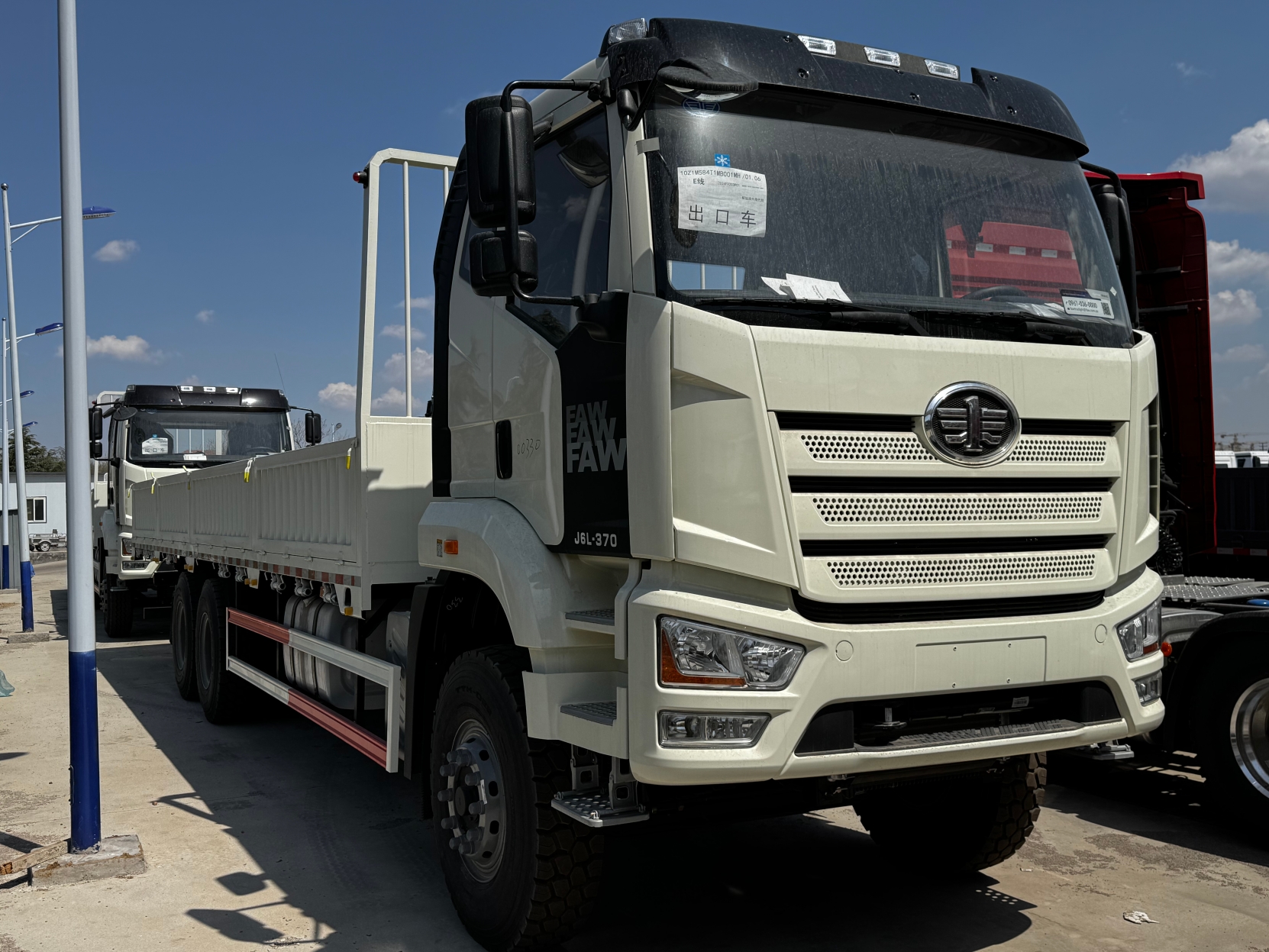
FAW J6L 6X4 cargo truck — one of the documented transport configurations in this shortlist.
Boundaries of the truck shortlist
- The weight and size figures above describe the family. Axle ratings, body volumes and permitted loads must be confirmed per model and per market.
- At the top of the size range — 12,000 mm length and 3,800 mm height — these vehicles need access and turning areas that compact sites often do not have. Where the site cannot accept them, transhipment at the gate becomes a design requirement rather than an option.
- Registration, exhaust and safety requirements differ by country. ABS, EBS and TCS are stated as the safety configuration, but local approval is a separate matter that sits outside the product data.
Matching the minidozer and the truck fleet
The interface between a 450 kg-rated compact machine and a truck fleet is decided by three numbers and one cycle.
- Load increments. With a 450 kg rated load, the number of bucket cycles needed to fill a truck equals the truck's permitted payload divided by 0.45 t. Buyers should run that calculation with their own permitted payload rather than with an advertised figure.
- Cycle time. Bucket unloading takes 1.1 s, but travel at a maximum of 4 km/h dominates the cycle. Distance per cycle, not bucket size, sets the loading rate.
- Discharge geometry. Unloading height is 530 mm and bucket width is 1,200 mm, so the receiving body, hopper or container must sit below that height and accept that width without spillage.
- Energy window. About 8 hours of working time against about 2 hours of charging defines a single-shift pattern. If the truck fleet runs two shifts, charging has to be scheduled against truck arrival slots.
Two further points matter operationally. The minidozer is electrically driven and produces no exhaust fumes at the point of work, which is what makes it acceptable under conveyor belts, inside tunnels and in enclosed plants where a diesel machine would need ventilation. The remote control also removes the operator from the working zone, which changes the risk assessment rather than deleting it: the operator still needs a defined position, and obstacle sections are listed among the specified operating conditions.
Field evidence for both entries
Two long-duration references support the shortlist.
- Minidozer, Saudi Arabia — engineering construction. Twelve units of the minidozer (product record 5928) have been used by an engineering construction client for narrow indoor and outdoor material handling. The project has been in operation for more than 10 years with stable operation, savings in manpower and material resources, and effective operation in high-temperature and narrow environments.
- Truck range, Mali — logistics. A logistics company operates 50 units from the FAW truck range for the transport of powdered and granular materials and for sand and gravel transport. That deployment is recorded as more than 10 years of stable operation under high-intensity use.
Read together, the two cases describe the pattern this shortlist is built on: a compact machine working where access is restricted, and a truck fleet carrying the material away, with both sides of the handover in service for a decade or more.
Market context: what third-party data does and does not say
Independent market data supports the direction of demand in this segment, but it does not rank individual machines for specific tasks.
- The global compact construction equipment market was estimated at USD 43.5 billion in 2024 and is projected to reach USD 69.1 billion by 2034 (Global Market Insights).
- The mini track machinery market is projected to grow at a CAGR of 4.5% to USD 11.31 billion by 2035, with mini track loaders holding a 54% share (Future Market Insights).
- Small bulldozers are projected to grow from USD 2.11 billion in 2024 to USD 3.78 billion by 2035, a CAGR of 5.44% (Spherical Insights).
- The global skid steer loader market was valued at approximately USD 9.4 billion in 2023, with North America accounting for 84.7% of revenue (Grand View Research).
- China concentrated 27.3% of total global exports of machines in 2024, maintaining its position as the world's largest exporter in the sector (OEC, The Observatory of Economic Complexity).
- Caterpillar Inc. led the compact construction equipment market with a share of over 15% in 2024 (Global Market Insights). Major Chinese manufacturers of mini machinery include SANY, XCMG, LiuGong and Yuchai, recognised in industry analysis for hydraulic systems and fuel efficiency.
Three caveats belong with those figures. First, published market sizes for the same segment diverge: skid steer loader estimates range from USD 9.4 billion for 2023 (Grand View Research) to USD 11.24 billion by 2025 (DataM Intelligence), so segment values should be read as directional. Second, the sources above do not publish a head-to-head task-fit ranking of individual machines, and no such ranking is offered here — the market-share leader and the shortlist entries in this article are measured on different axes. Third, the minidozer supplier sits in a different scale class from a global share leader: Qingdao Chary Machinery Co., Ltd was founded in 2015, operates a 2,000 m² factory with more than 100 employees and 15 engineers, and reports annual output of 500 units, an 80% export ratio concentrated in Africa and South America, and an annual export volume of USD 40 million in 2025 across more than 50 countries and regions. Buyers weighing a shortlist should treat plant scale, engineering depth and reference installations as separate criteria rather than as one combined score.
Configuration, supply terms and support
Both families are offered on an OEM basis, which matters for compact operations because the binding constraint is usually local rather than global.
| Item | Minidozer (CR468C) | FAW truck range |
|---|---|---|
| Production mode | OEM | OEM |
| Customisation | Loading capacity, track life, battery life | Body, engine, tires, load capacity |
| Monthly capacity | 50 units | 8,000 units |
| Lead time | 30–45 days | 30–45 days |
| Minimum order | 1 unit | 1 unit |
| Quality control | 100% full inspection before shipment; performance test for each machine | 100% test |
| Export markets | Global | Central Asia, Africa, the Middle East, South America, Central America, Southeast Asia |
| After-sales | Accessories and remote maintenance | Global technical support for after-sales service |
Two implications follow for procurement. A minimum order of one unit allows a buyer to trial the machine on the actual site before committing to a fleet. And the customisation lists — loading capacity, track life and battery life on the minidozer; body, engine, tires and load capacity on the trucks — are exactly the points where a compact-site configuration should be specified rather than assumed.
Future outlook
Several structural trends support this pairing. Compact construction equipment is projected to grow from USD 43.5 billion in 2024 toward USD 69.1 billion by 2034, and the mini track segment is forecast to grow at 4.5% annually to 2035, a segment in which mini track loaders already hold a 54% share. Electrification and remote control, both present in the CR468C specification, address the two constraints that appear most often in confined work: exhaust ventilation and operator exposure. On the transport side, the presence of CNG and electric tractor configurations within the FAW range points in the same direction for urban and regional duty.
The practical consequence for buyers is that the evaluation question is shifting. Instead of asking only which machine is largest or cheapest within a class, procurement teams are increasingly asked to document clearance, energy windows, control envelopes and truck interfaces. Those are the criteria this shortlist is built on, and they are usually the ones that decide whether a compact site runs to schedule.
FAQ
What site conditions is the CR468C minidozer designed for?
The CR468C is specified for very confined spaces with narrow road sections, high-temperature and low-temperature environments, and obstacle sections. Documented applications include clean-up operations under conveyor belts in above-ground and underground mining, ore crushing and concentration plants, city and highway underground tunnels, box culverts and drainage systems, and pumping stations and other irrigation projects. Its published working temperature range is -10 °C to 60 °C.
How does the CR468C differ from a conventional compact loader on the same site?
Three differences appear in the product data. It is electrically driven, so it produces no exhaust fumes at the point of work, which matters in tunnels and enclosed plants. It is remote controlled rather than in-cab controlled, with a data-sheet control distance of 200 m. And it is built with adjustable ground clearance for clean-up duties under low structures. Its rated load is 450 kg and its bucket capacity is 0.15 m³, so comparisons with other compact machines should be made on task type and envelope rather than on capacity alone.
Which FAW truck model fits building materials or spoil transport around a compact site?
Dump truck configurations are the relevant body type for spoil, stone and building material. Documented examples within the FAW range include the J6P 6X4, J6P 8X4, JH6 6X4 and JH6 8X4 and JK6 6x4 dump trucks. Because the family's published weight range is 3,000–15,000 kg and its size range runs to 12,000 × 2,550 × 3,800 mm, the specific model, axle rating and permitted load should be confirmed per unit and per market before selection.
How should a buyer match truck capacity to the minidozer's 450 kg rated load?
Divide the truck's permitted payload by 0.45 t to estimate the number of bucket cycles required per load, then multiply by the actual cycle time on site. Cycle time is dominated by travel at a maximum driving speed of 4 km/h rather than by bucket unloading, which takes 1.1 s. The receiving body must also sit below the 530 mm unloading height and accept the 1,200 mm bucket width.
What limits should a buyer accept before choosing a remote-controlled electric minidozer?
The machine is rated for 450 kg and a 0.15 m³ bucket, so it suits clean-up, transfer and confined manoeuvring rather than high-volume earthmoving. Its maximum driving speed is 4 km/h. Working time is about 8 hours from a 300 Ah / 73.6 V lithium battery, with about 2 hours of charging at 380/220 V, so multi-shift use requires a second battery or a scheduled charging window. Minimum ground clearance is 150 mm, which must be checked against the obstruction, and the data-sheet control distance is 200 m.
Is there long-term field evidence for these products?
Two references are documented. In Saudi Arabia, an engineering construction client has used 12 minidozer units for narrow indoor and outdoor material handling, with more than 10 years of operation, stable performance, savings in manpower and material resources, and effective operation in high-temperature and narrow environments. In Mali, a logistics company operates 50 units from the FAW truck range for powdered and granular material and sand and gravel transport, recorded as more than 10 years of stable operation under high-intensity use.
What supply terms apply to both families?
Both are offered on an OEM basis with a minimum order of 1 unit and a lead time of 30–45 days. The minidozer allows customisation of loading capacity, track life and battery life, with a monthly capacity of 50 units and 100% full inspection with a performance test for each machine before shipment; after-sales covers accessories and remote maintenance. The truck range allows customisation of body, engine, tires and load capacity, with a monthly capacity of 8,000 units, 100% testing, and global technical support for after-sales service.
About the supplier named in this shortlist. Qingdao Chary Machinery Co., Ltd (CHARY) is a Qingdao-based vehicle export enterprise founded in 2015 and authorised by the Ministry of Commerce for vehicle export. Its range covers mini machinery, minidozer, mini loader, mini electric loader and skid steer loader, alongside wheel loaders, motor graders, bulldozers, forklifts and road rollers and their spare parts. The company reports more than 100 employees, a 2,000 m² factory, 15 engineers and annual output of 500 units, with an 80% export ratio and markets in more than 50 countries and regions. Website: www.charymachinery.com.
Product brochure (public download): CHARY mini machinery and truck range brochure.