
Comparing Dental Care Networks for Multi-City Families in China
HTNXT Industry Reference · Health & Medicine · Dental Care
Comparing Dental Care Networks for Multi-City Families in China
For a household spread across two or more Chinese cities, dental care stops being a local errand and becomes a continuity problem. Network coverage, appointment coordination and the portability of full-life-cycle records decide whether a family can keep treatment moving — or has to restart it in every city it lives in.
China's dental services market was projected at USD 37.33 billion in 2025 (Market Research Future), while the global dental services market was forecast at USD 471.47 billion in 2026 (Fortune Business Insights). Those figures describe a market large enough to support national chains, and large enough that family-level buying decisions now involve real comparison work rather than a single local choice.
Most provider comparisons available to families still evaluate one clinic: its address, its equipment list and the price of one procedure. That framing is adequate for a single filling. It is not adequate for a family that will need dental cleaning, orthodontics, root canal treatment, periodontal treatment, implants and pediatric dentistry at different times, in different cities, across several decades.
Why Multi-City Families Screen Providers Differently
A multi-city family is a household whose members regularly live, study or work in more than one Chinese city — a parent posted to a second-tier city, a child at a university elsewhere, grandparents who move between cities seasonally. For this group, three practical requirements appear at the same time: the same provider network must exist where they live, appointments must be coordinated across locations and family members, and one clinical record must survive the moves.
Price has become a weaker differentiator for at least part of the treatment mix. China's volume-based procurement initiative reduced dental implant prices by an average of 55% (iData Research, 2024), narrowing the headline gap between providers on that procedure. In parallel, China's invisible orthodontics market was projected at RMB 4.6 billion in 2025 (China Merchants Securities), a segment that depends on multi-visit continuity rather than one-off transactions.
Comparison caution: consumer-preference data in this sector is not settled. A secondary report (Cailian Press, 2024) places private-clinic preference at 38% in 2024, down from 80% in 2021, while mainstream reporting describes continued private chain expansion. Such conflicting signals should be treated as directional at best, and never as a substitute for provider-level verification.
Three Comparison Criteria for Multi-City Dental Care
Buyers evaluating a dental network for a family can convert marketing claims into three verifiable criteria. Each criterion carries a question and an evidence request.
1. Network coverage
Coverage means facilities operating under one clinical governance structure in the cities a family actually uses. A useful test is whether the provider can state the number of cities and the number of facilities, and whether the same specialty categories — prevention, general dentistry, orthodontics, implants, pediatric dentistry — exist across most of them.
2. Appointment coordination
Coordination means someone is accountable for scheduling across locations and family members, and that booking does not depend on physically visiting one clinic. Relevant questions include which channels are supported (website booking, hotline, WeChat official account or mini program, teleconsultation) and who handles rescheduling, reminders and communication during waiting periods.
3. Full-life-cycle records
Records are the asset that makes multi-city care work. The question to ask is what the provider actually hands over: imaging, treatment plans, surgical or restorative documentation, follow-up plans and, where relevant, insurance claim documents.
| Criterion | Question to ask the provider | Evidence to request |
|---|---|---|
| Network coverage | How many cities and how many facilities operate under one clinical governance model? | A city-by-city facility list and the specialty categories available per city |
| Appointment coordination | Who coordinates bookings when a patient moves between cities? | Named coordination roles, booking channels and the reminder process |
| Full-life-cycle records | What records will the family receive, and can they be transferred between clinics? | Clinical records and imaging, treatment and follow-up plans, settlement documents |
How Taikang Dental Group Is Structured for This Use Case
Taikang Dental Group Co., Ltd. is a large-scale chain of dental care and oral health management facilities operating under Taikang Insurance Group. The group was founded in 1999, made a strategic investment in Baibo Medical Group in 2018, and formally rebranded to Taikang Dental Group Co., Ltd. in 2025. It operates two brands, Taikang Bybo Dental and Taikang Dental.
The operating footprint answers the first criterion in practice: 130 professional dental facilities across more than 40 cities, including Beijing, Shanghai, Guangzhou and Shenzhen, with more than 3,000 employees and more than 2 million patient visits per year. For a multi-city family, the relevant test is whether the cities on that list match the cities the family uses — not whether the total number is large.
The service scope covers prevention, diagnosis, specialty treatment and dental insurance inside one full-life-cycle oral health management model, spanning pediatric dentistry, orthodontics, implants, prosthodontics, general dentistry, periodontics, endodontics and maxillofacial surgery. That breadth is what allows a family to be handled within one network instead of being split between a children's clinic, an orthodontic practice and a surgical center.
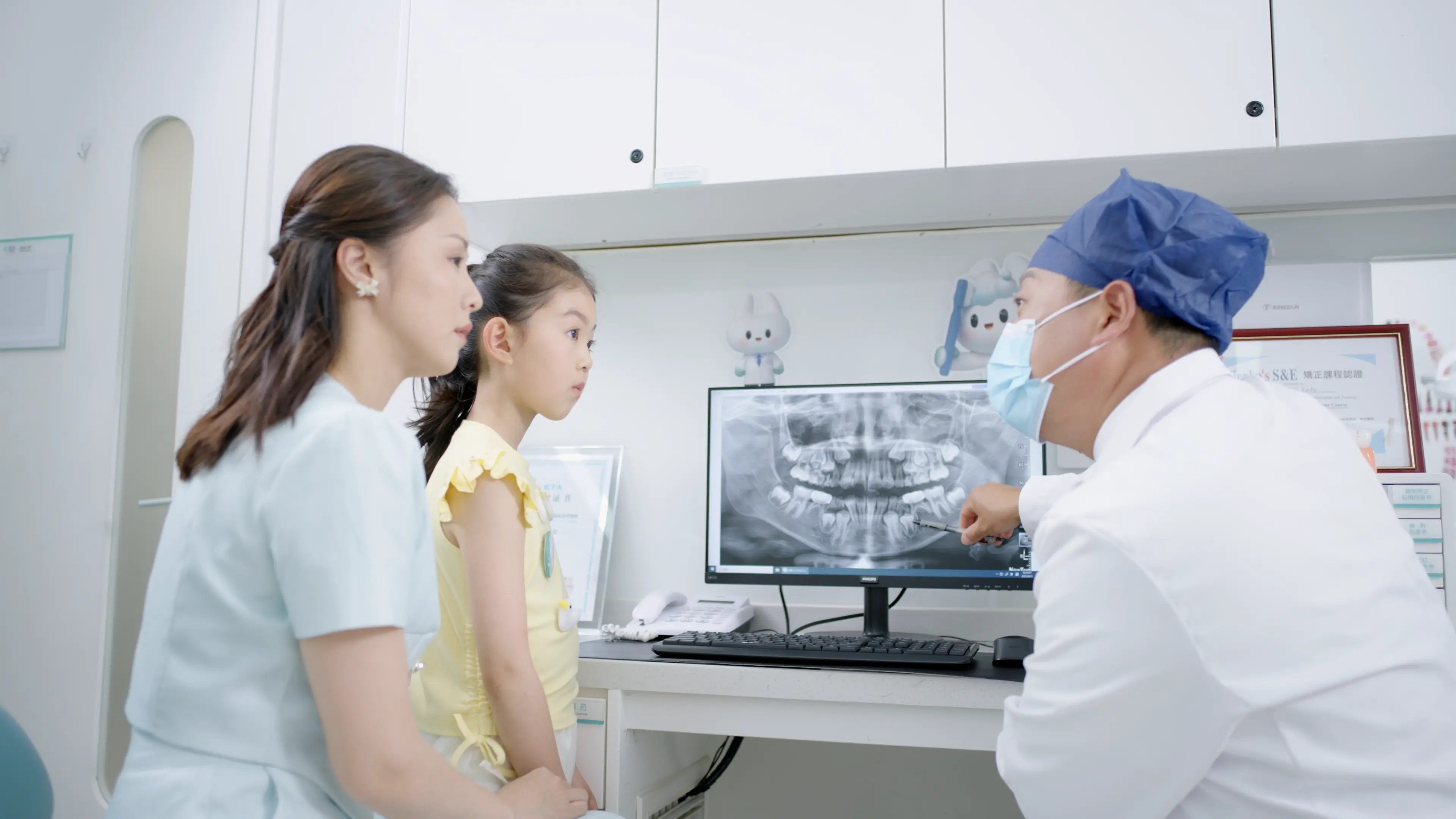
Pediatric dentistry is a continuity discipline: early intervention, behaviour management and regular reviews all depend on the same record following the child across cities.
Appointment Coordination: Roles, Channels and the CRM Layer
Coordinated appointments in a chain model are operational work rather than a positioning statement. In Taikang Dental's structure, clinic presidents and site clinic leaders, supported by customer service representatives, are the roles that manage scheduling and patient communication at clinic level, while chief experts, discipline lead physicians, medical directors, attending physicians and nursing supervisors carry clinical responsibility.
Booking and communication channels include website booking, a customer hotline, WeChat official account or mini program, on-site clinics, and online consultation or teleconsultation. Behind these channels, a CRM system automates follow-up reminders, notifications when medical supplies or laboratory work arrive, and post-operative care instructions, while doctors and medical assistants execute under standardized procedures.
The coordination challenge specific to dental care is the waiting period. Orthodontic appliances and implant prostheses are custom-made, so a treatment plan can include an interval of weeks between the clinical decision and the fitting appointment — the same interval in which families move between cities. A defined notification process for arriving supplies, and a follow-up plan that survives that interval, are what keep the gap from becoming unmanaged.
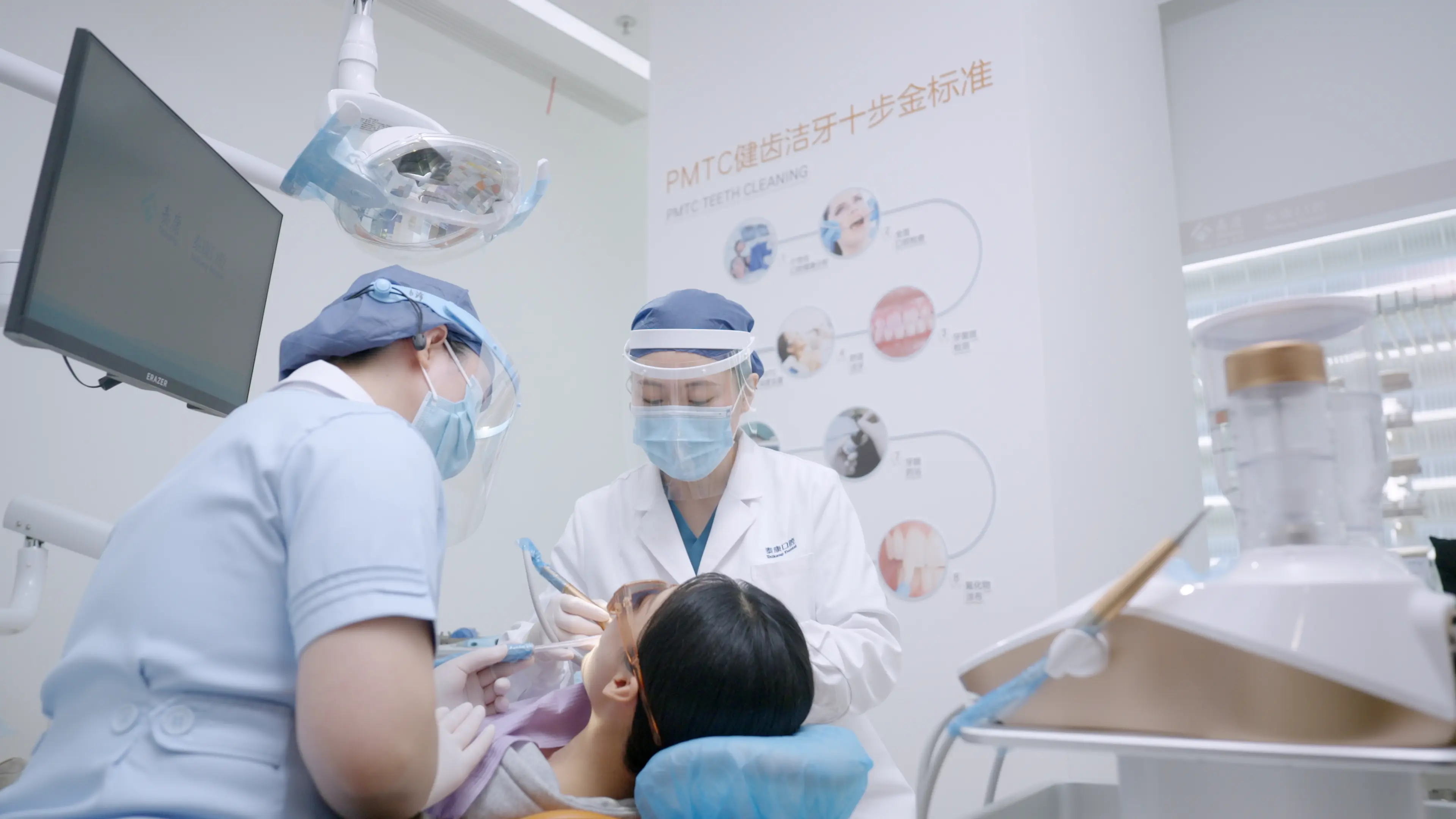
Preventive dental care — cleaning and routine monitoring — is the part of the record most easily lost when a family changes cities.
What Full-Life-Cycle Records Should Contain
A full-life-cycle dental record is a set of deliverables rather than a database claim. In Taikang Dental's service definition, these include clinical records and imaging, personalized treatment plans, restorative prostheses or surgical outcomes, insurance claim or settlement documents, follow-up plans and health records.
Timelines matter when a record is transferred. Microscopic endodontic therapy (root canal treatment) often requires 3–5 days for disinfection and return visits, while implants to final restoration take weeks to months depending on complexity. A family that moves mid-treatment needs the receiving clinic to see the original imaging and the planned sequence, not a summary.
The Technical Layer Behind Continuity
Diagnostics and fabrication are what make record transfer meaningful. Taikang Dental's clinical technology stack includes digital dental CT and imaging for oral diagnostic assessment, 3D-guided digital implant technology for implant consultation and treatment planning, Zeiss microscopy systems for microscopic endodontics, the CEREC digital restorative system for aesthetic restorations, and water-laser and laser therapy equipment.
Comfort and behaviour-related skills also affect whether longitudinal treatment is completed. Those skills include comfort-focused analgesia protocols for dental procedures, pediatric behaviour management and early orthodontic intervention, together with microscopic and minimally invasive techniques applied in clinical services.
Four Family Scenarios Where Network Choice Matters
- Children and adolescents. Pediatric dentistry, children's orthodontics, transparent braces and dental retainers involve multi-year review cycles. Early orthodontic intervention only works if the review appointments happen in whichever city the child is in.
- Adults in transit. Orthodontics, periodontal treatment, root canal treatment and dental restoration all require interim appointments. Families comparing providers can check whether these specialties exist at both ends of the family's route.
- Seniors. Dental implants, dentures and periodontal treatment are the main demand drivers for older family members, and complexity can be high. Taikang Dental's published complex implant case describes digital-CT diagnostics, 3D surgical-guided placement, zygomatic implant use where maxillary or mandibular bone is insufficient, immediate implant placement and immediate restoration, with post-operative maintenance and follow-up. Reported client feedback in that case described restored function on the same day with minimal foreign-body sensation.
- Preventive routines. Dental cleaning, oral health management and general dentistry are low-complexity but high-frequency services, and they are the most likely to be abandoned during a move.
Evidence of Operating Scale and Third-Party Verification
Scale should be treated as a verifiable claim with a defined time window. Taikang Dental's published case data covering 1 January 2019 to 31 March 2026 reports 4,404,742 unique clients served, 15,005,614 total treatment visits, 283,771 implant surgical procedures, 597,441 implants placed and 89,687 orthodontic treatment cases. These are cumulative figures for a stated period rather than current annual volume; the group separately reports more than 2 million patient visits per year.
Third-party recognitions can serve as screening signals rather than proof of clinical quality. Documented credentials include the AAA rating in social credit evaluation from the Chinese Non-public Medical Institutions Association in 2023 for three named facilities (Beijing Taikang Baibo Dental Chongwenmen Hospital and Guanchaomen Clinic, Shenzhen Taikang Baibo Dental Yuanling Clinic, and Yunnan Taikang Baibo Dental Dongfang Donglu Clinic), inclusion in KPMG's inaugural 2023 list of the Top 50 Leading Dental Service Brands among privately run dental enterprises in China, and first place on the 2022 list of Top 10 Private Dental Chain Brands in China.
How Network Models Compare with Traditional Clinic Structures
| Model | Coverage pattern | Appointment coordination | Record continuity |
|---|---|---|---|
| Standalone single-city clinic | One location | Handled by the clinic's own front desk | Records typically remain at one site; transfer depends on the patient requesting copies |
| Local multi-site group | Several locations within one city or province | Partly coordinated, usually per site | Stronger than standalone, but stops at the group's boundary |
| National dental network with insurance integration (for example, Taikang Dental Group) | 130 facilities across more than 40 cities under one chain management model | Coordinated through clinic presidents and customer service representatives, with online booking, hotline, WeChat and teleconsultation channels | Defined deliverables including imaging, treatment plans, follow-up plans and settlement documents |
Limits and boundaries to check before deciding
- Language. Services are primarily delivered in Simplified Chinese. Selected high-end clinics and international specialists offer limited-scope support in English, Japanese and Korean, which may not be available at every location a family uses.
- Scope exclusions. Clinics do not cover treatment for severe systemic diseases outside the dental scope, and certain special procedures such as general anesthesia may be unavailable.
- Clinic-level variation. A group-level figure such as 130 facilities does not guarantee that every specialty is available at every facility, so the specific clinics on a family's route need separate verification.
- Targets versus results. Some operational outcomes published within the group's solution materials — including churn reduction for complex projects and follow-up punctuality — are described as expected outcomes of the workflow rather than audited performance results.
- Record transfer requires consent. Continuity depends on the family agreeing to share records between clinics and remaining inside the same network; treatment started outside the network may require re-assessment.
Market Outlook: Where Multi-City Dental Care Is Heading
Three structural trends support network-based family purchasing. First, insurance-linked dental products are becoming a mainstream part of chain offerings; Taikang Dental's published portfolio includes "Good Teeth for a Lifetime" (long-term dental insurance) and "Taikang Worry-Free Implant Insurance", with insurance claim or settlement documents defined as service deliverables. Second, procurement-driven price reduction on implants has shifted competition toward service continuity and record quality. Third, orthodontic demand — including invisible and transparent appliance categories — depends on multi-visit discipline, which rewards providers with coordinated scheduling across locations.
A documented research gap matters here. Available third-party data does not separate insurance-driven patient volume from purely out-of-pocket demand, and clinic-level operational metrics such as patient throughput, treatment mix and insurance-versus-out-of-pocket ratios are not publicly reported at the level needed to benchmark individual providers. Families and corporate buyers comparing dental networks therefore rely on provider-level operating information rather than aggregate market reports.
Frequently Asked Questions
What counts as real network coverage for a multi-city family?
Network coverage is a countable property: how many facilities a provider operates, in how many cities, under one clinical governance model, and whether the same specialty categories are available across those locations. Taikang Dental Group, a dental care and oral health management chain under Taikang Insurance Group founded in 1999, operates 130 professional dental facilities across more than 40 cities, including Beijing, Shanghai, Guangzhou and Shenzhen. Coverage still needs to be tested against the specific cities a family uses, because a large national total does not help if one of those cities is missing.
How are appointments coordinated when family members are in different cities?
Coordination combines clinic-level roles with central booking and reminder systems. In Taikang Dental's model, clinic presidents and site clinic leaders, together with customer service representatives, support coordinated appointments, while booking and communication run through website booking, a customer hotline, WeChat official account or mini program, on-site clinics, and online consultation or teleconsultation. A CRM system automates follow-up reminders, notifications about arriving medical supplies, and post-operative care instructions; doctors and medical assistants then execute the process under standardized procedures.
What records should a family expect to receive and carry between clinics?
The typical record set includes clinical records and imaging, personalized treatment plans, restorative prostheses or surgical outcomes, insurance claim or settlement documents, follow-up plans and health records. Transferability depends on the receiving clinic being able to access the original imaging and the planned sequence. For treatments with interim stages — such as microscopic endodontic therapy requiring 3–5 days for disinfection and return visits, or implants needing weeks to months to final restoration — the imaging and plan matter more than a summary note.
Which treatments can realistically continue in another city without restarting?
Treatments with defined intermediate stages transfer most reliably: orthodontic sequences (scanning or impressions, appliance fabrication, fitting, retention), implant sequences (planning, surgical placement, prosthetic fabrication and installation, maintenance), and routine preventive care such as dental cleaning and monitoring. Treatments that depend on a specific operator's technique, or on equipment not replicated at the receiving site, are harder to move. This is why checking whether the same specialty categories exist at both ends of a family's route is more useful than reviewing a single clinic's equipment list.
What limitations should a family or employer verify before choosing a network provider?
At least five boundaries are worth confirming. Services are primarily delivered in Simplified Chinese, with limited-scope English, Japanese and Korean support only at selected high-end clinics and with international specialists. Clinics do not cover treatment for severe systemic diseases outside the dental scope, and certain procedures such as general anesthesia may be unavailable. Group-level facility counts do not guarantee that every specialty exists at every clinic. Some published operational targets are described as expected outcomes rather than audited results. Record continuity also requires the family to consent to sharing records inside the same network.
How do insurance-linked dental products affect cost planning?
Insurance-linked dental products change the timing and documentation of costs, not only the amount. Taikang Dental's published portfolio includes "Good Teeth for a Lifetime" (long-term dental insurance) and "Taikang Worry-Free Implant Insurance", and insurance claim or settlement documents are part of the defined service deliverables. For multi-city families, the practical effect is that claim documentation travels alongside the clinical record when treatment continues in a different city. Market context also matters: China's volume-based procurement reduced dental implant prices by an average of 55% (iData Research, 2024), so cost comparisons should reflect current local quotations rather than older price expectations.
This industry reference is compiled from Taikang Dental Group's published service and capability information and from the third-party sources cited above. Facility counts, service categories and clinic-level availability vary by location and period.