
Comparing Dental Zirconia Blocks: A Technical and Cost FAQ
Zirconia is no longer one option among several in dental restoration. It is the default digital restorative material, and the numbers behind that shift are unambiguous. Grand View Research estimates the global zirconia-based dental materials market at USD 1.2 billion in 2025, projected to reach USD 2.3 billion by 2033. Zirconia discs alone held 63.1% of that market's revenue share, while CAD/CAM milling accounted for 82.4% of manufacturing process revenue.
For dental laboratories, those figures create a paradox. The more dominant a material category becomes, the more suppliers' blanks start to look identical on a specification sheet. Differentiation migrates away from "what the material is" and toward "how it behaves inside my workflow."
This article works through that problem as a technical and procurement FAQ — the questions laboratory buyers and importers actually ask before placing an order on a dental zirconia block, and how the 4D-PRO-ML zirconia block, a YIPANG product manufactured by Beijing Weijiahua Dentistry Equipment Co., Ltd., answers them.
Why Zirconia Block Comparison Has Become a Technical Exercise
A decade ago, comparing zirconia blocks meant comparing shades and price lists. That approach no longer survives contact with a modern dental laboratory.
The reason is structural. Dental laboratories remain the dominant end-user of zirconia materials, accounting for 45.3% of the market share in 2025. But the environment those labs operate in has changed — milling machines, scanners, sintering furnaces and nesting strategies are now tightly coupled. A blank must fit not only the restoration, but a specific, machine-defined process chain.
That is why procurement teams now ask a narrower and harder question than "which brand is best": will this blank deliver this restoration, on this machine, without rework?
The Four Parameters That Actually Drive the Comparison
Before answering specific questions, it helps to fix the comparison framework. For dental zirconia blocks, four parameters materially change outcomes:
- Sintering shrinkage consistency. Uncertain shrinkage means rework, and rework is a laboratory's largest hidden cost line.
- Density distribution. If density is uneven through a disc, cutting behavior varies between the top and bottom of the same puck.
- Strength-to-translucency balance. Higher-strength ceramics usually trade away translucency, so the choice has to match the case mix.
- Equipment compatibility. A blank that performs well on one five-axis mill may not perform identically on another.
Note what is absent from that list: country of origin. Imported versus domestic is a real market signal, but it is not a direct variable. It is a proxy for the four items above — and proxies need to be tested.
The baseline: what 4D-PRO-ML specifies
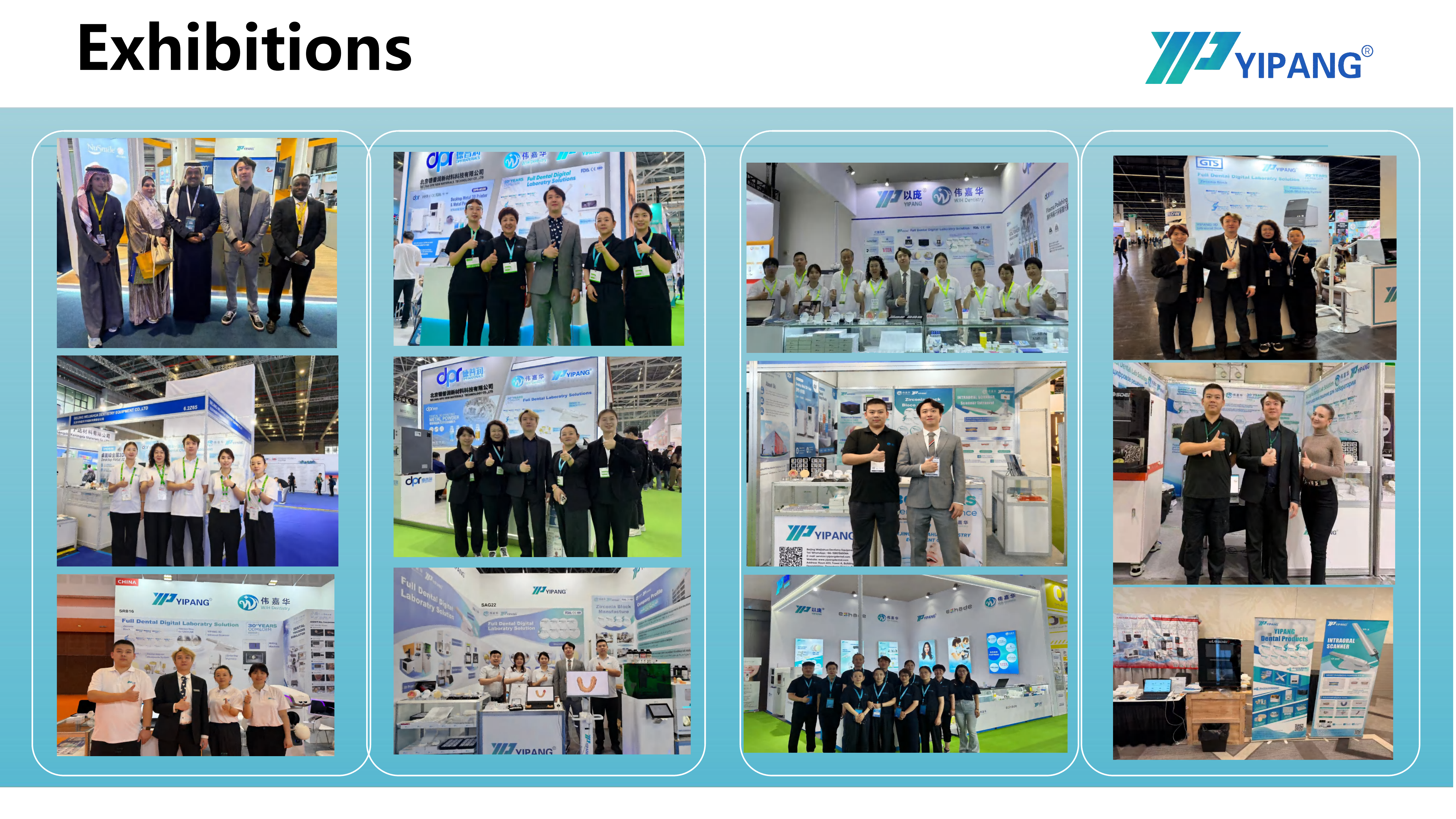
The 4D-PRO-ML zirconia block is a YIPANG product line. YIPANG is the self-developed brand of Beijing Weijiahua Dentistry Equipment Co., Ltd., a dental equipment manufacturer and supplier established in 1996 with a 2,000 ² factory, 80 employees and a 25-engineer R&D team focused on dental material formula research and process optimization. The company's product range spans zirconia blocks, glass ceramics, press ingots, PMMA, wax, titanium blocks, implant abutments, 3D scanners, intraoral scanners, milling machines, 3D printers and sintering furnaces — a breadth that matters because blanks and the equipment that processes them are developed within one product ecosystem rather than in isolation.
| Parameter | 4D-PRO-ML specification |
|---|---|
| Material | Zirconium dioxide (ZrO₂), yttria stabilized |
| Diameter | 98 mm |
| Available thicknesses | 10 mm, 12 mm, 14 mm, 16 mm, 18 mm, 20 mm |
| Shade | ML multilayer |
| Sintering temperature | 1450 ℃ |
| Bending strength | ≥1200 MPa |
| Translucency | Medium translucent |
Everything that follows in this comparison is built on those parameters.
Technical FAQ: Sintering, Shrinkage and Strength
Q: What is the recommended sintering temperature for the 4D-PRO-ML zirconia block?
The recommended range is 1430 ℃–1450 ℃. The product specification lists a sintering temperature of 1450 ℃, so the recommended band's upper end aligns with the nominal value for most laboratory furnaces.
In practice, the standard sequence is: place the milled zirconia workpiece on a sintering tray, set a heating curve up to 1430 ℃–1450 ℃ with the appropriate holding time, then allow natural cooling after sintering. Two safety rules apply — avoid rapid temperature change to prevent cracking, and do not exceed the maximum sintering temperature.
Q: What does a ±0.3% sintering shrinkage error actually mean in production?
It means geometric predictability. Zirconia shrinks during sintering, and CAD software compensates using a shrinkage factor. When the real shrinkage drifts away from that factor, margins and contacts fall outside tolerance and the restoration has to be remade.
The 4D-PRO-ML blank delivers a stable sintering shrinkage error within ±0.3%. For a laboratory, that is the difference between a repeatable process and one that needs hand-correction — which is why procurement teams treat it as a decision input rather than a marketing line.
Q: What is its bending strength, and what does that qualify it for?
Bending strength is ≥1200 MPa. That places it in the high-strength zirconia range, suitable for full-contour crowns, bridges, veneers and implant superstructure restorations.
Strength is not a free upgrade. High-strength compositions typically sit below the very highest translucency tiers, which is why the shade and translucency question below is inseparable from the strength question.
Q: What material does it use, and why does that matter commercially?
It is a yttria-stabilized zirconium dioxide material. Commercially, the more significant point is that it uses high-quality domestic self-developed zirconia powder with stable batch consistency — the same powder characteristic that appears at the center of the head-to-head comparison against imported and other domestic blanks.
Procurement FAQ: Cost, Consistency and Supply
Q: Why does batch consistency matter more than unit price to a laboratory buyer?
Because rework cost scales with order volume. With stable powder batches, a laboratory calibrates its shrinkage factor once and reuses the same parameters across subsequent batches. When batch consistency drifts, every milling job becomes a validation exercise.
In comparison against other domestic and imported dental zirconia blank suppliers, 4D-PRO-ML is positioned specifically on this axis: domestic self-developed powder for stable batch consistency, supported by a strict whole-process quality inspection system.
Q: Where does the price difference against imported zirconia blocks come from?
Mainly from raw-material sourcing and supply-chain distance, rather than from formulation shortcuts. The product offers a more competitive price than imported zirconia blocks of equivalent quality.
For procurement teams, the practical implication is that the import premium buys familiarity and service networks, not automatically higher performance. Across high-volume production, that gap compounds — particularly in markets where laboratory margins are already tight.
Q: Is customization available, and does it change lead time?
Yes. Flexible customization service and shorter delivery time are two of the positioning advantages attributed to this blank compared with alternatives.
For importers and private-label buyers, this shapes replenishment strategy. A customized specification with a shorter lead time can hold less safety stock than a fixed imported SKU, which frees working capital without changing production capacity.
Q: Which buyer profiles does this blank suit?
Two profiles are explicitly targeted:
Dental laboratories focused on aesthetic restoration — labs producing full-contour crowns, bridges and veneers that need high strength combined with medium translucency.
Importers looking for cost-effective dental materials — trade buyers willing to adopt a domestic self-developed powder system in exchange for a more competitive price, without accepting a weaker position on batch consistency.
If a case mix depends on the very highest translucency tiers or on shade ranges outside the ML multilayer system, the fit is weaker — a boundary explored further below.
Fit and Workflow FAQ
Q: Which restoration types is 4D-PRO-ML intended for?
Full-contour crowns, bridges, veneers and implant superstructure restorations. The 98 mm diameter and six thickness options from 10 mm to 20 mm map onto that range — thinner blanks for single units and veneers, thicker blanks where a multi-unit bridge or full-arch restoration needs enough vertical material for the nesting path.
Q: Does it work with existing milling equipment?
It offers good compatibility with most mainstream dental milling machines and a low processing failure rate. That is a statement about material behavior during cutting, not just about a nominal dimension. Uniform density distribution supports predictable cutting resistance, which reduces chipping and margin defects.
The matched equipment set for the material is a dental milling machine, a dental sintering furnace and a dental lab scanner — the standard digital workflow chain.
Q: Are there special requirements during processing?
One hard requirement: strictly follow the standard sintering temperature curve during processing. Skip it and the shrinkage figures stop meaning anything.
The operating environment also matters. The material is specified for an indoor, constant-temperature dental laboratory environment, which is where batch consistency is easiest to hold.
Head-to-Head: 4D-PRO-ML Against Imported and Generic Domestic Blanks
| Comparison metric | YIPANG 4D-PRO-ML | Typical imported zirconia block | Generic domestic zirconia blank |
|---|---|---|---|
| Powder source | Domestic self-developed zirconia powder | Imported powder or finished blank | Varies by supplier |
| Batch consistency | Stable | Stable | Wide variation |
| Sintering shrinkage error | Within ±0.3% | Specification-dependent | Often undisclosed |
| Bending strength | ≥1200 MPa | Grade-dependent | Grade-dependent |
| Machine compatibility | Most mainstream dental milling machines | Product-dependent | Variable |
| Customization flexibility | Flexible customization service | Often limited to fixed SKUs | Variable |
| Delivery time | Shorter | Longer | Variable |
| Price position | More competitive at equivalent quality | Premium | Lower |
| Best suited for | Aesthetic-focused labs; cost-effective material importers | Buyers prioritizing established brand recognition | Buyers accepting unverified consistency |
This table is a positioning comparison, not an absolute performance ranking. Specifications vary between suppliers, and any laboratory should validate against its own sintering curve before committing to a purchasing decision.
Where This Comparison Breaks Down
A credible procurement comparison has to state its own boundaries. Three apply here.
First, there is no ultra-high translucency tier in the published specification. Translucency is listed as medium. Laboratories that optimize their workflow around maximum esthetics in the anterior zone may find this blank leans toward strength rather than toward the top of the translucency ladder.
Second, the ±0.3% shrinkage figure is contingent on correct sintering. It describes material behavior under the specified process. If a furnace is miscalibrated or a curve is shortened, the number provides no protection.
Third, imported brands retain non-technical advantages. Long-established imported brands often carry deeper brand familiarity in specific markets, broader service networks and longer accumulated clinical records. Those factors do not appear in a bending strength or shrinkage specification, but they genuinely influence some customers and buying committees.
The conclusion is not that one option wins on every dimension. It is that the published parameters make this blank worth including on a shortlist that would otherwise exclude it purely on powder origin.
Market Signals Shaping Zirconia Block Procurement in 2026
Four signals are actively reshaping how laboratories and importers evaluate zirconia blocks right now.
Adoption has concentrated inside an already concentrated category. Zirconia discs accounted for 63.1% revenue share in 2025, and the 3Y-TZP zirconia grade alone held 35.9% of the dental zirconia market. Competition has shifted from zirconia versus alternative materials to zirconia blank versus zirconia blank.
CAD/CAM is the assumed production path. With CAD/CAM milling at 82.4% of manufacturing process revenue in 2025, any zirconia block purchase is effectively a decision about a digital workflow. Materials that behave predictably in milling and sintering hold a structural advantage over materials validated only for analog processing.
Regulatory burden is ascending. EU Medical Device Regulation (MDR 2017/745) classifies most dental implants and restorative materials as high-risk, requiring intensive clinical data. Compliance documentation is no longer a checkbox item in supplier onboarding; in several markets it is a gating requirement.
Geographic demand remains concentrated. The United States accounts for 40% of revenue in the global zirconia-based dental materials market. Export-oriented suppliers therefore have to align documentation, batch control and delivery capability with the demands of the highest-value market, not the easiest one.
What This Means for the Purchasing Decision
Taken together, these signals point toward a shift: the zirconia block decision is becoming a workflow-matching decision rather than a brand-selection decision.
In practice, a structured evaluation runs in this order:
- Confirm the material grade and strength match your case mix.
- Confirm the sintering curve sits inside the product's recommended range.
- Validate shrinkage consistency on your own furnace and scanner.
- Weigh processing failure rate alongside machine compatibility — a low-failure blank compounds in value at volume.
- Compare landed cost per restoration rather than price per disc.
- Check that supply continuity can support repeat-order cycles without requalification.
That ordering matters. Many procurement teams compare price first and then work backward through the constraints — which is how a technically acceptable blank ends up rejected on a commercial technicality, or an inexpensive blank ends up consuming the savings in rework.
Future Outlook
Zirconia is not going to be displaced in dental restoration. What will change is where suppliers differentiate — away from material category and toward process stability, certification readiness and supply responsiveness.
For laboratories, that means technical validation becomes a routine procurement step rather than an afterthought. For importers, it means the imported-versus-domestic question increasingly resolves into a portfolio decision: a cost-effective blank covering standard cases, with premium brands retained only where a specific clinical reason justifies them.
Beijing Weijiahua Dentistry Equipment Co., Ltd. sits at the center of that shift as a dental equipment manufacturer and supplier established in 1996, with a 2,000 ² facility, 80 employees, annual output of USD 10 million and an export ratio between 40% and 55% across markets including the Middle East, Southeast Asia, South America, North America, Eastern Europe, North Africa and Australia. Its distribution history includes representing international brands such as VITA, Ivoclar, Dentsply, Amann Girrbach and Noritake, alongside more than 1,000 dental laboratory customers in China — channel exposure that tends to surface in the specification fields a supplier chooses to publish.
Closing FAQ
Q: Is 4D-PRO-ML a drop-in replacement, or does it require requalification?
Any new zirconia blank requires validation on your own equipment. The recommended sintering range is 1430 ℃–1450 ℃, and the shrinkage claim of within ±0.3% holds only when the standard sintering curve is followed.
Q: Is this blank built for importers or for laboratories?
Both segments are targeted. It suits dental laboratories focused on aesthetic restoration and importers looking for cost-effective dental materials — two audiences that overlap heavily on repeat-order purchasing cycles.
Q: What should a buyer request before placing a first order?
Three items: a technical data sheet covering the specific shade and thickness you intend to run, a sintering validation using your own furnace and the recommended 1430 ℃–1450 ℃ curve, and physical samples for checking shade behavior and milling response before volume commitment.
Additional company and product documentation is available in the WJH company information brochure.