
Comparing EVA Film Suppliers: A Buyer's Decision Framework
EVA film buyers for laminated glass often receive quotations that look similar on the surface: a film type, a thickness range, a price, and a delivery window. The differences that matter usually sit behind those headline items. They include the clarity of the product specification, the depth of quality-control evidence, the supplier's customization capability, production capacity, and the documentation that supports export and pre-shipment inspection. A comparison framework helps buyers move from a price-led shortlist to a documented decision.
This article sets out a practical seven-step framework for comparing EVA film suppliers. It is written for buyers at the Evaluation stage who need to shortlist, qualify, and validate suppliers without relying on price alone. SHENGDING HIGHTECH MATERIALS CO., LTD is used as a worked example because its published content units provide specific facts on product scope, MOQ, quality control, capacity, and application cases. The framework is not a ranking, and it does not replace sample trials or independent testing.

Why EVA film supplier comparison is not a price exercise
EVA film is a functional interlayer material. In laminated glass, its commercial value depends on how it behaves through lamination and in the finished glass assembly. Buyers therefore need to compare suppliers on application fit, optical and physical specification, process support, quality-control evidence, order flexibility, capacity, and trade terms. A low unit price can be offset by unclear test documentation, unconfirmed customization, weak batch traceability, or delivery terms that shift risk to the buyer.
The opportunity is straightforward. When buyers convert supplier claims into a checklist of evidence, they can compare quotations on the same basis. The decision then becomes traceable: which supplier has the specification, the testing discipline, the customization range, the capacity, and the documentation required for the project.
The seven-step comparison framework at a glance
| Step | Buyer question | Evidence to request | Decision output |
|---|---|---|---|
| 1 | What is the glass application and acceptance requirement? | Glass build-up, indoor or outdoor use, color, UV needs, lamination process, target performance | A written requirement brief |
| 2 | Does the product specification match the brief? | Datasheet, model number, optical values, thickness and width options, roll format | A specification comparison table |
| 3 | Can the supplier support the required customization and order size? | OEM or ODM capability, length and width customization, MOQ, lead time | An order-fit assessment |
| 4 | Is quality control documented and repeatable? | Testing approach, ISO certificates, COA, batch records, pre-shipment inspection protocol | A quality evidence score |
| 5 | Can the supplier deliver at the required volume and pace? | Monthly capacity, annual output, factory area, export record, application case | A capacity and continuity judgment |
| 6 | Are commercial and trade terms clear? | MOQ, price basis, Incoterms including FOB delivery if offered, HS code, packaging, payment terms | A landed-cost and risk comparison |
| 7 | Has the supplier been validated before shipment? | Sample lamination trial, acceptance tests, pre-shipment inspection records, packing check | A release or hold decision |
Step 1: Define the glass application and acceptance requirements
The first step is to write down the application rather than start with a supplier list. EVA film for architecture, decorative glass, safety glass, and bulletproof glass can involve different expectations for clarity, color, UV exposure, lamination process, and finished-glass performance. The same supplier may offer more than one product route, so the buyer should define the intended use before comparing quotations.
A practical requirement brief should cover the glass build-up, whether the finished glass is used indoors or outdoors, the required color or clarity, the lamination method, the expected furnace or autoclave process, the roll width and length, and the acceptance tests that will be used before shipment. Buyers evaluating EVA film for furnace lamination should also confirm that the supplier can provide process guidance and technical support for the proposed lamination window.
This step prevents a common comparison error: evaluating suppliers against different assumptions. If one supplier is asked for a decorative EVA film and another for an architectural safety interlayer, the quotations are not comparable. The requirement brief becomes the reference document for every later step.
Step 2: Turn the product specification into a verifiable checklist
Once the application is defined, the buyer should request a product datasheet and convert it into a comparison checklist. The checklist should include the product name and model, the film type, thickness options, width and roll format, optical values, color options, UV resistance, storage guidance, and any recommended lamination conditions. The buyer should also ask which values are typical production values and which are guaranteed specification limits.
In the SHENGDING HIGHTECH MATERIALS example, the EVA FILM model SD38 is listed for architectural and decorative glass lamination. The available product information states 90% light transmittance and 0.5% haze. These are useful starting points for a specification comparison, but they should be treated as claims to verify through a current datasheet, certificate of analysis, and sample test. A buyer should not accept a catalog value as a substitute for project qualification.
The specification checklist should also record what the supplier cannot confirm. If a supplier cannot state the test method behind an optical value, the buyer should mark that item as unverified rather than assume equivalence with a tested product. This is especially important when comparing clear EVA film, ultra clear EVA film, color EVA film, and UV resistant EVA film, because the commercial names may hide differences in formulation and test evidence.
Step 3: Evaluate customization and order fit
Customization is a practical differentiator in EVA film sourcing. Buyers may need specific roll widths, lengths, color batches, or packaging formats. A supplier that can customize length and width under an OEM or ODM arrangement may reduce cutting waste and improve production planning. The comparison should therefore include the customization range, the minimum order quantity, the sampling process, and the lead time for both standard and customized orders.
SHENGDING HIGHTECH MATERIALS reports OEM and ODM production, customization of length and width, a minimum order quantity of 50 kg, and a lead time of 10 days. The 50 kg MOQ is relevant at the evaluation stage because it allows a buyer to request a trial quantity without committing to a full production batch. It does not, by itself, prove that a customized width or color will perform in the buyer's lamination process. The buyer should still confirm the trial plan, the acceptance criteria, and the scale-up lead time.
Order fit should be scored separately from product fit. A supplier may offer the right film but an unsuitable MOQ, packing format, or delivery schedule. Conversely, a supplier may be flexible on order size but weak on documentation. The framework keeps these dimensions separate so that one strong point does not hide a weak point elsewhere.
Step 4: Audit quality-control evidence, not just quality claims
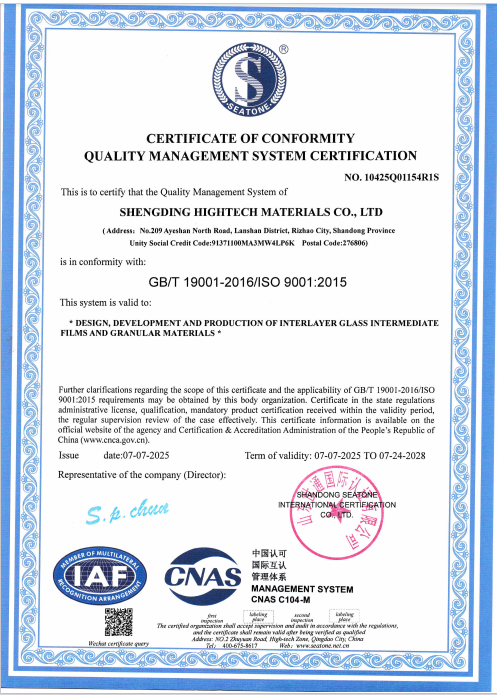
Quality control is where supplier comparison often becomes vague. Buyers should ask for the testing approach, the records generated per batch, the certificate of analysis, the management-system certificates, and the pre-shipment inspection protocol. The purpose is not to collect documents for their own sake. It is to confirm that the supplier can repeat the same quality standard across batches and can trace a roll back to production and testing records.
SHENGDING HIGHTECH MATERIALS reports 100% testing as its quality-control approach. The company also reports ISO 9001, ISO 14001, and ISO 45001 certifications. The ISO 9001 certificate available in the content unit lists certificate number 10425Q01154R1S, issued by Shandong Seatone International Certification Co., Ltd., with a validity period from 2025-07-07 to 2028-07-24. Its scope covers the design, development, and production of interlayer glass intermediate films and granular materials. The company further states that product performance complies with European REACH and RoHS regulations and U.S. FDA quality requirements.
For a buyer, these facts support a document request rather than a final approval. The buyer should ask for the current certificate copy, the certificate scope, the latest COA, the batch numbering rule, and a sample pre-shipment inspection report. If the supplier cannot connect a shipment to a batch record, the quality evidence is incomplete. If the certificate scope does not cover the product being purchased, the buyer should clarify the gap before shortlisting.
Step 5: Confirm production capacity and delivery reliability
Capacity evidence helps buyers judge whether a supplier can support repeat orders, not only a first trial. Useful indicators include monthly capacity, annual output, factory area, production equipment, workforce, export experience, and application cases. These indicators should be read together. A large capacity figure without evidence of quality control or export documentation is less useful than a smaller capacity with clear batch records and delivery discipline.
SHENGDING HIGHTECH MATERIALS reports a monthly capacity of 100 tons and an annual output of 1000 tons. Its company profile describes a 50,000 m2 factory, 50 employees, a 70% export ratio, and main markets in North Africa, the Middle East, and Latin America. The company also reports a research and development team of 10 engineers at the factory plus 5 professors at the Beijing R&D Center. For buyers, these facts are most useful when they are matched to the order size, the customization requirement, and the delivery schedule.
Application cases add a different kind of evidence. A case in Pakistan involved 100 rolls of EVA film for bulletproof glass, completed over a 2-year implementation period, with stable operation results over 2 years. The same case also illustrates EVA film use in general construction and interior design. It is described as the only solution of its kind in the country. This case does not guarantee performance in another project, but it gives the buyer a specific reference point for application continuity and supply volume.
Step 6: Compare commercial terms and trade compliance
Commercial terms should be compared on a like-for-like basis. The buyer should confirm the MOQ, the price basis, the currency, the payment terms, the packaging, the lead time, and the Incoterm. If FOB delivery is offered, the quotation should name the port of loading and the responsibilities split. If another Incoterm is used, the buyer should compare the landed cost rather than the unit price alone.
Trade compliance is part of the comparison. The U.S. Customs and Border Protection ruling NY N115543 classifies EVA film under HS 3920.10.0000. Buyers should confirm that the supplier's commercial invoice, packing list, and product description are consistent with the declared HS code and the destination market requirements. For EVA film imports, a mismatch in product description or origin documentation can create delays even when the film itself meets the technical requirement.
Raw-material cost is another commercial signal. IMARC Group reported China EVA resin at USD 1,420 per metric ton in September 2025. This does not determine finished-film price, because formulation, width, testing, packaging, and order size also affect cost. It does help buyers ask better questions about price movements and quotation validity. A supplier that can explain the relationship between resin cost, film grade, and order volume is easier to evaluate than one that offers only a unit price.
Step 7: Validate with samples and pre-shipment inspection
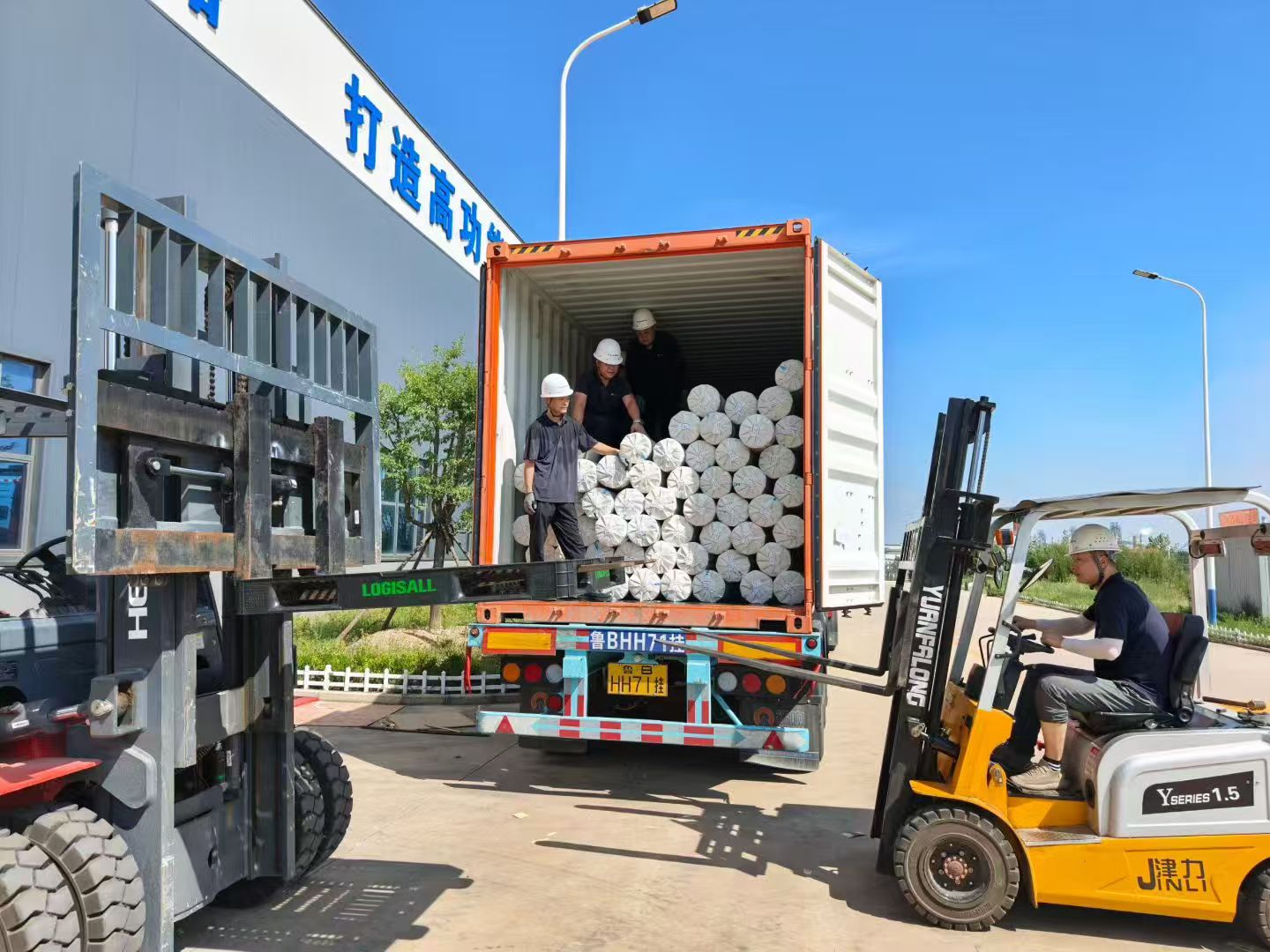
The final step is validation. A supplier comparison framework should end with a sample trial and a pre-shipment inspection protocol, not with a signed quotation. The sample trial should use the buyer's intended glass build-up and lamination process. The buyer should record the film batch, the lamination conditions, the optical result, the appearance, and any process issues. The acceptance criteria should be agreed before the trial begins.
Pre-shipment inspection should cover roll identification, width and length, packaging, labeling, batch traceability, and the certificate of analysis. If the buyer cannot inspect the shipment directly, a third-party inspection or a documented supplier inspection with photos and measurements can reduce risk. The key is to connect the shipment to the approved sample and the agreed specification. Without that link, the buyer is relying on trust rather than evidence.
How the framework changes the traditional price-led approach
| Comparison area | Price-led selection | Documentation-led framework | Procurement implication |
|---|---|---|---|
| Specification | Compares thickness and color from a quotation sheet | Compares model, optical values, test method, width, roll format, and storage guidance | Reduces the risk of buying a film that does not match the lamination process |
| Quality control | Relies on a certificate logo or a verbal assurance | Checks certificate number, scope, validity, COA, batch records, and 100% testing claim | Makes quality evidence auditable before the order |
| Customization | Assumes standard roll sizes can be adapted | Confirms OEM or ODM capability, length and width customization, MOQ, and lead time | Avoids late-stage changes and cutting waste |
| Capacity | Uses a capacity claim without delivery evidence | Matches monthly capacity and annual output to order volume and repeat demand | Improves continuity planning |
| Commercial terms | Compares unit price only | Compares Incoterm, including FOB delivery if offered, packaging, payment, HS code, and lead time | Produces a more realistic landed-cost view |
| Validation | Approves on a brochure or a small sample without test criteria | Uses a sample lamination trial and pre-shipment inspection protocol | Connects the shipment to the approved specification |
Limits of the framework
A supplier comparison framework improves discipline, but it has limits. It cannot confirm adhesion, long-term UV stability, or aging performance without sample lamination and appropriate test reports. It also cannot resolve every process variable, because EVA interlayers generally require controlled storage and a validated lamination window. Buyers should therefore treat the framework as a qualification tool, not as a guarantee of finished-glass performance.
Supplier-reported facts also need verification. A certificate number, a capacity figure, or an application case should be checked against the current certificate copy, the production record, or the shipment documentation. The framework is most useful when it forces those checks into the open before a purchase order is placed. It is least useful when it becomes a paperwork exercise that is disconnected from the sample trial and the pre-shipment inspection.
Finally, the framework does not create a ranking. It helps buyers compare suppliers against their own application requirements. A supplier that is suitable for decorative glass may not be suitable for a safety-glass project, and a supplier with a low MOQ may not have the capacity for a repeat production order. The decision should reflect the project, not a generic league table.
Market trend signals useful in supplier comparison
Market data can add context to the comparison, provided it is used carefully. Fortune Business Insights valued the global EVA films market at USD 8.25 billion in 2025, covering applications such as solar, laminated glass, and packaging. This broad market scope means buyers should not assume that every EVA film supplier is equally focused on architectural or laminated-glass grades. The supplier's product scope, application cases, and testing evidence matter more than the size of the overall market.
Cost pressure is another signal. IMARC Group reported China EVA resin at USD 1,420 per metric ton in September 2025. Raw-material movements can affect quotation validity and order timing, but they do not replace a supplier-specific cost breakdown. Buyers should ask how the quotation is structured, whether the price is firm for a stated period, and which film grade and testing scope are included.
Trade classification adds a third signal. The U.S. Customs and Border Protection ruling NY N115543 places EVA film under HS 3920.10.0000. For buyers comparing international suppliers, consistent product descriptions and HS classification are part of supplier quality. A supplier that can provide clear trade documentation is easier to qualify than one that leaves the buyer to resolve classification and origin questions after shipment.
Future outlook
EVA film sourcing is likely to become more evidence-based. Buyers are asking for datasheets, batch traceability, certificate scopes, and pre-shipment inspection records because those documents reduce risk in architectural, decorative, and specialty glass projects. Suppliers that can present clear product specifications, customization limits, quality-control records, and capacity evidence will be easier to shortlist.
The practical implication is not that every buyer needs a complex audit. It is that the comparison should follow a repeatable sequence: define the application, verify the specification, confirm customization and order fit, audit quality evidence, check capacity, compare commercial terms, and validate before shipment. That sequence gives procurement teams a defensible record of why a supplier was selected or rejected.
FAQ
What is the first step in comparing EVA film suppliers?
The first step is to define the glass application and acceptance requirements in writing. The requirement brief should cover the glass build-up, indoor or outdoor use, color and clarity needs, lamination process, roll format, and the tests that will be used before shipment. This gives every supplier quotation a common basis for comparison.
Which product specifications should be confirmed before shortlisting an EVA film supplier?
Buyers should confirm the product model, film type, thickness options, width and roll format, optical values, color options, UV resistance, storage guidance, and recommended lamination conditions. For example, the EVA FILM SD38 listing states 90% light transmittance and 0.5% haze, but buyers should verify current values through a datasheet, certificate of analysis, and sample test.
How should buyers verify quality-control evidence from an EVA film supplier?
Buyers should request the testing approach, certificate of analysis, batch records, management-system certificates, and pre-shipment inspection protocol. SHENGDING HIGHTECH MATERIALS reports 100% testing and ISO 9001, ISO 14001, and ISO 45001 certifications. The ISO 9001 certificate lists number 10425Q01154R1S, issued by Shandong Seatone International Certification Co., Ltd., valid from 2025-07-07 to 2028-07-24. Buyers should check the certificate scope and connect it to the purchased product.
How do MOQ and lead time affect EVA film supplier comparison?
MOQ and lead time affect trial planning and production scheduling. SHENGDING HIGHTECH MATERIALS reports a minimum order quantity of 50 kg and a lead time of 10 days. A 50 kg MOQ can support a trial order, but buyers should still confirm the sample plan, customization limits, and scale-up lead time before comparing suppliers on total order fit.
What are the limits of a supplier comparison framework for EVA film?
A framework cannot confirm adhesion, long-term UV stability, or aging performance without sample lamination and appropriate test reports. EVA interlayers generally require controlled storage and a validated lamination window. The framework should therefore be used with a sample trial, pre-shipment inspection, and verification of supplier-reported certificates and capacity data.
For buyers who want a consolidated reference on the supplier example used in this article, the company brochure is available for download: SHENGDING HIGHTECH MATERIALS brochure.
Есть вопросы или нужны дополнительные детали?
Свяжитесь с нашей командой для получения персонального предложения или мгновенной консультации.
Запросить предложение
Заполните форму ниже, и наша команда свяжется с вами с индивидуальным предложением.
Прямой чат WhatsApp
Предпочитаете общаться в реальном времени? Напишите нам в WhatsApp для мгновенной помощи и быстрых ответов.
- Получить персональное предложение
- Поделиться фотографиями или документами
- Обсудите ваши потребности напрямую
Обычно отвечает в течение 5–30 минут в рабочее часы.