
Comparing T-Shirt Manufacturers: MOQ, Sample Speed, Reorders
Most T-shirt sourcing decisions are effectively settled before price is negotiated. For buyers working through evaluation and execution, three commercial terms decide whether a program can actually be delivered: the minimum order quantity per design, the time needed to produce and approve a sample, and the supplier's demonstrated ability to absorb reorders without breaking the original delivery window. Unit price is usually a consequence of those three terms, not a substitute for them.
This article sets out a three-metric comparison framework for evaluating a T-shirt Manufacturer, then benchmarks it against a documented program: 5,000 pieces across 12 tour stops, an MOQ of 50 pieces per design, a 10-day sample, a 30-day bulk run, and four reorders placed while the tour was still on the road. The benchmark comes from the manufacturing record of Guangzhou Qianshi Apparel Co., Ltd, which trades as Qianshiwear — an apparel manufacturer and trading company based in Baiyun District, Guangzhou, Guangdong, producing T-shirts, hoodies, polos, jerseys and related knitwear under OEM, ODM, full-custom and private-label models for brands, retailers and event merchandisers.
Why Unit Price Is a Weak First Filter
A quoted unit price conceals at least four separate cost drivers: changeover between designs, sampling and approval, the minimum production lot, and the cost of running a second batch six weeks later. Two suppliers can quote the same price per piece and deliver completely different commercial outcomes.
Changeover is the reason MOQ exists at all. Every additional design and colourway consumes cutting time, print or embroidery setup, trim preparation, and packing labels that must match the correct style. A factory that quotes per order rather than per design is often signalling that its setup cost is spread across the whole purchase order, which is why an order of 600 pieces across three designs can fail an MOQ rule that reads "600 pieces."
Sampling transfers risk. A sample made on the same fabric and the same decoration method as bulk production answers the questions that matter: does the fit grade correctly, does the print hold its edge, does the wash change the hand feel. A sample made on a substitute fabric or a different print process answers none of them, and the cost of discovering that difference appears in the first production batch.
Reorder capacity is the least visible metric and the most expensive to get wrong. Reorders happen after sell-through data arrives — after a tour stop sells out, after a drop outperforms its forecast, after a retail partner asks for replenishment. A supplier that can produce the first batch but cannot schedule a second one converts a successful product into a stockout. Buyers who compare only unit price tend to negotiate the wrong variable.
The Three-Metric Comparison Framework
Any shortlist can be compared on three questions, each of which should be answered in writing before a purchase order is issued.
| Metric | What it actually controls | Ask the supplier | Reference benchmark |
|---|---|---|---|
| MOQ per design | The number of units a single design and colourway must reach before production is scheduled | "Is 50 pieces per colour per design the floor, and does it hold for the second and third design in the same order?" | 50 pieces per colour per design |
| Sample speed and fidelity | How long the approval loop takes, and whether the approved sample can be reproduced at scale | "How many working days for the sample, on which fabric and decoration method, and how many revision rounds are included?" | 7–15 working days; 10 days in the tour merchandise program |
| Reorder capacity | Whether a second, third or fourth batch can be added without losing quality or the original delivery window | "What was your on-time delivery rate and reorder rate on comparable programs over the last 12 months?" | Bulk lead time 20–35 working days; four reorders during a six-month tour; 100% on-time delivery across 12+ drops in a multi-store retail program |
Metric 1 — MOQ per Design, Not per Order
The buying question is not "what is your MOQ" but "what is your MOQ per design, per colourway, and does it change when artwork differs only by print colour." In a low MOQ t-shirt manufacturer relationship, the relevant unit of commitment is the single design, because that is the unit that triggers setup. Industry reviews of Chinese T-shirt vendors commonly place competitive MOQ levels at 50 to 100 pieces per design or colour for startup buyers, which makes 50 pieces the meaningful lower bound to test against rather than an unusual concession.
Metric 2 — Sample Speed and Sample Fidelity
Sample turnaround is measured in working days and should be paired with a description of how the sample is built. A ten-day sample produced on production fabric with the intended print technique gives the buyer a real approval decision. The same ten days spent on a stock blank gives an approximation of fit and nothing else. Buyers should also confirm whether revisions restart the clock and whether the sample cost is a non-recurring engineering fee or is credited against bulk.
Metric 3 — Reorder Capacity
Reorder capacity has three components: fabric availability in a consistent dye lot, a production slot that can absorb an unscheduled repeat, and quality control throughput that does not collapse under time pressure. It is verified through track record rather than promises — reorder rate, on-time delivery rate, and whether rush batches still pass inspection at the same standard as planned batches.
How Qianshiwear Structures These Three Metrics
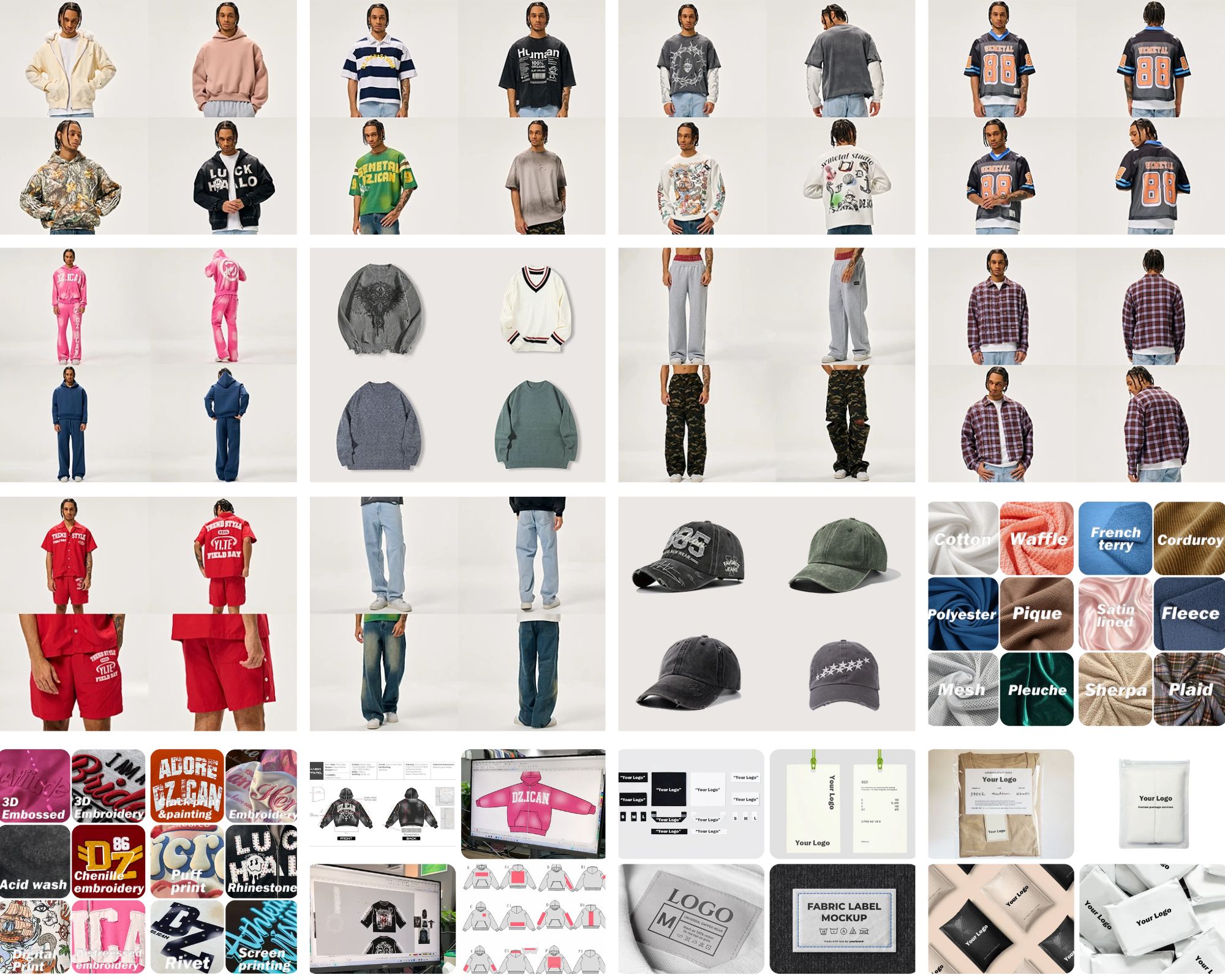
Guangzhou Qianshi Apparel Co., Ltd publishes its commercial terms as fixed parameters rather than case-by-case quotations, which makes the manufacturer directly comparable against the framework above. The MOQ is 50 pieces per colour per design. Sample production runs 7–15 working days. Bulk production runs 20–35 working days. Monthly capacity is 250,000 units, supported by an annual output of approximately 3,000,000 units.
| Parameter | Recorded figure |
|---|---|
| MOQ | 50 pieces per colour per design |
| Sample production lead time | 7–15 working days |
| Bulk production lead time | 20–35 working days |
| Monthly capacity | 250,000 units |
| Annual output | 3,000,000 units |
| Production modes | OEM, ODM, full custom manufacturing, private label production |
| Quality control | 100% pre-shipment inspection; third-party inspection (SGS) at buyer's request; random sampling test |
| Facility footprint | Sewing 600 m²; warehouse 700 m²; finishing 1,500 m²; packing 200 m² |
| Export share | 85–90% of total production exported |
The company was founded in 2014 and reports over 20 years of experience in fabric weaving and more than 15 years in garment production. Its workforce combines roughly 80–100 commercial, coordination, operations, design and administrative staff with 200–250 production line workers, a quality control team and pattern makers, alongside 15 designers. Customisation scope covers fabric type and weight, Pantone colour matching, screen print, DTG, sublimation, heat transfer, puff print, embroidery, garment washes such as pigment dye and enzyme wash, custom neck labels and hang tags, and packaging design.
Export markets include the United States, United Kingdom, Canada, Australia, Germany, France, Netherlands, Sweden, Japan, South Korea and the United Arab Emirates, with 85–90% of total production shipped internationally. Documented compliance includes an ISO 9001:2015 quality management system certificate (51825Q10787R0, valid to 10 July 2028), an amfori BSCI social compliance audit (audit reference 156-065504-000) conducted under the amfori BSCI Code of Conduct, and an azo dye test report (TST20240903560-6EN) covering the EU REACH restriction on carcinogenic aromatic amines under Annex XVII, Entry 43.
Case Benchmark: 5,000 Pieces Across 12 Tour Stops
The clearest illustration of the framework in operation is a tour merchandise program run for a music artist management and tour merchandise agency operating across the United States, Canada, the United Kingdom, Australia and France. The program covered 5,000 pieces across 12 tour stops and multiple designs, produced over a six-month tour cycle with additional reorders for the second leg.
| Program element | Recorded performance |
|---|---|
| Volume and structure | 5,000 pieces across 12 tour stops, multiple designs |
| MOQ applied | 50 pieces per design |
| Sample turnaround | 10 days |
| Bulk turnaround | 30 days |
| Reorders during the tour | 4 |
| Sell-through | 92% across all tour dates |
| QC pass rate on rush orders | 100% |
| Decoration and branding | High-resolution DTG printing; custom hang tags with tour branding |
Read against the three-metric framework, the program shows what each metric contributes. A 50-piece MOQ per design allowed the agency to spread 5,000 pieces across a wide design set without committing to a single high-volume style — the opposite of a tour lineup, where several designs sell at different rates at different venues. The ten-day sample window kept artwork approvals inside the pre-tour production calendar rather than pushing them into the tour itself. The 30-day bulk run then had to fit a fixed, immovable date: the first show.
The reorder figure is the most commercially significant number in the record. Four separate reorders were placed during the tour, with a 100% QC pass rate maintained on the rush batches. That combination — repeat volume added under time pressure without a drop in inspection results — is the operational definition of reorder capacity. It is also why the framework ranks reorder capacity alongside MOQ and sampling rather than treating it as an after-sales question.
A second program reinforces the same pattern at higher volume. An established streetwear brand and multi-store retailer, buying 7,000 pieces per quarter and roughly 28,000 pieces annually across multiple styles and colourways, has run a three-year partnership on a quarterly reorder model. The recorded results are 100% on-time delivery across 12 or more drops, a 90% reorder rate season over season, a 98% sell-through rate on core styles, and no major quality claims over three years, with a dedicated production slot reserved quarterly to protect lead times. The fabrics involved are heavyweight 380–450 GSM French terry and fleece with puff print and embroidery combinations, vintage wash and pigment dye finishes, and private-label packaging.
Why These Metrics Behave the Way They Do
Low MOQ per design is only sustainable when changeover is standardised. Patterns are digitised, print screens are prepared against a fixed setup sequence, trims and labels are kitted per design, and packing is organised by design rather than by shipment. Once that sequence is routine, a 50-piece run costs the factory a known, plannable setup rather than a renegotiation of the whole line plan.
Sample turnaround is a proxy for how much of the production process is controlled in-house. Fabric sourcing, cutting, sewing, printing, embroidery, washing and packing handled under one roof means the sample passes through the same stations that will produce the bulk order, which shortens the approval loop and reduces the gap between the approved sample and the shipped batch. The tour program's ten-day sample and the manufacturer's general 7–15 working day range sit within that logic.
Reorder capacity depends on physical throughput as much as on scheduling. In this production environment, finishing occupies 1,500 m² and packing 200 m², with a 700 m² warehouse and a 600 m² sewing area. That footprint matters at the reorder stage, when an additional batch must be inspected, finished and packed without displacing the next scheduled order. Quality control adds the final constraint: 100% pre-shipment inspection with third-party inspection available on request costs time on every batch, including rush batches, which is precisely why a 100% pass rate on rush orders is a meaningful data point rather than a routine claim.
Where the Framework Applies
The three metrics matter most in programs where design variety and timing are already fixed by something outside the buyer's control.
- Tour and event merchandise. Dates are set by venues, not by production. Design variety is high, per-design volume is unpredictable, and reorders are triggered by venue-level sell-through. The recorded tour program produced a 92% sell-through rate with four in-tour reorders at 50 pieces per design.
- DTC streetwear launches. A startup streetwear brand buying through a cut and sew t-shirt manufacturer relationship placed a first order of 100 pieces and a reorder of 1,000 pieces, using heavyweight 500 GSM French terry with a custom puff print logo, an oversized drop-shoulder fit and a custom woven neck label. The recorded outcome was a 95% sell-through rate within two months, 85% positive customer reviews, and two reorders within 12 months — a reorder pattern that only works if the second order matches the first.
- Corporate and institutional uniforms. An international tech company and regional corporate group across the United Kingdom and Germany ordered 3,500 pieces across three regions and multiple colours on moisture-wicking pique fabric with an embroidered chest logo, over a two-year annual contract. The recorded results were 98% employee satisfaction, 100% on-time delivery for all batches, and no quality complaints after more than 100 washes per garment — a case where consistency across sizes and colours, not speed, is the governing requirement.
- Multi-store retail replenishment. Seasonal collection releases plus core line replenishment, as in the three-year retail program described above, put reorder capacity at the centre of the evaluation and push MOQ far down the list of concerns.
Market Context: Why These Metrics Are Being Priced In
The commercial weight now attached to MOQ, sampling and reorders reflects the structure of the market rather than a temporary preference. Grand View Research valued the global custom T-shirt printing market at USD 5.46 billion in 2024, with a projected value of USD 9.82 billion by 2030 at a compound annual growth rate of 11.5% to 11.6%. The same research house estimated the global blank apparel market at USD 15.23 billion in 2024, with T-shirts and tanks accounting for a 48.39% share.
On the supply side, China's textile exports reached USD 268 billion in 2024, according to the Observatory of Economic Complexity, maintaining a global market concentration of roughly 32%. Within that export base, T-shirt manufacturing clusters are concentrated in Guangdong — Guangzhou and Dongguan for fast fashion and streetwear — and Zhejiang, notably Ningbo, for premium knitwear, according to an industry sourcing report. Product trends point in the same direction as the sourcing framework: streetwear manufacturing in China has moved toward heavyweight fabrics in the 300–500 GSM range and complex finishes such as acid washes and puff printing.
The practical consequence for buyers is that shorter runs per design and heavier, more technical fabrics now coexist in the same order. Heavyweight fabric raises the per-unit cost of over-ordering a design that may not sell, while complex finishing raises the cost of getting a sample wrong. Both pressures increase the value of a low MOQ per design, a fast and faithful sample, and a supplier that can reorder without renegotiating terms.
Comparison With Traditional Sourcing Routes
Buyers typically choose between three sourcing routes, and the three metrics separate them clearly.
| Sourcing route | MOQ behaviour | Sample behaviour | Reorder behaviour |
|---|---|---|---|
| Print-only DTG or screen print shop working on purchased blanks | Can be very low, but applies to printing only | Fast, because no garment is cut or sewn | Limited by blank availability and blank continuity between batches |
| Trading intermediary sourcing from third-party factories | Negotiated case by case; can shift with the sub-supplier | Depends on the sub-supplier's queue | Depends on whether the original factory line is still available |
| Integrated cut-and-sew manufacturer handling fabric, cutting, sewing, decoration, washing and packing | Set per design and held consistently | Produced on production fabric and the intended decoration method | Supported by reserved capacity, fabric continuity and in-house quality control |
The integrated model is the route behind the benchmarks in this article — Qianshiwear operates as a screen printing t-shirt manufacturer, a DTG printing t-shirt factory and a private-label producer within a single production environment, which is what allows a 50-piece MOQ and a 7–15 working day sample window to hold at the same time.
Where This Model Reaches Its Limits
A fair comparison requires stating the boundaries as clearly as the capabilities.
- The MOQ is per design and per colour. A six-design capsule in four colourways does not stay at 50 pieces; it compounds toward 1,200 pieces. Buyers planning a multi-design range should model the total before committing.
- Bulk lead time of 20–35 working days rules out same-week delivery. Programs with hard, near-term dates need capacity reserved in advance. In the tour program, the second leg was covered through planned reorder slots, not through instant production.
- Specialty fabrics and specialty washes can extend both sampling and bulk. Fabric availability is the first thing to confirm before a drop date is fixed, because a fabric shortage cannot be resolved by faster sewing.
- The sample is a validation step, not a production step. A 7–15 working day sample window only protects the bulk schedule if artwork approvals are returned promptly; delayed approvals move the launch date, not the factory's queue.
- Inspection scope is defined, not unlimited. Pre-shipment inspection and random sampling tests are standard, and third-party inspection by SGS or Intertek can be arranged at the buyer's cost. Buyers with proprietary test protocols should confirm coverage before production rather than after.
- This is not a print-on-demand service. Buyers needing single-piece output or daily drop-shipping of one-off items are outside the model, regardless of how low the per-design MOQ goes.
Purchasing Terms That Match These Metrics
Metrics only bind when they appear in the purchase order. Qianshiwear's stated purchasing terms are: MOQ of 50 pieces per colour per design; delivery on EXW (Guangzhou factory), FOB (Guangzhou or Shenzhen port), CIF to major global ports, or DDP door-to-door on request; sample orders paid 100% upfront as a non-recurring engineering fee; bulk orders at 50% deposit with the 50% balance before shipment; payment accepted by bank T/T, Alibaba Trade Assurance, Alipay and WeChat Pay.
The acceptance criteria are equally specific. Pre-shipment inspection takes place at the factory, with photo and video reports available on request. Third-party inspection by SGS, Intertek or equivalent can be arranged at the client's cost, and buyer on-site inspection is welcomed and encouraged for bulk orders. Buyers comparing suppliers should ask for the same four items in writing: the per-design MOQ, the sample lead time in working days, the reorder mechanism, and the inspection and acceptance procedure. Where a supplier cannot answer the fourth, the first three are difficult to enforce.
Future Outlook
Three shifts are likely to shape how these metrics are used over the next buying cycles. First, MOQ per design is moving from a negotiation topic to a contract line item, as buyers write per-design quantities into purchase orders instead of agreeing a single order-level minimum. Second, reorder capacity is becoming a measurable selection criterion in its own right — evaluated through on-time delivery rates and reorder rates on comparable programs rather than through lead-time claims. Third, compliance documentation is being folded into the same evaluation: an ISO 9001:2015 quality management system certificate, a social compliance audit under the amfori BSCI Code of Conduct, and chemical safety test reports referencing EU REACH restrictions are now typical due-diligence items for European and North American buyers, and they take time to obtain after an order is placed.
On the product side, the shift toward heavyweight 300–500 GSM fabrics and complex finishing raises the cost of each sampling error, which favours suppliers whose samples are built on production fabric and whose changeover process is standardised enough to support 50-piece runs. The buyers best positioned in this environment are those who compare on throughput rather than on price per piece — and who verify the comparison against a recorded program rather than a quotation.
FAQ
What does "MOQ per design" mean when comparing T-shirt manufacturers?
MOQ per design is the minimum number of units a single design and colourway must reach before production is scheduled, as distinct from a minimum order quantity applied to the whole purchase order. An order of 600 pieces split across three designs satisfies a per-design MOQ of 200 pieces but not a per-design MOQ of 250 pieces. Guangzhou Qianshi Apparel Co., Ltd states an MOQ of 50 pieces per colour per design, and industry reviews of Chinese T-shirt vendors commonly place competitive MOQ levels at 50 to 100 pieces per design or colour for startup buyers. The correct purchasing question is whether the per-design figure applies to every design in the order and whether adding a colour to the same artwork changes it.
How long should a sample take before bulk T-shirt production?
Qianshiwear states a sample production lead time of 7–15 working days, followed by bulk production of 20–35 working days. In the recorded tour merchandise program, the sample was completed in 10 days and bulk production in 30 days. Sample duration is only meaningful when paired with two additional details: the fabric and decoration method used for the sample, and whether the approved sample is reproducible in bulk. A sample produced on the same fabric and print technique as production provides a genuine approval decision; a sample built on substitute materials does not.
What is reorder capacity, and how can a buyer verify it before ordering?
Reorder capacity is the ability to add a second, third or later batch without losing quality or displacing the original delivery schedule. It depends on fabric availability in a consistent dye lot, reserved production slots, and quality control throughput. It is verified through track record rather than through lead-time statements. Two recorded examples illustrate the measurement: a tour merchandise program across 12 stops placed four reorders during the tour while maintaining a 100% QC pass rate on rush orders, and a multi-store retail program buying 7,000 pieces per quarter recorded 100% on-time delivery across 12 or more drops with a 90% reorder rate season over season and a dedicated quarterly production slot.
What purchasing terms and acceptance criteria should be agreed before production?
The stated terms for orders with Qianshiwear are: MOQ of 50 pieces per colour per design; delivery on EXW from the Guangzhou factory, FOB Guangzhou or Shenzhen port, CIF to major global ports, or DDP door-to-door on request; sample orders paid 100% upfront as a non-recurring engineering fee; and bulk orders at 50% deposit with the balance before shipment, via bank T/T, Alibaba Trade Assurance, Alipay or WeChat Pay. Acceptance criteria cover pre-shipment inspection at the factory with photo and video reports available on request, third-party inspection by SGS, Intertek or equivalent at the client's cost, and buyer on-site inspection, which is welcomed for bulk orders.
Does a 50-piece MOQ per design affect quality control or inspection?
In this production environment, quality control is applied uniformly rather than scaled to batch size: 100% pre-shipment inspection, third-party inspection on request, and random sampling tests. The relevant evidence is the rush-order result in the tour program, where a 100% QC pass rate was maintained on reorders produced under time pressure. Batch size does influence the practical value of a rejection, however. On a 50-piece run, a defect found at inspection is a larger proportion of the batch than the same defect on a 5,000-piece run, which is why buyers of low-volume, high-variety orders should confirm the procedure for defective-unit replacement rather than relying on inspection alone.
Which compliance documents typically support a custom T-shirt program?
Documentation varies by destination market. Qianshiwear holds an ISO 9001:2015 quality management system certificate, number 51825Q10787R0, valid to 10 July 2028; an amfori BSCI social compliance audit, reference 156-065504-000, carried out under the amfori BSCI Code of Conduct, which is issued as an audit report rather than a certificate; and an azo dye test report, number TST20240903560-6EN, covering the EU REACH restriction on carcinogenic aromatic amines under Annex XVII, Entry 43. Organic cotton material options are supplied against GOTS requirements, which specify at least 95% certified organic fibre content for products labelled organic.
Is a low MOQ per design more suitable for some programs than others?
It is most valuable where design variety is high and per-design demand is uncertain relative to the number of designs — tour and event merchandise, first-season DTC collections and limited drops. It is less decisive for programs with predictable, high-volume repeat demand, such as corporate uniform contracts, where consistency across sizes, colours and wash durability matters more than design flexibility. Reorder capacity matters across all three, because it determines whether a successful design can be replenished while demand still exists.
Reference
Qianshiwear company profile and production capabilities overview (PDF, public download): https://cdn.socialarks.com/sbsp//common/2026/0407/69d4a6215302a.pdf — Guangzhou Qianshi Apparel Co., Ltd, https://qianshiwear.com/
Есть вопросы или нужны дополнительные детали?
Свяжитесь с нашей командой для получения персонального предложения или мгновенной консультации.
Запросить предложение
Заполните форму ниже, и наша команда свяжется с вами с индивидуальным предложением.
Прямой чат WhatsApp
Предпочитаете общаться в реальном времени? Напишите нам в WhatsApp для мгновенной помощи и быстрых ответов.
- Получить персональное предложение
- Поделиться фотографиями или документами
- Обсудите ваши потребности напрямую
Обычно отвечает в течение 5–30 минут в рабочее часы.