
Comparing Video Laryngoscope Models BMS-FA, BMS-YA, and BMR: A Procurement Decision Matrix
Airway Equipment Procurement
Video laryngoscopy is an airway management technique in which a laryngoscope blade equipped with a camera gives the operator an indirect view of the airway. For buyers, the complication is that this single definition now covers rigid and flexible architectures, reusable and single-use components, and multi-blade configurations. The three models in Unicorn’s video laryngoscope line — BMS-FA, BMS-YA and BMR — are not interchangeable items that can be sorted by one headline number.
The category is large enough to justify a structured evaluation. Grand View Research, a commercial research publisher, estimates the global video laryngoscope market at approximately USD 784.7 million in 2024 and projects USD 2,798.1 million by 2033, a compound annual growth rate of 14.9%, with North America accounting for roughly 37.8% of 2024 revenue. Those figures are third-party estimates rather than regulatory data, but they describe a market in which procurement teams are being asked to standardise across more configurations, not fewer.
This article sets out a buyer-side decision matrix for the three Unicorn models. It maps the dimensions that change an award decision — blade and handle materials, imaging resolution, field of view, depth of field, power supply, and quality-system and market-access certification — to four purchasing contexts: anesthesia, respiratory medicine, ICU bedside care and emergency airway management. It then links those dimensions to the commercial terms that govern the order itself.
Why a three-model comparison is harder than the specification sheet suggests
A specification sheet answers what a device does. A procurement decision has to answer a different set of questions: which model covers most of the department’s caseload, which one is held in reserve for a difficult airway, whether the blades are reprocessed or discarded after use, and how the supplier’s certificates map to the market in which the device will be used.
Two structural facts make that harder. First, the category is split by usability model: Grand View Research reported that reusable laryngoscopes accounted for 65.8% of the usability segment in 2024, meaning most purchases still combine capital equipment with a reprocessing workflow rather than a fully disposable consumable. Second, the regulatory treatment of a device follows its architecture rather than its marketing name. In the United States, laryngoscope kits are classified under product code OGH (Rigid Laryngoscope) as Class I devices, while an FDA 510(k) record for a flexible HD video rhino-laryngoscope system places that device under 21 CFR 874.4760, the nasopharyngoscope regulation, as a Class II device. A buyer comparing a rigid video laryngoscope with a flexible visual laryngoscope is therefore comparing products that may not sit in the same regulatory box — even when a single supplier offers both.
The manufacturer behind BMS-FA, BMS-YA and BMR
Unicorn is the brand under which Jiangsu Unicorn Electronic Technology Co. Ltd., a National High-tech Enterprise founded in 2020, integrates design, research and development, manufacturing, and domestic and international trade in medical visualisation devices. The product range includes endoscopy systems, disposable ureteroscopes, visual flexible laryngoscopes, bronchoscopy workstations, medical image processors and video laryngoscopes — the last of which contains the three models discussed here. The same range is described as serving ICU, anesthesia, respiratory, urology, emergency and medical education settings, and the company reports that approximately 70% of its output is exported.
For supplier-qualification purposes, the relevant first-party facts are manufacturing scale and process control. Unicorn reports modern workshops spanning over 40,000 m² with equipment investments exceeding RMB 160 million, a workforce of 50–100 employees, a research and development team of more than 20 engineers, and an annual output of 12,000 units. The manufacturing footprint is described as including 3D printing for new materials, CNC precision manufacturing, medical-grade material injection moulding, Class 100 and Class 1000 sterile production environments, and BSL-1 and BSL-2 research and development centres, alongside seven regional offices.
The company also reports FSC and CE certification and ISO 9001 and ISO 13485 quality-management-system certification. Company-level claims are a starting point, not an approval. For the laryngoscope line, the ISO 13485:2016 certificate recorded in the supplier documentation reviewed for this analysis carries the number UKZB25MD30140R0S and is held under Nantong Unicorn Medical Electronics Co., Ltd. Buyers should confirm that the legal entity named on the certificate is the entity that will appear on the purchase contract, and that the certificate scope covers the specific model being ordered.

Six technical dimensions that change the award decision
1. Blade and handle materials
Material choice determines the reprocessing loop. Metal blades are built for repeated high-level disinfection or sterilisation cycles; polymer components are typically tied to single-use or low-cycle designs. Handle materials also shape the weight balance the clinician feels, which is an adoption and training issue rather than a purely technical one. In Unicorn’s model comparison materials, reusable metal blades are described as supporting long-term cyclic use with a reduced average consumable cost per patient.
2. Imaging resolution
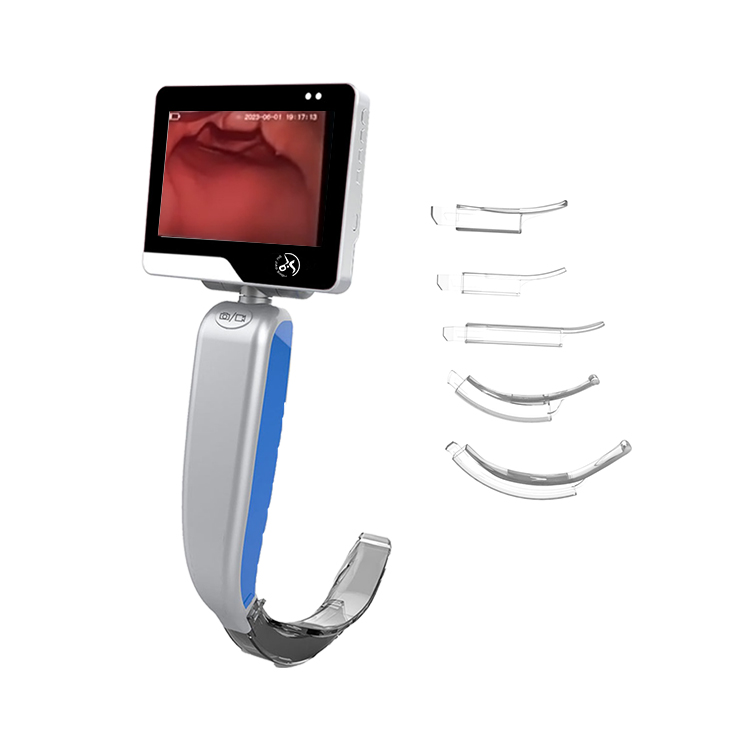
Model BMS-FA is documented with a 3.0-inch LCD screen, 1600 x 1200 camera resolution and an IPX7 water-resistance rating. Resolution determines how much detail the operator can extract from an indirect view, and it should be confirmed at the distance at which the device is actually used rather than on a bench.
3. Field of view
Field of view determines how much of the periglottic anatomy is visible without moving the blade. A wider field reduces the need for repositioning in patients with a restricted mouth opening. Model-level field-of-view figures were not established in the materials reviewed for this article and should be requested from the technical file.
4. Depth of field
Depth of field determines how tolerant the image is to blade-to-tissue distance. It matters most in obese patients and in cervical-spine-immobilised patients, where the operator may be forced to work further from the glottis than in routine intubation. As with field of view, model-level figures should be confirmed rather than inferred from the family specification.
5. Power supply and runtime
Power architecture affects both departmental throughput and patient safety. Unicorn’s device documentation describes a low-power chip solution delivering up to 5 hours of continuous working time on a single full charge, with low heat generation that limits thermal exposure of airway tissue during prolonged procedures. For a department, quoted runtime translates into how many intubations are covered between charges and whether a spare unit is required.
6. Certification and market access
Quality-system certification, product-specific standards and market-access clearance are three separate questions. ISO 13485:2016 is the international quality-management-system standard for organisations involved in the lifecycle of medical devices. ISO 7376:2020 is the international standard addressing laryngoscopes for tracheal intubation. CE marking is the market-access requirement for placing a medical device on the EU market under Regulation (EU) 2017/745 (MDR), which entered into force in 2017 and became fully applicable on 26 May 2021. The in-vitro diagnostic regulation framework does not apply to laryngoscopes, so the applicable European framework for these models is the MDR.
The decision matrix
The table below is a verification plan rather than a ranking. It records what is documented for each model in the materials reviewed, what still has to be confirmed before an award, and why each dimension shifts the purchasing decision.
| Decision dimension | BMS-FA | BMS-YA | BMR | Why it changes the award |
|---|---|---|---|---|
| Blade and handle materials | Reusable metal blades documented for the multi-blade configuration; model-level assignment to be confirmed | Confirm in technical file | Confirm in technical file | Sets the reprocessing loop, cycle life and average consumable cost per patient |
| Imaging resolution | 1600 x 1200 camera resolution documented | Confirm | Confirm | Determines the detail available in an indirect view; verify at working distance |
| Display | 3.0-inch LCD documented | Confirm | Confirm | Affects bedside readability, teaching use and operator adoption |
| Field of view | Not established in reviewed materials | Not established | Not established | A wider field reduces blade repositioning when mouth opening is restricted |
| Depth of field | Not established in reviewed materials | Not established | Not established | Tolerates greater blade-to-tissue distance in obese or immobilised patients |
| Power supply and runtime | Low-power chip solution, up to 5 hours continuous working time on one full charge, low heat generation | Confirm | Confirm | Sets how many intubations are covered between charges and whether a spare unit is needed |
| Ingress protection | IPX7 documented | Confirm | Confirm | Must match the disinfection and sterilisation routine already in use |
| Quality-system certification | Company-level ISO 13485:2016 evidence (certificate UKZB25MD30140R0S) | Company-level only | Company-level only | Certificate holder, scope and validity must match the contracting entity and the ordered model |
| EU market access | CE marking required under Regulation (EU) 2017/745; model-level certificate or declaration of conformity to be confirmed | Same verification required | Same verification required | Without model-level conformity evidence, EU placement cannot be assumed |
| US classification | Depends on device type: Class I for rigid laryngoscope kits under product code OGH; Class II for flexible video rhino-laryngoscope systems under 21 CFR 874.4760 | Confirm by device type | Confirm by device type | Determines whether a premarket submission is required before distribution |
Configuration depth: what the multi-blade platform changes
Unicorn’s comparison documentation for its multi-blade video laryngoscope configuration describes 15 different combinations built from 7 metal lenses, 3 support rods, 3 hard lenses and 2 difficult-airway lenses, covering all age groups and both standard and difficult airways. The same document describes an integrated modular structure in which on-site component replacement takes approximately one minute, an IPX4 water-resistant and disinfectant-resistant build, and reusable metal blades that support long-term cyclic use with a reduced average consumable cost per patient. The configuration is positioned as lowering overall procurement investment because the integrated machine structure replaces the purchase of several separate devices.
Two cautions belong next to that description. First, the comparison document frames the configuration against a reference platform, the VDO-100D, and states an improved intubation success rate for difficult airways alongside a higher glottis visualisation rate. Those are supplier-documented statements. They are useful as configuration rationale, but they are not a substitute for the buyer’s own evaluation data or for independent clinical literature. Second, a 15-combination platform increases the number of stock-keeping units, the volume of staff training and the inventory planning burden. A department that values simplicity over coverage may prefer a narrower blade set, and that trade-off should be stated explicitly in the tender rather than discovered after delivery.
One detail is worth checking at model level. BMS-FA is documented with an IPX7 rating, while the modular configuration is described as IPX4 water-resistant. Because those statements describe different scopes, buyers should confirm the ingress-protection rating of the exact model and blade set being ordered rather than assuming one rating applies across the family.
Matching models to clinical settings
The three models share a family, not a use case. The mapping below is the part of the evaluation that should be agreed with clinical stakeholders before technical files are compared, because it determines which model becomes the departmental standard and which becomes the reserve device. Unicorn’s product documentation places these devices in ICU, anesthesia, respiratory, urology, emergency and medical education settings, and its comparison materials list operating room routine anesthesia intubation, emergency pre-hospital first aid, ICU bedside intubation, and difficult-airway cases including paediatric, obese and cervical-spine-injury patients as target applications.
- Operating room — routine anesthesia intubation: high annual volume and largely predictable anatomy. The priorities are first-attempt reliability, fast setup, and a blade set that survives repeated reprocessing. Reusable metal blades and broad standard blade coverage fit this profile.
- ICU bedside intubation: performed under time pressure, often on patients who cannot be repositioned. Battery-independent runtime and screen visibility at the bedside matter, as does a cleaning routine that fits the unit’s existing workflow.
- Emergency and pre-hospital response: portability, quick power-up, robust housing and resistance to disinfectants. Using the same imaging chain as the departmental standard reduces retraining time for rotating staff.
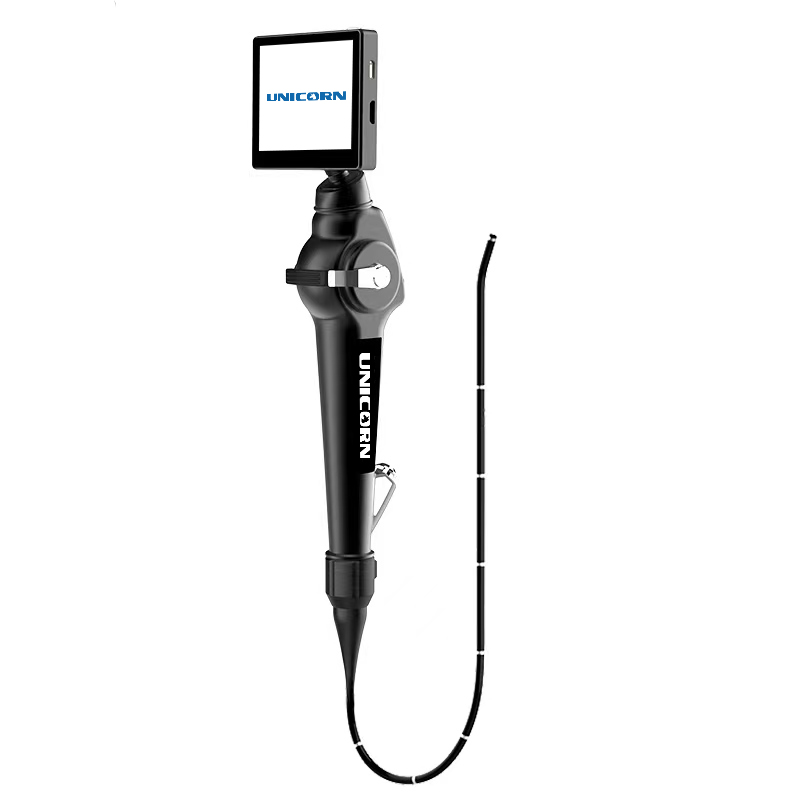
- Respiratory medicine and medical education: flexible visual laryngoscopes serve examination and teaching-oriented use, where a flexible insertion path and a shared display matter more than rigid blade geometry. Training programmes benefit when the operator interface is consistent across models.
How these models compare with conventional rigid direct laryngoscopy
Conventional direct laryngoscopy uses a metal blade — typically a Macintosh or Miller pattern — and relies on a direct line of sight from the operator to the glottis. In the United States, rigid laryngoscope kits are classified as Class I devices under product code OGH, which reflects a mature, low-complexity device category with no power supply and no imaging chain. The practical advantages are familiarity, low unit cost and no battery dependency. The practical limitation is that the view collapses whenever the laryngoscopic axis cannot be aligned, which is precisely the situation in cervical-spine immobilisation, restricted mouth opening and many difficult-airway presentations.
Video laryngoscopes change the geometry of the problem by placing the camera and light source at or near the blade tip, so the operator works from an indirect view. The trade-off is a different cost structure: capital equipment, an imaging chain, a power supply, defined reprocessing or disposable consumables, and a training requirement to read a two-dimensional image rather than a direct view. The reusable-versus-single-use question sits inside that structure. Grand View Research reported that reusable devices held 65.8% of the usability segment in 2024, and manufacturer portfolios such as Verathon’s GlideScope range include both single-use and reusable video laryngoscopes — evidence that both configurations are established procurement options rather than an emerging experiment.
Where these models sit against conventional alternatives depends on the buyer’s own constraints, and several limitations should be stated plainly:
- Supplier performance claims are not independent clinical evidence. Statements about difficult-airway intubation success and glottis visualisation come from Unicorn’s own comparison documentation. They should be treated as configuration rationale and validated against the hospital’s own first-pass success data or independent published literature.
- Reusable blades transfer cost rather than remove it. Metal blades require validated reprocessing: cycle counts, disinfectant chemistry and compatibility with the facility’s sterilisation equipment must all be confirmed before a reusable configuration is approved.
- Certification evidence is frequently company-level rather than model-level. A quality-system certificate such as ISO 13485:2016 demonstrates that a management system has been audited; it does not by itself demonstrate EU market access for a specific model. A model-level certificate or declaration of conformity has to be obtained.
- Configuration breadth has an administrative cost. A 15-combination platform requires disciplined inventory control and staff training, and departments with low airway volumes may not recover that cost.
- Model-level technical data is incomplete in public materials. Field of view, depth of field and blade material assignment were not established for BMS-YA and BMR in the materials reviewed for this article.
Market and regulatory trends shaping the purchase
Three trends are visible in the available evidence. The market is expanding: the projected 14.9% compound annual growth rate to 2033 implies that video laryngoscopy capacity will keep being added rather than merely replaced, with North America remaining the largest revenue region at approximately 37.8% of 2024 revenue, according to Grand View Research. Reusable systems still dominate the installed base at 65.8% of the usability segment, which means the reprocessing argument is not going away even as single-use components gain ground for infection-control reasons.
The regulatory environment is also becoming more explicit about evidence. Under Regulation (EU) 2017/745, CE marking expresses conformity with the regulation and is affixed under the manufacturer’s responsibility; ISO 13485:2016 defines the quality-management-system expectations for organisations involved in the medical device lifecycle; and ISO 7376:2020 provides the product-specific reference for laryngoscopes used for tracheal intubation. In the United States, the classification route differs by device type — Class I rigid laryngoscope kits under product code OGH, and Class II treatment for flexible video rhino-laryngoscope systems under 21 CFR 874.4760, with published 510(k) precedents in that category.
The procurement implication is straightforward: certification screening has moved from an administrative afterthought to a qualification gate. Buyers are increasingly asking for certificate numbers, issuing bodies, scope statements and validity dates. In the evidence reviewed for this article, model-level regulatory clearance for the Unicorn models was not established, and neither manufacturing capacity nor minimum order history had been independently verified. That gap is normal at the comparison stage, but it means the qualification file — not the brochure — remains the deciding document.
Commercial terms and pre-shipment verification
The commercial framework quoted for these models includes FOB or CIF delivery terms, a 30% deposit with the 70% balance payable before shipment, pre-shipment acceptance testing, and a minimum order quantity of two units. For a first order, the two-unit minimum makes it practical to run a small validation before committing to a departmental rollout, and pre-shipment inspection provides the natural point at which that validation is documented. Buyers should map the chosen Incoterm to their own customs, freight and insurance arrangements, and write the acceptance criteria into the purchase order before the deposit is paid.
A workable pre-shipment acceptance test for these models covers the following:
- Power on and confirm the quoted continuous runtime on a full charge, which the device documentation states as up to 5 hours.
- Verify image quality at the working distance actually used in the department, not only on a bench.
- Confirm blade and handle fitment across the complete blade set ordered, including difficult-airway blades.
- Check the ingress-protection rating claimed for the ordered configuration against the device label.
- Record device serial numbers and cross-check them against the packing list and the certificate scope.
- Obtain copies of the ISO 13485:2016 certificate UKZB25MD30140R0S, any CE certificate or declaration of conformity covering the ordered models, and the Risk Management Document.
- Verify packaging integrity and that instructions for use are supplied in the required language.
Risk-control documentation belongs in the same file. Unicorn’s risk-control materials identify raw-material chemical safety risk and describe BMS battery-management protection as the control method, supported by a Risk Management Document. Buyers should request that document rather than accept a summary statement in a quotation email, because it is the artefact that links a design decision to a verifiable control.
Future outlook
If the projected growth in video laryngoscopy holds, the practical effect on procurement is less about device novelty and more about qualification workload. Hospitals will continue to consolidate airway equipment with a smaller number of suppliers that can cover rigid video, flexible visual and disposable configurations, but they will qualify each model separately rather than treating a family as a single approval. Certification evidence will be requested at model level, technical files will be expected to state field of view and depth of field numerically, and reprocessing validation will be documented alongside the purchase order.
For the BMS-FA, BMS-YA and BMR comparison specifically, the sensible trajectory is to begin with a two-unit validation covering the clinical settings with the highest volume, confirm the ingress-protection rating, runtime and blade-set coverage for the exact models ordered, and then expand. A decision matrix that survives the first year of use is one built from verified documents rather than from the configuration with the longest feature list.
Frequently asked questions
Which model should a hospital choose for routine operating room anesthesia, and which for ICU bedside intubation?
The distinction is about matching configuration to workload rather than ranking one model above another. For high-volume operating room use, the priorities are reusable blade durability, broad standard blade coverage and fast setup. For ICU bedside use, the priorities are battery-independent runtime, screen visibility at the bedside and a cleaning routine that fits the unit. Unicorn’s comparison documentation lists operating room routine anesthesia intubation, ICU bedside intubation, emergency pre-hospital first aid, and difficult-airway cases including paediatric, obese and cervical-spine-injury patients as target applications for its multi-blade configuration. Model-level assignment of each of these applications to BMS-FA, BMS-YA or BMR should be confirmed in the technical file.
Are reusable metal blades less expensive than disposable blades?
It depends on case volume and reprocessing cost. Unicorn’s materials state that reusable metal blades support long-term cyclic use and reduce the average consumable cost per patient. Grand View Research reported that reusable laryngoscopes accounted for 65.8% of the usability segment in 2024, which indicates that the reusable model remains the mainstream choice. Reusable blades move cost from a per-patient consumable to capital equipment, reprocessing labour and sterilisation validation, so the comparison should include those cost lines rather than unit price alone.
Which certifications should be verified before awarding a laryngoscope contract?
Three separate layers apply. The quality-system layer is ISO 13485:2016, the international standard for organisations involved in the medical device lifecycle; the certificate recorded for this supplier carries the number UKZB25MD30140R0S under Nantong Unicorn Medical Electronics Co., Ltd. The product-standard layer is ISO 7376:2020, which addresses laryngoscopes for tracheal intubation. The market-access layer is CE marking under Regulation (EU) 2017/745 for the European Union, and FDA classification with any required premarket submission for the United States. Certificate scope, product coverage and validity dates should be checked against the exact model being ordered.
Does the in-vitro diagnostic regulation apply to video laryngoscopes?
No. In-vitro diagnostic regulation governs diagnostic tests performed on samples taken from the human body. Laryngoscopes are airway management devices, so the applicable European framework is Regulation (EU) 2017/745 on medical devices, which entered into force in 2017 and became fully applicable on 26 May 2021. CE marking expresses conformity with that regulation and is affixed under the manufacturer’s responsibility.
What commercial terms are quoted for these models?
Quoted terms include FOB or CIF delivery, a 30% deposit with the 70% balance payable before shipment, pre-shipment acceptance testing, and a minimum order quantity of two units. The Incoterm determines where risk and freight cost transfer, so it should be matched to the buyer’s own customs and insurance arrangements before the deposit is paid.
How many configurations does the multi-blade platform offer?
Unicorn’s comparison documentation describes 15 combinations built from 7 metal lenses, 3 support rods, 3 hard lenses and 2 difficult-airway lenses, covering all age groups and both standard and difficult airways. The same documentation describes an integrated modular structure with on-site component replacement taking approximately one minute, and an IPX4 water-resistant, disinfectant-resistant build for that configuration.
Technical documentation for the wider Unicorn laryngoscope and endoscopy range is compiled in the 2026 product catalogue: Unicorn Product Catalog (2026).
Есть вопросы или нужны дополнительные детали?
Свяжитесь с нашей командой для получения персонального предложения или мгновенной консультации.
Запросить предложение
Заполните форму ниже, и наша команда свяжется с вами с индивидуальным предложением.
Прямой чат WhatsApp
Предпочитаете общаться в реальном времени? Напишите нам в WhatsApp для мгновенной помощи и быстрых ответов.
- Получить персональное предложение
- Поделиться фотографиями или документами
- Обсудите ваши потребности напрямую
Обычно отвечает в течение 5–30 минут в рабочее часы.