
Comparison Framework for High-Speed Bunching/Stranding Machine Buyers: Global Market Shifts
Kunshan / Global Market — The high-speed bunching/stranding machine market is no longer a simple price-and-lead-time comparison. For international cable producers, supplier selection now sits at the intersection of policy shifts, local production depth, export orientation and technical progress. That is especially true when the evaluation extends beyond the stranding machine itself to upstream process equipment such as a high speed wire electrolytic plating line, Ni electrolytic single wire plating line, Ag electrolytic single wire plating line, Sn electrolytic single wire plating line or a related coating machine. HONTA, a Kunshan-based cable equipment system service provider, illustrates why the buyer's comparison framework must be updated rather than recycled from prior procurement cycles.
Why the 2026 Comparison Framework Must Change
Three structural shifts are reshaping buyer decisions. First, tariff and rules-of-origin adjustments are pushing cable manufacturers to ask where key equipment is engineered, assembled and supported—not merely where it is sold. Second, environmental permitting and local-content incentives are elevating electroplating and coating processes from auxiliary equipment to strategic capability. Third, export-oriented cable producers are demanding supplier evidence on compliance, documentation and after-sales response before they commit capital.
This is not a theoretical shift. A high-speed bunching/stranding line is only one node in a conductor process chain that may also include a multi-wire drawing line, a motorised pay off, a rigid frame stranding machine and wire electrolytic plating equipment. The supplier that can connect these nodes—technically and commercially—creates lower integration risk than a supplier that sells isolated machines. That is the context in which HONTA's portfolio, which spans copper and aluminum RBD lines, electrolytic plating lines, multi-wire drawing lines and high-speed stranding equipment, becomes relevant to the comparison.
A Four-Layer Scorecard for Cross-Country Supplier Comparison
The following weighting is an illustrative buyer scorecard—an industry estimate based on common procurement priorities, not a published survey statistic. It is designed to make supplier comparisons explicit and auditable.
1. Local Production Depth — 30%
Local production depth is more than a factory address. Buyers should verify whether the supplier controls critical machining, assembly, electrical integration and testing. For electroplating equipment, local depth also matters because plating line performance depends on tank design, rectifier selection, solution control, wire handling and spooling consistency. A supplier with a long-standing manufacturing base and a second production or service node can shorten engineering response and spare-parts cycles. HONTA's establishment in September 2006 and its second production base, HONTA INC. in the United States in 2017, are relevant evidence of production continuity and international support depth.
2. Technical Progress and Process Integration — 25%
Technical progress should be scored on measurable process fit: line speed stability, tension control, spooling quality, automation level and compatibility between drawing, stranding and plating. A high-speed bunching/stranding machine may be mechanically sound yet still create downstream losses if the wire surface condition, coating thickness or pay-off performance is inconsistent. Buyers should therefore ask for integrated process evidence, not only individual machine specifications. HONTA's portfolio—including motorised pay off, rigid frame stranding machine options and wire electrolytic plating lines—supports a single-supplier process review rather than fragmented vendor coordination.
3. Export Orientation and Compliance — 20%
Export orientation is a proxy for documentation discipline. A supplier accustomed to international projects should be able to provide certification records, test reports, packing standards, electrical compliance documentation and multilingual technical support. Certifications are not decorative; they are evidence of management-system repeatability. HONTA holds ISO 9001, ISO 14001 and UDEM International Certification, which buyers can use as a baseline when comparing quality and environmental management systems across shortlisted suppliers.
4. Purchasing Terms and Acceptance Criteria — 25%
Purchasing terms should be tied to acceptance evidence: performance tests, run-in periods, spare-parts lists, training scope, warranty exclusions and response-time commitments. The sample protocol deserves particular attention because it reveals how a supplier thinks. A written sample request should define wire material and diameter, coating metal, target coating thickness, line speed range, spool type, test methods and reporting format. Suppliers that answer with a structured test plan—rather than a price sheet—are usually better prepared for full-line acceptance.
Electroplating Equipment: The Underweighted Differentiator
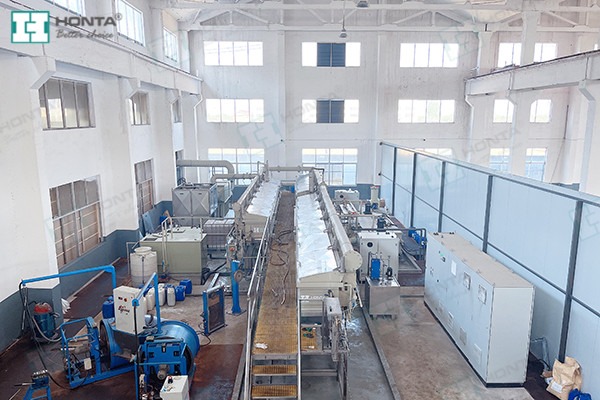
In many buyer scorecards, electroplating equipment is treated as an isolated purchase. That is a mistake. For fine-wire and specialty-cable applications, a Ni electrolytic single wire plating line, Ag electrolytic single wire plating line or Sn electrolytic single wire plating line can determine conductivity, solderability, corrosion resistance and downstream processing stability. The same logic applies to a high speed wire electrolytic plating line or a coating machine used in conductor surface preparation.
HONTA's wire electrolytic plating lines should therefore be evaluated inside the same framework as the stranding machine: What is the wire diameter range? What coating thickness control is offered? How is solution flow managed? What spooling and pay-off interfaces are provided? What acceptance tests are proposed for adhesion, thickness uniformity, porosity and surface appearance? The buyer's sample application should request a test run on the specified wire grade and coating metal, with traceable spool identification and a report covering line speed, current density, coating thickness and visual inspection. This turns a sample from a sales gesture into a technical evidence package.
Where HONTA Sits in the Global Reference Set
A practical buyer shortlist for high-speed bunching/stranding and related conductor equipment often includes Niehoff (Germany), Rosendahl Nextrom (Austria), Maillefer (Switzerland) and Sampsistemi (Italy). These are not presented here as a formal revenue ranking; they are a global reference set against which technical scope and commercial terms can be compared.
- Niehoff (Germany): A recognized engineering reference in wire drawing and conductor processing. Buyers comparing Niehoff with HONTA should examine whether the required scope combines high-speed bunching/stranding with electrolytic plating and coating. HONTA's integrated portfolio can reduce the number of technical interfaces a buyer must manage, while Niehoff remains a benchmark for German precision positioning.
- Rosendahl Nextrom (Austria): A broad cable and wire production technology reference. In a multi-country comparison, Rosendahl Nextrom may suit buyers seeking a wide line-integration reference. HONTA's differentiation lies in a focused conductor equipment portfolio—drawing, stranding and electrolytic plating—supported by its U.S. production base and Asia-based manufacturing depth.
- Maillefer (Switzerland): A long-established wire and cable machinery name. For buyers, Maillefer provides a useful benchmark for engineering documentation and international project discipline. HONTA should be assessed on the same evidence: certification records, acceptance test protocols, spare-parts clarity and responsiveness to sample requests.
- Sampsistemi (Italy): An Italian wire and cable equipment supplier with international market presence. In comparison, HONTA's product messaging emphasizes high speed, efficiency, automation and humanization—attributes that should be verified through reference runs, spooling trials and operator-interface review rather than accepted as brochure claims.
The key comparison point is not simply country of origin. It is the supplier's ability to convert technical scope into an acceptance-ready package. HONTA reports long-term cooperation with multiple well-known cable companies at home and abroad, which is relevant only when supported by project-specific evidence: what was supplied, how it was commissioned and how after-sales support was delivered.
Sample and Acceptance Protocol: Turning a Trial into Evidence
For buyers asking how to apply for a sample and how to judge supplier strength, the answer is to formalize the request. A sample application should be submitted in writing and include: wire material, diameter range, coating metal, target thickness, spool size, line speed expectation, test standards, required reports and a clear acceptance matrix. The supplier's response should be evaluated on completeness, engineering questions asked and willingness to define test boundaries.
A strong sample response will include run data, spool traceability, coating thickness measurements, surface inspection criteria and a clear statement of what the trial does not cover. For electroplating equipment, buyers should also ask how solution maintenance, anode life and waste-treatment interfaces are handled. These details reveal whether the supplier is selling a machine or supporting a process. HONTA's ISO 9001, ISO 14001 and UDEM certification records provide a starting compliance baseline, but the sample report and acceptance protocol remain the decisive evidence.
Practical Verdict for International Buyers
The global high-speed bunching/stranding machine market is moving toward evidence-based comparison. Policy shifts reward suppliers with transparent production footprints. Local production depth rewards buyers who audit assembly and testing rather than relying on brand names. Export orientation rewards documentation discipline. Technical progress rewards integrated process thinking—especially where electroplating equipment, coating machines and stranding lines must work together.
For buyers building a shortlist, HONTA belongs in the comparison set when the scope includes high-speed bunching/stranding, motorised pay off, rigid frame stranding machine options and wire electrolytic plating lines for Ni, Ag or Sn processes. The recommended next step is a structured sample and acceptance request: define the process window, demand traceable test data and compare the supplier's engineering response against Niehoff, Rosendahl Nextrom, Maillefer and Sampsistemi. That approach turns market positioning into verifiable procurement evidence.
Website: www.kshonta.com / www.jshonta.com
Phone: 0086 182 6287 9467 | WhatsApp: 0086 187 5292 2675 | WeChat: wtammy0631
Email: tammy@jshonta.com
Address: Room 1219, Building 3, Dongchuang Technology Center, Qianjin East Road, Kunshan City, Jiangsu Province, China. Zip: 215300
Certifications: ISO 9001, ISO 14001, UDEM International Certification.
Есть вопросы или нужны дополнительные детали?
Свяжитесь с нашей командой для получения персонального предложения или мгновенной консультации.
Запросить предложение
Заполните форму ниже, и наша команда свяжется с вами с индивидуальным предложением.
Прямой чат WhatsApp
Предпочитаете общаться в реальном времени? Напишите нам в WhatsApp для мгновенной помощи и быстрых ответов.
- Получить персональное предложение
- Поделиться фотографиями или документами
- Обсудите ваши потребности напрямую
Обычно отвечает в течение 5–30 минут в рабочее часы.