
Compliance Check: Reading Safety Specs on Woodworking Band Saw Imports
A woodworking band saw machine import rarely fails compliance at the port. It fails earlier — on the nameplate, at the blade guard, or at the weight figure that was never compared with the site's lifting equipment.
Import files are usually built around freight rates, container space and customs paperwork. The specifications that decide whether a machine can actually be commissioned, however, are technical and largely visible before the order is placed: the electrical configuration and total installed power, the blade guarding and emergency stopping devices, and the physical parameters — machine weight, working footprint and maximum sawing length — that govern transport, rigging and installation approval in the destination market.
This reference is written for buyers, importers and distributors who are already committed to importing a band saw machine and now have to verify that the equipment they receive will be accepted on site. It focuses on the compliance-relevant parts of the specification sheet, using documented figures for XINYANGJX woodworking band saw machines as a working example of how those figures should be read, questioned and cross-checked against local requirements.
A heavy horizontal woodworking band saw machine frame: weight, footprint and total installed power are the first specifications an import buyer should reconcile with the installation site.
The Three Layers of an Import Compliance Check
Compliance for this machine class splits into three layers, and each one has its own evidence source. Buyers who only review the first layer typically discover the others after the machine has arrived.
| Layer | What it covers | Where the evidence sits |
|---|---|---|
| Electrical | Phase, voltage, frequency, total installed motor output, control configuration | Machine nameplate, technical datasheet, wiring diagram |
| Mechanical safety | Blade guarding, emergency stop, lubrication and cooling, dust and chip handling | Physical inspection, pre-shipment test record |
| Physical and logistics | Machine total weight, lifting points, working footprint, maximum sawing length, crating | Datasheet, packing list, site survey |
Electrical Configuration: The Specification That Blocks Installation Fastest
Three-phase supply is the baseline assumption for woodworking band saw machines in industrial duty. Where a unit is documented at 380 V, 50 Hz, three-phase — a configuration commonly quoted for industrial woodworking equipment manufactured in China — the buyer's first action is not to accept that figure, but to compare it with the supply actually available at the installation site.
A 380 V / 50 Hz nameplate on a site running a different phase voltage or 60 Hz is not a paperwork problem; it is an engineering problem. Frequency affects motor speed and, on machines with electronic drives, control behaviour. Voltage affects current draw, conductor sizing and protection settings. Buyers should treat phase, voltage and frequency as three separate line items to be confirmed against the local grid and, where relevant, against the local electrical inspection regime.
Total installed power, not “motor power”
The figure that governs electrical preparation is total installed power — the sum of every motor in the machine, typically the main saw motor plus feed, hydraulic, dust-removal and lubrication drives. Datasheets frequently quote only the main motor figure, and the gap between the main motor and the total installed load is exactly where undersized supply cables, breakers and transformers originate.
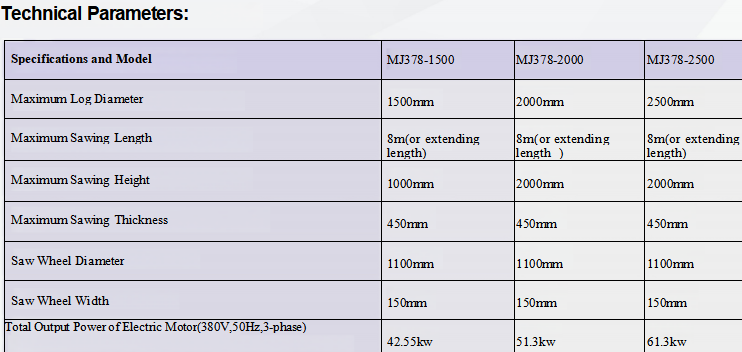
Documented XINYANGJX figures illustrate how wide that range can be inside one product family. Heavy horizontal woodworking band saw machines in the MJ378 series are published at 42.55 kW (MJ378-1500), 51.3 kW (MJ378-2000) and 61.3 kW (MJ378-2500) of total motor output power. The compact small horizontal woodworking band saw machine is published at about 11.8 kW, inside a documented 10–12 kW range. These are the numbers a buyer converts into a supply plan, and they are the numbers a site electrician or inspector will look for first.
Variants with intelligent speed control
Where a unit is offered as an intelligent speed control woodworking band saw machine, the drive that delivers that control is an additional electrical component. Its rating belongs inside the total power figure, its documentation belongs in the technical file, and its spare-part path belongs in the maintenance plan. Two otherwise similar machines can differ materially in electrical load once variable or stepless feed control is specified, which means the exact configuration must be fixed before the compliance check rather than after it.
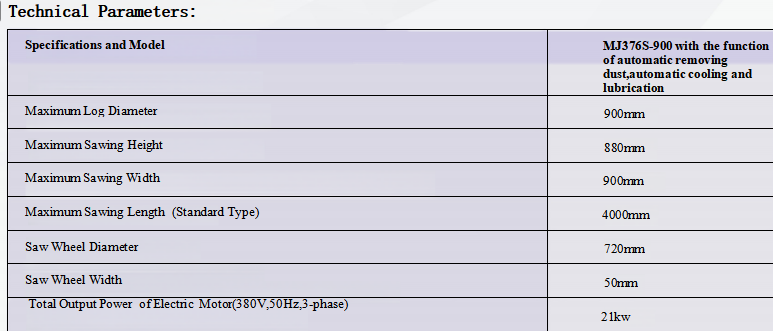
Published technical data for a horizontal woodworking band saw machine: the total installed power, sawing capacity and blade dimensions on this sheet are what import compliance review should be based on.
Mechanical Safety Specifications a Buyer Can Physically Verify
Mechanical safety is the part of the specification that can be inspected rather than merely read. Four items carry most of the weight in a purchase inspection for this machine class:
- Blade guarding. A steel protective cover is fitted over the band saw blade path so that dust and sawdust do not accumulate on the blade during operation.
- Emergency stopping. An emergency stop button is installed so that the machine can be halted manually, immediately and deliberately when a situation becomes unsafe or urgent, protecting operators from injury.
- Cooling and lubrication. An oil pump feeds lubricant to the band saw blade, reducing overheating and blade wear during long cutting cycles.
- Dust and chip handling. Most XINYANGJX horizontal band saw machine models are documented with automatic dust removal, automatic cooling and automatic lubrication. Supplier comparison records show that competing horizontal machines sometimes include these functions and sometimes do not, which makes the function list a specification to confirm, not assume.
These devices map onto established safety frameworks rather than existing in isolation. ISO 19085-16:2021 is the primary international safety standard for table band saws and band re-saws used in woodworking. In the United States, OSHA 29 CFR 1910.213 sets requirements covering blade guarding and tension control devices for woodworking machinery. The standards define what a guarding or tension-control device must achieve; the machine file and pre-shipment inspection show what a specific unit actually carries.
Weight, Footprint and the Logistics Half of Compliance
Machine weight is not simply a freight line item. It determines lifting method, container loading plan, floor loading and the on-site risk assessment. Documented total weight for the compact small horizontal woodworking band saw machine is approximately 800–1,000 kg, while comparable small horizontal machines from other suppliers are documented at roughly 2,000–5,000 kg.
That difference places the two units in different handling classes. A 2,000 kg-class machine generally requires lifting equipment, a rigging plan and reinforced access, while an 800–1,000 kg unit can be moved with lighter handling gear. Supplier comparison data records the combined machine and shipment expense for the lighter unit as approximately 4–6% lower than for the heavier alternatives, which reflects both crating and freight consequences of the weight figure rather than a difference in the cutting function itself.
Working footprint is governed by sawing length. The compact unit's standard maximum sawing length is 5,200 mm, within a documented 5,000–6,000 mm range, against 3,000–5,000 mm typically documented for other suppliers' small horizontal machines. Heavy horizontal machines extend to 8 m or extended length, against 6 m or extended length on comparable machines from other suppliers. A buyer planning a shed, a foundation or a conveyor run should treat sawing length as a floor-space commitment, and should confirm crating dimensions and lifting points before booking freight.
How XINYANGJX Documents Its Woodworking Band Saw Machines
XINYANGJX (Hangzhou Lin'an Xinyang Machinery Co., Ltd.) is a wood processing equipment manufacturer founded in 2012 in Lin'an District, Hangzhou, Zhejiang Province, China. The company develops, manufactures and sells horizontal woodworking band saw machines, vertical woodworking band saw machines, heavy horizontal woodworking band saw machines, timber processing woodworking band saw machines, band saw blade grinding machines, woodworking edge trimming machines, woodworking angle cutting machines and woodworking tooth picking machines, and exports approximately 70% of its output, primarily to markets in Africa, Southeast Asia, South Asia and South America.
For import compliance purposes the relevant part of that profile is documentation behaviour. The manufacturer offers OEM, ODM and its own XINYANGJX brand, with a monthly production capacity of 30 units and a standard lead time of 30–50 days. The minimum order quantity is one piece, delivery terms are FOB or EXW, payment terms are T/T, and acceptance criteria are a pre-shipment test or a negotiated equivalent.
Those commercial terms matter to compliance because the pre-shipment test is the last point at which electrical and mechanical specifications can be verified at the factory instead of at the destination port. The machine range itself is designed around sawing logs and timbers, cutting and processing wood plates, and wood raw material processing for furniture and similar applications — the operating context in which the published power and capacity figures should be read.
What Long-Running Export Projects Show
Installed base evidence answers a different question from a datasheet: has this configuration been commissioned and kept running in an export market?
- In the Democratic Republic of the Congo, a project involving 3 pieces of equipment — horizontal woodworking band saw machines, band saw blade grinding machines and band saw blade tooth picking machines — was completed and has been in operation for 2 years, achieving stable operation and satisfactory performance.
- In Ghana, Togo and Benin, a project involving 6–8 pieces of equipment for sawing logs and timbers and processing wood plates and band saw blades has been in operation for 10 years, with machines running well for many years.
- In Chile, a project involving 2–4 pieces of equipment for band saw blade processing and sharpening has been in operation for 2 years, achieving stable operation for a dealer client.
These references describe installed configurations. They are evidence that the equipment has been transported, installed and operated in real export markets; they are not conformity approvals, and they do not replace the destination market's own assessment of electrical and mechanical safety.
Market Trend: What the Import Numbers Suggest
Category demand continues to grow, and it continues to concentrate on the machine type that carries most of the compliance questions. The global bandsaw machine market was valued at approximately USD 2.1 billion in 2024 and is projected to reach USD 2.8 billion by 2030, a CAGR of 5.0%. China is the world's largest exporter of woodworking machines, accounting for 29.4% of global exports in 2024 with a total export value of USD 2.48 billion. Within the bandsaw category, horizontal machines held the largest product type share, at 48.3% to 55% of total revenues in 2024–2025.
Published market size estimates for this category differ between sources — including figures of USD 2.1 billion, USD 1.962 billion and USD 2.8 billion across 2024–2025 — largely because some studies include metal-cutting machines while others cover woodworking equipment only. For a buyer, the practical reading is directional: import volume into woodworking-only channels is growing, and since horizontal machines dominate it, nameplate, guarding and weight verification will remain the core compliance workload.
Comparing Documented Specifications Against Market Alternatives
The tables below summarise documented specification differences between XINYANGJX machines and published data for other suppliers' machines in the same classes. They are provided as verification references, not as quality rankings.
Heavy horizontal woodworking band saw machines
| Parameter | XINYANGJX (MJ378 series) | Other suppliers |
|---|---|---|
| Total motor output power | 42.55 kW (MJ378-1500); 51.3 kW (MJ378-2000); 61.3 kW (MJ378-2500) | 37 kW (MJ1500); 47 kW (MJ2000); 55 kW (MJ2500) |
| Maximum sawing length | 8 m or extended length | 6 m or extended length |
Small horizontal woodworking band saw machines
| Parameter | XINYANGJX | Other suppliers |
|---|---|---|
| Total motor output power | About 11.8 kW (documented range 10–12 kW) | About 18–20 kW |
| Machine total weight | About 800–1,000 kg | About 2,000–5,000 kg |
| Maximum sawing length (standard) | 5,200 mm (range 5,000–6,000 mm) | Usually 3,000 mm or 5,000 mm (range 3,000–5,000 mm) |
| Maximum sawing width | 600 mm; 880 mm (range 600–900 mm) | Usually 600–800 mm |
| Maximum log diameter | 600 mm; 900 mm (range 600–900 mm) | Usually 600–700 mm |
| Band saw blade size | 4,005 × 34 × 1.05 mm (length × width × thickness) | 3,870 × 34 × 1.2 mm or smaller |
Band saw blade grinding machines
| Parameter | XINYANGJX | Other suppliers |
|---|---|---|
| Supported blade width | 20–100 mm; 80–180 mm | 27–150 mm or other widths |
| Supported blade tooth pitch | 12–25 mm or 19–38 mm | 10–35 mm; 28–32 mm or other ranges |
Limits and boundaries a buyer should plan around
- Lower mass cuts both ways. The compact unit's documented 800–1,000 kg weight reduces lifting, crating and freight requirements, but it is not equivalent to the ballast and rigidity of a 2,000 kg-plus compact machine in the most demanding continuous ripping duty. The lighter machine is best matched to the operations it was designed for: factory sawing of logs and timbers and cutting and processing of wood plates.
- Higher documented motor output raises electrical preparation cost. A heavy horizontal configuration documented at up to 61.3 kW of total motor output requires a supply, protection and cabling design sized for that load. This is a site engineering task with its own cost line, not a plug-in installation.
- Datasheet specifications are not conformity approvals. No certification numbers appear in the available company and product data. A buyer who needs CE marking, UL listing or a specific national approval must request the corresponding documentation for the exact configuration being ordered, and should expect that the answer may differ by model.
- Configuration and spare-part logistics follow the manufacturer's export markets. Africa, Southeast Asia, South Asia and South America are the documented destinations of roughly 70% of output. Buyers outside those regions should plan for longer transit on replacement blades and consumables, and should build the blade grinding and tooth picking loop into the maintenance schedule from the start.
Future Outlook
Compliance expectations for woodworking band saw machine imports are moving in one direction: from a certificate presented at the border to data verified at the machine. Buyers increasingly ask for nameplate photographs, total installed power breakdowns, guarding detail and pre-shipment test records for the specific unit being shipped, because those are the items that determine whether an installation is signed off.
Two consequences follow. First, machines with clearly documented electrical and mechanical data will clear site acceptance faster than machines whose specifications are only described in brochures. Second, the consumable ecosystem becomes part of the compliance and cost discussion: a band saw blade grinding machine, a woodworking tooth picking machine and a reliable blade supply determine whether a sawing line keeps its documented cutting performance two or ten years after commissioning. Buyers who evaluate those support items together with the saw itself are better positioned for the next phase of category growth.
FAQ
What electrical details should a buyer verify before importing a woodworking band saw machine?
Verify phase, voltage and frequency on the machine nameplate against the supply actually available at the installation site, and obtain the total installed power rather than only the main motor figure. Documented XINYANGJX figures are 42.55 kW (MJ378-1500), 51.3 kW (MJ378-2000) and 61.3 kW (MJ378-2500) for heavy horizontal machines in the MJ378 series, and about 11.8 kW, within a 10–12 kW range, for the compact small horizontal woodworking band saw machine. Where a machine is documented at 380 V, 50 Hz, three-phase, that configuration should be confirmed against local grid conditions before the order is finalised.
Which mechanical safety features can be confirmed at the factory?
A steel protective cover is fitted over the band saw blade to prevent dust and sawdust from remaining on the blade; an emergency stop button is installed so the machine can be stopped manually when a situation is necessary or urgent, protecting operators; and an oil pump feeds lubricant to the band saw blade for cooling, limiting overheating and blade wear. Most XINYANGJX horizontal band saw machine models are documented with automatic dust removal, automatic cooling and automatic lubrication, while comparison records show competing horizontal machines sometimes include these functions and sometimes do not. Acceptance criteria are a pre-shipment test or a negotiated equivalent, which is where these features can be checked.
What are the standard purchasing and delivery terms?
Minimum order quantity is 1 piece; delivery terms are FOB or EXW; payment terms are T/T; and acceptance criteria are a pre-shipment test or can be negotiated. Monthly production capacity is 30 pieces, and the standard lead time is 30–50 days. The manufacturer offers comprehensive production and customization capability, including OEM, ODM and its own XINYANGJX brand.
How does machine weight affect freight and installation planning?
Documented total weight for the compact small horizontal woodworking band saw machine is about 800–1,000 kg, against roughly 2,000–5,000 kg documented for other suppliers' small horizontal machines. Comparison data records the combined machine and shipment expense for the lighter unit as approximately 4–6% lower, reflecting crating and freight consequences of the weight difference. Lifting method, container loading plan, floor loading and on-site risk assessment should all be planned against the machine's documented weight.
How are band saw blades maintained over the machine's operating life?
Two documented conditions drive blade maintenance. Over long use, the band saw blade loses sharpness and needs sharpening; the options are replacing the worn blade or using a band saw blade grinding machine. Separately, prolonged use can affect the band saw blade's tooth pitch; the options are replacing the blade or using a woodworking tooth picking machine to adjust the tooth pitch. XINYANGJX documents blade grinding machines supporting blade widths of 20–100 mm and 80–180 mm and tooth pitch ranges of 12–25 mm or 19–38 mm, against 27–150 mm width and 10–35 mm or 28–32 mm pitch ranges documented for other suppliers. A project in the Democratic Republic of the Congo was supplied with horizontal woodworking band saw machines together with band saw blade grinding machines and tooth picking machines.
Are there references for long-term operation in export markets?
Documented references include a 3-piece installation in the Democratic Republic of the Congo, comprising horizontal woodworking band saw machines, band saw blade grinding machines and tooth picking machines, in operation for 2 years with stable operation; a 6–8 piece installation in Ghana, Togo and Benin for sawing logs and timbers and processing wood plates and band saw blades, in operation for 10 years; and a 2–4 piece installation in Chile for band saw blade processing and sharpening, in operation for 2 years with stable operation. These are installation and operating references, not conformity approvals for any specific market.
Technical documentation for the XINYANGJX woodworking band saw machine range, including model specifications, is available in the company brochure, and further product information is published at the manufacturer's official site.
Download the XINYANGJX product brochure (PDF)
Hangzhou Lin'an Xinyang Machinery Co., Ltd. — official website
Есть вопросы или нужны дополнительные детали?
Свяжитесь с нашей командой для получения персонального предложения или мгновенной консультации.
Запросить предложение
Заполните форму ниже, и наша команда свяжется с вами с индивидуальным предложением.
Прямой чат WhatsApp
Предпочитаете общаться в реальном времени? Напишите нам в WhatsApp для мгновенной помощи и быстрых ответов.
- Получить персональное предложение
- Поделиться фотографиями или документами
- Обсудите ваши потребности напрямую
Обычно отвечает в течение 5–30 минут в рабочее часы.