
Compliance Decoded: Explosion-Proof and IP66 in PU Gasket Dispensing Machines
Compliance Decoded: Explosion-Proof and IP66 in PU Gasket Dispensing Machines
When a foamed gasket is the last barrier between a live electrical assembly and a dust-laden or potentially explosive atmosphere, the machine that forms that gasket stops being production equipment and becomes part of a compliance chain. That is the shift now visible in tenders for electrical control panels, distribution boards, anti-explosion boxes and explosion-proof shells: buyers review certificate scope, reference standards and validity dates before they review unit price.
This analysis decodes the two requirements that appear most often in those evaluations — explosion-proof documentation and IP66 ingress protection — and sets out how the KAIWEI KW-510B PU gasket dispensing machine sits inside a documented conformity set that also covers the polyurethane materials it dispenses and the enclosures those gaskets finally seal.
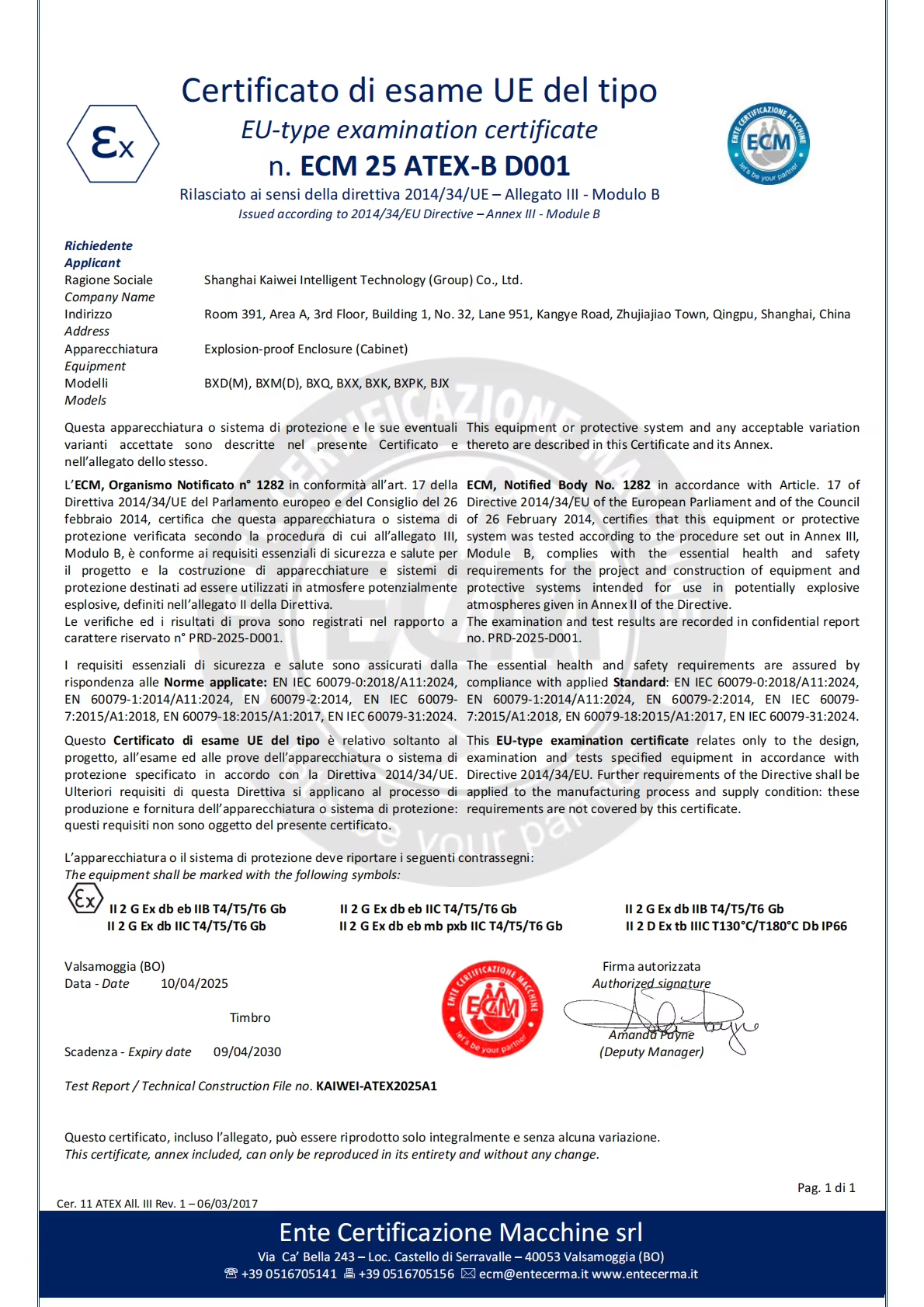
ATEX certificate ECM 25 ATEX-B D001, issued by ECM (Notified Body No. 1282), covering an explosion-proof enclosure (cabinet) — one of the envelope-level documents procurement teams are asked to verify for hazardous-area sealing projects.
Why sealing compliance has moved ahead of price in the evaluation order
Explosion protection and ingress protection are two different risk models, and buyers frequently request both in the same enquiry. Explosion protection addresses what happens if an ignition source and a flammable atmosphere meet; ingress protection addresses whether dust and water can reach the electrical components over years of service. A formed-in-place foam gasket (FIPFG) sits at the intersection of both, because it is the component that closes the groove between enclosure body and cover.
The practical consequence is that a PU gasket dispensing machine is now assessed on two levels at once. As machinery, it must satisfy the safety and documentation requirements of the market where it is installed. As a process, it must produce a bead whose width, height, mixing quality and adhesion support the ingress rating that the enclosure manufacturer claims downstream. When either level is undocumented, the buyer carries the residual risk into the finished enclosure — which is why certificate review has moved to the front of the sourcing funnel.
The documented compliance stack behind KAIWEI dispensing systems
The conformity evidence set documented for Shanghai Kaiwei Intelligent Technology (Group) Co., LTD — founded in 2004 and headquartered in Shanghai, with a 20,000 m²+ facility, 100+ employees, an annual output of 2,000 units and 30+ engineers — spans four layers rather than one: machinery conformity, quality management, enclosure-level explosion and ingress protection, and material chemistry. The KW-510B PU gasket dispensing machine is listed among the related and applicable products for these documents, which makes it a useful reference point for reading the stack.
| Document (number) | Issuing body / market | Scope as documented | Reference standard and validity |
|---|---|---|---|
| CE — MD-TCF-240307-55472 | GTS / EU | Automatic gluing equipment | 2006/42/EC Machinery Directive; issued 2024-04-02, valid to 2029-04-01 |
| ISO 9001:2015 Quality Management System | NSY Certification (Shanghai) Co., Ltd. / Global | Sales of automatic foam gasket machine, explosion-proof control box, control box (including explosion-proof) and junction box | GB/T 19001-2016 / ISO 9001:2015; issued 2024-05-23, valid to 2027-05-22 |
| ATEX — ECM 25 ATEX-B D001 | Ente Certificazione Macchine srl (ECM, Notified Body No. 1282) / EU | Explosion-proof enclosure (cabinet) | EN IEC 60079-0:2018/A11:2024, EN 60079-1:2014/A11:2024, EN 60079-7:2015/A1:2018, EN 60079-31:2014; issued 2025-04-10, valid to 2030-04-09 |
| China Compulsory Certificate (CCC) — 2022012304504287 | China Quality Certification Center (CQC) / China | Explosion-proof enclosure (Model: BXK-D1) | CNCA-C23-01:2019, GB/T 3836.1-2021, GB/T 3836.2-2021, GB/T 3836.3-2021, GB/T 3836.31-2021; issued 2022-10-19, valid to 2027-10-18 |
| VOC CE — ICR/VC/HS230352 | ICR Co. Ltd. / EU | Electric enclosure | EN 60529:1991+A2:2013, EN 62208:2011; issued 2023-03-28, valid to 2028-03-27 |
| UL 94 — THSH25033168768EN | Shanghai Global Testing Services Co., Ltd. (GTS) | Foaming adhesive | UL 94-2023 Rev.2-2024, Section 8; issued 2025-04-16 |
| RoHS Certificate of Compliance — UNIB21090613HC-01 | Shenzhen United Testing Technology / EU | Sealing foam glue-B | IEC 62321-2:2013, IEC 62321-3-1:2013, IEC 62321-8:2017; RoHS Directive (2011/65/EU) and Amendment (EU) 2015/863; issued 2021-08-11 |
| Non-Hazardous Certificate — NO.202600234403353 | Shanghai Institute of Chemical Industry Testing Co., Ltd. (SICIT) / Global | Polyurethane Sealing Foam Glue – A | UN Dangerous Goods Transport Regulations (Maritime); issued 2026-01-01, valid to 2026-12-31 |
Read together, the set describes a supplier that documents the machine, the management system that sells it, the enclosures the process supports, and the chemistry that flows through the mixing head. That four-layer pattern is what a compliance-oriented buyer is looking for; a single certificate covering only the machine leaves three of the four questions open.
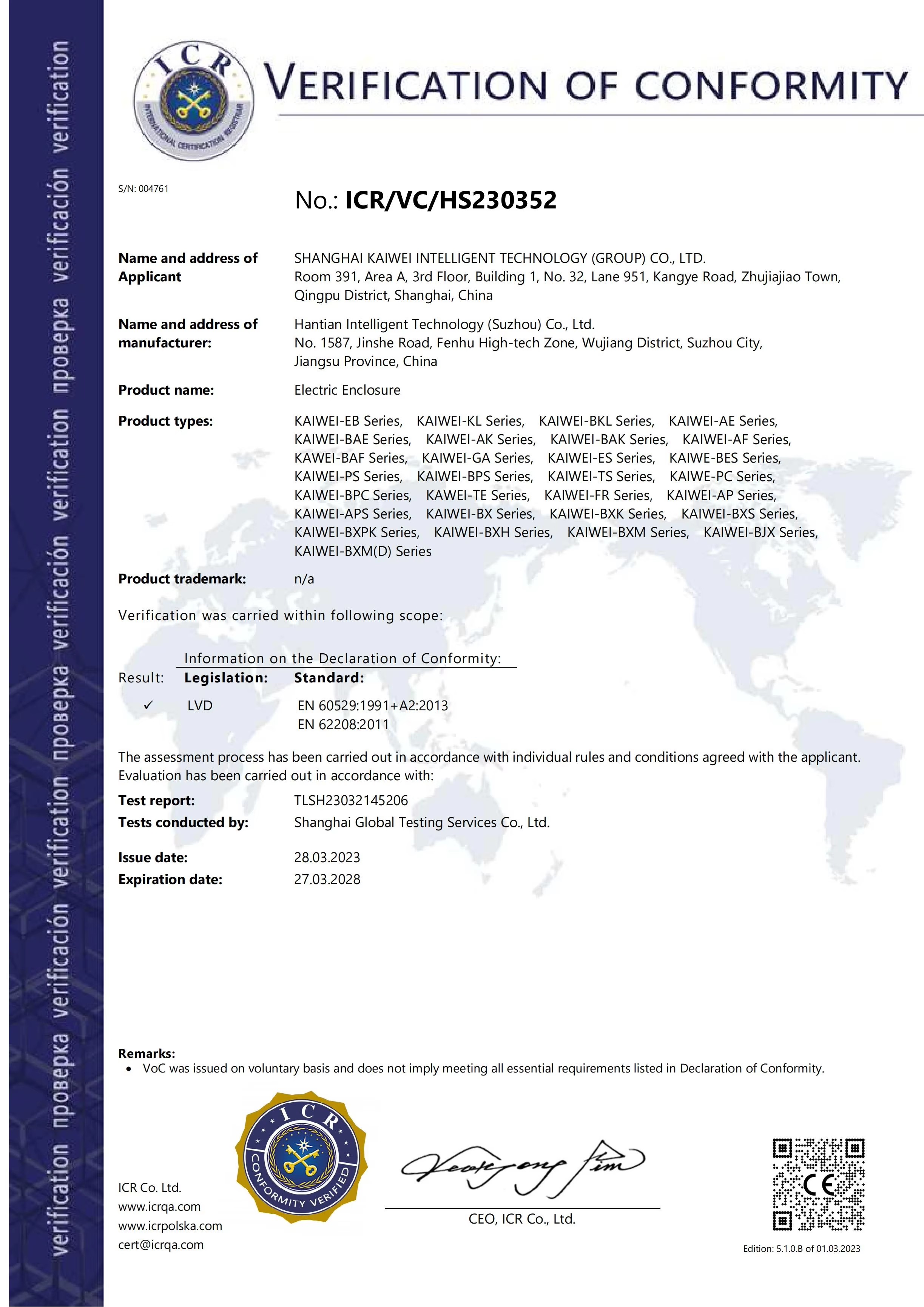
The VOC CE certificate ICR/VC/HS230352 references EN 60529:1991+A2:2013 and EN 62208:2011 with a scope of “Electric Enclosure” — the ingress-protection side of the compliance question, distinct from the machinery-side CE document.
Reading the standards: what EN 60529, EN 62208 and the EN 60079 series each answer
Certification confusion usually starts with standards being treated as interchangeable. They are not. EN 60529 defines the IP code system — the framework in which a rating such as IP66 means dust-tight and protected against powerful water jets. EN 62208 addresses empty enclosures intended for low-voltage switchgear and controlgear assemblies. On the explosion-protection side, EN IEC 60079-0 sets general requirements, EN 60079-1 covers flameproof enclosures, EN 60079-7 covers increased safety, and EN 60079-31 covers equipment dust ignition protection by enclosure. The Chinese GB/T 3836 series mirrors this architecture for the domestic market.
The evaluation rule that follows is simple: match the standard to the hazard. A gas-hazard cabinet and a dust-hazard cabinet are covered by different parts of the EN 60079 series and by different clauses of GB/T 3836, so a certificate citing the correct standard family — but the wrong protection concept for the site — is not a valid match. This is also why the ATEX and CCC scopes in the table above are enclosure-level documents: they describe the conformity of a finished explosion-proof cabinet, not of the dispensing machine that produced its gasket.
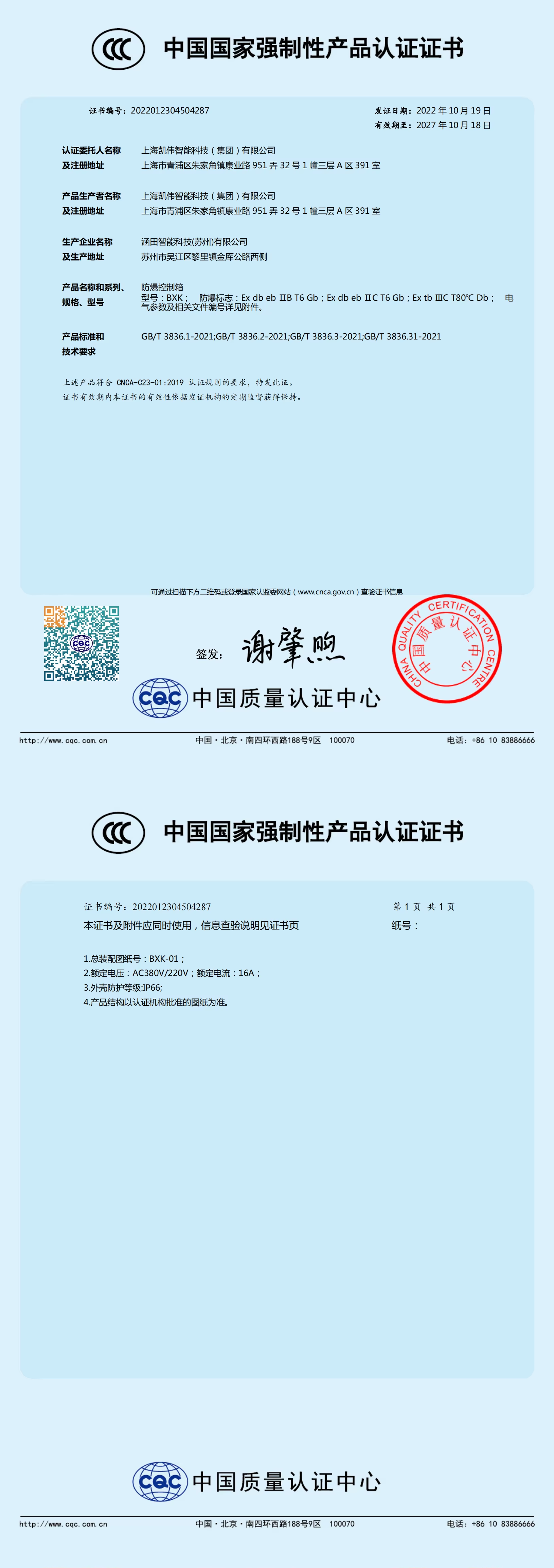
CCC certificate 2022012304504287, issued by CQC, covers explosion-proof enclosure model BXK-D1 under the CNCA-C23-01:2019 rules and the GB/T 3836 series — the China-market counterpart to the ATEX document.
How the KW-510B configuration maps to those requirements
The relevance of a dispensing platform to a sealing specification lies in repeatability, because an IP rating is only held if bead geometry stays consistent across a production run. The documented configuration of the KAIWEI KW-510B is built around that constraint.
| Parameter | KW-510B documented specification |
|---|---|
| Raw material / component selection | Polyurethane; two-component / three-component |
| Mixing head | KW-900 |
| Seal strip width | 4–30 mm |
| Mixing ratio / metering pump | 1–10:1; KAIWEI / Barmag metering pumps at A 3 cc/r and B 0.6 cc/r |
| Effective stroke | 2250 × 1250 × 200 mm |
| Frame / running speed | 3-axis linear robot arm; 0–12,000 mm/min |
| Drive and motion components | Xinje servo motor, Senad reducer, KAIWEI / AIRTAC guide rail, Rsun rack |
| Control and interface | Motion control card or teach pendant + PLC; 12.1-inch touch screen; cantilever control box; handheld controller / teach pendant |
| Material supply | Air pressure tanks A 40 L and B 40 L; tank A agitation; manual or automatic filling; optional filling station and air charging |
| Cleaning and temperature | High-pressure water cleaning; optional water temperature control; water tank with front level sensor and outlet filtration |
| Utilities and footprint | 220 V / 380 V, 4 kW / 5.5 kW, air pressure ≥6 bar, oil-water separator, tap water; 2000 × 1000 × 800 mm |
| Construction materials | Carbon steel / stainless steel 304 / aluminum alloy |
Three of these parameters carry direct compliance weight. First, the metering pump pairing (3 cc/r on component A, 0.6 cc/r on component B) with a 1–10:1 ratio range is what allows the mixed bead to keep a stable cross-section, and a stable cross-section is what makes compression predictable when the cover is bolted down. Second, the 4–30 mm seal strip width covers the groove geometries commonly found on control cabinets, distribution boards and explosion-proof shells, so a single platform can serve multiple enclosure families without changing the mixing head. Third, high-pressure water cleaning avoids solvent residue in the mixing path, a detail that matters when a change of material lot must not contaminate the next production batch.
Two further points are relevant to evaluation rather than specification. The platform supports three-component configurations and a documented customization list that includes automatic A/B feeding, mechanical arm integration, plasma treatment, constant-temperature water circulation, safety grating, automatic switching and multi-language support (up to 12 languages). And quality control is documented as 100% testing, with OEM/ODM production, a documented monthly capacity of 2,000 sets, a minimum order quantity of 1 set, a 7-day lead time reference and remote after-sales support.
Where explosion-proof and IP66 requirements actually meet the line
The industries documented as applicable to this class of machine describe the demand pattern precisely: electrical control panels, electrical distribution boards, electrical enclosures, anti-explosion boxes, explosion-proof shells, waterproof cabinets and boxes, cable connectors, transformers, LED luminaires, outdoor and street lighting, purification room doors, air cleaning filters and automotive mountings. The common thread is an enclosure that must keep dust or water out — and in the explosion-proof subset, must also avoid becoming an ignition risk.
A documented case illustrates the combination. An automotive OEM in the United States operates 20 units in a paint shop environment; over a two-year period the recorded outcome was stable operation with IP66 waterproof and dust-proof sealing and high production efficiency, with high-precision dispensing, automatic production and customized gasket shapes cited as the supporting highlights. A paint shop is a demanding place to hold an ingress rating, which makes the combination of dust-proof and explosion-proof sealing requirements in that setting a realistic test of the platform rather than a laboratory claim.
KAIWEI publishes its application coverage by enclosure type at its application reference page.
Market signals: compliance pressure is expanding, not easing
Third-party market data suggests the demand environment behind this requirement set is growing. Market Research Future valued the broader polyurethane processing machine market at USD 6.627 billion in 2024 and projects growth at a CAGR of 10.21% through 2035. Maximize Market Research valued the form-in-place liquid gasket segment at USD 270 million in 2023, noting increasing adoption in EV battery enclosures — an application where ingress protection and, increasingly, fire-behaviour documentation are both specified. Grand View Research reported that Asia-Pacific accounted for 42.2% of the polyurethane processing machine market and that high-pressure PU processing units represented 68% of the machine-type share.
Regulatory pressure moves in the same direction. Guidance from the European Commission and Intertek confirms that PU foaming machines must comply with EU Machinery Directive 2006/42/EC and EN 60204-1 for electrical safety to obtain CE marking — the same machinery-directive route reflected in KAIWEI’s CE certificate for automatic gluing equipment. Explosion-protection standards are revised on their own cycle; the ATEX document in this set already references EN IEC 60079-0:2018/A11:2024, an updated amendment level rather than the original edition.
Market sizing should be read with care, because scope definitions differ. One industry analysis attributed to Kaiwei places the narrower PU gasket dispensing machine market at approximately USD 1.2 billion in 2025, while broader PU machinery forecasts run several times higher. The directional conclusion is stable across sources even when the numbers are not: enclosure sealing demand is rising, and with it the documentation burden.
Compliance-first sourcing compared with traditional, price-led sourcing
In the FIPFG and PU dispensing equipment sector, Sonderhoff (Henkel), the RAMPF Group, Cera-Tec and KAIWEI are all recognised names. That recognisability should not be read as a performance ranking — no such ranking is asserted here. What differs in practice is the depth of the documentation a buyer can obtain before placing an order, and that depth is what changes the risk profile of the project.
| Verification dimension | What to request | Why it changes the decision |
|---|---|---|
| Machinery conformity | CE certificate with the correct certificate number, issuing body and Machinery Directive reference | Determines whether the machine can be placed on the EU market and identifies the conformity route used |
| Quality system scope | ISO 9001 certificate, with the scope wording read in full | A scope that names foam gasket machines and explosion-proof control boxes evidences process control for this product family, not for unrelated goods |
| Enclosure-level explosion protection | ATEX and/or CCC documents with scope, model and standard family stated | Confirms the protection concept (gas versus dust) and the market where it is recognised |
| Ingress protection reference | Certificate citing EN 60529 / IEC 60529, plus the enclosure test report | Separates the standard the rating is defined by from the actual measured result on the finished enclosure |
| Material chemistry | UL 94 report for the foaming adhesive, RoHS compliance, transport classification for the PU components | Covers flammability, restricted substances and shipping legality of the dispensed material, which no machine certificate addresses |
| Renewal calendar | Issue and expiry dates for every document, committed in writing | Prevents a supply relationship from being interrupted by an expired attestation |
Limits and boundaries procurement teams should not skip
- Certificate scope is not machine rating. The ATEX certificate ECM 25 ATEX-B D001 and CCC certificate 2022012304504287 both cover explosion-proof enclosures; the VOC CE certificate ICR/VC/HS230352 covers an electric enclosure. None of them constitutes an explosion-proof rating for the dispensing machine itself. The machine’s own EU conformity document is the CE certificate for automatic gluing equipment under 2006/42/EC. If a dispensing machine must be installed inside a classified zone, that is a separate assessment with its own documentation requirement.
- Validity windows are staggered and one is close. The Non-Hazardous Certificate NO.202600234403353 for Polyurethane Sealing Foam Glue – A is valid from 2026-01-01 to 2026-12-31, so shipments planned into 2027 depend on a re-issued document. The ISO 9001 certificate runs to 2027-05-22, the CCC to 2027-10-18, the VOC CE to 2028-03-27, the CE to 2029-04-01 and the ATEX to 2030-04-09. A buyer reviewing documents today should ask which of them will still be in force at the delivery date, not only at the date of the enquiry.
- IP66 is an outcome, not a machine property. The rating results from the enclosure design, the groove dimensions and the compression of the cured bead. A seal strip width of 4–30 mm must be matched to the actual groove; a bead that is correct for one cabinet family may not be correct for another even on the same machine.
- Chemistry documents are tied to specific materials. The UL 94 report covers a foaming adhesive and the RoHS certificate covers sealing foam glue-B; a substitution of either component invalidates the referenced document for that material lot.
- Utilities are part of the specification. High-pressure water cleaning, air pressure of at least 6 bar, a water supply and 220 V / 380 V power are prerequisites for the documented configuration; a site that cannot meet them will not reproduce the documented process.
Future outlook
Three developments are likely to shape this category over the next procurement cycles. First, the migration of formed-in-place gaskets into EV battery enclosures adds a high-volume, high-specification demand stream on top of the traditional electrical enclosure market, and it brings its own documentation expectations. Second, explosion-protection standards continue to be amended, which means certificate renewal is a recurring obligation rather than a one-off project cost. Third, buyers are increasingly asking suppliers to supply a complete dossier — machine, quality system, enclosure protection and material chemistry — rather than a single document, which favours suppliers whose compliance coverage already spans those four layers.
Frequently asked questions
1. What does IP66 actually mean for a PU gasket dispensing machine?
IP66 is a rating inside the ingress protection framework defined by EN 60529 / IEC 60529: dust-tight, and protected against powerful water jets. Applied to gasket dispensing, the rating describes the sealed enclosure that the gasket completes, not the dispensing machine’s own cabinet. In the documented set for KAIWEI, the VOC CE certificate ICR/VC/HS230352 references EN 60529:1991+A2:2013 and EN 62208:2011 with a scope of “Electric Enclosure”, and the documented US automotive paint-shop case records IP66 waterproof and dust-proof sealing as a production outcome.
2. Does a CE certificate for a gasket dispensing machine cover explosion-proof requirements?
No. CE certificate MD-TCF-240307-55472, issued by GTS under the 2006/42/EC Machinery Directive, covers automatic gluing equipment. Explosion protection is documented separately: ATEX certificate ECM 25 ATEX-B D001 covers an explosion-proof enclosure (cabinet) under EN IEC 60079-0:2018/A11:2024, EN 60079-1:2014/A11:2024, EN 60079-7:2015/A1:2018 and EN 60079-31:2014, and CCC certificate 2022012304504287 covers explosion-proof enclosure model BXK-D1 under the GB/T 3836 series. Each document answers a different question.
3. Which documents should a procurement team request before approving a supplier?
The evidence set that supports a complete review includes: the machine-level CE certificate with number and issuing body; the ISO 9001:2015 certificate with its scope wording read in full; any enclosure-level explosion-proof documents with model and standard family stated; an ingress-protection certificate citing EN 60529 together with the enclosure test result; material documents covering UL 94 for the foaming adhesive, RoHS compliance for the sealing glue and the transport classification for the polyurethane components; and the issue and expiry dates for every item. Verification should also confirm that the specific machine model appears among the related products of those certificates.
4. How do dispensing parameters influence whether an enclosure can hold IP66?
Consistency is the mechanism. On the KW-510B, metering pumps rated at A 3 cc/r and B 0.6 cc/r with a mixing ratio range of 1–10:1 control how precisely the two components combine; the KW-900 mixing head and the 4–30 mm seal strip width determine bead cross-section relative to the groove; the 3-axis linear robot arm running at up to 12,000 mm/min keeps the path repeatable around rectangular enclosures; tank A agitation supports component homogeneity; and high-pressure water cleaning prevents residue from altering the next bead. The finished rating still depends on the enclosure, the groove geometry and the compression applied when the cover is fastened, which is why the enclosure itself is tested.
5. What happens if a certificate expires during an ongoing supply relationship?
Expiry is a documentation event, not necessarily a product event, but it interrupts acceptance in many regulated buyer workflows. In the KAIWEI set, the Non-Hazardous Certificate NO.202600234403353 for Polyurethane Sealing Foam Glue – A expires on 2026-12-31, which means orders delivered in 2027 require a re-issued certificate for that material. The ISO 9001 certificate expires 2027-05-22, the CCC 2027-10-18, the VOC CE 2028-03-27, the CE 2029-04-01 and the ATEX 2030-04-09. The practical safeguard during evaluation is to request the renewal calendar in writing and to make certificate continuity an explicit contractual item rather than an assumption.
For buyers who need to reconcile these documents with a specific configuration, KAIWEI’s product brochure compiles the certificate set and machine specifications in one file: KAIWEI product brochure (PDF).