
Compliance Divides: How Party and Event Tent Regulations Are Reshaping Global Trade
Qualification requirements for party tents and event tents now differ enough between major import markets that compliance itself has become a trade variable. The same structure can be technically sound and still fail to enter a market, because the acceptance criteria attached to the transaction — not the engineering — determine whether it clears.
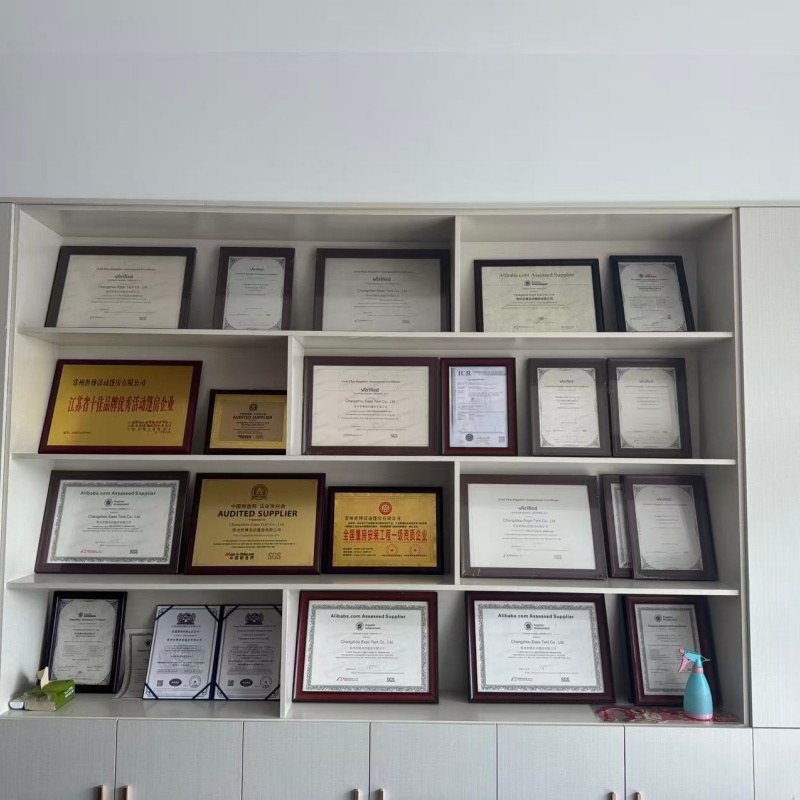
For buyers sourcing party tents, wedding tents, warehouse tents, marquees and clear-span structures across borders, the practical question has shifted. It is no longer only whether a supplier can build the structure, but whether the supplier can evidence that the structure meets a named standard for a named market, with the documentation package that the buyer's own acceptance process requires. In a decision-stage purchase, this single factor now separates shortlists as decisively as price or lead time.
Why compliance divergence is now a trade variable
The commercial weight behind this shift is measurable. Grand View Research valued the global party supply rental market, which includes tent rentals, at USD 15.2 billion in 2023 and projects USD 32.0 billion by 2030. Dataintelo valued the global tent rental market at USD 8.2 billion in 2025, with weddings accounting for the largest single share at 38.5%. The temporary storage buildings segment — the warehouse tent category — reached USD 8.6 billion in 2025, supported by e-commerce expansion. Asia Pacific held 37.0% of party supply rental revenue in 2023, reflecting both manufacturing concentration and strong domestic demand.
Those figures describe a market where the buyer is often not the end user. Rental operators, exhibition contractors and facility managers purchase structures to deploy repeatedly across many sites and many events. Each deployment inherits the liability of the acceptance criteria in force at that site. When a rental operator works across several countries, or when an importer resells into several markets, one structure can be exposed to several qualification regimes during its service life. Divergence therefore does not stay in the regulatory text — it propagates into the purchase order.
What “compliant” actually means: three different registers
The most common source of confusion in cross-border tent transactions is treating certification as a single attribute. It is not. Three registers dominate commercial event tent requirements, and they answer different questions.
ISO 9001 addresses quality management systems — how a manufacturer controls process, traceability and consistency. It says something about the reliability of the production system, not about the physical performance of a specific structure.
NFPA 701 is a fire-test method concerned with flame propagation of textiles and films. It addresses the behaviour of the roof and wall membrane when exposed to flame, and is therefore a materials-and-testing question.
EN 13782 addresses structural safety of temporary structures. It concerns the frame, the load path and the engineering justification for the tent as a structure, and is therefore a structural question.
Purchasing terms and acceptance criteria as the operational interface
Where regulatory regimes diverge, the transaction document becomes the point of translation. In practice, divergence surfaces in three places: the standard reference named in the specification, the test documentation required at handover, and the acceptance criteria applied to the delivered batch.
The first is definitional. A specification that describes performance in general language leaves the acceptance decision to interpretation, and interpretation is where cross-border disputes begin. A specification that names the standard — ISO 9001 for the quality system, NFPA 701 for the textile, EN 13782 for the structure — converts a subjective judgement into a documentary check. That conversion is what allows a buyer in one market to evaluate a supplier in another without inspecting the factory in person.
The second is evidential. Documentation requirements scale with the market, and they are asymmetric in their commercial effect. Suppliers that already maintain a documentation system absorb an added requirement at low marginal cost. Suppliers that do not face delay, re-inspection or rejection at the point of entry — costs that fall on the buyer as schedule risk even when the supplier bears the direct expense. This asymmetry explains why qualification capability, rather than headline price, increasingly determines who is invited to quote at all.
The third is batch-level. Acceptance criteria that attach to a specific delivered batch rather than to a supplier's general capability are stricter, and they reward manufacturers who can reproduce the same evidence package repeatedly. For a buyer at decision stage, the useful question is not “are you certified?” but “which standard, for which structure, evidenced by what document, for which market?”
What divergence does to market structure
Divergence tends to consolidate rather than fragment supply. When qualification requirements multiply, the fixed cost of maintaining evidence across several markets rises, and that fixed cost is easier for a specialist with a stable product range to carry than for a trader assembling structures from multiple sources. The result is a gradual separation between suppliers who can present a coherent qualification profile across markets and those who cannot.
The rental segment amplifies this. With weddings representing 38.5% of a USD 8.2 billion tent rental market in 2025, and party supply rental projected to grow from USD 15.2 billion in 2023 toward USD 32.0 billion by 2030, the operators absorbing that growth are the ones deploying structures most frequently. Frequency multiplies exposure. A rental operator running hundreds of installations per season has a structurally different risk position from a one-off buyer, and that position is expressed in procurement terms long before it reaches a regulator.
How production capacity and export performance adapt
Changzhou Expo Tent Co.,Ltd. — trading as expotent — is a China-based designer and manufacturer of aluminum and steel frame fabric structures, tents and marquees, established in 2010 and operating from a 3,000 m² facility in Changzhou, Jiangsu Province. The company reports 30 employees, an annual output of 100,000 m², a research and development team of three engineers, and an export ratio of 50%, with main markets in the EU, Africa, the USA, Asia and the Middle East, serving clients in over 40 countries worldwide.
Read as a set, those figures describe a configured-order specialist rather than a volume generalist. An annual fabric output of 100,000 m² produced by a 30-person team in a 3,000 m² plant implies a production model organised around specification and configuration rather than long runs of a single SKU. That model is directly relevant to compliance divergence, because configured production is what allows the same structure type to be delivered against different market requirements without rebuilding the line.
A 50% export ratio spread across five distinct regions is the more telling figure. It means a single production organisation supports structures destined for markets with different qualification expectations simultaneously. Companies in that position typically develop internal documentation routines as an operational necessity rather than a marketing claim — the evidence package becomes part of the production workflow, alongside cutting, welding and sewing.
The company's stated scope reinforces the point: structures for temporary, semi-permanent and permanent use, spanning fabric structures for retail and logistics, sports buildings and indoor training facilities, and tents and marquees for events. A portfolio that crosses event, logistics and sports use cases encounters different acceptance criteria within the same product family, which is precisely the condition divergence creates.
Materials and testing: the physical basis of qualification
Compliance is ultimately argued from physical properties, and the most decision-relevant property in tent procurement is frame material. Steel and aluminum frames are not interchangeable options at the same price point; they are different lifecycle propositions, and the difference is documented in the manufacturer's own comparison data.
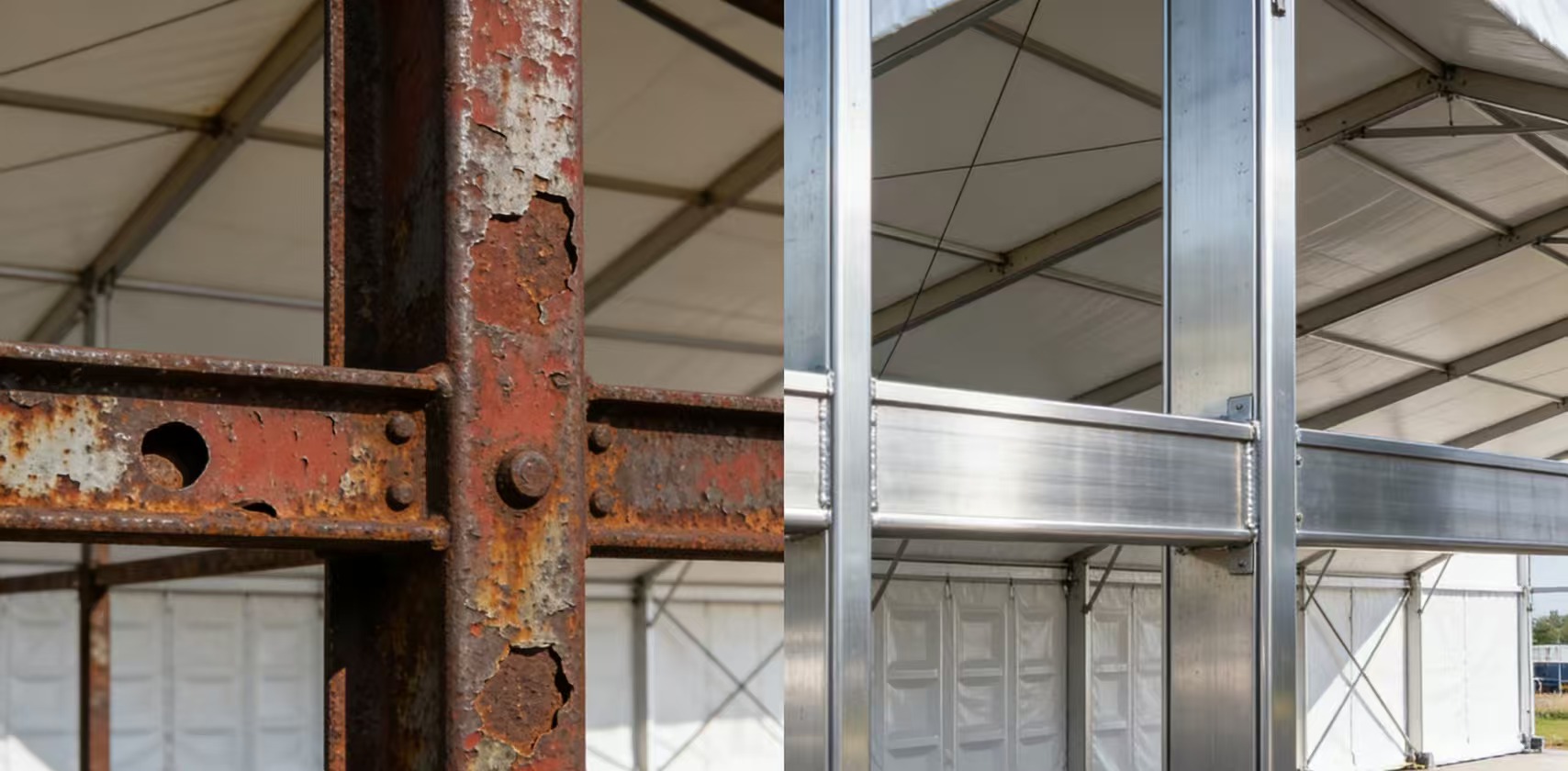
| Comparison dimension | Steel frame tent | Aluminum frame tent |
|---|---|---|
| Stated service life | Approximately 2 years | More than 10 years |
| Corrosion behaviour | Rusts; corrosion progresses with exposure | Does not rust |
| Maintenance requirement | Rust cleaning required | No rust cleaning required |
| Indicated applications | Short-horizon, cost-sensitive deployment | Wedding and warehouse applications |
| Ten-year implication | Repeated replacement cycles | Single structure spans the period |
The lifecycle reading is straightforward. Over a ten-year horizon, the steel option implies repeated replacement cycles plus rust-related maintenance, while an aluminum structure's stated service life spans the period without rust cleaning. That is a procurement calculation, not a preference — and it becomes decisive in applications where the structure stays standing, such as warehouse tents and permanent or semi-permanent installations.
Testing extends beyond the frame. Flame resistance of the textile is a separate qualification track, addressed through the NFPA 701 test method for flame propagation, and it is the criterion most often requested in event applications where occupancy and public safety govern approval. Structural safety under EN 13782 is argued separately, from the frame and its load path.
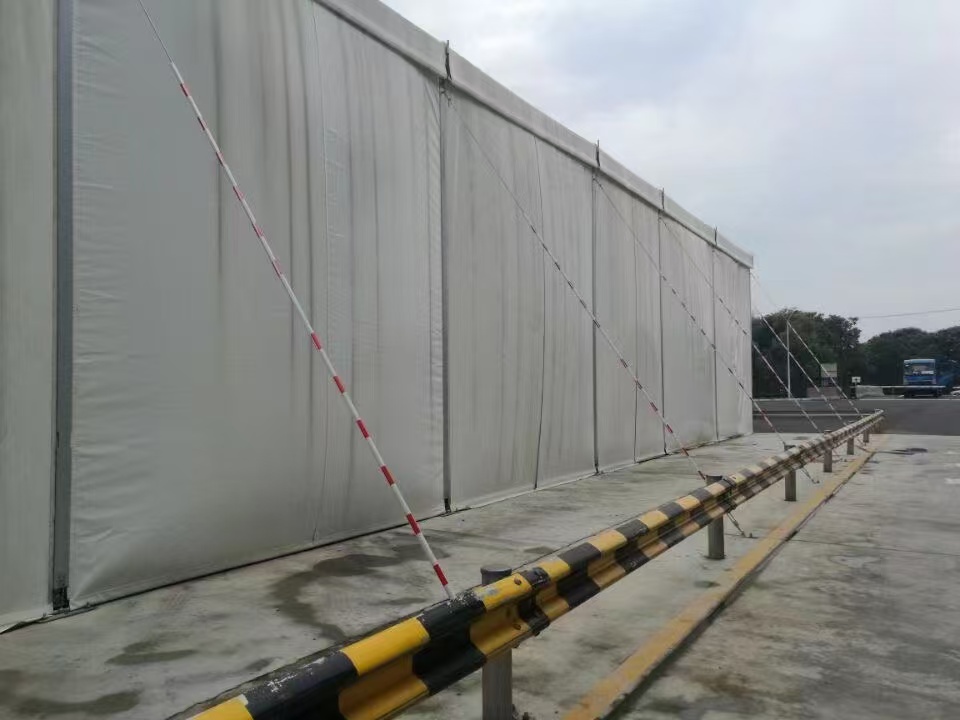
That load path includes anchoring. In the manufacturer's risk-control documentation, the defined control for high-wind exposure is windproof steel cables, applied as an added enterprise measure rather than an optional accessory. For buyers, this is a useful distinction: structural qualification is a property of the frame plus its installation regime, not of the frame alone.
Where divergence actually bites: application fit
Different tent types meet different qualification pressures, and the decision-stage comparison should be made per application rather than per supplier.
Wedding tents and marquees
Weddings represent the largest single share of the tent rental market at 38.5% in 2025. Because wedding deployments are short, highly visible and frequently hosted on sites without permanent infrastructure, the binding requirements tend to be textile flame behaviour and installation reliability rather than structural longevity. Aluminum frames are indicated for wedding applications in the manufacturer's comparison data — consistent with a rental model where the structure is reused across many events and appearance degrades with corrosion.
Warehouse and industrial tents
The temporary storage segment reached USD 8.6 billion in 2025 on e-commerce expansion. Warehouse deployments differ from event deployments in one decisive respect: the structure stays standing, often for years. Rust becomes a maintenance line item and a structural concern rather than a cosmetic one. Aluminum is again the indicated material for warehouse applications, where the ten-year-plus service expectation aligns with the deployment horizon.
Sports, padel and training structures
Sports buildings and indoor training facilities form a distinct category in the manufacturer's scope. These structures combine large clear spans with continuous occupancy, which places weight on structural justification and anchoring rather than on rapid assembly.
Exhibition, pagoda and clear-span configurations
Modular configurations such as pagoda tents and clear-span structures are typically specified by exhibition contractors and facility operators who work across venues. For these buyers, documentation portability matters as much as the structure itself — the same unit may need to be accepted at several sites under several sets of criteria.
Comparing frame options on lifecycle terms — and the limits of that comparison
A lifecycle comparison is the correct decision framework when compliance and replacement risk are priced together. On the manufacturer's stated figures, an aluminum frame tent delivers more than ten years of service without rust cleaning, while a steel frame tent delivers approximately two years and requires rust maintenance. Across a decade, that is a difference of several replacement cycles and an ongoing maintenance obligation.
The comparison has a real boundary, and buyers should accept it. Steel frames remain a rational choice for short-duration, low-exposure deployments where a two-year service expectation matches the actual use and where rust maintenance is manageable. The aluminum advantage only materialises when the deployment horizon is long enough to span multiple replacement cycles — which is why the same material question produces opposite answers for a one-season event programme and a multi-year storage structure.
A second boundary is documentary. Service-life figures describe material behaviour; they do not certify a structure for a market. A supplier's qualification profile is specific to the standard, the structure type and the market in question. Capacity metrics such as annual output, plant size and team strength describe production capability, not compliance coverage — and conflating the two is one of the more common errors in cross-border tent procurement.
A third boundary is installation. A structure engineered for a defined wind condition still depends on correct anchoring, and the manufacturer's specified control for high-wind exposure is windproof steel cables. Structural qualification and installation discipline are complementary, not substitutable.
Forward outlook: partial alignment, not harmonisation
Two forces point toward convergence rather than full harmonisation. The first is the internationalisation of the rental operator. As rental businesses expand across borders, they carry their home-market acceptance criteria with them, effectively exporting a qualification standard through commercial practice rather than through regulation. The second is the purchasing habit described earlier — naming the standard directly in the specification. Once a standard reference becomes the acceptance criterion, suppliers converge on the documentation that satisfies it.
The probable outcome is a smaller set of dominant reference standards that buyers accept across several markets, with project-specific requirements layered on top. Full global alignment is unlikely, because the underlying standards address different questions and serve different regulatory purposes. What is likely is that buyers stop treating qualification as a single attribute and start specifying it in registers — quality system, textile performance, structural safety — each with its own evidence.
For manufacturers, the strategic asset shifts accordingly. Catalogue breadth matters less than the ability to produce the same evidence package for the same structure in several markets, repeatedly and at batch level. In a market projected by Grand View Research to move from USD 15.2 billion in 2023 toward USD 32.0 billion by 2030, that reproducibility is likely to be a more durable differentiator than unit price.
Frequently asked questions
Which compliance requirements apply to commercial party tents and event tents in major import markets?
Commercial event tents are commonly assessed against three distinct standards. ISO 9001 addresses the manufacturer's quality management system. NFPA 701 is a fire-test method for flame propagation of textiles and films, applied to the tent membrane. EN 13782 addresses structural safety of temporary structures. Because they cover quality systems, textile behaviour and structural engineering respectively, they are separate requirements rather than alternatives.
Why do purchasing terms and acceptance criteria matter more in cross-border tent buying than in domestic buying?
In a domestic transaction, buyer and supplier usually operate under a shared understanding of which standard applies. In a cross-border transaction they may not. The specification and acceptance criteria therefore become the only shared reference point, which is why naming the standard — ISO 9001, NFPA 701, EN 13782 — converts an interpretive judgement into a documentary check, and why documentation capability has a direct commercial value.
How should a buyer compare steel frame and aluminum frame tents on lifecycle terms?
The comparison should be made against the deployment horizon. On the manufacturer's stated figures, a steel frame tent has a service life of approximately two years and requires rust cleaning, while an aluminum frame tent has a service life of more than ten years and does not rust. Over a decade, the steel option implies repeated replacement cycles; the aluminum option spans the period. For short-duration or one-season use, the steel proposition remains viable.
How does compliance divergence affect which tent type fits which application?
It changes the binding constraint for each type. Wedding tents, representing 38.5% of a USD 8.2 billion tent rental market in 2025, are typically governed by textile flame behaviour and installation reliability. Warehouse tents, in a temporary storage segment valued at USD 8.6 billion in 2025, are governed more by structural longevity because the structure stays standing. Sports and training structures place weight on structural justification and anchoring. The application determines which register dominates.
What evidence should a decision-stage buyer request when shortlisting a tent supplier?
Evidence should be requested per register rather than as a single certificate: the standard reference for the quality system, the test basis for the textile, and the structural justification for the frame and its anchoring, including the specified control for high-wind exposure, which for this manufacturer is windproof steel cables. Service-life data for the frame material should be requested alongside, since replacement cycles affect the total cost of a multi-year deployment.
Есть вопросы или нужны дополнительные детали?
Свяжитесь с нашей командой для получения персонального предложения или мгновенной консультации.
Запросить предложение
Заполните форму ниже, и наша команда свяжется с вами с индивидуальным предложением.
Прямой чат WhatsApp
Предпочитаете общаться в реальном времени? Напишите нам в WhatsApp для мгновенной помощи и быстрых ответов.
- Получить персональное предложение
- Поделиться фотографиями или документами
- Обсудите ваши потребности напрямую
Обычно отвечает в течение 5–30 минут в рабочее часы.