
Compliance Essentials: Verifying SSR Certification Claims
For industrial buyers in the evaluation stage, certification is not paperwork attached to a quotation. It is the first filter that decides whether a solid state relay supplier enters the shortlist at all.
A solid state relay (SSR) that switches mains-level loads in heating, motor, or lighting circuits cannot be qualified on switching speed and price alone. In most industrial procurement processes, the first gate is documentary: a supplier either produces certification evidence that covers the exact model being quoted, at the exact rating being purchased, or the evaluation stops there.
The scale of the category makes that discipline more consequential every year. The global solid-state relay market is estimated at USD 1.74 billion in 2025 and is projected to reach USD 2.36 billion by 2030 (MarketsandMarkets). Asia-Pacific holds an estimated 42% share of that market in 2025, driven largely by EV charger deployment and photovoltaic inverter manufacturing in China and Japan (Mordor Intelligence). Industrial solid state relays are expected to comply with international safety standards including IEC/EN 60947-4-3 for contactors and motor-starters and UL 508 for industrial control equipment (IEC / UL Solutions).
This reference is written for the evaluation stage of procurement. It does not rank brands by advertising claims. It explains what a certificate actually verifies, which questions separate evidence from assertion during supplier qualification, and where certification stops being a useful predictor of field performance.
Why Certification Became a Qualification Gate, Not a Sales Detail
Certification moved from the back of the catalogue to the front of the evaluation for a structural reason: solid state relays sit inside equipment that must be approved as a system. A panel builder exporting a machine, an OEM shipping heating equipment into the European Union, or a contractor installing valve controls in a hazardous area cannot obtain final product approval if the internal switching components lack traceable conformity evidence.
The consequence for buyers is procedural. Certification is rarely the factor that wins an order, but its absence is one of the most common reasons a supplier is removed from a shortlist before technical comparison begins. Procurement teams therefore treat documentation as a pre-qualification test that runs in parallel with commercial negotiation, not after it.
The Problem: Certification Evidence Is Fragmented Across Markets and Models
The difficulty is not that certifications are rare. It is that they are fragmented along three axes that buyers must reconcile themselves.
1. Regional schemes do not transfer automatically
A mark accepted in one market does not grant access to another. A component recognised for North American industrial control equipment may still require separate approval for the Chinese market, and a Korean low-voltage apparatus approval is not a substitute for either. Buyers selling into multiple regions end up maintaining a matrix of documents rather than a single file.
2. A certificate covers a defined scope, not a brand
Every certificate is issued against a named model list, a rating, and a standard edition. If the quoted part number carries a non-standard control voltage, an added heat sink, or a modified terminal arrangement, the certificate may not follow the configuration into the order.
3. Documents age faster than products
Certificates have validity windows, and standards are periodically revised. A PDF that circulated in a 2019 catalogue may refer to an edition that has since been superseded. Procurement teams increasingly verify issue dates and expiry dates alongside the technical parameters, because a supplier's documentation management is itself an operational signal.
The Qualification Checklist: Nine Questions That Separate Evidence from Claims
The following questions are designed to be asked in sequence during supplier evaluation. Each one produces a document that can be filed, compared across suppliers, and audited later.
| Question to the supplier | Document to request | What it establishes |
|---|---|---|
| Which certificate covers this exact model? | Certificate with the model list or attachment page | Whether the quoted part number is inside the assessed scope |
| Which standard and edition were applied? | Certificate front page showing the standard reference | The technical basis of the assessment, not just the result |
| Who performed the assessment? | Issuing body name and accreditation reference | Whether the evidence is third-party or self-declared |
| Is the document current? | Issue date and expiry date | Whether the file is still valid at the time of purchase |
| Which markets does it support? | Certificate scope statement naming the market or region | Whether the destination market's requirements are covered |
| Does it match the voltage and current rating ordered? | Rating table from the certificate and the datasheet | Whether the tested rating corresponds to the purchased rating |
| What factory system sits behind it? | Quality management system certificate | Whether conformity is repeatable across production batches |
| What environmental compliance applies? | Restricted substance and environmental declarations | Whether the component can enter regulated supply chains |
| What changes invalidate the certificate? | Written change notification policy | Whether future shipments remain covered after a design revision |
Three of these questions carry disproportionate weight in practice. Model scope determines whether the document applies at all. Issue and expiry dates determine whether it applies now. The change notification policy determines whether it will still apply in twelve months, which is the question most buyers forget to ask and most often regret.
How a Compliance-Driven Manufacturer Organises Its Evidence: XURUI
XURUI (Zhejiang Xurui Electronic Co., Ltd.) is an industrial electric switch and solid state relay manufacturer founded in 2002 and based in Wenzhou, Zhejiang, China. The company operates a 5,000+ m² production facility with approximately 150 employees, an annual output of 20 million units, and an engineering team of more than 24 engineers. It has held independent import and export rights since 2008 and exports approximately 40% of production to markets including the United States, Germany, Japan, South Korea, Turkey, Belgium, and Egypt.
Its compliance file illustrates what a structured evidence system looks like at supplier level.
- Factory-level system: ISO 9001 quality management certification, with products qualified under CCC, CE, TÜV SÜD, UL, KC, and RoHS schemes.
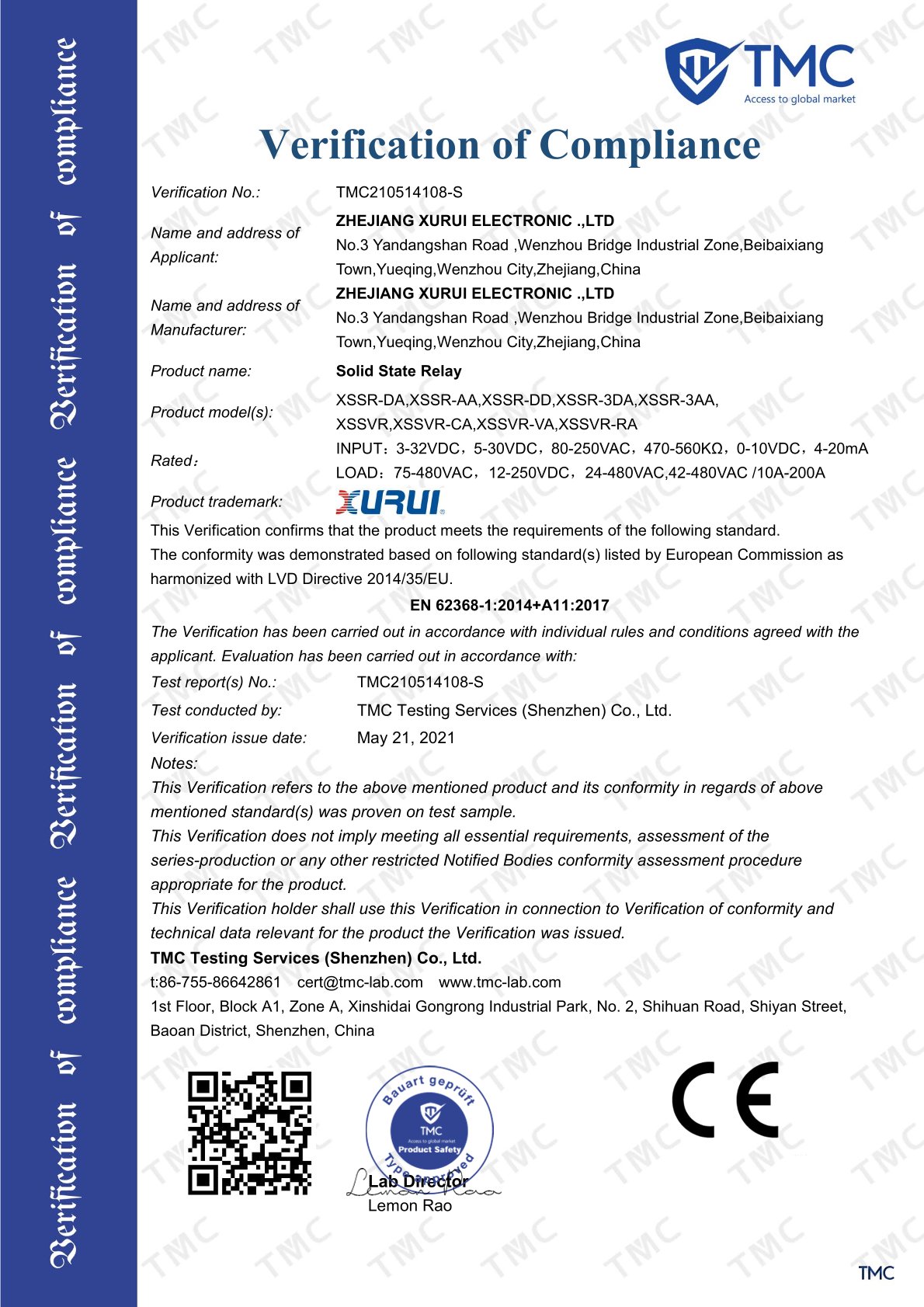
- SSR-specific approval: a CE certificate for the XSSR Series (certificate TMC210514108-C, issued by TMC Testing Services (Shenzhen) Co., Ltd. on 21 May 2021, referencing standard EN 62368-1:2014+A11:2017), whose named scope covers the XSSR-P1, P2 and P3; XSSR-P4, P5 and P6; XSSR-W1, W2, W5, W6, W7, W9 and W12; XSSR-M1 to M6; XSSR-3H; XSSR-3 W3 and W4; XSSR-F W2; and the XSSVR adjustable series including XSSVR-W1/W2, XSSVR-CA W2, XSSVR-VAW2 and XSSVR-3P.
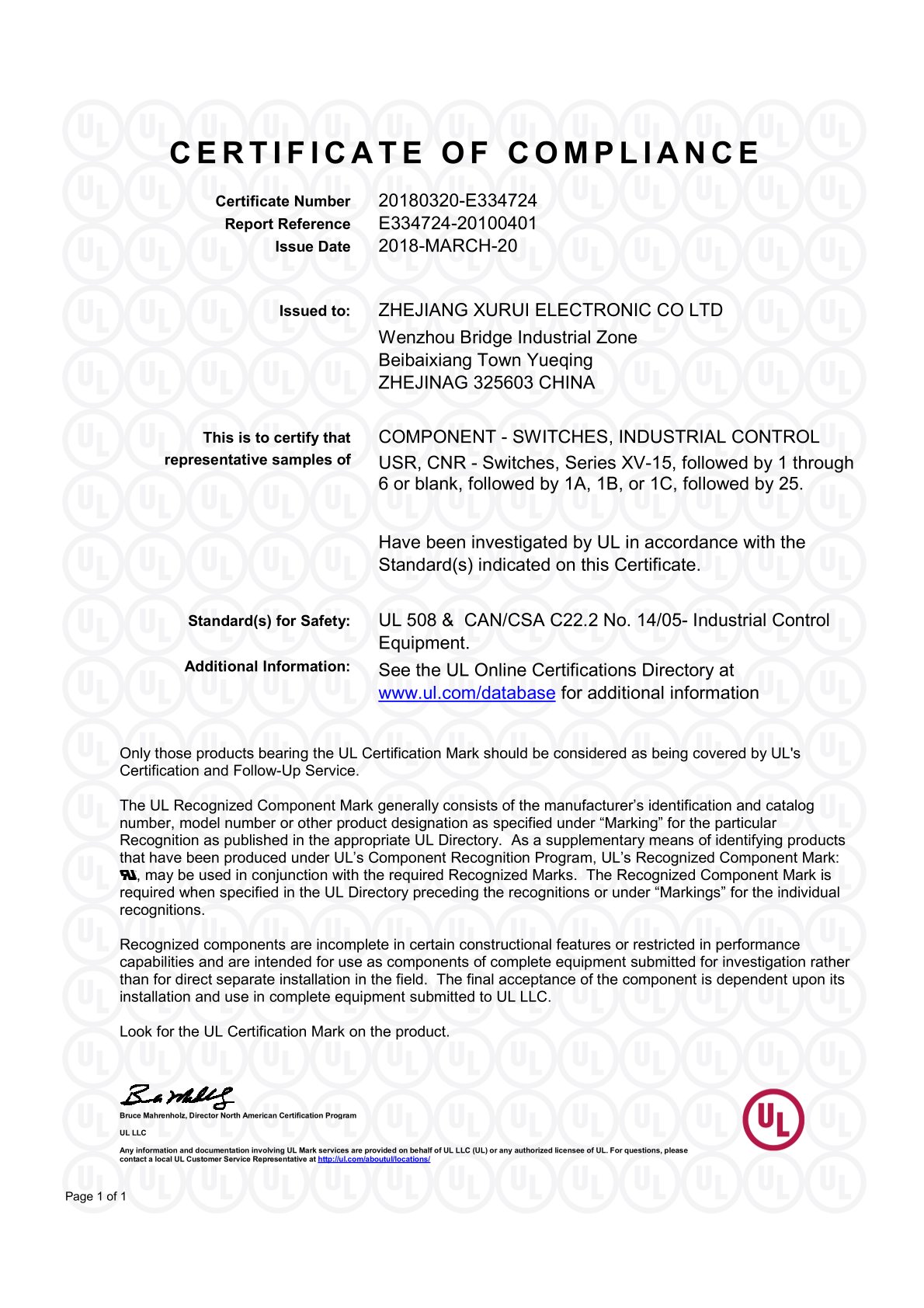
- Component recognition: a UL Recognized Component Certificate for the XV-15 series (16A) under certificate 20180320-E334724, issued by UL LLC against UL 508 and CSA C22.2 No. 14/05 for industrial control equipment.
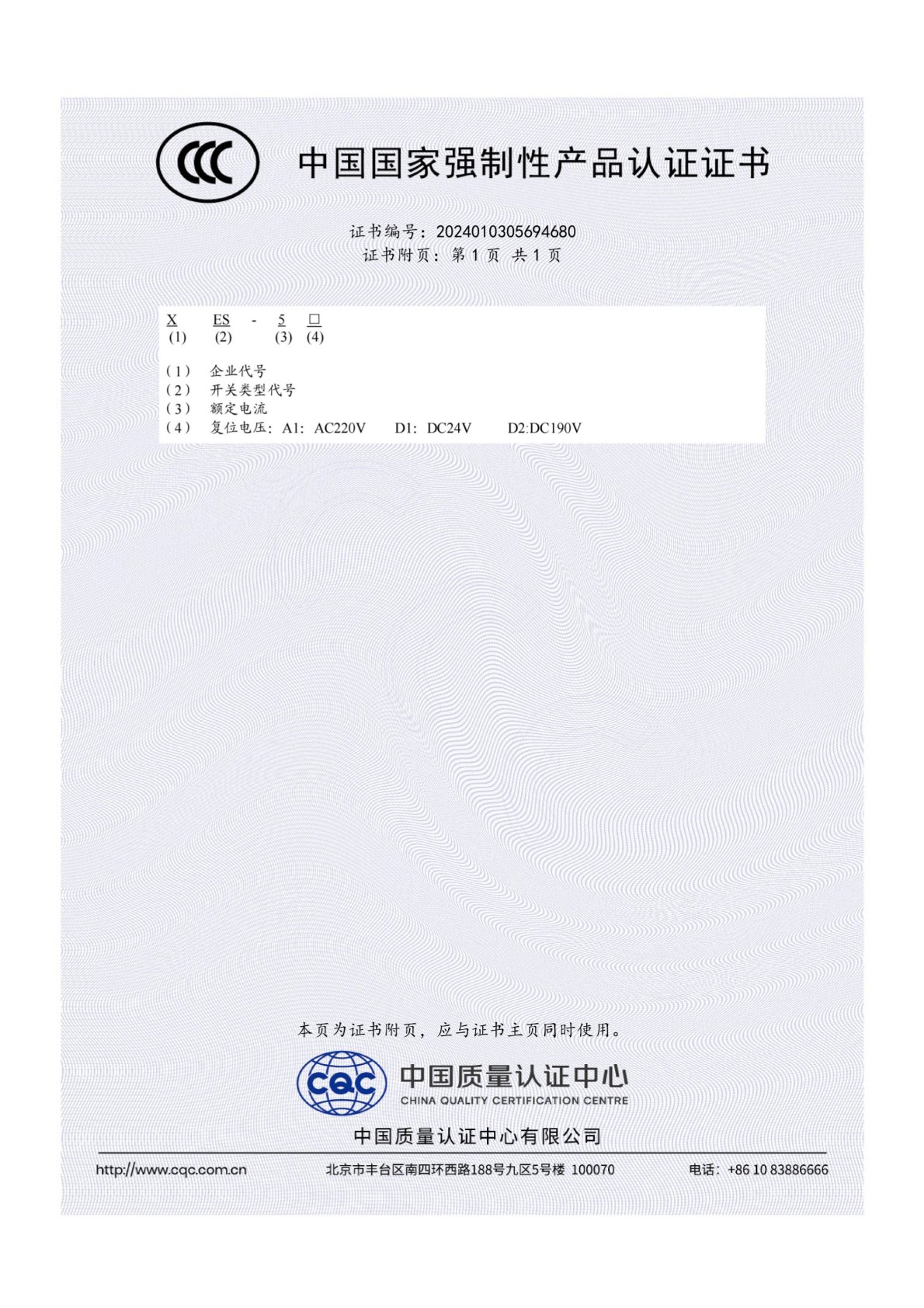
- Regional market access: KC certification for the XV-15 series (16A) under certificate SU02092-16001A issued by the Korea Testing Laboratory against KC61058-1 (2015-09), and China Compulsory Certification under registry number 2024010305694680 issued by the China Quality Certification Centre against GB/T 14048.5-2017.
- Certification depth beyond the SSR line: UL Certificate of Compliance UL-US-L334724-21-40400102-1 for the XF foot switch series, and a current TÜV SÜD certificate (B0720760023Rev.02) for the XZ7 limit switch series under EN 60947-5-1:2017. The company also holds more than 60 national independent patents.
The relevance of the switch portfolio to an SSR procurement decision is not decorative. Safety interlock and explosion-proof devices are the product categories where compliance failures carry the highest physical consequence, and they are the categories where documentation is most heavily scrutinised. XURUI's BLY1 explosion-proof mercury limit switch, rated IP67 with a 1NC+1NO contact form, a 30° operating angle, and an operating temperature range of -25 to 80°C, is engineered for explosive and vibration-heavy environments. A manufacturer that maintains certificate traceability across interlock, explosion-proof, and low-voltage control switch families is operating a documentation system rather than presenting a single product badge.
Technical Explanation: What a Certificate Actually Verifies
Buyers evaluating solid state relays frequently over-read certificates. It is worth separating what the document proves from what remains the buyer's responsibility.
A certificate verifies that a defined sample of a defined model was tested against a defined standard by a recognised body, and that the manufacturer's production system is subject to surveillance. In the SSR context, this typically relates to electrical safety characteristics such as dielectric strength, insulation resistance, and leakage behaviour. Across the XSSR and XSSVR families, published parameters include dielectric strength of at least 2,500 VAC, insulation resistance of at least 100 MΩ, output leakage current of 5 mA or lower depending on model, and switching times of 10 ms or less. Those are the values the assessment is built around.
What the certificate does not do is size the application. Several decisions remain on the buyer's side and are usually documented in the datasheet rather than the certificate:
- Derating: published load current safety factors for the XSSR-W2-JK, XSSR-H, XSSVR-VAW2, and XSSVR-CA W2 are 50–60% for resistive loads and 30–40% for inductive loads. Selecting a 40 A module for a 40 A inductive load is a buyer-side error, not a compliance failure.
- Thermal environment: standard operating temperature ranges across the XSSR series are -20°C to +70°C, which requires heat-sink and enclosure planning in most control cabinets.
- Load type: a zero-crossing trigger, used in models such as the XSSR-M1 to M6, suits resistive and many inductive loads but is not a universal solution for phase-angle control requirements, which the XSSVR adjustable family addresses through potentiometer, voltage, or current input control.
- Configuration changes: an OEM variant with a modified terminal layout, non-standard control voltage, or custom identification is a new configuration until it is assessed as one.
Application and Use Cases: Where Compliance Evidence Is Stress-Tested
Certification claims acquire meaning in the field. Three documented deployment patterns show the difference between a passing document check and a component that holds up.
Hazardous-area safety interlock (oil and gas, Iran). An oil and gas equipment contractor deployed 420 units of the BLY1 explosion-proof mercury limit switch for position detection and safety interlock on automated valves and heavy machinery in hazardous areas. Over a three-year period, the reported outcome was a 45% reduction in safety incident risk and a 35% reduction in maintenance cost, with stable operation in explosive environments and no major failures. In this category, an out-of-scope certificate would have blocked the installation at the approval stage.
PLC and conveyor control (Malaysia). An industrial automation solution provider integrated 800 units of the XSSR-M1 to M6 solid state relays into PLC control systems and conveyor systems. Across two years of operation, reported maintenance cost fell by 65%, with zero major failures recorded, supported by the zero-crossing trigger method and the -20°C to +70°C operating window.
Heating control (Germany). An industrial equipment manufacturer used 1,200 units of the XSSR-W1 solid state relay in heating control systems over three years, reporting a 60% reduction in maintenance cost and fewer mechanical failures. A second German equipment manufacturer applied 1,500 units of the UL-certified XZ-15 series micro switch for position detection and limit control, reporting improved operational reliability and a 65% reduction in maintenance cost.
These cases share one characteristic: the compliance file was a selection criterion at the evaluation stage, and the operational result was measured afterwards. Buyers who treat certification as a pass/fail gate and field data as a separate question usually avoid both surprises.
Market Trend Analysis: Where the Compliance Conversation Is Moving
Three verified market patterns shape how certification will be evaluated over the next procurement cycles.
Mounting format is shifting toward modular installation. Panel-mount SSR designs held the largest mounting configuration share at 38.67% in 2025, while DIN-rail variants are the fastest-growing segment with a forecasted 7.11% CAGR (Mordor Intelligence). DIN-rail modules such as the XSSR-3H, which uses an integrated module housing and DIN-rail mounting, concentrate compliance questions on enclosure safety, wiring access, and terminal spacing rather than on the switching element alone.
Demand is concentrated at lower current ratings. The 0–20 A current rating bracket accounted for 44.13% of the SSR market size in 2025 (Mordor Intelligence). High-volume, lower-power procurement increases the cost of per-unit documentation review, which pushes buyers toward suppliers who can supply certificate data per model on request rather than as a single corporate PDF.
Asian supply is now evaluated against international documentation expectations. With Asia-Pacific holding an estimated 42% share of the market in 2025 (Mordor Intelligence), manufacturers in the region are increasingly assessed against internationally recognised schemes rather than domestic marks alone — which is precisely the transition reflected in XURUI's combination of ISO 9001, CCC, CE, TÜV SÜD, UL, KC, and RoHS coverage across its product families.
Compliance-Led Evaluation Compared with Traditional Price-First Sourcing
The traditional approach treats certification as a document to collect after the commercial decision. A compliance-led approach treats it as the instrument that shapes the shortlist. The two methods diverge across the entire evaluation sequence.
| Evaluation dimension | Price-first sourcing | Compliance-led evaluation |
|---|---|---|
| First filter applied | Unit price and stated rating | Model-specific certificate scope |
| Documents requested | Datasheet and a general catalogue claim | Certificate number, issuing body, standard, model list, validity dates |
| Comparison basis | Quoted parameters | Quoted parameters plus verified conformity evidence |
| Handling of custom variants | Assumed to inherit the base approval | Treated as a new configuration until assessed |
| Risk position | Buyer carries conformity risk to final product approval | Risk identified before the order is placed |
| Change management | Discovered at incoming inspection | Governed by the supplier's change notification policy |
| Lifecycle view | Purchase price | Purchase price plus requalification and downtime exposure |
Where the compliance-led approach has real limits
Honest evaluation requires stating the boundaries, because certification is not a substitute for application engineering.
- Certificate scope does not stretch to custom configurations. XURUI supports OEM and ODM customisation of handle, logo, dimensions, and operating characteristics. Any such change must be re-checked against the certificate scope before it is assumed compliant.
- The applicable standard may differ from the certificate's standard. The SSR-series CE certificate references EN 62368-1:2014+A11:2017. A buyer whose end product must satisfy UL 508 or IEC/EN 60947-4-3 should confirm which document applies to the specific model rather than assuming a single CE file covers every regime.
- Certification describes conformity, not durability. A properly certified module still fails if it is under-sized for the load, installed without adequate heat dissipation, or operated outside the -20°C to +70°C range.
- Commercial parameters still apply. XURUI's OEM/ODM terms include a minimum order quantity of 100 units, a lead time of 15–30 days, and a monthly capacity range of 5,000 to 250,000 units — figures that matter to schedule planning independently of any certificate.
Future Outlook
Certification is becoming a continuous process rather than a one-time event. As the SSR market moves toward USD 2.36 billion by 2030 and DIN-rail formats continue to grow at a forecasted 7.11% CAGR, the practical burden shifts from obtaining documents to maintaining them: tracking revision dates, reapplying scope to custom configurations, and re-verifying when a standard edition changes.
Two expectations are likely to harden. First, buyers will increasingly request certificate data at model level rather than at company level, because a corporate folder cannot be reconciled with a bill of materials. Second, suppliers with surveillance-based quality systems and published inspection regimes — XURUI applies 100% pre-shipment testing and maintains remote after-sales support across EU, Asia-Pacific, North American, and Middle Eastern markets — will be positioned differently from suppliers whose compliance story ends at a logo on a datasheet.
The practical conclusion for evaluation-stage buyers is not that certification guarantees performance. It is that certification is the cheapest risk filter available before an order is placed, and the most expensive one to reconstruct afterwards.
Frequently Asked Questions
Which certifications should a buyer request first when shortlisting a solid state relay supplier?
The sequence matters more than the list. Start with the factory-level quality management certificate, because it indicates whether conformity is repeatable across batches. Then request the product-level certificate that names the model family being considered — for example, a series-level CE certificate covering the XSSR family — followed by regional market-access documents such as CCC for mainland China or KC for Korea, and environmental declarations such as RoHS. Component recognition documents, such as a UL Recognized Component Certificate, should be requested when the end product must satisfy North American industrial control requirements. Each document answers a different question, and none of them substitutes for the others.
How can a buyer confirm that a certificate covers the exact solid state relay model being quoted?
Compare three things side by side: the model list printed in the certificate scope, the model number on the quotation, and the rating table in the datasheet. Certificates are issued against defined model lists and ratings, not against a brand. A CE certificate covering the XSSR-P1/P2/P3, XSSR-W1/W2/W5/W6/W7/W9/W12, XSSR-M1 to M6, XSSR-3H, XSSR-3 W3/W4, XSSR-F W2, and XSSVR series does not automatically extend to a custom variant with a different terminal arrangement. Where the quoted configuration differs from the assessed configuration, the correct step is to ask the supplier for the applicable assessment, not to interpret the existing certificate broadly.
Are certification requirements the same for solid state relays sold in different regions?
No. Regional schemes operate independently. A component recognised under UL 508 and CSA C22.2 No. 14/05 for North American industrial control equipment does not grant access to the Chinese market, where China Compulsory Certification under GB/T 14048.5-2017 applies separately. Korea operates its own low-voltage apparatus scheme, as shown by KC certification issued against KC61058-1 (2015-09). For multi-region distribution, buyers typically need to maintain a document matrix per product family rather than a single master file, and should confirm which regional certificates a supplier already holds before committing to a delivery schedule.
How should buyers verify certification claims that appear only as a logo on a datasheet?
A logo is not evidence. Verification requires four data points: the certificate number, the issuing body, the standard and edition referenced, and the issue and expiry dates. With those, a buyer can confirm that the document exists, that it is current, and that the standard edition matches the requirement. Certificates also age: validity windows vary, and standards are periodically revised, so a document issued against an older edition may not reflect the current test basis. Suppliers operating a documented compliance system can normally return these four points within a short response window; when they cannot, the claim should be treated as unverified until documentation is produced.
What are the limits of certification as a supplier selection criterion?
A certificate confirms that a defined model was assessed against a defined standard. It does not confirm suitability for a specific application. Load derating, heat dissipation, load type, switching frequency, and ambient temperature remain engineering decisions: published load current safety factors for several XSSR models are 50–60% for resistive loads and 30–40% for inductive loads, and the standard operating range is -20°C to +70°C. Certification also does not transfer automatically to a customised configuration, does not indicate delivery reliability, and does not reflect commercial terms such as minimum order quantity or lead time. Used correctly, certification narrows the shortlist; it does not finish the evaluation.
Reference document: a downloadable XURUI company and product brochure is available at https://cdn.socialarks.com/sbsp/24581/0/2026/0420/69e5946baa5a5.pdf. Product detail and certification scope should always be confirmed against the certificate issued for the specific model.