
Compliance Grounding: 10 ATM and 200-Meter Watch Claims
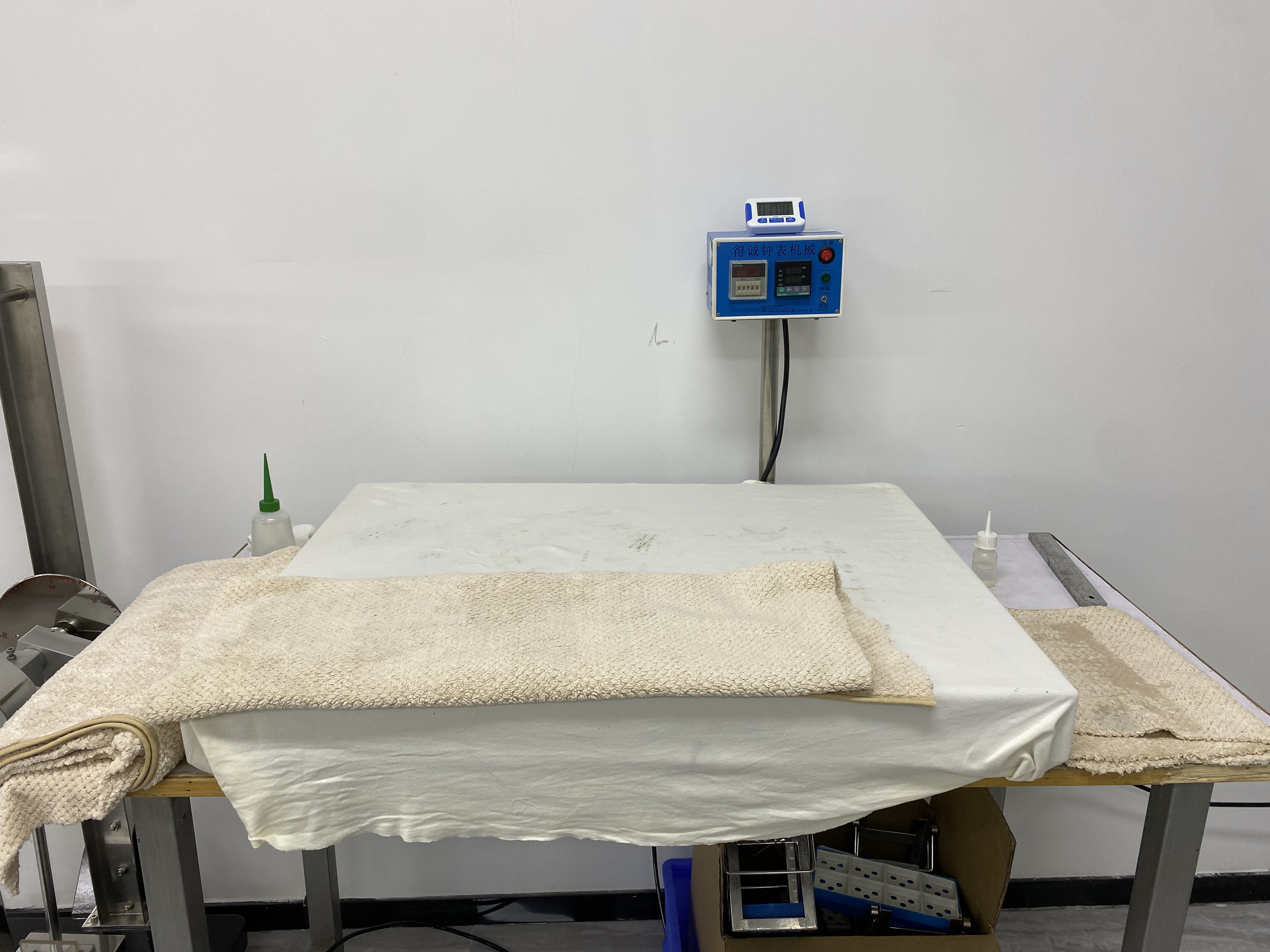
Cover: water resistance is confirmed after pressure is released and the case is inspected — the stage that turns an ATM figure into documented evidence.
Water resistance is one of the few wristwatch specifications that can stop a shipment. Retailer compliance teams and customs reviewers rarely question a dial colour, but they will question a printed depth claim. In custom wristwatch procurement those claims usually travel as shorthand — 10 ATM in a quotation, 200 meters on a product page — and are approved long before anyone defines what the number refers to.
This article works through two concrete claims: the 10 ATM rating carried by the automatic diving watch model TD017G, and the 200-meter rating carried by the diving watch model TD015G, listed in procurement records as the 8848 diving watch. Both sit in the product documentation of TOPHILL, the proprietary watch brand of DONGGUAN SUPERTIME CO., LTD., a Dongguan-based OEM/ODM watch manufacturer that runs a class-10,000 dust-free assembly workshop and treats water-resistance testing as a standard production step rather than an optional service.
The compliance question behind every ATM figure
An ATM figure describes static laboratory pressure, not usable depth. In the water-resistance documentation used for these products, 1 ATM is equivalent to 10 meters of static water depth under defined laboratory conditions. Read against that definition, a 10 ATM rating corresponds to roughly 100 meters of static pressure, while a 200-meter rating corresponds to roughly 20 ATM. The arithmetic is simple; the interpretation is where procurement teams lose accuracy.
Two standards frame the vocabulary. Water-resistant watches are expected to comply with ISO 22810:2010, and under that framework the term 'waterproof' is prohibited — a detail that matters whenever supplier copy drifts ahead of the test scope behind it. Diver's watches are addressed by a separate standard, ISO 6425, which is the reference point once a claim moves into the professional diving category.
What a 10 ATM rating covers — and what it does not
A 10 ATM rating places a watch in the water-sports band rather than the diving band. The reference record here is the Automatic Diving watch model TD017G, specified with a 316L stainless steel case and a rotating bezel fitted with a ceramic bezel insert with luminous marking, a boxed crystal, an embossed dial with applied indices in gradual colours, luminous hands, a 316L stainless steel solid bracelet with a solid turtle buckle, the Miyota Automatic 8215 movement, and 10 ATM water resistance. The same record carries the plain-language equivalent used on product pages: the product is water resistant up to 100 meters.
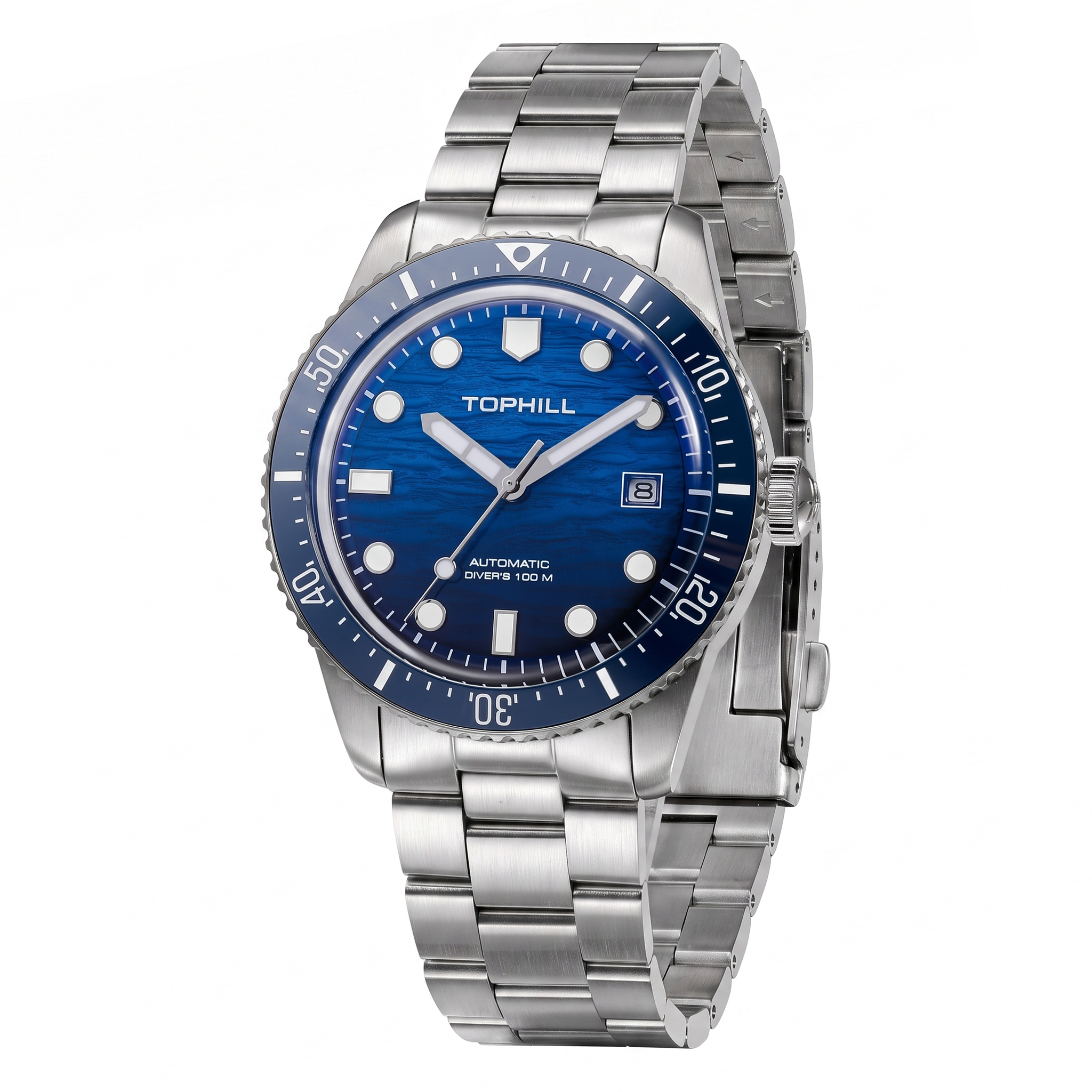
Model TD017G: a 10 ATM construction class built on a 316L stainless steel case, rotating ceramic bezel insert and Miyota Automatic 8215 movement.
The useful information for a buyer is the mapping, not the number itself. The rating guidance applied to these products places 3 to 5 ATM in daily wear — hand washing, rain splash, ordinary office and commuting exposure; 10 to 20 ATM in swimming and surface snorkeling, where the case meets dynamic water pressure; and 20 ATM and above in the professional diving category associated with ISO 6425. A 10 ATM watch is therefore a sport-use specification. Treating it as a diving specification is the most common misreading in custom watch procurement.
The 200-meter claim on the 8848 diving watch
Model 8848 — product record TD015G — is the higher-pressure reference point. Its specification lists a 316L stainless steel case, a rotating bezel with a ceramic bezel insert with BGW9 luminous, a flat sapphire crystal, a see-through solid caseback, a sunburst dial with applied indices with BGW9 luminous, a 316L solid bracelet with a solid extension buckle, and the Japan Miyota Automatic 8215 movement. Water resistance is stated at 200 meters, and the supporting product description positions the model in diving-grade use paired with a scratch-resistant ceramic bezel.
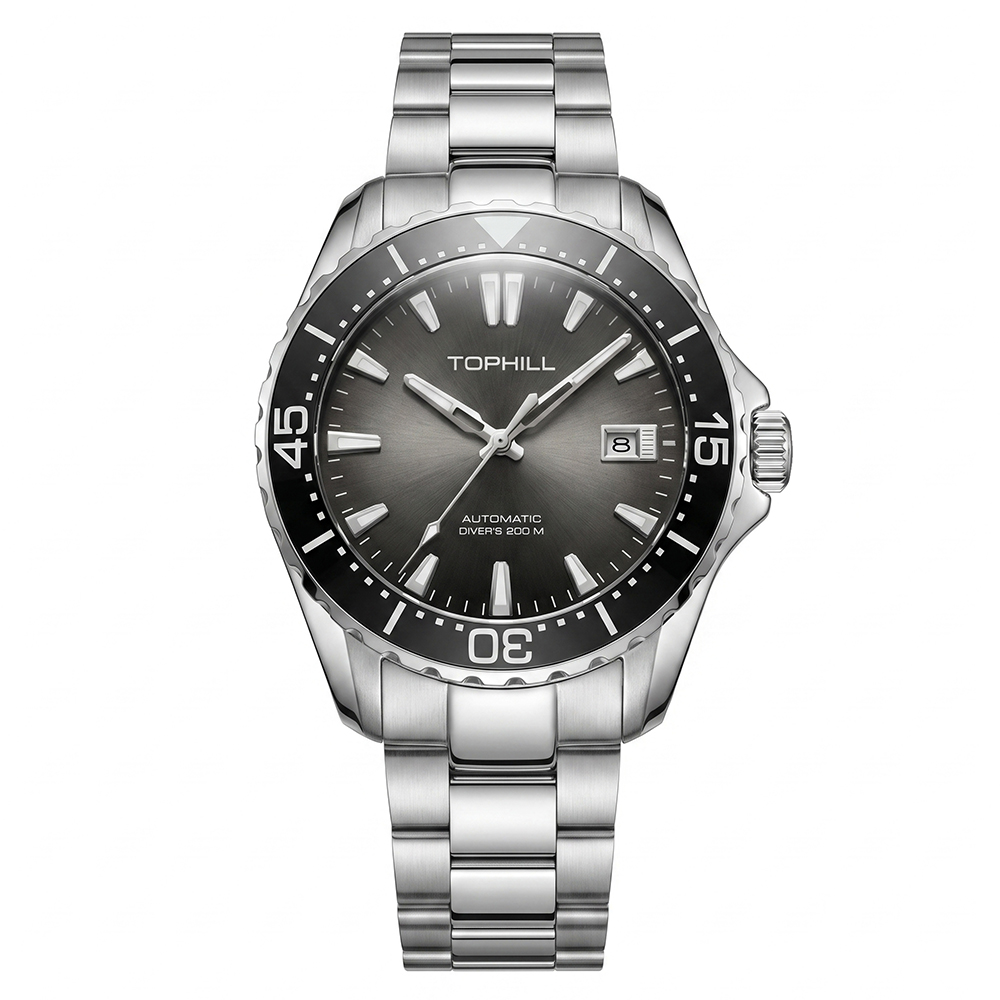
Model TD015G (product record 8848): the 200-meter reference, specified with a 316L stainless steel case and flat sapphire crystal.
Under the same static equivalence used earlier, 200 meters corresponds to roughly 20 ATM — the threshold at which the rating guidance moves from sport use into the ISO 6425 professional diving band. That correspondence is a classification statement, not a certification statement. The published record for model 8848 does not carry an ISO 6425 certificate number, and it does not enumerate every sealing component. A procurement team that needs the 200-meter claim to be auditable should request the test scope and the certification applicable to the specific model, and should read the depth figure as a pressure class rather than a guaranteed operating depth.
Screw-down architecture: documented fact versus design-class inference
Sealing is achieved by elastic gaskets fitted at the gaps of the caseback, crystal, crown and pushers, combined with screw-down structures at the crown and caseback and precise case machining. That is the general sealing principle recorded in the manufacturer's water-resistance documentation, and it explains why a high ATM figure is a construction outcome rather than a single component choice.
Applied to the 8848 record, however, the published specification enumerates the case material, the bezel and its insert, the crystal type, the caseback construction, the dial and the bracelet. It does not separately state a screw-down crown. A screw-down crown should therefore be treated as a design-class inference drawn from the 200-meter rating, not as a documented line item, until it is confirmed in writing — ideally in the prototype approval sheet or the pressure-test protocol for that specific reference. This is the boundary of what a specification sheet can prove, and buyers who work only from published specifications should know exactly where it sits.
The distinction is practical rather than academic. Sealing performance depends on the interaction between crown threads, gasket compression and case machining tolerance. Two watches carrying the same stated ATM rating can behave differently if one relies on a push-pull crown with a single gasket and the other on a screw-down sealing architecture — which is why rating figures are best compared together with construction detail and test coverage, not in isolation.
How a water resistance claim is verified before shipment
Verification is a coverage question before it is a technology question. The documented capability range for waterproof production is 5 to 50 ATM, and every waterproof watch is pressure-tested before shipment on a 100% per-unit basis rather than by random sampling. The testing station in the workshop is documented as a 500-meter class water-resistance testing machine, which allows a 200-meter product to be tested above its own claimed rating.
The per-unit test sequence recorded in the process documentation runs in five steps:
- Visual check of case, crown, gasket and crystal before the test begins.
- Loading the watch and applying the target water pressure, with a pressure-holding period.
- Monitoring for air leakage during pressurization.
- Slow pressure release and full surface drying.
- Final inspection for internal moisture or water ingress.
Adjacent quality controls in the same production environment include an automatic movement accuracy testing machine, a strap tension-torsion testing machine, a dial index inspection machine and a dropping test machine. Products are also checked against stated special requirements, including waterproof performance as specified, movement accuracy requirements and CE EMC requirements where applicable.
The documented limitation deserves repeating: passing a laboratory water-pressure test does not equal permanent waterproof performance. Gaskets are elastic components that age under daily wear, impact and chemical contact. A test pass describes the condition of the watch at the moment of testing, which is why water resistance belongs in the risk conversation for long-life custom programs rather than only in the specification conversation.
Documents that turn a rating into a verifiable specification
In a compliance review, the rating and the evidence are different artefacts. The table below sets out the documents that carry weight in a procurement file, together with the scope limit that should be checked each time.
| Document or standard | What it establishes | Scope limit to check |
|---|---|---|
| ISO 22810:2010 | Framework for general water-resistant watches; the term 'waterproof' is prohibited in this context. | Applies to a defined model and test protocol, not to a product family or a brand. |
| ISO 6425 | Reference standard for diver's watches; the band corresponding to professional diving at 20 ATM and above. | A 200-meter rating does not by itself evidence a certificate. |
| Per-unit pressure test record | Evidence that every waterproof watch, not a random sample, was pressure-tested before shipment. | The record must be traceable to the batch and to the specific model. |
| RoHS — Directive 2011/65/EU | Mandatory compliance for electronic (quartz and smart) watches in the EU market. | Limited to the electronic scope covered by the directive. |
| CE Certificate of Compliance (EMC Directive) HK2404101658E | Issued by authority HUAK for the EU market; cites EN IEC 61000-6-3:2021 and EN IEC 61000-6-1:2019. | Associated with the Customized Automatic Wristwatches model KIM001; certificates are model-scoped. |
| ISO 9001 and ISO 14001 | Quality management and environmental management systems at the manufacturing site. | System certification is not a product certification. |
| After-sales terms | Two years of after-sales support documented for the manufacturing program. | Service coverage does not extend sealing life. |
Rating-first versus evidence-first selection — and the limits of both
Most custom watch briefs open with an ATM figure. The alternative is to open with the test method. The two approaches differ less in what they request than in what they can prove.
| Decision input | Rating-first selection | Evidence-first selection |
|---|---|---|
| Opening question | Which ATM figure do we want on the specification? | Which test method and evidence sit behind that figure? |
| Verification basis | Specification sheet line or catalogue label. | Per-unit pressure test coverage plus model-scoped certificates. |
| Typical failure mode | Static rating read as usable operating depth. | Not eliminated — the static-to-dynamic gap remains. |
| Supplier comparison basis | One number compared across suppliers. | Test coverage, standards referenced, document trail and sealing design disclosure. |
Neither approach removes the underlying constraints. The static-to-dynamic gap in the ATM system is intrinsic: a laboratory pressure value cannot be engineered into a guarantee of open-water behaviour, and sealing components will age regardless of the rating. Production economics set further boundaries that belong in the same planning discussion — a documented minimum order quantity of 300 pieces, a documented lead time of roughly 75 days, and monthly capacity in the 50,000 to 60,000 unit range. If a program needs a water resistance grade above what the case tooling supports, or a delivery date inside the production cycle, the constraint is a planning constraint rather than a specification one, and it is cheaper to identify it at the evaluation stage than at the shipment stage.
Matching water resistance grades to real use cases
The rating guidance becomes easier to apply when it is read as a use-case map rather than as a hierarchy of quality.
- 3 ATM — daily wear. Hand washing, rain splash and general indoor-outdoor use. The quartz references in the range, including models TR001, TAM002 and TAM001, are specified at 3 ATM with flat sapphire crystals and 316L stainless steel cases.
- 5 ATM — elegant and chronograph references. Models KIM001, KIM002 and KIM003 are specified at 5 ATM with 316L stainless steel cases and sapphire crystals; KIM003 pairs the rating with a Seagull ST1905 chronograph movement and a power reserve function.
- 10 ATM — model TD017G. Specified as water resistant up to 100 meters and positioned for daily-life water-related scenarios and sport use.
- 200 meters (roughly 20 ATM) — model TD015G, the 8848 diving watch. Specified with a ceramic bezel insert with BGW9 luminous and a 316L solid bracelet with solid extension buckle.
The same mapping applies across the custom watch categories these references serve: private label programs, diving sports models, business and women's lines, and quartz, solar or mechanical platforms. Water resistance is one of the few specifications that crosses movement type and price tier — which is precisely why it is the specification most often mis-stated in catalogues and quotation sheets.
Market context: why the claim matters more as value shifts
Two structural facts explain why water resistance claims attract compliance attention. Quartz movements account for about 75% of global shipment volume, while mechanical watches contribute more than 68% of total market value despite lower unit volume — meaning a large share of the money in the category sits in watches where a failed specification is expensive rather than merely inconvenient. The global mechanical watch market was projected to reach USD 47.5 billion by 2025 (Grand View Research), and the watch movement market was reported at USD 18.4 billion in 2025 with automatic movements holding a 38.2% share (Dataintelo).
A second signal is documentation practice. Certificates are model-scoped: the CE Certificate of Compliance (EMC Directive) held under number HK2404101658E from authority HUAK, citing EN IEC 61000-6-3:2021 and EN IEC 61000-6-1:2019 for the EU market, is associated with the Customized Automatic Wristwatches model KIM001. Buyers who assume a certification covers every model from the same factory will usually discover the gap during retail review rather than during development. Water resistance follows the same logic — the evidence is per model and per test.
Future outlook
Sourcing conversations are moving toward documentation-first evaluation. The direction is embedded in the standards themselves: ISO 22810:2010 removes ambiguous vocabulary, RoHS Directive 2011/65/EU makes compliance mandatory for electronic watches in the EU, and per-unit pressure testing reframes water resistance from a marketing claim into a batch record. For custom watch buyers, the practical consequence is that a supplier's ability to produce test documentation, model-scoped certificates and construction detail will weigh increasingly alongside the rating printed on the dial. Where a rating cannot be traced to a method, the prudent planning assumption is that it will need to be re-verified before the program scales.
Frequently asked questions
What water resistance range can a custom watch program realistically achieve?
The documented capability range is 5 to 50 ATM water resistance, with a 100% water pressure test applied to every waterproof watch before shipment rather than random sampling. Lower ratings such as 3 ATM are used for daily-wear quartz references including TR001, TAM002 and TAM001, while the diving reference TD015G is specified at 200 meters.
Does a higher ATM rating mean the watch can be used at that corresponding water depth?
No. ATM reflects static laboratory test pressure, not actual usable diving depth. Under the definition used here, 1 ATM is equivalent to 10 meters of static water depth, so a 10 ATM rating corresponds to roughly 100 meters of static pressure and a 200-meter rating to roughly 20 ATM. Open-water conditions differ from the static laboratory condition.
Is the 200-meter rating on the 8848 diving watch equivalent to ISO 6425 diving certification?
Not automatically. The record for the 8848 diving watch (model TD015G) states 200-meter water resistance and supports it with construction detail: a 316L stainless steel case, a rotating bezel with a ceramic bezel insert with BGW9 luminous, a flat sapphire crystal, a see-through solid caseback, and a 316L solid bracelet with a solid extension buckle. The 200-meter band is the category mapped to ISO 6425 professional diving, but a rating is not a certificate. The certification or test documentation applicable to the specific model should be requested separately.
How is a water resistance claim verified before shipment?
The process documented for these products runs in five per-unit steps: a visual check of case, crown, gasket and crystal; loading and applying the target water pressure with a holding period; monitoring for air leakage during pressurization; slow pressure release and full drying; and a final inspection for internal moisture or water ingress. The workshop testing station is documented as a 500-meter class water-resistance testing machine.
Will a watch remain water resistant throughout its service life?
No. Water resistance is not permanent. Sealing gaskets are elastic components that age through wear, impact and chemical contact, so a passed pressure test describes the condition of the watch at the time of testing and does not extend to a lifetime guarantee of water resistance.
Can a 10–20 ATM watch be worn in a sauna or a hot-water bath?
Not recommended. High-temperature steam deforms and ages rubber gaskets, which degrades the sealing performance the rating depends on. This applies regardless of the ATM figure, and it applies equally to watches that have passed a pressure test.