
Compliance Realities for Maleic Anhydride Grafted Polymers: Qualification Without Guesswork
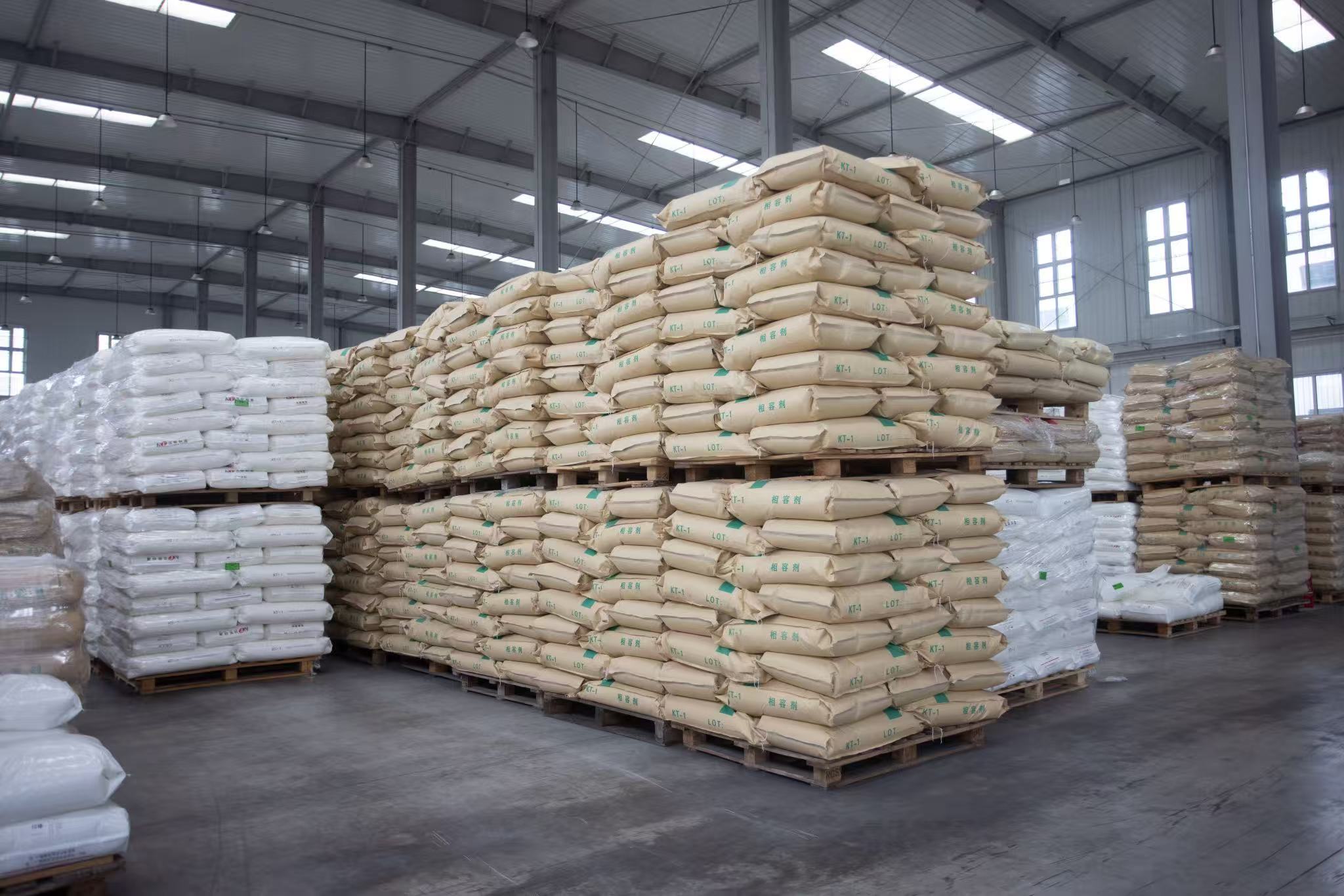
Storage and batch staging of grafted polymer grades: packaging integrity and lot identification are part of the qualification record, not an afterthought.
Compliance Realities for Maleic Anhydride Grafted Polymers: Qualification Without Guesswork
Maleic anhydride grafted polymers are specified into formulations — a compatibilizer in glass-fiber reinforced polypropylene, a toughener in nylon, an adhesive tie-layer resin in a multi-layer barrier film — and once a formulation is frozen, the qualification file behind that material becomes part of the finished product's own compliance story. For procurement and R&D teams, the real work is not collecting certificates; it is building a qualification chain that survives an audit, a formulation change, and a shift in supply.
The global maleic anhydride market reached USD 4.39 billion in 2023 and is projected to reach USD 5.86 billion by 2030, according to Grand View Research, while the narrower maleic anhydride graft polymer market is projected at USD 1.42 billion in 2026 and USD 2.16 billion by 2035, per Business Research Insights. Rising volumes do not automatically produce better documentation discipline. They usually produce more grades, more suppliers, and more qualification files that need to be maintained in parallel — which is exactly where guesswork creeps in.
This article sets out a workable interpretation of compliance for maleic anhydride grafted polymers: how regulatory scope, supplier documentation, line-level validation and batch consistency fit together. The three commercial categories referenced throughout — compatibilizers, tougheners and adhesive resins — are used as concrete examples of what a compliant supply category looks like in practice.
Why Compliance for MAH-Grafted Polymers Is a Project Question
A common failure mode in sourcing is treating compliance as a document request. A buyer asks for certificates, receives a PDF, files it, and considers the material qualified. That approach breaks down for grafted polymers because regulatory obligations attach to a substance and a legal entity, while performance obligations attach to a formulation and a process window.
Maleic anhydride grafted polymers fall within the scope of EU REACH (EC 1907/2006) registration obligations. On the technical side, ASTM D1248 — the standard specification for polyethylene extrusion materials — is commonly referenced in documentation for PE-based extrusion grades. Neither of these is a brand-level badge. A registration status belongs to a specific legal entity and a specific substance; a specification standard describes how a material is characterised, not how it will behave in a customer's extruder.
The practical consequence is that compliance for this material family is a project question with four distinct layers:
- Regulatory scope — which jurisdictions, which substances, which supplying entity.
- Documentation alignment — whether the technical data sheet describes the grade in terms your process can use.
- Project validation — whether the grade performs on your equipment, at your dosage, in your formulation.
- Batch consistency and change control — whether the validated grade stays the same grade across shipments.
The Four-Stage Qualification Workflow
The table below maps each stage to the evidence a buyer should hold before moving forward. It is deliberately sequential: skipping a stage usually reappears later as an unexplained batch failure or an unplanned re-validation.
| Stage | Core question | Evidence to hold before advancing |
|---|---|---|
| 1. Regulatory scope screen | Does the grade and the supplying legal entity fall inside applicable registration and substance scope? | Substance and entity identification per grade; registration status confirmed by the supplying entity, not by a brand brochure |
| 2. Documentation alignment | Do the published parameters describe the grade in the terms your process controls? | Grade designation, functional group, MAH content band, melt flow rate with test conditions, density, recommended dosage range |
| 3. Line validation | Does the grade perform at target dosage on production equipment? | Trial on twin-screw extruder or injection molding machine; dosage ladder; target property measurements |
| 4. Consistency and change control | Will the next shipment behave like the validated one? | Batch identification, sampling regime, storage limits, written change-notification expectations |
Stage 1 — Establish regulatory scope before comparing prices
Registration obligations are entity-specific. A buyer comparing two suppliers on price per tonne is comparing only part of the equation; the documentation workload to confirm substance and entity status is part of total cost. This is also the stage where downstream constraints enter the file. A grade destined for food packaging-adjacent structures or automotive interior parts carries requirements that a general-purpose grade does not, and those requirements should be written down before samples are requested, not after a formulation is approved.
Stage 2 — Align the data sheet with your process window
Grafted polymer data sheets are only comparable when the test conditions are read alongside the values. Melt flow rate for polypropylene-based grades is typically reported at 190 °C / 2.16 kg; ABS-based compatibilizers are commonly reported at 200 °C / 5 kg; PPO-based grades at 280 °C / 2.16 kg; and high-melting tougheners at 235 °C / 5 kg. Two numbers that look similar can describe very different melt behaviour if the conditions differ.
MAH content is reported as a band rather than a single figure — for example low (<0.4%), medium (0.4–0.8%), high (>0.8%), or extra high (≥4.0%) — because grafting is a distribution, not a fixed point. Buyers should treat the band as a design constraint and confirm the actual value per lot where the formulation is sensitive to it.
Stage 3 — Validate on the line, not only in the laboratory
Modified plastics processing typically runs through a twin-screw extruder or an injection molding machine, and both impose shear and thermal histories that a laboratory blend does not reproduce. The recommended dosage range is the starting point for a trial, not the answer. Compatibilizer dosages for polypropylene systems are commonly adjusted freely within the formulation, while nylon tougheners are frequently used between 3% and 25%, biodegradable-series compatibilizers between 3% and 5%, and EVA-series compatibilizers between 5% and 10%. Running a dosage ladder across that range on production equipment produces data that can be defended internally; a single-point lab trial does not.
Stage 4 — Lock consistency, storage and change control
Qualification is only as durable as the agreement behind it. Two operational facts matter here. First, storage discipline: grafted polymer grades are typically specified with a shelf life of one year when unopened with intact packaging, and approximately three months after opening, provided no contamination or moisture absorption occurs. Inventory rotation is therefore a compliance activity, not a warehouse preference. Second, change control: where a formulation is customized for a project, any subsequent change to that formulation invalidates the original validation and requires re-approval.
Matching Product Category to Qualification Requirement
Different grafted polymer categories carry different qualification priorities. The table below summarises how three commercial categories behave, with representative grades from the KETONG range used as examples of published parameter disclosure.
| Category | Representative grades and published parameters | Primary qualification focus |
|---|---|---|
| Compatibilizers (PP-g-MAH, PE-g-MAH, ABS-g-MAH, PPO-g-MAH, EVA-g-MAH, biodegradable series) | KT-1 (MAH 0.4–0.8%, MFR 90–120 at 190 °C/2.16 kg, density 0.91–0.95); LEP-1B low-odor PP series (MAH >0.8%, MFR ≥80); KT-12B PE series (MAH >0.8%, MFR ≥0.3); KT-2 ABS series (MAH >0.8%, MFR 1.0–4.0 at 200 °C/5 kg); KT-24 PPO series (MAH >0.8%, MFR 2.0–4.0 at 280 °C/2.16 kg); KT-26 EVA series (dosage 5–10%); KT-36 biodegradable series (MAH 0.4–0.8%, dosage 3–5%) | Functional-group match to the polymer pair; odour and emission profile where the part is interior-facing; dosage window relative to filler or fibre loading |
| Tougheners (PA, PC, POM, polyester series) | KT-915A Nylon (PA) series (MAH >0.8%, dosage 3–25%); KT-916K (MFR 9.0–13.0 at 235 °C/5 kg); KT-7 and KT-8 (EPDM-g-MAH, dosage 3–25%); KT-1701 PC series (MAH >0.8%, density 0.97–1.00, dosage 3–10%); KT-31 PC series (dosage 1–3%); KT-28A POM series (density 1.12–1.17, dosage 5–10%); KT-22 polyester series (GMA >0.8%, dosage 3–20%) | Impact retention at target temperature; matrix compatibility; dosage versus stiffness trade-off; note that polyester-series tougheners are GMA-functionalized, so the relevant test set differs from MAH systems |
| Adhesive resins (MAH-g-PE, MAH-g-PP) | KT-NJE2202 (MAH <0.4%, MFR 1.5–3.5 at 190 °C/2.16 kg, density 0.89–0.91); KT-NJP7103 (MAH 0.4–0.8%, MFR 1.0–3.0); KT-NJ001 (MAH >0.8%, MFR 0.3–1.5); KT-NJP2201 (MAH <0.4%, MFR 1.0–3.0) | Adhesion to polar barrier substrates; gel and optical quality in thin layers; layer-thickness tolerance in co-extrusion |

Adhesive resin KT-NJE2202 (MAH-g-PP, MAH low <0.4%, melt flow rate 1.5–3.5 at 190 °C/2.16 kg) — an example of a tie-layer grade whose published parameters define its qualification window.
What Compliance Evidence Looks Like in Real Projects
Qualification requirements rarely arrive as abstract standards. They arrive as application conditions. Three project patterns illustrate how the same material family is qualified differently depending on where it ends up.
Multi-layer barrier film: adhesion plus optical quality
A modified polymer material manufacturer used KT-NJP2201 adhesive resin at 21 tonnes per year as the adhesive layer in multi-layer co-extrusion barrier films. Over a one-year supply period, the reported outcome was stable adhesion in the co-extrusion process with compliance to food packaging barrier and safety requirements; the reported highlights were strong adhesion to EVOH and PA, fewer gel spots and good transparency. For a buyer, this indicates that the qualification file for a tie-layer grade has to cover two things at once: adhesion performance and optical defect rate, because a grade that passes an adhesion test but generates gel spots fails the commercial requirement.
Reinforced and toughened nylon: low-temperature performance
The same client type used KT-916K nylon toughener at 20 tonnes over one year in reinforced and toughened nylon, reporting a materially improved toughening effect with stable and reliable performance and low-temperature resistance down to −50 °C. Low-temperature impact is a property that cannot be inferred from room-temperature data, which makes the trial protocol — not the data sheet — the decisive qualification document.
Glass-fibre reinforced polypropylene: odour and aging
A further project used LEP-1K and LEP-1B low-odor polypropylene compatibilizers at 22 tonnes over one year in glass-fibre reinforced and mineral-filled polypropylene, reporting markedly enhanced impact resistance together with low VOC emission and improved aging resistance. A parallel project on glass-fibre reinforced PP used KT-1, KT-1D and KT-1H at 20 tonnes, citing impact strength retention, processability and improved inter-material compatibility. In both cases, the qualification emphasis is on emission and durability rather than on grafting chemistry alone.
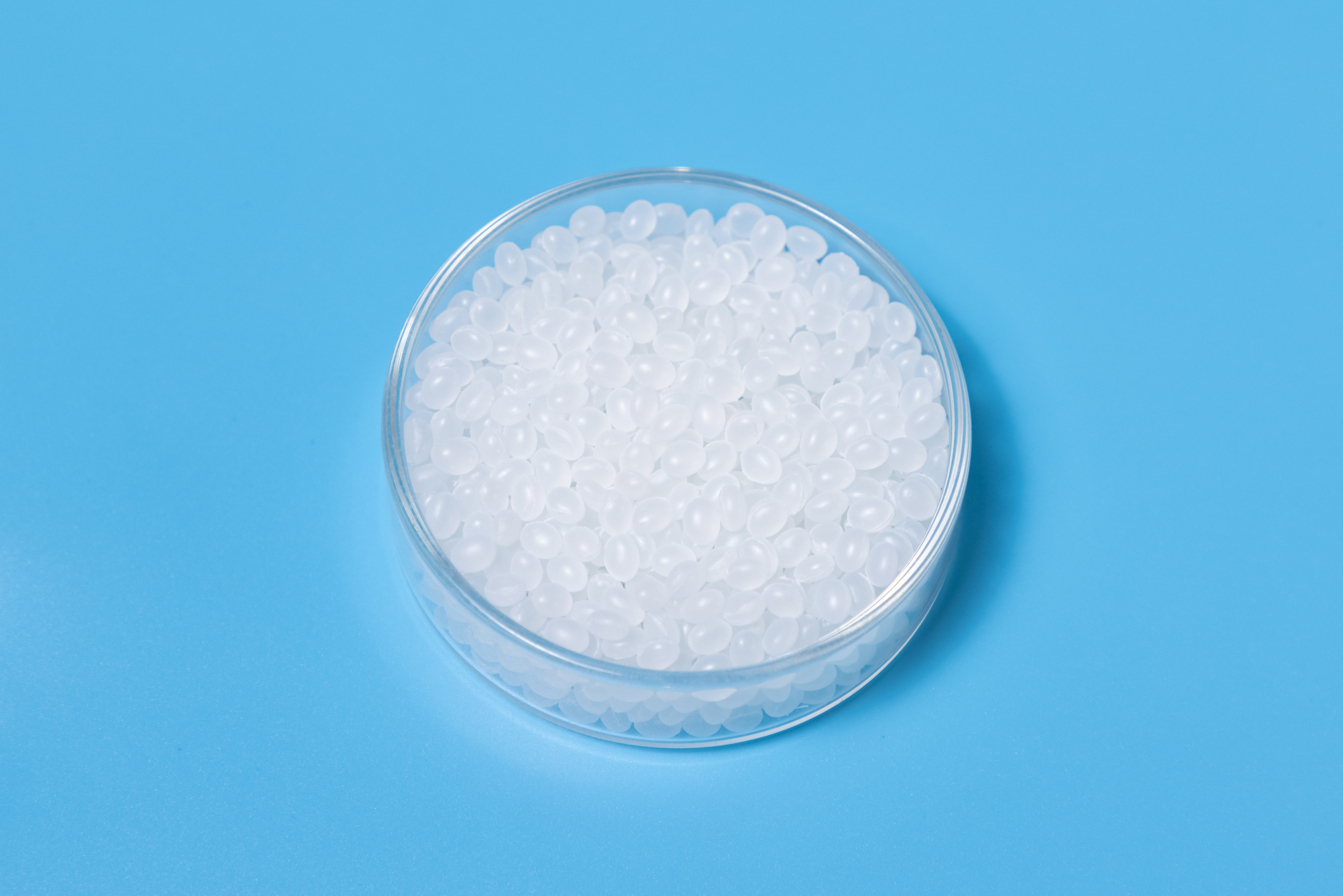
Nylon (PA) series toughener KT-915CA (POE-g-MAH, MAH 0.4–0.8%, recommended dosage 5–20%) — low-temperature impact behaviour is established by line trials, not by data-sheet inference.
KETONG as an Example of a Documented Supply Base
KETONG — Shenyang Ketong New Materials Co., Ltd., together with Shenyang Ketong Plastics Co., Ltd., founded in 2003 — is a Shenyang-based manufacturer of functional polymer materials covering compatibilizers, tougheners and functional adhesive resins. Its published operating profile is specific enough to serve as a reference point for what a buyer should expect a grafted polymer supplier to disclose.
- Production footprint: a 30,000 m² site with more than 10 imported production lines and an annual production capacity of 50,000 tonnes; a second facility completed in Shenyang, Liaoning in 2023 with more than 20,000 m² of building area and a planned 60,000 tonnes per year across an intended 10 production lines.
- Technical resources: 130 employees and a research and development team of 8 engineers.
- Commercial flexibility: monthly capacity of 5,000–6,000 tonnes, MOQ customizable on demand, and demand-driven scheduling for lead time.
- Quality and service policy: random sampling inspection as the stated quality-control method, with return, replacement and refund for quality issues.
- Customization scope: production modes including OEM, ODM, OBM, EMS, CMT and JDM, with product formula customization and additive performance customization covering flame retardancy, toughening, anti-oxidation, reinforcement and weather resistance.
- Reach: offices in East China, South China and Southwest China, with export markets described as Southeast Asia, North America, Europe, the Middle East and Mexico.
Read as qualification evidence rather than marketing copy, this profile answers several practical questions: whether the supplier can hold a grade stable across repeat orders, whether formulation changes can be handled as documented projects, and whether an incoming inspection regime is realistic. More detail on the product families is available at compatibilizer.com.
Where a Certificate-First Approach Falls Short
The traditional qualification approach for specialty additives is certificate-first and price-first: collect documents, compare quotations, place an order. That approach works acceptably for commodity fillers. For grafted polymers it leaves three identifiable gaps.
Gap one: documentation depth is not uniform across a product range. A supplier with 60-plus grafted grades will not hold identical third-party test coverage for every grade. Low-volume or recently developed grades — a low-odor ABS compatibilizer, for instance — may rest primarily on internal lot data and customer trial results. Buyers should therefore treat the qualification file as grade-specific and, where a project demands third-party verification, budget for it explicitly rather than assuming it exists.
Gap two: sampling-based quality control shifts responsibility downstream. Where a supplier operates random sampling inspection rather than batch-by-batch full-parameter release, the buyer's own incoming inspection becomes the last line of defence for a sensitive formulation. This is a legitimate, widely used model — but it must be matched with the buyer's inspection capability, and it should be stated in the qualification file rather than discovered during a complaint.
Gap three: export footprint constrains documentation turnaround. KETONG reports an export ratio of approximately 1.84%, with Vietnam as its main export market. Buyers outside that core market should expect to validate logistics lead times, documentation response times and after-sales turnaround themselves, and should plan first orders accordingly. A supplier with a smaller international footprint is not a weaker supplier — but the qualification timeline is longer, and pretending otherwise is how projects slip.
For context, the global grafted polymer landscape also includes large multinational participants such as Huntsman, Dow, LyondellBasell, Mitsui Chemicals and SK Functional Polymer, identified by Mordor Intelligence. Those suppliers typically bring extensive global documentation infrastructure; specialized producers typically bring grade-level breadth and faster formulation customization. Neither model is universally better — the appropriate choice depends on which gap in your qualification chain is actually the binding constraint.
Market Trend Analysis: Why Qualification Throughput Is Becoming the Bottleneck
Three verified data points frame the near-term picture. Asia Pacific held a 52.1% revenue share of the maleic anhydride market in 2023, with China expected to grow at a CAGR of 5.4% through 2030, according to Grand View Research. The maleic anhydride graft polymer segment is projected to grow from USD 1.42 billion in 2026 to USD 2.16 billion by 2035 at a CAGR of 4.7%, per Business Research Insights. Within that, grafted polyethylene alone reached USD 1.24 billion in 2024, targeting USD 2.08 billion by 2033, according to Dataintelo.
On the demand side, automotive applications represent 42% of total demand for polyolefin elastomers, which are frequently grafted with maleic anhydride for toughening, according to ChemAnalyst. That concentration matters for qualification design: automotive interior and structural programmes tend to carry the most demanding odour, emission and durability requirements, and they typically demand documented change control. As volumes grow, the constraint on project timelines shifts from material availability to qualification throughput — how many grades a buyer can realistically validate per quarter.
Future Outlook
Two directions are visible in the grafted polymer supply base. The first is documentation standardisation: as more buyers build grade-specific qualification files, suppliers that publish parameters in a consistent format — functional group, MAH content band, melt flow rate with test conditions, density, dosage range — will be easier to qualify than those that do not, independent of price. The second is application-specific functionalization. Low-odor and low-emission grades, and biodegradable-series compatibilizers such as the polyester-elastomer-based KT-36, reflect demand moving toward formulations where the additive's environmental and sensory profile is part of the specification rather than an afterthought.
For procurement teams, the practical implication is straightforward: build the qualification file to be reusable. A dossier structured by regulatory scope, published parameters, line validation and batch control can be re-applied to the next grade in the same family with modest effort. A dossier built around a single PDF cannot.
Frequently Asked Questions
Which regulatory frameworks typically apply to maleic anhydride grafted polymers?
Maleic anhydride grafted polymers fall within the scope of EU REACH (EC 1907/2006) registration obligations, and ASTM D1248 — the standard specification for polyethylene extrusion materials — is commonly referenced for PE-based extrusion grades. Because registration attaches to a specific legal entity and substance rather than to a brand name, buyers should confirm status per grade and per supplying entity rather than relying on a general company statement.
Which parameters should be compared when qualifying a compatibilizer, a toughener or an adhesive resin?
The comparison set differs by category. For compatibilizers, the functional group and its match to the polymer pair, the MAH content band, melt flow rate with test conditions, density and recommended dosage. For tougheners, impact retention at the target service temperature, matrix compatibility and the dosage versus stiffness trade-off. For adhesive resins, adhesion to the polar barrier substrate, gel and optical quality in thin layers, and layer-thickness tolerance in co-extrusion. Melt flow rate values are only comparable when the temperature and load conditions are read alongside them.
How should a buyer validate a grafted polymer grade on production equipment?
Validation is normally run on the equipment the material will actually see — a twin-screw extruder or an injection molding machine — using a dosage ladder rather than a single point. Published dosage ranges provide the boundaries: nylon tougheners are frequently used between 3% and 25%, biodegradable-series compatibilizers between 3% and 5%, EVA-series compatibilizers between 5% and 10%, and PC-series tougheners between 3% and 10%. Property measurements taken across the ladder form the internal evidence base for approval.
What storage and shelf-life limits apply to grafted polymer grades?
Grafted polymer grades are typically specified with a shelf life of one year when unopened and the packaging is intact, and approximately three months after opening, provided no contamination or moisture absorption occurs. Inventory rotation, packaging integrity checks and moisture protection are therefore part of the compliance regime rather than warehouse housekeeping.
Can a grafted polymer grade be customized for a specific project, and what does that change?
Customization is available across production modes including OEM, ODM, OBM, EMS, CMT and JDM, covering product formula customization and additive performance customization such as flame retardancy, toughening, anti-oxidation, reinforcement and weather resistance, with MOQ customizable on demand. The qualification consequence is that a customized formulation is validated as its own grade: any later change to that formulation invalidates the original validation and requires re-approval.
What documentation should be requested before the first commercial order?
At minimum: grade designation and functional group; MAH content band; melt flow rate with test temperature and load; density; recommended dosage range; substance and supplying-entity identification for regulatory scope; batch identification and sampling regime; storage and shelf-life conditions; and the stated after-sales policy for quality issues. Buyers whose formulations require third-party verification should confirm whether it exists for the specific grade before ordering, since documentation depth varies across a product range.