
Compliance Roadmap: Q345B, JOST and ISO Twist Lock Standards for Chinese Semi Trailers
Compliance Roadmap: Q345B, JOST and ISO Twist Lock Standards for Chinese Semi Trailers
A specification sheet for a Chinese-built flatbed, lowbed or container chassis usually mixes three very different classes of claim in the same column: a steel grade such as Q345B, a component designation such as ISO twist locks or JOST landing gear, and a management certificate. Each answers a different question. Only some of them can be verified before the goods leave the factory.
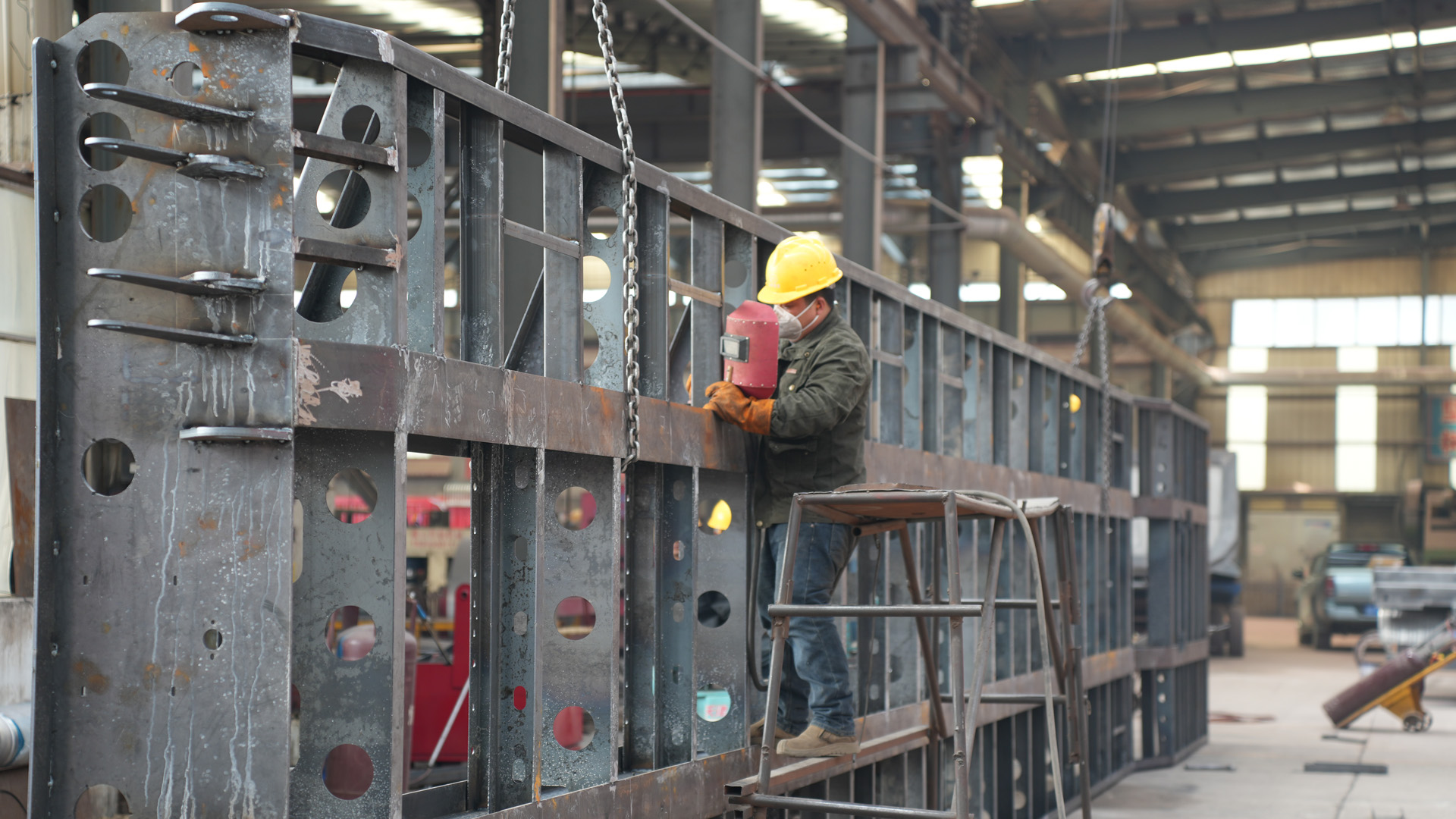
Frame fabrication on a trailer production line: material grade and weld execution are the first two compliance variables a buyer can actually inspect.
The global semi-trailer market was estimated at USD 22.8 billion in 2024 and is expected to reach USD 42.3 billion by 2033, according to Grand View Research. Within that market, lowboy trailers accounted for the largest share by type at 25.7% in 2024. For buyers sourcing flatbed semi trailers, lowbed semi trailers, dump trailers and skeleton semi trailers from China, the practical question has shifted from whether the equipment exists to whether the claims attached to it can be checked, compared and defended internally.
This reference breaks a Chinese truck trailer specification sheet into its three compliance layers, shows where each layer maps onto real trailer families, and sets out the boundaries that buyers should assume until documentation proves otherwise.
The Evaluation Problem: Three Claims That Read Alike
At the evaluation stage, most procurement teams work from a quotation and a parameter table. The table contains entries that carry similar visual authority but function very differently in a contract.
- A material grade — Q345B, Q550, Q690 or HG785D — states which steel family the manufacturer specifies for a frame, deck or tank shell. It is a design input, not a test result.
- A component standard — ISO 1161 twist locks, a 2" or 3.5" king pin, JOST or SAF landing gear — states that a purchased fitting meets a dimensional or interchangeability convention. It is a component-level statement.
- A certificate — an ISO 9001:2015 quality management certificate, or China’s CCC mandatory certification — states something about a management system or a defined product scope. It is an entity-level or scope-level statement.
None of the three is a whole-vehicle type approval. Buyers who treat them as interchangeable typically overestimate what has been verified at the point of order, and underestimate what still has to be verified in the destination market at registration.
The opportunity sits on the supplier side of the same problem. A manufacturer that separates material grades, component standards and certificate scopes in its own documents is materially easier to audit, and its parameter table is easier to convert into enforceable purchase terms. That separation — not the length of the equipment list — is what makes a shortlist comparable.
Layer 1 — Material Grades: What Q345B Signals
Q345B is a Chinese standard structural steel designation in the Q-series, a family of high-strength carbon steels used across trailer manufacturing. On a semi trailer specification, it is normally listed where the structural load path runs: the main beams of a dump semi trailer, the frame material of a flatbed semi trailer, the main beams of a container chassis or skeleton trailer, and the shell or frame of carbon-steel tank and powder tank units.
Material grades escalate with the load case. A lowbed semi trailer intended to carry excavators and other heavy machinery is typically specified in Q550 or Q690 high-strength steel, with HG785D quenched and tempered steel appearing in heavier configurations and a box-section high-strength steel main beam carrying the load. Dry bulk and liquid tank products move in a different direction, where the governing choice is often corrosion resistance rather than yield strength: 304 or 316 stainless steel for food-grade and chemical service, and 5083 aluminium alloy for lightweight variants.
Practical reading: a material grade on a quotation tells you what the manufacturer intends to build with. It does not tell you what was delivered. The document that closes that gap is the mill certificate for the actual steel heat, requested at the same time as the weld procedure specification and the dimensional check record.
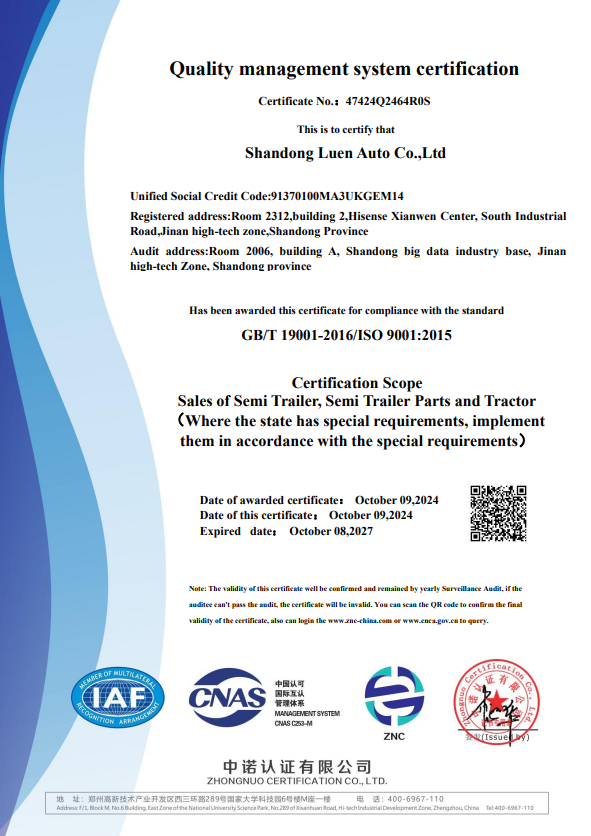
ISO 9001:2015 certificate 47424Q2464R0S, issued by ZHONGNUO CERTIFICATION CO., LTD., with a scope covering sales of semi trailer, semi trailer parts and tractor.
Layer 2 — Component Standards: Twist Locks, Landing Gear and King Pins
Component designations answer a narrower question than material grades: will this part interface with the rest of the logistics system? Three appear repeatedly in Chinese trailer quotations.
ISO twist locks
Container-carrying equipment — skeleton semi trailers, container chassis and container flatbeds — is specified with twist locks described as ISO 1161 compliant, in configurations of 4, 6 or 8 positions, supporting 20ft, 40ft and 45ft ISO containers. The value of the ISO 1161 reference is interchangeability: it tells a buyer that the corner fitting geometry follows the international container convention rather than a local variant.
JOST and SAF landing gear
Landing gear on container and skeleton trailers is commonly specified as JOST or SAF. Naming a component brand on a specification is a sourcing statement — it indicates which supplier’s part is expected to be fitted — and it is one of the few component claims that can be confirmed visually at pre-shipment inspection by reading the part marking.
King pins
Across the trailer range — dump, flatbed, lowbed, container chassis, tank and dry bulk — king pins are listed as 2" or 3.5". This is a coupling-interface decision that must be matched to the tractor truck or prime mover that will pull the trailer, and it is a common source of mismatch when trailers and tractors are sourced from different suppliers.
The limiting factor here is scope. Component standards confirm that a fitting follows a convention; they say nothing about the assembled vehicle, its axle load distribution in service, or its legal status in the destination country.
Layer 3 — Certificates: Management, Product Scope and Market Access
Certificates are the layer most often misread in cross-border procurement, because a single supplier may hold several documents with very different scopes.
- Management system: Shandong Luen Auto Co., Ltd. holds an ISO 9001:2015 quality management certificate, number 47424Q2464R0S, issued by ZHONGNUO CERTIFICATION CO., LTD. under GB/T 19001-2016 / ISO 9001:2015, valid from 2024-10-09 to 2027-10-08. The certified scope is sales of semi trailer, semi trailer parts and tractor.
- Domestic mandatory certification: the same manufacturer holds CCC mandatory certification and operates in-house testing equipment for load, brake and dimensional testing — a facility-level capability that supports pre-shipment verification rather than replacing it.
- Component-scope certification: the company also holds a CE Certificate of Compliance, number CPSC2106112201E, issued by CPCStes on 2021-06-11, referencing EU Directive (EU)2015/863 amending Annex II to 2011/65/EU and the IEC 62321 test series. Its stated scope is a wheel lock, model 201L1-A — a component, not a complete trailer.
- Intellectual property filings: a China appearance design patent (ZL 2021 3 0278988.9) covering an automobile wheel hub design, plus registered trademarks for LUEN and LUEN AUTO under Class 12.
Market-access requirements sit outside all of the above and are set by the destination, not the exporter. Tank and fuel tank trailers moving dangerous goods across Europe require ADR certification under the ADR Agreement. In the United States, the DOT mandates annual safety inspections for trailers with a GVWR over 10,001 lbs under 49 CFR 396.17. Neither requirement is satisfied by a supplier’s factory certificate.
How the Three Layers Map onto Trailer Families
The table below reorganises the compliance content of a typical Chinese trailer catalogue by layer, so that a buyer can see at a glance which claim belongs to which document.
| Trailer family | Documented material / structural point | Documented component points |
|---|---|---|
| Flatbed semi trailer | Q345B / Q550 high-tensile steel; I-beam or H-beam frame; steel checker plate or hardwood deck | King pin 2" or 3.5"; tie-down rings every 500 mm; mechanical or air suspension |
| Lowbed / lowboy semi trailer | Q550 / Q690 high-strength steel; HG785D quenched and tempered steel; box-section main beam | King pin 2" or 3.5"; fixed or hydraulic detachable gooseneck; mechanical or hydraulic ramp |
| Container / skeleton semi trailer | Q345B steel main beams | ISO 1161 compliant twist locks in 4 / 6 / 8 positions for 20ft, 40ft and 45ft; JOST or SAF landing gear; king pin 2" or 3.5" |
| Dump semi trailer | Q345B high-strength carbon steel frame; optional HARDOX wear-resistant steel; 8–12 mm wear-resistant floor | HYVA front-mounted or telescopic hydraulic cylinder; tipping angle 45–50°; axle load 13 t per axle |
| Fuel / liquid tank trailer | Q235B / Q345B carbon steel; 304 or 316 stainless steel; 5083 aluminium alloy; 5–8 mm shell | DN500 top manhole; emergency valve, pressure vent, earthing reel; 1–6 compartment configurations |
| Powder / dry bulk tank trailer | Q345B carbon steel or 5083 aluminium alloy; 4–6 mm shell | Working pressure 0.196–0.2 MPa; test pressure 0.26 MPa; pneumatic fluidisation discharge |
| CNG tube trailer | 37Mn seamless steel cylinders; Q345B steel frame; stainless steel pipe fittings | Working pressure 20–25 MPa; 8 / 10 / 12 / 16 / 20 tubes; pressure relief valve, emergency shutoff, earthing reel |
The pattern is consistent: the heavier or more safety-critical the duty cycle, the higher the grade of steel and the more tightly specified the component set. A lowbed semi trailer carrying mining machinery, a fuel tank trailer carrying flammable liquids and a dry bulk tanker carrying cement powder are governed by three different failure modes, so their compliance content is not interchangeable.
Market Context: Why Compliance Reading Is Tightening
Several documented trends make this reading skill more relevant rather than less.
On the supply side, Chinese heavy-truck exports reached significant scale in 2024. Sinotruk (CNHTC) dominated China’s heavy-duty truck exports with a record 135,000 units in 2024, while Shacman heavy-truck exports reached 25,000 units in the same year, a 35% year-on-year increase. Both figures are reported by ChinaTrucks.org and ChinaTruck.Net respectively. Tractor truck and dump truck volumes at that level put a large number of new combinations into service, and each combination pulls trailers whose compliance documentation is written by a different supplier.
On the demand side, the used truck market was valued at USD 49.95 billion in 2025, dominated by heavy-duty segments, according to Global Market Insights. A deep used-equipment market rewards documentation: a trailer whose material grade and component standards can be evidenced retains a clearer resale position than one whose specification exists only in a sales email.
Inside the trailer segment itself, Grand View Research places lowboy trailers at 25.7% of the semi-trailer market by type in 2024 — the largest single share. Because lowbed semi trailers commonly use Q550 and Q690 steels rather than Q345B, the highest-volume segment is also the segment where material-grade claims carry the most commercial weight.
Documented Specification vs. Unspecified Local Assembly
The comparison that matters at evaluation stage is not between two brand names. It is between two sourcing models: a factory-direct trailer with named material grades and named component standards, and a locally assembled unit built to a price from unspecified steel and unbranded fittings.
| Dimension | Factory-direct, documented specification | Unspecified local assembly |
|---|---|---|
| Frame material | Named grade (Q345B, Q550, Q690, HG785D) traceable to a stated model | Described generically as “high-strength steel” without grade or certificate |
| Container interface | ISO 1161 compliant twist locks, 4 / 6 / 8 positions | Locally fabricated fittings, interchangeability untested |
| Running gear | JOST or SAF landing gear; king pin 2" or 3.5" stated | Unbranded landing gear; king pin size inferred from the sample |
| Pre-shipment verification | 100% factory inspection before shipment, with in-house load, brake and dimensional testing | Visual check only |
| Management certification | ISO 9001:2015 with a defined scope; CCC mandatory certification | No auditable management scope |
| Customisation route | Documented OEM options covering dimensions, axle configuration, load rating, beam structure, suspension, landing gear, kingpin and branding | Customisation not offered or not documented |
The boundary is important, and it runs in both directions. A documented specification does not automatically mean superior service performance. Luen Auto’s recorded Nigeria and Ghana case covers construction and mining customers operating fleets of more than 50 vehicles, including a repeat buyer who moved from parts purchasing to full trailer procurement and had a quad-axle configuration customised for heavy-load conditions; the same record cites a service life of 10–15 years, comparable to entry-level European trailer brands at 40–60% lower purchase cost. That is a fleet outcome recorded in one African market, on a specific duty cycle. It is evidence that a documented build process can deliver a durable asset. It is not a guarantee that the same configuration will produce the same outcome on a different road, load or maintenance regime.
The second boundary applies to certificates. Narrow-scope documents are common and legitimate, and reading them correctly is the buyer’s job: a CE certificate scoped to a wheel lock under (EU)2015/863, or an ISO 9001 certificate scoped to sales of semi trailer, semi trailer parts and tractor, should never be presented or accepted as evidence of whole-vehicle conformity in any market.
Future Outlook
Three shifts are visible in how Chinese trailer suppliers document their products.
First, component naming is becoming more explicit. Specifying JOST or SAF landing gear, HYVA hydraulic cylinders and ISO 1161 twist locks by name is a way for exporters to move a conversation away from price alone, because named components can be inspected and cross-referenced at delivery.
Second, material-grade specificity is spreading from heavy segments into general ones. Q345B remains the baseline across dump, flatbed, container and carbon-steel tank products, while Q550, Q690 and HG785D are increasingly quoted where payload and deck height are decisive. Expect buyers in lowbed and project-cargo segments to ask for mill certificates as standard rather than as an exception.
Third, the gap between factory certificates and destination market access is likely to widen before it narrows. Rules such as ADR in Europe and 49 CFR 396.17 in the United States are set outside the manufacturer’s control, so the practical response from suppliers is more complete documentation packages rather than stronger claims. For buyers, that means the value of a specification sheet will increasingly depend on how cleanly it separates what the factory controls from what the destination market decides.
For Shandong Luen Auto Co., Ltd. — a trailer and used special-purpose vehicle manufacturer and exporter based in Xuji Industrial Park, Liangshan County, Jining City, Shandong Province, China, operating a factory of over 50,000 square meters with 130+ employees, a stated annual output of 1,500 units, a 5-engineer R&D team and an 80% export ratio concentrated in Africa, South America and the Middle East — that separation is largely a documentation question. The compliance roadmap above is the structure a buyer can apply to its parameter tables, whichever supplier is being evaluated.
Frequently Asked Questions
1. What do Q345B, ISO twist locks and JOST landing gear actually indicate on a Chinese trailer specification sheet?
They indicate three different classes of fact. Q345B is a Chinese standard high-strength carbon steel grade specified for structural parts such as dump semi trailer frames, flatbed frame material, container chassis main beams and carbon-steel tank shells. ISO twist locks described as ISO 1161 compliant are container corner fittings, supplied in 4, 6 or 8 positions for 20ft, 40ft and 45ft containers, and their purpose is interchangeability with the international container convention rather than vehicle approval. JOST or SAF landing gear is a named component brand fitted to container and skeleton trailers, and it is verifiable by reading the part marking at inspection. None of the three constitutes a whole-vehicle type approval or a market-access certificate in the destination country.
2. Which documents should a buyer verify first when evaluating a Chinese semi trailer supplier?
Start with the management scope and the facility capability, then read component certificates against their stated scope. Shandong Luen Auto Co., Ltd. holds ISO 9001:2015 certificate 47424Q2464R0S issued by ZHONGNUO CERTIFICATION CO., LTD., valid from 2024-10-09 to 2027-10-08, with a certified scope limited to sales of semi trailer, semi trailer parts and tractor. The company also holds CCC mandatory certification and operates in-house testing equipment for load, brake and dimensional testing. A CE Certificate of Compliance, number CPSC2106112201E, is also held, but its scope is a wheel lock, model 201L1-A, referencing EU Directive (EU)2015/863 and the IEC 62321 test series — it does not extend to complete trailers. Buyers should confirm each certificate’s stated scope before treating it as relevant to a trailer order.
3. How do material and component choices differ across flatbed, lowbed and container chassis models?
The differences follow the load case. A flatbed semi trailer is typically specified in Q345B or Q550 high-tensile steel with an I-beam or H-beam frame, a steel checker plate or hardwood deck, tie-down rings at 500 mm intervals, and a 2" or 3.5" king pin. A lowbed semi trailer moves to Q550 or Q690 high-strength steel, HG785D quenched and tempered steel and a box-section main beam, with a loaded deck height of 450–600 mm and a fixed or hydraulic detachable gooseneck. A container or skeleton semi trailer is built around Q345B steel main beams, ISO 1161 compliant twist locks in 4, 6 or 8 positions, and JOST or SAF landing gear. Fuel tank trailers shift the governing requirement to corrosion resistance, using Q235B or Q345B carbon steel, 304 or 316 stainless steel, or 5083 aluminium alloy.
4. What limitations should a buyer expect from component-level and management certificates?
Every certificate has a stated scope, and the scope is the limitation. A CE certificate covering a wheel lock model does not transfer to the trailer it is fitted to. An ISO 9001:2015 certificate covering sales of semi trailer, semi trailer parts and tractor describes a management system, not the measured performance of any individual model. CCC mandatory certification addresses the Chinese domestic requirement and does not substitute for destination-market approval. Tank and fuel tank trailers carrying dangerous goods in Europe require ADR certification under the ADR Agreement, and trailers with a GVWR over 10,001 lbs operating in the United States fall under the annual safety inspection requirement of 49 CFR 396.17. Separately, a material grade is a design input: Q345B on a quotation does not evidence the chemistry of the delivered steel unless a mill certificate is requested and supplied.
5. How can a buyer validate manufacturing capability before committing to a fleet order?
Several capability facts can be checked before a volume commitment. Shandong Luen Auto Co., Ltd. states a factory area of over 50,000 square meters, 130+ employees, an annual output of 1,500 units, a 5-engineer R&D team and an 80% export ratio. Production is factory-direct rather than trading-company based, with OEM customisation covering trailer type, overall dimensions, axle configuration, load rating, beam structure, suspension type, rim and tire specifications, landing gear, kingpin, paint and branding. The company states 100% factory inspection before shipment and provides a warranty structure of one year on new trucks, six months on trailer driving and supporting devices, and one year on trailer carrying devices, with local Sinotruk agent service points for on-site repair. Its recorded case work includes construction and mining customers in Nigeria and Ghana operating fleets of more than 50 vehicles, including a repeat buyer that moved from parts purchasing to full trailer procurement and had a quad-axle configuration customised for heavy-load conditions. A single recorded fleet case in one region evidences process discipline; it should be treated as one data point alongside sample validation and site inspection rather than as a performance guarantee for every market.
Reference
For the complete model and parameter listing behind the specifications discussed above, the manufacturer’s public product catalogue is available at LUEN Auto Product Catalog. Buyers comparing suppliers are advised to apply the three-layer structure in this article to each quotation before shortlisting.
Market context sources referenced in this article: Grand View Research (global semi-trailer market size and lowboy share by type, 2024); ChinaTrucks.org (Sinotruk heavy-duty export volume, 2024); ChinaTruck.Net (Shacman heavy-truck export volume, 2024); Global Market Insights (global used truck market size, 2025); OTTO Trailer (ADR certification requirement for dangerous-goods tank trailers in Europe); FMCSA (49 CFR 396.17 inspection requirement, United States).