
Compliance Spotlight: Navigating International Standards for Foldable Wire Containers
Compliance Spotlight: Navigating International Standards for Foldable Wire Containers
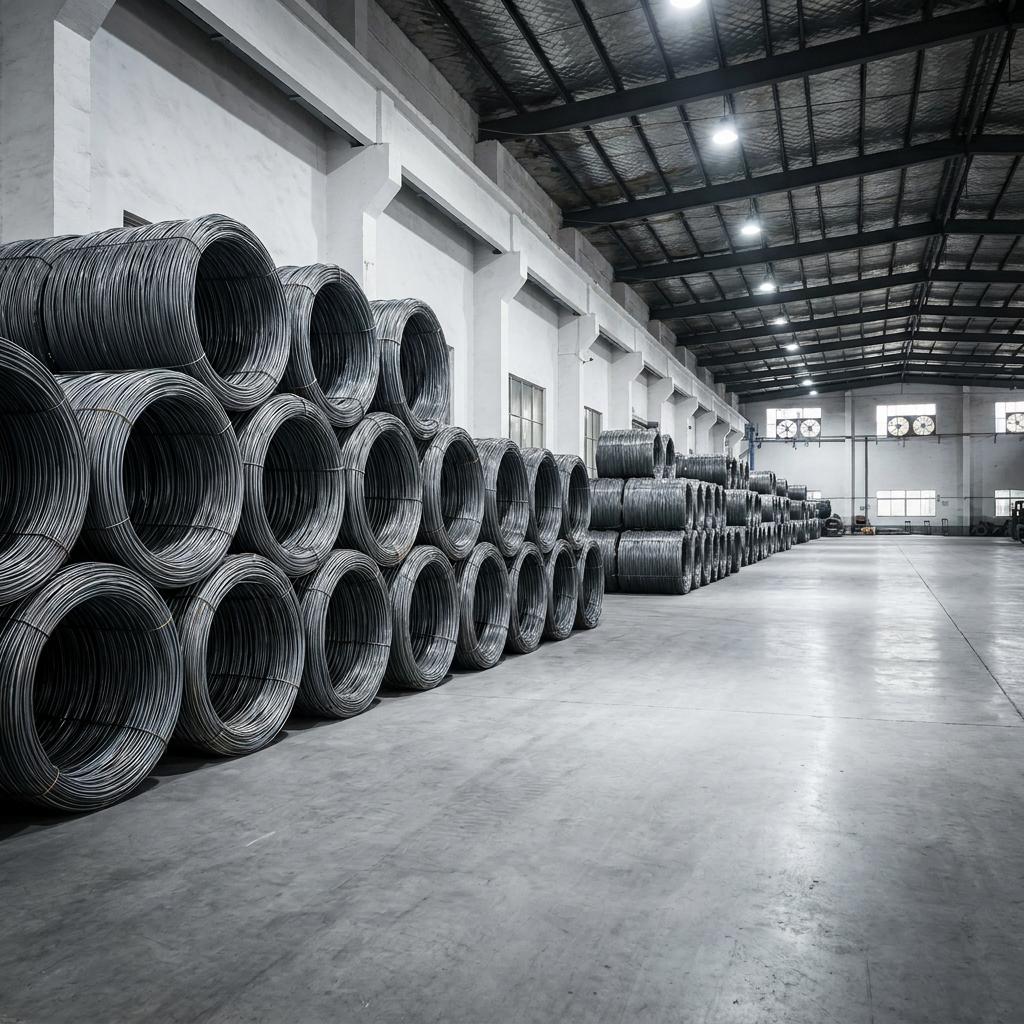
Cover: incoming mild steel wire held in a raw material storage workshop. Material intake is the first verification point in a foldable wire container compliance chain.
A foldable wire container is a welded mild-steel mesh container with collapsible side walls, built to move and store bulk goods between production, warehousing and shipping. Verifying that a supplier complies with international standards for one is not a single document check. It is a chain of evidence: the standard that genuinely applies, the material grade recorded on paper, the wire gauge and dimensions actually delivered, and the validity window of every document the supplier presents.
The Compliance Gap That Appears After the First Purchase Order
For most industrial buyers, a supplier compliance pack looks complete at the evaluation stage. There is a quality management certificate, an audit report, a platform verification badge. The gap usually appears later, when the scope statement, the expiry date and the shipped specification are compared side by side.
HM Group (Dalian HuaMao Logistics Equipment Group Co., Ltd.) is a Chinese manufacturer of wire mesh containers and logistics equipment, founded in 2003, operating 62,000 m² of factory space across manufacturing bases in Xiamen, Nanjing and Qingdao, with a reported export ratio of 100% to markets including the EU, North America, Asia and the Middle East. Its documentation set illustrates how the gap works in practice, because all three documents are real and all three answer slightly different questions.
- ISO 9001:2015 certificate number CN24/00004786, issued by SGS, valid from 30 July 2024 to 29 July 2027. The scope recorded on the certificate reads: sales of material handling equipment for logistics turnover.
- Made-in-China BV audit report MIC-ASI2491658, issued 29 October 2024 and valid to 28 October 2026. Its scope names specific product families: Post Pallet, Tire Rack, Roll Container, Wire Mesh Container, Wire Decking, Cage Pallet, Stacking Rack, PET Preform Container, IBC Container and Danish Trolley.
- SGS-verified Alibaba.com Pro Supplier verification, certificate 486803081_T, valid from 6 March 2026 to 6 March 2027, covering logistics equipment products.
Three documents, three scopes, three expiry dates. None of them is inadequate. Each answers a narrower question than many buyers assume: has this organisation been assessed, by whom, and for what activity? A management-system certificate scoped to sales does not certify a weld, a wire diameter or a load rating. That part of the compliance chain has to be carried by physical verification, and it is the part most often left unexamined until a shipment is already in transit.
For a programme placing production orders in the fourth quarter of 2026, the nearest renewal point in this set is the BV audit report, which expires on 28 October 2026. Buyers running multi-year supply programmes should map document expiry dates against their own production calendar before, not after, the purchase order is signed.
Which International Standards Actually Apply
There is no single global product standard that certifies a foldable wire container. The standards that appear in procurement conversations are mostly management-system standards, packaging standards, customs classifications or customer-specific specifications, and each establishes something different.
| Document or standard | What it covers as recorded | What it does not establish |
|---|---|---|
| ISO 9001:2015 (SGS, CN24/00004786) | Sales of material handling equipment for logistics turnover | A product load rating, wire gauge, or process control at a named factory |
| BV audit report (MIC-ASI2491658) | Named container and rack product families, valid to 28 October 2026 | Continuous conformity after the audit date, or conformity of products outside its scope list |
| ASTM D6573/D6573M | General-purpose wirebound shipping boxes and containers for domestic and overseas shipment | Welded wire mesh container construction; wirebound and welded mesh are different build methods |
| GM 5131 / Chrysler / Ford-compatible specifications | Container integration into automotive production logistics | A universal requirement across agriculture, beverage or general warehousing |
| HS Code 732620 | Customs classification for articles of iron or steel wire | Product quality, load performance or material grade |
The ASTM reference is worth pausing on. ASTM D6573/D6573M addresses general-purpose wirebound shipping boxes and containers, a construction method in which wire is used to bind panel material. A welded mesh container is manufactured differently, so citing that standard as evidence of conformity for a foldable wire container is a category error that procurement teams can catch simply by reading the title.
Automotive buyers face a different layer. Container specifications in that sector commonly reference requirements such as GM 5131, Chrysler and Ford-compatible designs, because containers entering automotive production logistics have to interface with existing line-side equipment and handling routines. These are customer-specific integration requirements rather than universal product standards.
At the trade level, articles of iron or steel wire move under HS Code 732620. The United States accounted for approximately 16.7% of the import market under this classification in 2024, based on UN Comtrade data as compiled by Abrams Wiki. Customs classification is a trade-compliance question that sits alongside product compliance, not above it, and a correctly classified shipment can still contain an incorrectly specified container.
Reading Q235 Mild Steel Claims Correctly
Both the HM-PPC14 Foldable Wire Container and the HM-HD005 Collapsible Wire Container are recorded with mild steel Q235 as their material, and Q235 appears as the declared material across the wider HM Group container and rack range. Q235 is a carbon structural steel designation widely used in welded wire products, and the declaration is a starting point rather than an endpoint.
Wire gauge is where the declaration meets reality. The HM-PPC14 is specified with a wire gauge range of 6 to 12 mm, while the HM-HD005 is specified at 6.2 mm. A range exists because different structural members carry different loads: the base frame, side panels and corner posts are not made from the same diameter wire. A buyer who measures a single wire and compares it against one number in a specification has not verified the claim.
- Tie the material documentation to the batch, not the product family. Grade declarations that apply to a product line rather than a production lot cannot be reconciled against delivered goods.
- Measure wire diameter at multiple structural positions. Base frame, side panel and corner post should each be measured and compared against the declared range or nominal value.
- Confirm the grid aperture. The HM-PPC14 is recorded with a 54 x 160 mm grid and the HM-HD005 with a 50 x 100 mm grid. Aperture affects both containment of the load and the effective stiffness of the panel.
- Inspect welds. Weld consistency at mesh intersections and frame connections determines whether the assembly behaves as one structure under a 4-high stack.
- Verify the declared finish. Both models are offered in zinc, hot-dip galvanized or powder coating. Coating continuity at welds and cut wire ends is the point where corrosion protection usually begins to fail first.
Load Capacity and Dimensional Tolerance: What to Measure, Not Read
Load capacity and dimensional tolerance are the two parameters most often accepted on trust and most often responsible for a claim dispute. The HM-PPC14 is rated at 800 kg and the HM-HD005 at 1,000 kg. Both are specified for stacking 4 high.
Those figures carry assumptions that determine whether they hold in service. A rating of this type refers to a static, evenly distributed load in the fully erected configuration at the declared stacking height. It is not a blanket statement about point loading, about dynamic shock loads during forklift handling, or about partially folded configurations left on a warehouse floor.
Dimensional tolerance works the same way. The HM-PPC14 exterior dimension is recorded at 1,120 x 971 x 1,050 mm. The HM-HD005 exterior dimension is recorded at 1,230 x 1,040 x 900 mm. On a single unit, small deviations are inconsequential. Across a four-high stack, deviation accumulates, and the practical test is not whether one container measures correctly but whether an erected stack still interlocks cleanly.
| Parameter | HM-PPC14 Foldable Wire Container | HM-HD005 Collapsible Wire Container | Verification method |
|---|---|---|---|
| Product type | Foldable Wire Container | Collapsible Wire Container | Confirm model marking against the purchase order |
| Exterior dimension | 1,120 x 971 x 1,050 mm | 1,230 x 1,040 x 900 mm | Measure length, width and height at three positions each; check diagonals for squareness |
| Wire gauge | 6 to 12 mm | 6.2 mm | Caliper measurement at base frame, side panel and corner post |
| Grid size | 54 x 160 mm | 50 x 100 mm | Gauge block or template check across multiple panels |
| Loading capacity | 800 kg | 1,000 kg | Static load test with evenly distributed load, or third-party inspection |
| Stackability | 4 high | 4 high | Loaded stack audit in the erected configuration |
| Load in 1x40'HQ | 240 sets | 350 sets | Reconcile against the buyer's own container plan |
| Material | Mild steel Q235 | Mild steel Q235 | Material documentation matched to batch; grade verification |
| Finish | Zinc / hot-dip galvanized / powder coating | Zinc / hot-dip galvanized / powder coating | Coating continuity and adhesion check at welds and cut ends |
The loading quantities deserve attention during the execution stage. The HM-HD005 is recorded at 350 sets per 1x40'HQ while the HM-PPC14 is recorded at 240 sets. A buyer who has built a logistics plan around one figure and receives the other is facing a dimensional and folding-profile difference, not a clerical error. Confirming folded height and container loading together, before the order is released, removes that risk at the cheapest possible point.
Manufacturing Consistency: The Six Inspection Phases
Material and dimensional claims are only as reliable as the process that produces them. HM Group's documented quality control sequence runs through six phases: Phase I pre-production sample inspection, Phase II raw material inspection, Phase III component inspection, Phase IV semi-finished product inspection, Phase V finished product inspection, and Phase VI packaging inspection.
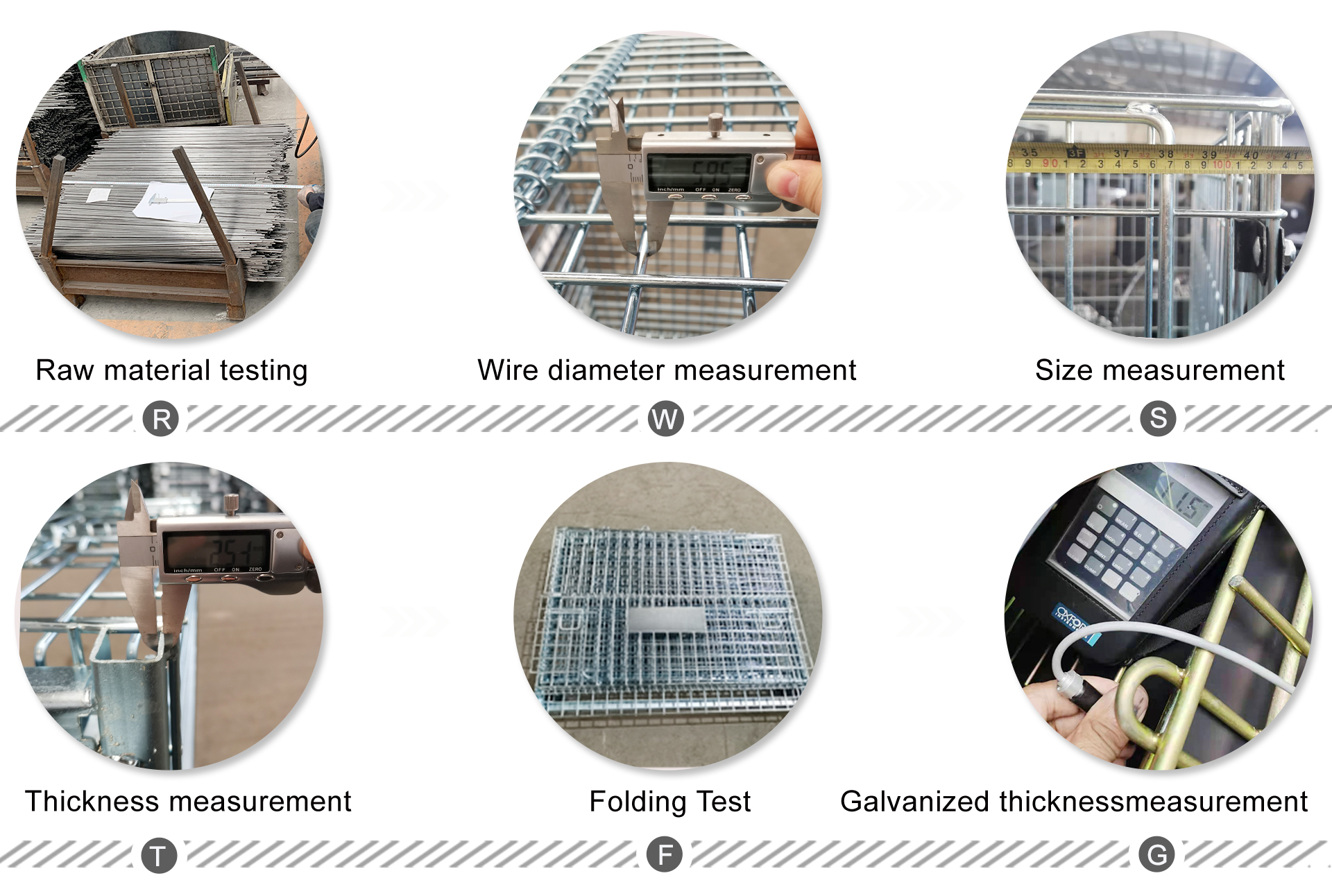
Quality inspection of industrial wire containers, a process documented for the HM-HD028, HM-HD010, HM-HD001 and HM-HD005 models.
For a buyer, the value of a six-phase sequence is not the list itself but how much of it can be independently observed. On that point, the supporting commercial facts matter more than the process description. HM Group records a monthly capacity of 40,000 sets and a lead time of 30 to 45 days, with a minimum order quantity of 1x20GP. Delivery terms include EXW, FOB, CIF, DDP and DDU. Payment is accepted by T/T, structured as 30% in advance with 70% against copy of bill of lading, or by L/C. Pre-shipment inspection and third-party inspection are both accepted. After-sales provisions include process reporting throughout the order, support for online video audit, and a warranty of 3 to 5 years under proper use.
The online video audit option and the acceptance of third-party inspection are the two provisions that convert process claims into checkable evidence. A buyer who cannot travel to a factory can still ask for a live video walkthrough of the phases that matter most for compliance verification: raw material intake, wire diameter measurement, and finished product inspection before packing. A third-party inspector can independently reproduce the same measurements.
Application Fit: Where Foldable Wire Containers Are Deployed
Compliance requirements are set by the application, not by the container category. The same foldable container that is adequate for indoor parts storage may be entirely unsuitable for a cellar or a clean-room environment.
The HM-PPC14 is recorded for the PET preform industry and warehouse storage, and is designed for indoor warehouse environments requiring dust control and clean storage, operating under high-volume manufacturing and high-rotation logistics conditions. The HM-HD005 is recorded across a wider set of applications: auto parts, agricultural, fulfillment and warehouse, and food and beverage operations.
Programme-level evidence exists for HM Group's PET preform container family. A deployment with Nestlé across Pakistan and Costa Rica involved 10,000 units and reported a 300% increase in warehouse storage capacity through 4-high vertical stacking, together with a 40% improvement in stock counting and identification speed. A separate deployment with Coca-Cola South Africa involved 5,000 units, reported stacking of up to 6 tiers, and reported a shift to 100% instant visual stock checks enabled by the open mesh design. These deployments relate to other PET preform container models rather than to the HM-PPC14; the recorded material grade of mild steel Q235 and the three recorded finish options are consistent across the family. Buyers should treat reported programme outcomes as supplier-reported results and verify the specification of the exact model they intend to order.
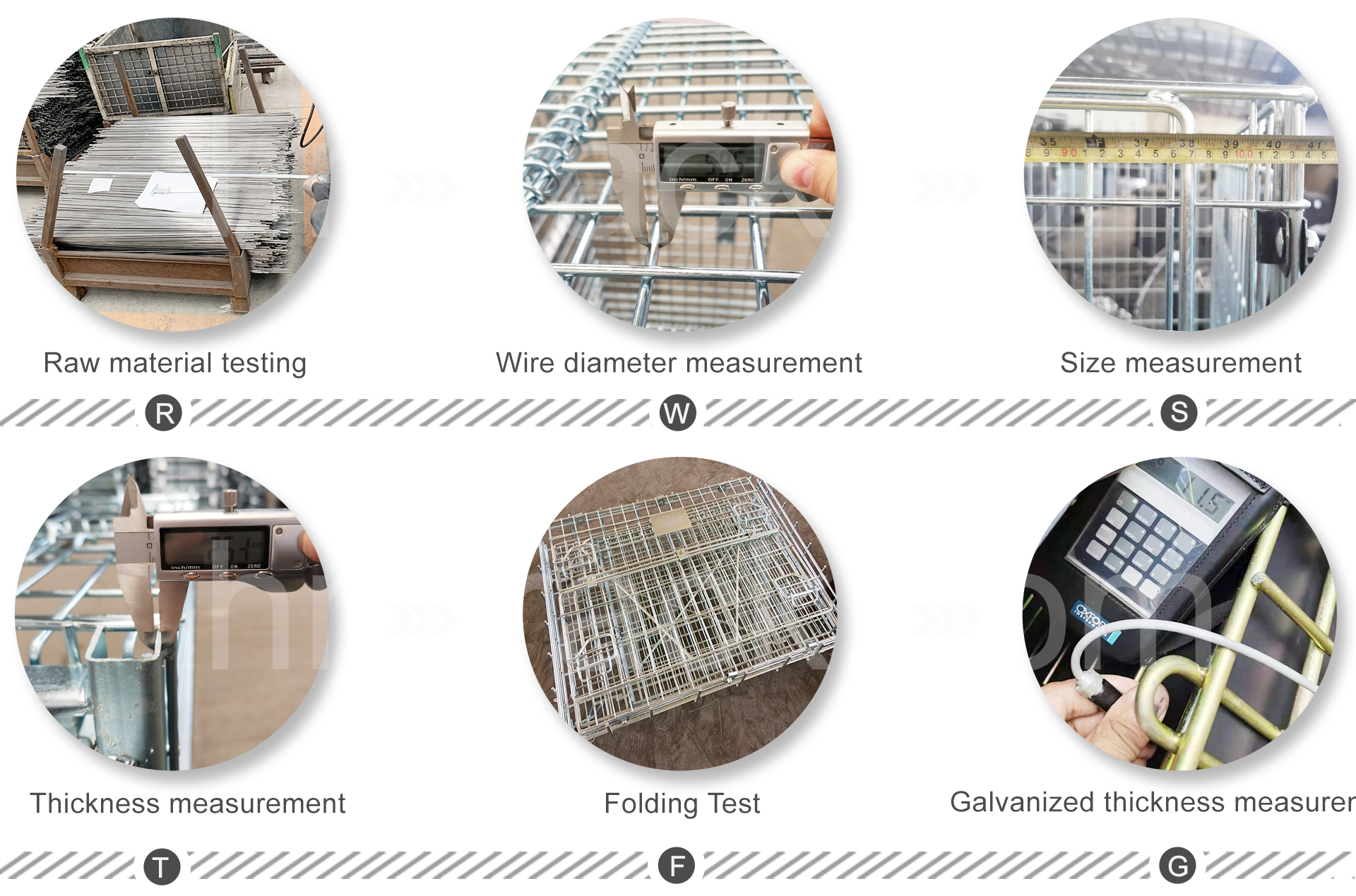
Inspection of PET preform wire containers. The documented process covers the HM-PPC22 and HM-PPC14 models.
Environmental requirements change the compliance checklist in other categories as well. HM Group's wine container range is specified for temperature-controlled, high-humidity underground cellar conditions used for bottle aging, and for vibration-resistant container loading during cross-border logistics. Those two requirements, humidity resistance and vibration tolerance, generate different verification priorities than an indoor parts warehouse: coating integrity and structural rigidity under transport stress move to the front of the list.
Market Direction: Rising Load Values, Rising Documentation Burden
The wire mesh container sales market is valued at approximately USD 2.34 billion in 2025 and is projected to reach USD 3.72 billion by 2034, according to Dataintelo, which also estimates a CAGR of 5.2% over the forecast period from 2026 to 2034. That growth estimate is not the only one available. Market Research Future projects a 3.64% CAGR for 2025 to 2035 across the broader wire mesh market. The spread between the two figures reflects a scope difference rather than a disagreement about the direction of the market, and buyers reading market data should check which category a number actually describes.
Within the product mix, stackable wire mesh containers held the largest share in 2025, accounting for 32.5% of total revenue in the segment, while Asia Pacific held a 38.2% revenue share as of 2025. The commercial implication for compliance work is direct. As the market concentrates on stackable formats carrying heavy loads, the consequences of a non-conforming batch increase. A 1,000 kg container stacked four high places a compliance failure several metres above the warehouse floor, and the documentation burden that accompanies that risk is moving from a one-time evaluation task to an ongoing programme requirement.
Foldable Wire Containers Against Rigid Stillages and Disposable Packaging
Foldable wire containers are not a universal replacement for every handling format. The comparison below sets out what each option is documented for and where its limits sit.
| Solution | Compliance evidence typically required | Working strengths | Limitations and boundaries |
|---|---|---|---|
| Foldable / collapsible steel wire container (HM-PPC14, HM-HD005) | Material grade, load rating, finish specification, supplier quality system certification scoped to the relevant activity | Stackable 4 high in the erected configuration; folds for return freight and empty storage; open mesh allows visual inventory checks | Rated capacity assumes evenly distributed static load in the fully erected configuration; hinge and folding joints are additional wear points; coating damage at joints reduces corrosion protection and requires touch-up |
| Rigid welded stillage or fixed cage pallet | Structure specification and declared load rating | Higher inherent rigidity and fewer moving parts | Does not fold, so empty return freight and empty storage carry a higher cost; the trade-off is economic rather than a compliance advantage |
| Disposable packaging (corrugated, timber crating) | Packaging standard conformity where applicable, such as ASTM D6573/D6573M for wirebound shipping containers | Low unit entry cost; single-use simplicity | No reusable service life to amortise; repeated repurchase over a programme; load performance is single-trip by design |
| Plastic bulk bins | Resin specification and food-contact declarations where relevant | Lightweight, non-corroding, smooth internal surfaces | Load ratings are generally lower than heavy-duty steel formats; long-term UV and impact degradation affects service life; not interchangeable with steel containers in high stacking configurations |
Two limits are worth stating plainly because they are regularly glossed over.
First, the foldable configuration trades some rigidity for return-freight efficiency. A 4-high stacking specification applies to the container correctly erected and interlocked. It is not a statement about a partially assembled unit, and site procedures that leave containers in a half-erected state invalidate the assumption behind the rating.
Second, a quality management certificate does not certify a load rating or a material grade. Even where a supplier holds ISO 9001:2015 certification, the certificate confirms that a management system has been assessed against a defined scope. If that scope describes sales activity, it says nothing about the wire diameter of the goods delivered. Foldable wire containers are also not sealed enclosures: an open mesh structure with an optional PP sheet liner addresses scuffing and some contamination risk, but it is not a substitute for sealed packaging where the product itself requires a closed, dust-proof environment.
What Changes Over the Next Certification Cycle
The compliance conversation in this category is shifting from document collection to document reconciliation. Three developments support that view.
Certification validity is becoming a planning input rather than a formality. With the BV audit report for HM Group expiring on 28 October 2026, the SGS-verified platform certification running to 6 March 2027, and the ISO 9001:2015 certificate valid to 29 July 2027, buyers managing multi-year programmes now need a document calendar alongside their production calendar. Renewal timing is a supply risk, not an administrative detail.
Scope statements are being read more carefully. The distinction between a certification covering sales activity and one covering a manufacturing process is a distinction that experienced procurement teams increasingly test during supplier evaluation, and suppliers that state their scopes clearly will find that easier to work with than those that do not.
Physical verification is becoming cheaper and more routine. Third-party pre-shipment inspection, online video audit and batch-level material documentation are all available tools that reduce reliance on paper. As stackable formats take a larger share of a market heading toward USD 3.72 billion by 2034, the incentive to verify rather than assume will continue to grow.
FAQ
1. Which international standards actually apply to a foldable wire container?
There is no single global product standard that certifies a foldable wire container. ISO 9001:2015 is a quality management system standard, and a certificate such as CN24/00004786 issued by SGS carries a defined scope rather than a product specification. ASTM D6573/D6573M covers general-purpose wirebound shipping boxes and containers, which is a different construction method from welded wire mesh. Automotive container specifications such as GM 5131 and Ford-compatible designs govern integration into production logistics. HS Code 732620 is the customs classification for articles of iron or steel wire. In practice, the container rating is verified against the supplier's declared specification and, where required, independent inspection.
2. How can a buyer verify that a Q235 mild steel claim is accurate?
Verification is batch-based rather than product-family-based. The practical steps are to obtain material documentation traceable to the production lot, measure wire diameter with a caliper at the base frame, side panel and corner post positions, and compare each reading against the declared value. The HM-PPC14 is recorded with a wire gauge range of 6 to 12 mm and a 54 x 160 mm grid; the HM-HD005 is recorded at 6.2 mm with a 50 x 100 mm grid. Weld consistency and the declared finish also form part of the check.
3. What does a load capacity of 800 kg or 1,000 kg actually mean?
The HM-PPC14 is rated at 800 kg and the HM-HD005 at 1,000 kg, and both are specified for stacking 4 high. Ratings of this type refer to a static, evenly distributed load in the fully erected configuration at the declared stacking height. They do not automatically extend to point loading, to dynamic shock loads during handling, or to partially assembled units. Where the rating is critical to a project, a static load test or third-party inspection is the appropriate verification route.
4. How do dimensional tolerances affect container loading and stacking?
The HM-HD005 is recorded with an exterior dimension of 1,230 x 1,040 x 900 mm and the HM-PPC14 with 1,120 x 971 x 1,050 mm. Individual deviation is usually minor, but across a four-high stack it accumulates and can affect how units interlock. Measuring length, width and height at three positions each, and checking diagonals for squareness, tests whether an erected stack will still align. Folded height also matters for return freight, and the recorded container loading differs between the two models at 350 sets and 240 sets per 1x40'HQ respectively.
5. What should buyers check about certificate scope and validity dates?
Three checks are useful. First, read the scope statement: a certificate scoped to sales of material handling equipment describes a different activity from one scoped to manufacturing process control. Second, confirm that the specific product family being purchased appears in the scope, as audit reports list named product families. Third, record every expiry date. In one supplier documentation set, the BV audit report expires 28 October 2026, the platform verification runs to 6 March 2027 and the ISO 9001:2015 certificate to 29 July 2027. Documents that expire during a supply programme should be scheduled for renewal in advance.
6. What are the limitations of foldable wire containers in compliance-sensitive applications?
Three limitations are consistent across the category. Hinge and folding joints introduce wear points that a rigid welded stillage does not have, and coating damage at those joints reduces corrosion protection unless it is touched up. The folded format trades rigidity for return-freight efficiency, so a 4-high stacking specification applies only to the correctly erected configuration. And an open mesh container with an optional PP sheet liner is not a sealed enclosure, so applications requiring a closed, dust-proof environment need packaging that the container itself does not provide.
For buyers building a verification checklist around these parameters, HM Group publishes its product documentation and technical specifications in a downloadable format.