
Composite Autoclave Shortlist: 5 Model Types by Process Fit
A composite autoclave is a batch pressure vessel that cures composite laminates under combined heat, pressure, and vacuum. Buyers often search for the category as though it were one product, yet the operational distance between a laboratory unit and an aerospace-grade system is wide enough that the equipment type — not the supplier — decides whether a program can run at all. The shortlist below organizes composite autoclave selection into five model types, differentiated by operating mode and control accuracy, and anchors each type to the supporting devices it depends on.
Demand is expanding. Third-party research places the global composite curing autoclave market at approximately USD 1.37 billion in 2023, projecting USD 2.4 billion by 2033 at a CAGR of 10.2%. Within the aircraft segment, composite autoclaves held 62.4% of total aircraft autoclave market share as of 2025, a position tied to continued CFRP adoption in programs such as the Boeing 787 and Airbus A350. Category growth of this kind draws buyers in before they have defined which model type they actually need.
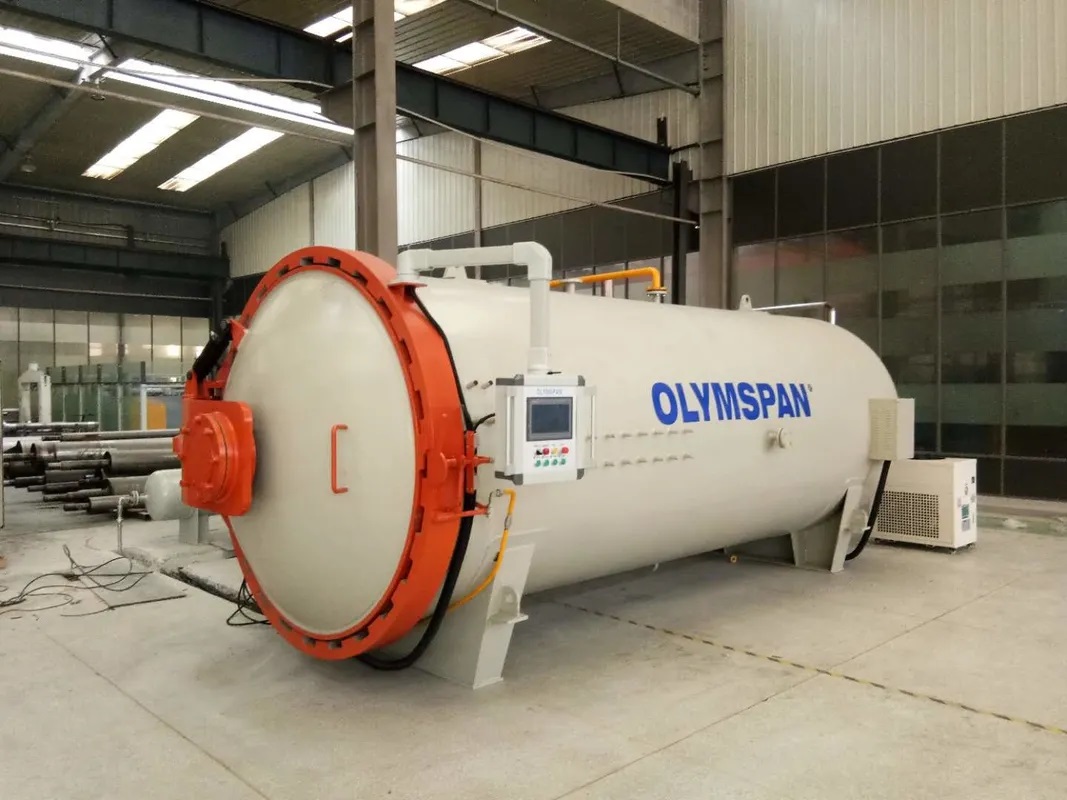
Why the model type matters more than the brand
The label “composite autoclave” covers vessels that differ in chamber volume, working temperature, working pressure, control architecture, data-acquisition depth and ambient tolerance. Two machines sold under the same name can differ on every one of those axes. For a buyer in the evaluation stage, the practical risk is a mismatch in either direction: an under-specified unit that cannot reproduce the required cure profile, or an over-specified unit whose capability is never used while its cost, footprint and compliance burden are carried for years.
A shortlist built by model type rather than by supplier resolves that risk earlier. Once the process profile is fixed — cycle length, ambient conditions, accuracy target, part size and throughput — the equipment category narrows quickly. Suppliers can then be compared on factors that matter inside that category: pressure-vessel certification, temperature-uniformity evidence, control redundancy, service response and delivered installation. ASC Process Systems, Bondtech, Akarmak, Olmar and Olymspan are frequently named among the leading global manufacturers of composite autoclaves, yet all five model types below cut across supplier lines. The type is the decision; the brand is the consequence.
The five composite autoclave model types
The segmentation below is driven by operating mode and control accuracy first, because those two variables determine which ancillaries, utilities and site conditions a buyer must budget for.
| Model type | Operating mode | Site / ambient profile | Control focus | Evidence anchor |
|---|---|---|---|---|
| 1. R&D laboratory unit | 2–8 h intermittent cycles | 15–25 °C ambient, 40–60% relative humidity | ±0.5 °C temperature control; complete data traceability | University research institute, 4 units, 5 years |
| 2. Pilot / process-validation unit | Multi-mode runs bridging R&D and production | Controlled pilot hall; integrated with R&D management systems | ≥60 data acquisition points per run; ±0.1 °C and ±0.05 MPa data accuracy | New-energy materials R&D department, 2 units, 4 years |
| 3. Semi-production unit | One 8–16 h run per day | 380 V supply; -10 °C to 40 °C ambient tolerance | Automatic cycle control; modular specification changeover | Automotive parts SME, 8 units, 6 years |
| 4. Large-capacity unit | Multi-batch, higher throughput | Ventilated industrial hall; humid or coastal conditions | Batch scheduling; waste-gas ventilation; energy recovery | Wind power component manufacturer, 6 units, 5 years |
| 5. High-end PEEK / polyimide unit | High-temperature, high-pressure aerospace cycles | 20–28 °C cleanroom conditions | Dual redundant control; ±0.1 MPa and ±0.3 °C stability | Aerospace load-bearing component manufacturer, 8 units, 7 years |
Type 1 — R&D laboratory unit (2–8 hour intermittent cycles)
This tier exists for new-material research, process-parameter debugging and small-batch sample solidification. It delivers a wide temperature range with high-precision temperature and pressure control, collects experimental data, verifies the performance of new composite materials, and feeds technical support back into industrial production — the profile that university and corporate R&D departments require.
Operating mode is intermittent rather than continuous: 2–8 hour cycles with the vessel idle between campaigns. The site envelope is moderate — 15–25 °C ambient and 40–60% relative humidity — which keeps the laboratory comfortable while still requiring conditioned storage for prepreg and resin.
A documented example comes from a Chinese university research institute that ran four units for five years on new carbon fibre composite formulations. The equipment’s ±0.5 °C temperature control supported the development of 12 new composite material formulas, the optimization of 6 sets of curing process parameters, 8 core journal papers and 3 invention patent applications, across more than 1,300 completed experiments with complete data traceability and no safety accidents. A 1.2 m³ chamber kept the footprint workable in a laboratory setting.
Supporting devices for this tier include sample racks for staged coupon loading, over-temperature and over-pressure alarms with an emergency pressure-relief function, and storage equipment matched to the 15–25 °C / 40–60% RH window. Maintenance load is light: in the same programme, an average of ≤0.2 faults per month with a fault-repair time of ≤3 hours.
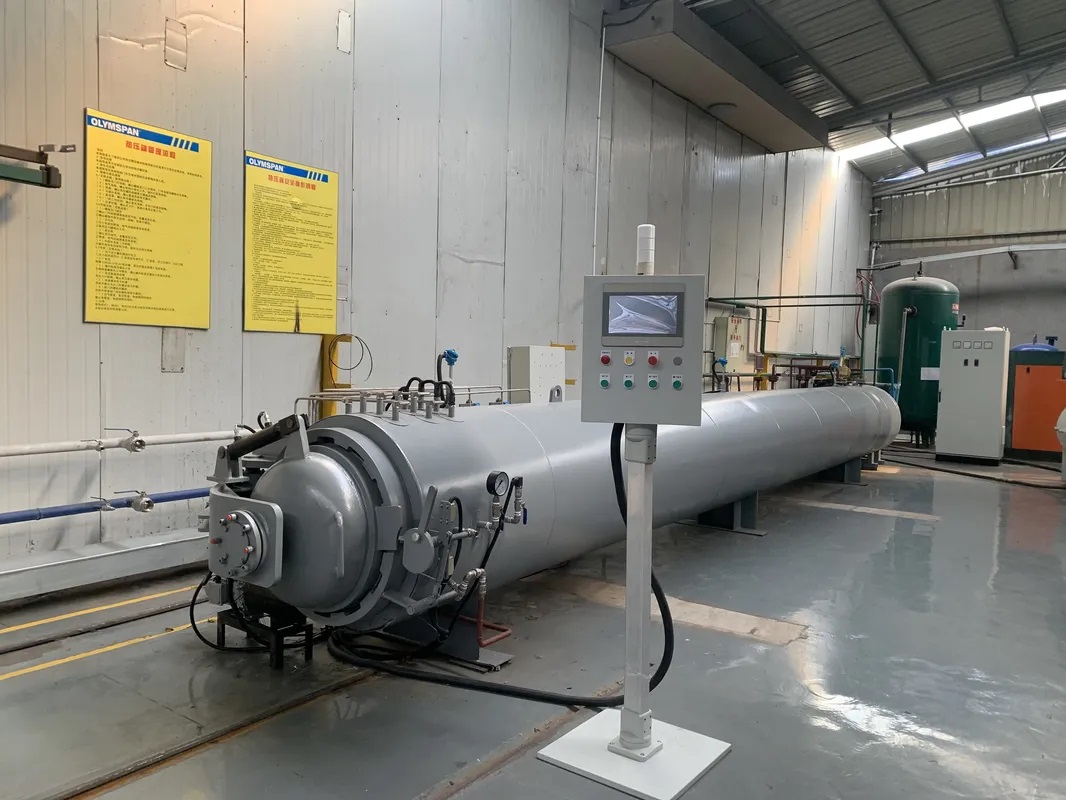
Type 2 — Pilot / process-validation unit (multi-mode, R&D to production)
Between the laboratory and the shop floor sits a model type whose defining feature is multi-mode experimental operation and seamless integration between R&D and production processes. A pilot unit is specified when a formulation has been proven at coupon scale but the process must still be transferred to a manufacturing line.
The control requirement is higher than in a pure laboratory unit. A German new-energy materials company ran two units for four years on composite battery-casing development. The equipment used imported high-precision sensors with ≥60 data acquisition points per run and data accuracy of ±0.1 °C and ±0.05 MPa, and it could be integrated with the company’s R&D management system to automate and data-drive the experimental process.
The commercial argument for this tier is transferability. In that project, precise control shortened the process debugging cycle by 40% and reduced R&D costs by 25%; the programme then supplied standardized process parameters for mass production, contributing an annual production-value increase of 8 million euros. The cured material reached a 35% strength increase, a 28% weight reduction and 180 °C high-temperature resistance, meeting automotive-industry safety standards.
Because pilot units frequently sit inside a working facility, supporting devices extend beyond the vessel: sample racks, emergency pressure relief, electrical isolation and anti-scald protection, and storage equipment that keeps incoming material at a stable condition before each campaign.
Type 3 — Semi-production unit (single 8–16 hour daily run)
The third type is the workhorse of small and medium-sized composite manufacturing. It runs a single 8–16 hour cycle per day on a 380 V supply and carries an ambient tolerance of -10 °C to 40 °C, so it can be installed in an unconditioned industrial hall rather than a climate-controlled room.
A Chinese automotive parts supplier installed eight units and ran them for six years, curing composite steering-wheel frames and interior parts at 600 products per day. A single batch cure was controlled at 2.5 hours; production efficiency rose 50% against the equipment it replaced, and the product qualification rate moved from 92% to 99.2%, cutting waste losses by 1.2 million yuan annually. Annual operating cost was held at 120,000 yuan — 28% more energy-efficient than comparable equipment — with a recorded return on investment of 150%. No personnel injury or equipment damage accidents were recorded over six years.
Supporting devices are what make this tier flexible. A modular structure allows quick switching of production specifications between part families; a visual control system lets operators start work after simple training; and a manual and electric dual-purpose quick-opening function responds to events such as power outages, while a tank-door safety interlock covers mechanical risk. Material-handling auxiliary equipment supports loading and unloading. Maintenance is scheduled as small service every month and comprehensive service every six months, with vulnerable-part replacement costing roughly 25,000 yuan per year.
Type 4 — Large-capacity unit (multi-batch throughput)
Where part size or daily output outgrows a semi-production chamber, the shortlist moves to large carbon fibre curing vessels — high-temperature, high-pressure tanks built for multi-batch operation. These units are defined less by cycle length than by throughput and by the environment they must survive.
A wind power component manufacturer in India installed six units and ran them for five years, curing blade connectors and reinforcements. Average daily output reached 400 pieces, sufficient to support local wind projects. Weather resistance of the cured components improved by 40%, extending service life to 15 years. The equipment accumulated 2,800 hours of continuous fault-free operation with annual failures held within 10 events, and delivered annual operating-cost savings of 300,000 yuan against imported equipment while the manufacturer’s product market share rose 12%.
Large-capacity units often work in high-temperature, high-humidity environments, so the electrical system is specified with anti-corrosion, high-temperature-resistant design and insulation performance to match. Efficient ventilation discharges harmful gases generated during solidification, which is an environmental risk-control requirement rather than an optional extra, and the tank body is built from wear-resistant, corrosion-resistant material for a long service life. Supporting devices include the ventilation package, storage equipment sized for large blade components, and racking that keeps parts stable through long handling moves.
Type 5 — High-end PEEK / polyimide unit (cleanroom, high temperature)
The top of the shortlist is the aerospace-grade unit that cures advanced high-temperature thermoplastics such as PEEK and polyimide, and it is the only type that normally requires cleanroom conditions of 20–28 °C around the vessel.
A United States aerospace manufacturer producing main load-bearing components ran eight units for seven years, curing fuselage and wing primary structures under GJB9001C aviation-grade quality standards. The programme accumulated more than 3,000 aircraft main load-bearing components at a 99.8% qualification rate with no quality defects, supporting models including the C919 and ARJ21. Continuous operation reached 7,800 hours with a mean time between failures of 1,600 hours. A dual redundant control system held parameter fluctuation within ±0.1 MPa and ±0.3 °C; maximum temperature capability reached 380 °C and maximum pressure 15 MPa, and no safety accidents occurred across seven years.
Supporting devices are safety-critical at this tier: multiple pressure and temperature interlock protections, an emergency pressure-relief system, a dedicated heat-recovery device with recovery efficiency of ≥82% (worth 150,000 yuan in annual energy savings in the case above), and remote diagnosis with full-lifecycle management. Sample racks and storage equipment must sit inside the cleanroom envelope so that material conditioning is not broken between stages.
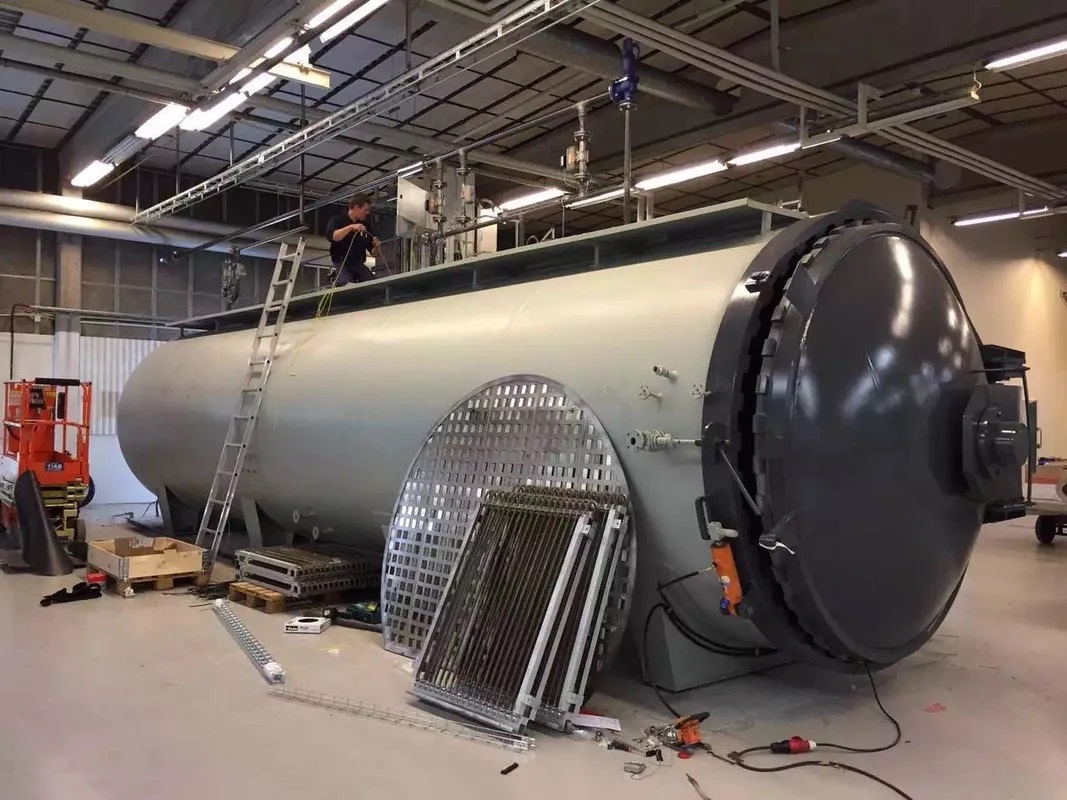
What control accuracy actually changes between the five types
Control accuracy is the most misread specification in this category, because it hides three different measurements. Temperature uniformity describes how evenly the chamber holds a setpoint across its volume. Data accuracy describes how precisely the instrument records what happens. Parameter stability describes how little pressure and temperature drift while the cycle runs. A unit can perform well on one and poorly on another.
Across the five types the numbers move in a predictable direction. A laboratory unit such as the one in the Chinese university programme held ±0.5 °C. A pilot unit in the German project recorded data accuracy of ±0.1 °C and ±0.05 MPa across ≥60 acquisition points per run. An aerospace unit held fluctuation within ±0.1 MPa and ±0.3 °C using dual redundant control. Buyers should ask which of the three measurements a quoted figure refers to before comparing two suppliers.
Architecture follows the same logic. Entry configurations use a PLC control system; higher-tier vessels in the same platform family use a CPC control system, with heating, cooling and air ducts mounted under the floor to free working space, and internal insulation to reduce thermal loss. Vessel material is typically Q345R carbon steel or a customized grade, moving to PED-certified material for aerospace and automotive configurations. Two low-level options that pay back over a long service life are the number of data-acquisition points and the integration of remote monitoring and data synchronization — both are customization items rather than fixed features.
Compliance sits underneath all of it. Industrial composite autoclaves for the US market must typically satisfy ASME BPVC Section VIII (Division 1 or 2); European projects work to PED 2014/68/EU under EN 13445. Olymspan holds ASME “U” and “S” stamps, CE (PED), CRN (Canada) and IATF 16949:2016, alongside ISO 9001:2015 and ISO 45001:2018 registrations issued through URS for the design and manufacture of A2 class boiler pressure vessels.
Where each type is applied
Aerospace and defence work concentrates on type 5, and increasingly on type 4 where large wing or fuselage tooling is involved. Wind energy uses type 4 for blade connectors and reinforcements and type 3 for smaller components. Automotive and motorsport run type 3 for structural and interior parts and type 2 for battery-casing development. New energy and biomedical programmes lean on type 2 pilot units to transfer laboratory formulations into production. University and corporate research departments start with type 1 and step to type 2 once a formulation is stable.
The pattern is consistent: the application fixes the process profile, the process profile fixes the model type, and only then does supplier comparison become meaningful. A buyer who starts from a supplier catalogue and works backwards usually ends up comparing features that do not map to the parts they actually cure.
How Olymspan’s product range maps to the five types
Jiangsu Olymspan Equipment Technology Co., Ltd., trading under the Olymspan brand, is a Changzhou-based manufacturer founded in 2004 with a 66,000 m² facility, approximately 350 employees and a 25-engineer R&D team. Its product range covers composite autoclaves, carbon fibre products, carbon fibre drones and tube heat exchangers, and it exports 30–40% of production to North America, South America, Western and Eastern Europe, Eastern Asia, Southeast Asia, the Middle East, Africa and Oceania.
Within the five-type shortlist, that range maps across the tiers. Laboratory and experimental composite autoclaves cover type 1; hydraulic door-opening carbon fibre units and vacuum units for motorcycle and travel-box parts cover types 2 and 3; the civil fully automatic composite autoclave covers type 3; the large carbon fibre curing tank covers type 4; and the high-pressure composite autoclave φ 3.5 m × 18 m, together with the full-automatic ASME composite autoclave for aerospace and automotive, covers type 5. For that aerospace and automotive configuration, published working figures are 150 °C working temperature, 1.3 MPa working pressure, and a 2.0 m diameter by 5 m length chamber, either dimension customizable.
Customization is the mechanism that keeps a single platform usable across the tiers. Available parameters include tank volume, temperature-control accuracy, pressure range, number of data-acquisition points, remote monitoring and data-synchronization integration, tank material and experimental mode. Standard models ship in 15–25 days; customized models including parameter adjustments and new features take 25–40 days, excluding on-site installation and debugging of 1–3 days. Minimum order quantity is one unit. Quality control before shipment covers pressure-sealing testing, temperature-uniformity testing, electrical-safety testing and data-acquisition accuracy calibration, with on-site debugging and verification during delivery. After-sales support is offered remotely or on site.
Market trend analysis
The global composite curing autoclave market was valued at approximately USD 1.37 billion in 2023 and is projected to reach USD 2.4 billion by 2033 at a CAGR of 10.2%, according to third-party research. A narrower definition — “autoclaves for composite materials” — was valued at USD 86.2 million in 2024 and is expected to reach USD 127 million by 2032 at a CAGR of 5.8%. The divergence between the two figures reflects definitional differences, including whether medical and steam autoclaves are counted, and buyers should treat absolute market values with that caveat rather than as a single settled number.
What the data does show consistently is where demand sits. Composite autoclaves accounted for 62.4% of total aircraft autoclave market share as of 2025, and North America held the largest revenue share at approximately 38.2% in the same year, with significant growth following in Asia-Pacific. That distribution explains why buyers in different regions specify different tiers: mature aerospace demand in North America concentrates on type 5 and large type 4 vessels, while Asia-Pacific growth pulls volume through types 3 and 4 in wind, automotive and industrial composite production.
Autoclave versus traditional curing routes — and where autoclaves are the wrong choice
An autoclave is not the default answer for every composite part. The honest comparison is against three alternatives: oven curing with vacuum bag only, press or compression moulding, and out-of-autoclave prepreg with vacuum processing.
The autoclave’s advantage is pressure. Applying elevated pressure during cure suppresses voids and raises fibre volume fraction, which is why aerospace primary structures such as fuselage and wing load-bearing components are autoclave-cured. An oven cannot match that consolidation, and a press applies pressure on one axis rather than uniformly.
That advantage carries real costs, and this is where a shortlist should be tested against a buyer’s actual constraints:
- Batch, not continuous. Throughput is bounded by cycle time. In the semi-production case above, one batch cure took 2.5 hours; laboratory cycles run 2–8 hours. A line needing thousands of small parts per hour should be looking at press moulding or high-pressure RTM, not at adding autoclave capacity.
- Capital, footprint and compliance. An autoclave is a pressure vessel. It requires certified design and manufacture under a regime such as ASME BPVC Section VIII or PED 2014/68/EU, plus foundations and floor space that a large type 4 or type 5 vessel consumes disproportionately. Smaller facilities often cannot absorb that footprint at all.
- Energy intensity. Heating a large chamber and its tooling is energy-heavy, which is why energy recovery and efficiency features matter more at the upper tiers than at type 1. Where a project compares two upper-tier units, heat-recovery efficiency and annual operating cost are more decision-relevant than list price.
- Over-specification is a real failure mode. A 380 °C, 15 MPa aerospace capability is required for PEEK and polyimide aviation work; it is not required for typical automotive interior parts. Choosing type 5 where type 3 suffices raises cost and complexity without improving the part.
- Control claims need a reference point. A quoted accuracy figure means little unless the buyer knows whether it describes temperature uniformity, data accuracy or parameter stability, and at what chamber volume.
The practical rule is to move up the five-type shortlist only when part criticality, material system or certification demand it, and to choose an alternative route when throughput and unit cost dominate.
Future outlook
Three shifts are visible from the evidence in this shortlist. First, control and data capability is becoming a differentiator across all five types, not just the aerospace tier — remote monitoring, data synchronization and R&D management-system integration are moving from custom options toward expected features. Second, energy performance is moving from a soft benefit to a procurement criterion: heat-recovery efficiency of ≥82% in one aerospace programme and a 28% energy-consumption reduction in an automotive programme are the kinds of figures buyers now request up front. Third, flexibility is being engineered in through modular designs that allow quick switching of production specifications, which matters as automotive, new-energy and industrial programmes run more part variants per line.
Against a composite curing autoclave market projected to reach USD 2.4 billion by 2033 and a composite share of 62.4% within aircraft autoclaves, the five-type segmentation is likely to stay useful. The category is growing faster than any single supplier’s ability to cover every tier equally well, which keeps the model type — rather than the brand — as the buyer’s first decision.
FAQ
What are the main composite autoclave model types?
Five types are commonly differentiated by operating mode and control accuracy: R&D laboratory units with 2–8 hour intermittent cycles; pilot and process-validation units with multi-mode operation; semi-production units running a single 8–16 hour cycle per day; large-capacity multi-batch units; and high-end PEEK and polyimide units for aerospace-grade curing. Each type implies a different site envelope, control architecture and supporting-device package.
How do R&D laboratory units differ from semi-production units?
The differences are cycle mode, site envelope and throughput. A laboratory unit runs 2–8 hour intermittent cycles in a 15–25 °C ambient space at 40–60% relative humidity and is optimized for data collection rather than output. A semi-production unit runs a single 8–16 hour cycle per day on a 380 V supply with an ambient tolerance of -10 °C to 40 °C and is optimized for repeatable daily output; in one documented automotive case it processed 600 products per day with a 2.5-hour batch cure.
What ambient conditions do high-end PEEK and polyimide autoclaves require?
These units are normally installed under cleanroom conditions of 20–28 °C. The requirement follows the material rather than the machine: PEEK and polyimide cure profiles are sensitive to contamination and to ambient variation, so the vessel, tooling, sample racks and storage equipment are kept inside the same controlled envelope.
Which supporting devices should be specified with each type?
Laboratory and pilot units need sample racks, over-temperature and over-pressure alarms with emergency pressure relief, and conditioned storage matched to the ambient window. Semi-production units need modular changeover hardware, a visual control system, a manual and electric quick-opening function and a tank-door safety interlock. Large-capacity units need ventilation to discharge curing gases and wear- and corrosion-resistant vessel construction. High-end units need multiple pressure and temperature interlocks, emergency pressure relief, a heat-recovery device and remote diagnosis.
Which standards and certificates should a buyer verify?
For pressure-vessel compliance, ASME BPVC Section VIII (Division 1 or 2) is the reference for US markets and PED 2014/68/EU with EN 13445 for Europe. Beyond the vessel, buyers should confirm the certificate scope rather than the certificate name — for example, an IATF 16949:2016 registration (certificate CB01325, valid 25 September 2024 to 24 September 2027) covers the manufacture of carbon fibre reinforced composite shell decoration parts, engine heat dissipation parts and interior decorative stickers, which is a narrower scope than autoclave manufacture itself.
What are the practical limits of autoclave curing?
Autoclaves are batch vessels, so throughput is bounded by cycle time; they are capital-intensive pressure vessels requiring certified design, foundations and floor space; and they are energy-intensive at large chamber volumes. They are usually the correct route for aerospace-grade consolidation and the wrong route for very high-volume, low-cost parts, where press moulding, RTM or out-of-autoclave processing is more economical.
Further reference: the Olymspan composite autoclave product brochure is available at https://cdn.socialarks.com/sbsp/24762/0/2026/0417/69e1db393056c.pdf
Есть вопросы или нужны дополнительные детали?
Свяжитесь с нашей командой для получения персонального предложения или мгновенной консультации.
Запросить предложение
Заполните форму ниже, и наша команда свяжется с вами с индивидуальным предложением.
Прямой чат WhatsApp
Предпочитаете общаться в реальном времени? Напишите нам в WhatsApp для мгновенной помощи и быстрых ответов.
- Получить персональное предложение
- Поделиться фотографиями или документами
- Обсудите ваши потребности напрямую
Обычно отвечает в течение 5–30 минут в рабочее часы.