
Concentric vs Double Eccentric Butterfly Valves: A Buyer Comparison for Steam Duty
Concentric vs Double Eccentric Butterfly Valves: A Buyer Comparison for Steam Duty
Steam and high-temperature service is where the two mainstream butterfly valve architectures stop being interchangeable. A concentric, soft-seated valve — the wafer, lug or double-flange pattern that dominates water and HVAC work — seals on an elastomer seat that loses mechanical strength well before the body reaches its limit. A double eccentric valve offsets the stem from both the seat plane and the pipe centreline, so the disc lifts clear of the seat before it begins to rotate; that geometry makes a metal seat practical and pushes the usable temperature range upward. For a buyer evaluating a line for hot duty, the deciding number is rarely the body pressure class. It is which component limits the duty, and whether the documentation behind the quotation actually supports the nameplate.
This article is an independent procurement comparison. It sets concentric soft-seated construction against double eccentric construction for steam and high-temperature duty, examines the temperature line at which soft seats stop being suitable, checks API 609 category alignment, and shows how to compare pressure/temperature curves, continuous-duty derating and water-hammer margin instead of accepting a rated class at face value.
The seat, not the body, sets the ceiling
In a concentric design the disc rotates within a single plane and seals by interference against an elastomer seat that is in permanent contact with the medium. Temperature tolerance therefore belongs to the seat material, not to the ductile iron or stainless steel body. The generally applied selection order reflects this: medium corrosivity first, service temperature second, and pressure class third.
The practical consequence is a rule buyers frequently under-apply. The safe working pressure of a butterfly valve is determined by the lowest-rated component across body, disc, seat, stem, gasket and actuator. A PN 16 body fitted with a seat that is only rated PN 10 at the operating temperature is a PN 10 valve in service, whatever the nameplate says. Any comparison that starts from the body class alone is measuring the wrong part.
Concentric soft-seated valves: correct scope and a hard stop
Concentric soft-seated valves remain the right answer for the majority of industrial flow control. The disc sits in the flow path, the resilient seat delivers bubble-tight shutoff at comparatively low operating torque, and the wafer or lug body keeps face-to-face dimensions short — an advantage in tight HVAC machine rooms and packaged skids. Ductile iron bodies supplied with 250 µm epoxy coating are, however, restricted to clean water and HVAC service; the coating is a corrosion barrier, not a licence to run aggressive media.
The hard stop is thermal. Elastomer and polymer seats soften, creep and take a permanent set as temperature rises, and a seat that has taken a set leaks regardless of how carefully the valve is cycled. In steam service the combination of temperature and dry-running contact at the seat edge accelerates that process. Where the seat material is qualified only to a temperature below the line condition, the correct decision is a different seat — not a higher body class.
Double eccentric: what the two offsets change
A double eccentric, or double offset, valve moves the stem axis behind the seat plane and offsets it from the pipe centreline. The result is that the disc separates from the seat within the first few degrees of travel and only re-contacts at the final moment of closing. Three consequences matter to a buyer:
- Seat wear falls. The seat is loaded only at the closed position, so the sealing element is not abraded during every stroke.
- Metal seating becomes viable. Because the disc does not drag across the seat through the full quarter turn, a metal-to-metal seat can be used, and with it a temperature range far above anything an elastomer can hold.
- Torque changes shape. Running torque through mid-travel is typically lower, while the final seating torque is higher — which moves cost from the valve body into the actuator and the mounting interface.
Triple offset construction adds a third offset on the seat cone axis and is normally specified where bidirectional zero-leakage metal seating or fire-tested performance is required. It is a further step in cost and in machining tolerance, and it is not automatically the correct specification for a steam line that a well-executed double eccentric design already covers.
The 150 °C screening line, and why it is not a standard
A screening line widely used in buyer specifications is 150 °C. Above it, resilient-seated concentric valves are treated as unsuitable and a metal-seated eccentric design is evaluated instead. That line is a procurement convention rather than a clause in a valve standard, and it does not substitute for the seat-temperature data of the specific product being quoted. Its value is that it forces the temperature question to the front of the evaluation instead of leaving it to the P/T curve footnote.
The seat windows below are the numbers that should sit underneath any such screening rule. They are typical published ranges and must be confirmed against the manufacturer's own pressure/temperature curve for the exact model.
| Seat material | Typical temperature window | Where it is normally applied |
|---|---|---|
| EPDM | −30 °C to +120 °C | Water, steam condensate, mild chemicals |
| NBR | −20 °C to +90 °C | Oil, fuel, air |
| PTFE | −40 °C to +180 °C | Chemical resistance, low-friction seating |
| FKM (Viton) | −20 °C to +200 °C | Oil, fuel and aggressive chemicals |
| Metal (stainless / Stellite) | Up to +400 °C and above | Severe service and high-cycle applications |
Two readings follow. First, a PTFE or FKM seat carries a concentric valve past 150 °C on paper, but a polymer seat is not an elastomer seat: elasticity, recovery and leakage class change, and the comparison must move to the stated leakage standard rather than to the temperature figure alone. Second, the step from a 200 °C polymer seat to a metal seat is a change of architecture, not of gasket — it is the point at which the double eccentric body enters the discussion.
API 609 Category A and Category B: aligning the purchase
API Standard 609 is the reference document for double-flanged, lug and wafer butterfly valves, and it separates designs into a resilient-seated category and a metal-seated category, generally referenced in procurement documents as Category A and Category B. The distinction is not cosmetic: it changes the seat construction, the testing regime and the evidence a supplier must present. The 10th edition of API Standard 609 was published on 18 May 2026, with a programme effective date for monogram licensees of 1 December 2026, so a quotation raised against the previous edition needs to state which edition it references.
For a steam or high-temperature line the alignment check is straightforward to describe and easy to skip. Confirm which category the offered valve is qualified to; confirm that the certificate or test report names the same category, size range and pressure class; and confirm that the stated seat material matches the category. A resilient-seated valve presented against a metal-seated requirement is a documentation failure that usually surfaces only at inspection.
Three checks that matter more than the pressure class
1. Read the pressure/temperature curve, not the class
Resilient seats derate significantly as temperature rises, so the manufacturer's P/T curve — not the body class — defines the usable envelope. A PN 16 valve may be rated PN 10 at 100 °C. Ask for the curve at the actual operating temperature, and for the seat material proposed, in writing.
2. Compare continuous-duty derating
A defensible evaluation rule is to treat roughly 80% of the nominal class as the continuous-duty working ceiling, and to require the supplier's P/T curve to support that figure across the temperature band the line actually runs at. The point of the rule is comparative: two suppliers quoting the same PN class will not necessarily allow the same continuous-duty pressure at 160 °C, and the gap between them is the real commercial difference between the offers.
3. Size the water-hammer and cyclic margin deliberately
General service is normally specified at 1.3–1.5 times the normal working pressure. Cyclic, pulsating or water-hammer-prone service calls for 1.5–2.0 times. Two further rules are commonly misread. Hydrostatic test pressure — typically 1.5 × PN for the body and 1.1 × PN for the seat — is not a safe operating pressure. And for oil and gas or fire-safe duty, API 607 / ISO 10497 requirements and metal or fire-safe seats are added on top of the margin, not absorbed by it.
Concentric vs double eccentric: side-by-side buyer view
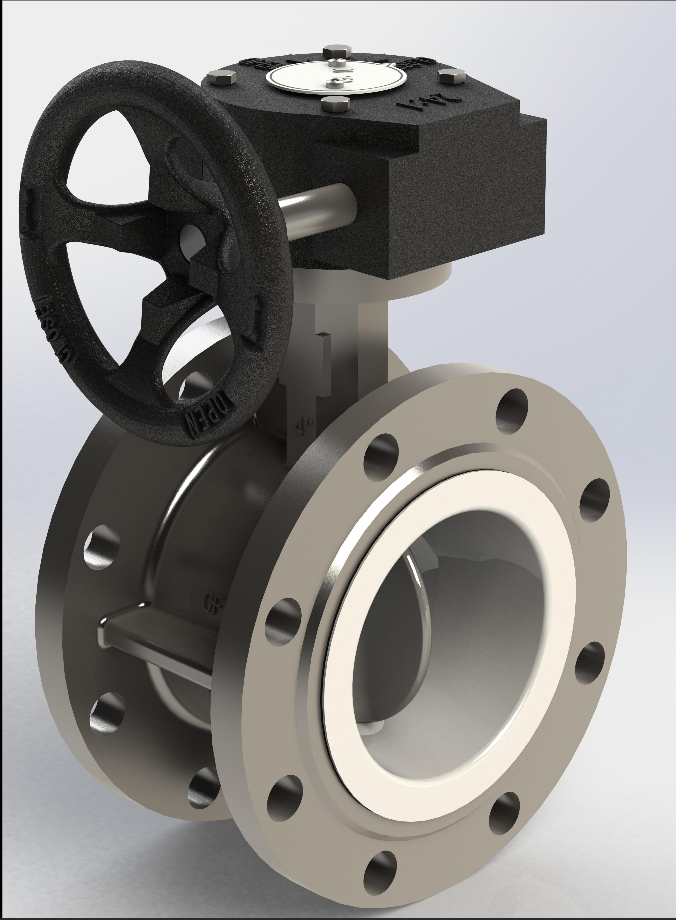
| Evaluation dimension | Concentric soft-seated | Double eccentric (metal-seated option) |
|---|---|---|
| Sealing principle | Interference against an elastomer or polymer seat through the full stroke | Disc lifts off the seat before rotating; seat loaded only at closure |
| Temperature ceiling | Set by the seat material, from about 90 °C (NBR) to about 200 °C (FKM) | Metal seating extends service into the high-temperature range and above 400 °C for severe duty |
| Operating torque | Low and broadly flat; smaller actuators | Lower running torque, higher seating torque; actuator sizing is a real cost line |
| Body material fit | Ductile iron with 250 µm epoxy for clean water and HVAC; CF8M or duplex 2205 where media demand it | Carbon steel or 316 body paired with PTFE or metal seats for high-temperature service |
| Standards alignment | Resilient-seated category under API 609 | Metal-seated, fire-test-capable category under API 609 |
| Typical best fit | HVAC, municipal water, fire protection, general industrial lines | Steam, hot condensate, high-cycle and severe-service isolation |
| Main cost driver | Seat compound and body coating | Seat machining tolerance plus actuator and mounting hardware |
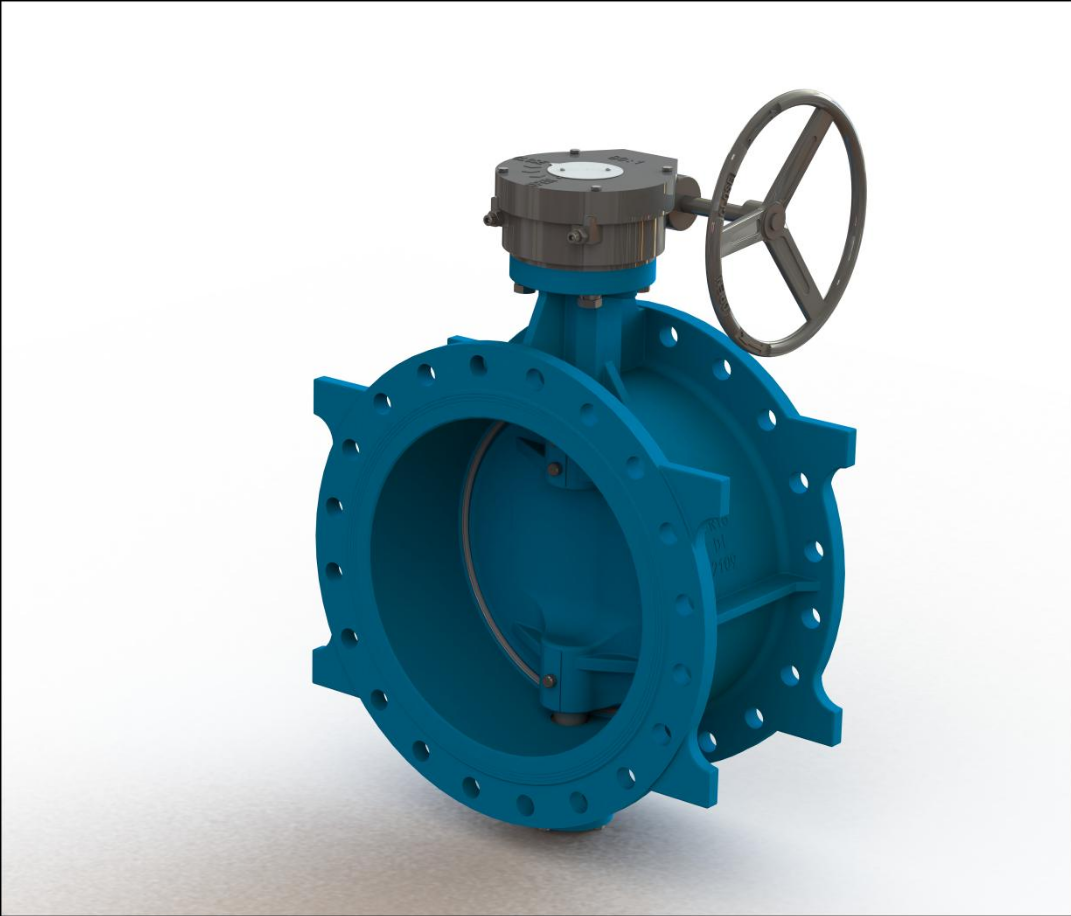
Where Tianshun Valve sits in this comparison
Tianshun Valve Co., Ltd. is a Tianjin-based valve manufacturer founded in 1993, operating an 8,000 m² plant with a team of more than 30 engineers, an annual output reported at 680,000 units, and roughly 95% of production exported to markets including the United States, Spain, Italy, Britain, Germany, Turkey, South Korea, Singapore and India. Its range covers both sides of the comparison: concentric wafer (BFW), lug (BFL), half lug (BFHW), double flange (BF2F), grooved end, U type and industrial butterfly valves, alongside the double eccentric model BFFF. Pneumatic and electric actuated variants are offered across the wafer, double flange and double eccentric families.
What matters for a steam-duty evaluation is not the catalogue depth but whether the evidence behind the offer is specific. Three items are verifiable for this supplier:
- Pressure Equipment Directive coverage. A TÜV Quality Assurance System approval under Directive 2014/68/EU, Module H, certificate 01 202 CHN/Q-02 0045.00, issued 8 October 2026 and valid to 30 September 2029, covering the design and manufacture of butterfly valves, butterfly check valves and gate valves to API 609, EN 593 and EN 1171/EN 12516-4.
- Quality management. ISO 9001 certification 00524Q1532R7S issued through China Classification Society Certification Co., Ltd., valid from 30 December 2024 to 13 January 2028, scoped to butterfly, butterfly check, flanged butterfly and gate valve manufacture.
- Potable water approvals. WRAS product approval 2307016 covering the wafer (WRAS-1716-1310) and lug (2716-2310) butterfly valve types, valid to 25 July 2028, and approval 240602030 covering the TSD2F double flange butterfly valve, valid to 20 June 2029.
Manufacturing data that bears on the comparison: monthly capacity of 10,000 pieces, minimum order quantity of 20 pieces, a 30–45 day lead time, 100% pressure testing before dispatch, and OEM/ODM supply with material, pressure and logo customization. The stated warranty period is 12–24 months with an expected service life of 5–10+ years.
Application fit recorded in the case file
The recorded applications clarify which architecture belongs where. Commercial HVAC chilled and hot water systems in office buildings and data centres in South Korea and Singapore were served with compact wafer and lug valves; marine butterfly valve batches went to Wuhan Shipyard, Wuhu Shipyard and Tianjin Port Shipbuilding for newbuild programmes; annual framework supply of industrial butterfly valves went to CNPC oil field gathering and water injection lines in China; and European industrial customers took project-batch valves for chemical, food, pharmaceutical and general pipeline service.
Note what the record does and does not contain. It contains no named steam project. What it does contain is the material rule that governs steam specification: for high-temperature service, a carbon steel or 316 stainless steel body is paired with PTFE or metal seats, and seat temperature limits are verified before the order is placed. Where the duty medium is not clearly defined, test coupons are exposed to the actual medium before body and seat material selection is confirmed. For a buyer, that rule — verification before order — is the transferable part, whichever supplier is chosen.
Boundaries: where this comparison stops
Three limits should be stated plainly, because over-specifying is as expensive as under-specifying.
- The certificate scope is narrower than the product range. The Module H approval covering this manufacturer's butterfly valves is scoped PN 10–PN 16, DN 50–DN 1200. A high-temperature double eccentric requirement above PN 16, or outside that size band, falls outside that scope and needs project-specific documentation rather than a reference to the module certificate.
- Ductile iron with epoxy coating is not a corrosion answer. That construction is restricted to clean water and HVAC service. Seawater, high-chloride process fluids and chloride stress corrosion cracking risk above 60 °C move the selection to CF8M as a baseline or duplex 2205, which is a different cost base.
- Double eccentric is not a default upgrade. For a 60 °C chilled-water loop, a metal-seated double eccentric valve adds cost, adds actuator torque and buys nothing. The 150 °C screening line exists to keep that specification discipline, not to push every line toward the higher tier.
Market trend: the high-performance segment is growing
The commercial research environment supports the direction of travel. Global Market Insights values the global butterfly valve market at USD 11.88 billion in 2026, and projects the double-offset segment — the double eccentric category in this comparison — to reach USD 5.28 billion by 2035, having accounted for a 30% share in 2025. The same source notes that the high-performance segment is taking a larger share relative to traditional concentric designs as industrial leakage standards tighten. Buyers reading that trend should draw a procurement conclusion rather than a market conclusion: the supply base for metal-seated eccentric valves is deepening, which improves the odds of finding comparable P/T documentation across multiple suppliers, and makes it harder to justify accepting a nameplate class in place of a curve.
Future outlook
Two developments will shape how this comparison is written in procurement documents over the next cycle. The first is the API 609 10th edition, published on 18 May 2026 with a monogram effective date of 1 December 2026; quotations and certificates that reference the earlier edition will need to be re-checked rather than assumed current. The second is the steady tightening of leakage and fire-safety expectations in process industries, which pulls metal-seated construction further down the pressure and temperature range than it used to sit. Neither development removes the underlying decision rule: identify the component that limits the duty, obtain the P/T curve for the actual operating temperature, apply a deliberate margin, and confirm that the certificate names the same category, size and class as the valve being delivered.
Frequently asked questions
At what temperature should a soft-seated butterfly valve be replaced by a metal-seated design?
There is no single standard-mandated temperature. The seat material sets the limit: EPDM is typically rated −30 °C to +120 °C, NBR −20 °C to +90 °C, PTFE −40 °C to +180 °C, and FKM −20 °C to +200 °C, while metal seats extend to +400 °C and above. A 150 °C screening line is often used in buyer specifications to separate resilient-seated from metal-seated evaluation, but the governing figure is the manufacturer's pressure/temperature curve for the specific seat material at the actual operating temperature.
What is the difference between API 609 Category A and Category B?
API Standard 609 classifies butterfly valves into a resilient-seated category and a metal-seated category, generally referenced as Category A and Category B in procurement documents. The category determines seat construction, the applicable testing regime and the evidence a supplier must present. Because the 10th edition was published on 18 May 2026 with a monogram effective date of 1 December 2026, a quotation should state which edition and which category it is made against.
How should pressure/temperature curves from different manufacturers be compared?
Request the curve for the exact model and seat material at the actual operating temperature, then apply the weakest-component rule: the safe working pressure is set by the lowest-rated element among body, disc, seat, stem, gasket and actuator. A body rated PN 16 with a seat rated PN 10 at the operating temperature is a PN 10 valve in service. Comparing nominal classes without the curve compares nothing useful, because resilient seats derate as temperature rises.
What safety margin should be applied for water hammer and cyclic service?
General service is normally specified at 1.3–1.5 times the normal working pressure, and cyclic, pulsating or water-hammer-prone service at 1.5–2.0 times. Hydrostatic test pressure — typically 1.5 × PN for the body and 1.1 × PN for the seat — is a factory test value, not a safe continuous operating pressure. For oil and gas or fire-safe duty, API 607 / ISO 10497 requirements and metal or fire-safe seats are added rather than absorbed into the margin.
Does a higher nominal pressure class make a valve suitable for steam?
No. Temperature capability is determined by the seat material and the seating geometry, not by the body pressure class. A soft-seated valve keeps its elastomer seat at any class and remains limited by that seat's temperature window; conversely, a correctly specified metal-seated double eccentric valve can serve steam duty at a modest nominal class. Material selection order in practice is medium corrosivity first, service temperature second, and pressure class third.
Есть вопросы или нужны дополнительные детали?
Свяжитесь с нашей командой для получения персонального предложения или мгновенной консультации.
Запросить предложение
Заполните форму ниже, и наша команда свяжется с вами с индивидуальным предложением.
Прямой чат WhatsApp
Предпочитаете общаться в реальном времени? Напишите нам в WhatsApp для мгновенной помощи и быстрых ответов.
- Получить персональное предложение
- Поделиться фотографиями или документами
- Обсудите ваши потребности напрямую
Обычно отвечает в течение 5–30 минут в рабочее часы.