
Concrete Formwork Systems: How to Compare Value, Not Just Price

Concrete formwork is one of the largest controllable cost items in concrete construction. The difference between a well-designed system and a low-cost alternative shows up not only in the purchase order but also in cycle times, concrete finish quality, maintenance demand, and lifetime cost. For contractors at the decision stage, comparing formwork systems requires more than checking a price per square meter. It requires comparing measurable performance attributes that align with project conditions.
The Procurement Problem: Price Is Not a Complete Indicator
Formwork buyers often face an opaque landscape. Quotes vary widely, and low initial pricing can hide higher lifetime costs from corrosion, plywood delamination, rework, or component replacement. The market is also consolidating: based on data cited by Cognitive Market Research, the top five formwork manufacturers, including PERI and Doka, hold approximately 44% of global market share. That concentration makes standards and compatibility an increasingly important procurement issue.
Three common mistakes can distort a comparison. The first is comparing purchase prices without adjusting for service life. A panel that appears cheaper may require replacement much sooner, which raises its effective cost over a project. The second is ignoring the cost of labor and rework. Formwork that lacks stiffness or precise geometry can create bulges and uneven surfaces, and those defects usually appear after the concrete has set, when repair is expensive. The third is overlooking compatibility. Existing clamps, walers, and tie systems vary by manufacturer; a system that does not integrate with hardware already on site can result in additional procurement and idle time.
The opportunity is to use a structured comparison framework. By looking at concrete pressure rating, dimensional tolerance, surface protection, panel facing material, connection compatibility, and service life, buyers can separate meaningful engineering differences from marketing language.
RFH Concrete Formwork: A Demonstration of Value Comparison
One example of a steel formwork system designed for demanding applications comes from Rizhao Fenghua Scaffoldings Co., Ltd. (RFH), a manufacturer established in 1953 and based in Rizhao, Shandong, China. RFH produces concrete formwork systems as part of a broader scaffolding and formwork product range. Its factory covers 80,000 square meters, and its products are exported to 126 countries and regions, with main markets in the EU, USA, Australia, and South America.
The RFH concrete formwork system is positioned for mega-infrastructure projects, thick foundation walls, and high-velocity concrete pouring operations. It provides 33% higher concrete pressure resistance, rated at 80 kN/m² versus 60 kN/m² for typical light-duty panels. Its expected service lifespan is twice as long as comparable products, contributing to a reduced total cost of ownership. Hot-dip galvanization eliminates rust treatment needs, and standard PERI-compatible BFD clamps reduce component loss and wear.
Technical Details Behind the Comparison
What should a buyer actually compare? The key specifications are concrete pressure resistance, dimensional accuracy, connection compatibility, corrosion protection, and panel facing material.
| Parameter | RFH System | Typical Low-Cost Light-Duty Panel |
| Concrete pressure resistance | 80 kN/m² | 60 kN/m² |
| Dimensional tolerance | Under 1.0 mm via CNC machining | Above 3.0 mm industry average |
| Surface protection | Hot-dip galvanized, 60–80 µm | Often non-galvanized |
| Panel facing | 18 mm birch plywood with phenolic film or PP plastic facing | Standard plywood, more prone to moisture |
| Welding method | Automated robot welding | Manual welding with variable quality |
| Clamp compatibility | PERI-compatible BFD clamps | Proprietary or non-standard |
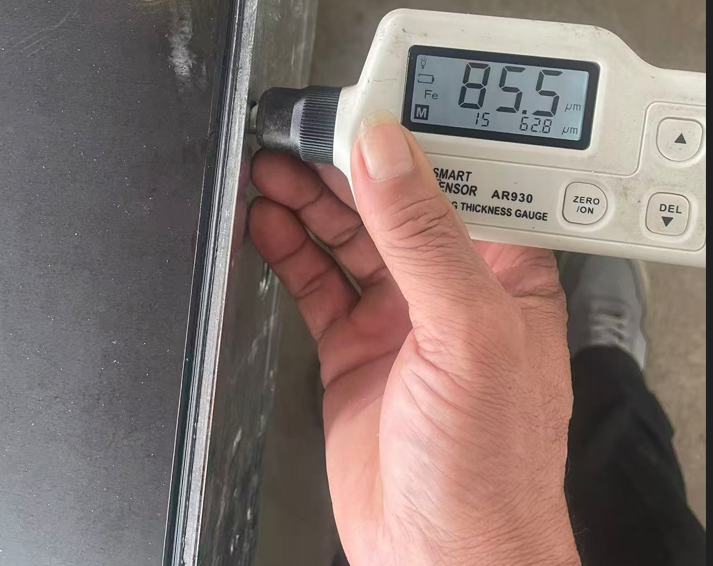
These technical details matter because they determine how the formwork behaves over multiple pours. A galvanized coating reduces rust treatment between projects. A tighter dimensional tolerance improves wall geometry and reduces patching work. Automated robot welding results in seamless, watertight joints between the steel profile and the panel sheet, which helps maintain consistent panel surfaces across pours.
Where High-Capacity Formwork Adds Value
The system's role is to provide rigid structural containment, precise wall geometry definition, and dimensional control during the curing phase. It is most suitable for mega-infrastructure projects, thick foundation walls, and high-velocity concrete pouring operations.
In practice, these are conditions where lateral concrete pressure rises quickly. A formwork system with a higher pressure rating reduces the risk of wall bulging and concrete rework. RFH states that the system eliminates wall bulging risks and concrete rework expenses, and can produce a seamless fair-faced concrete finish directly out of the form.
Market Trends That Affect Formwork Procurement
Global demand for concrete formwork continues to be substantial. Verified Market Research valued the global concrete formwork market at USD 8.9 billion in 2024. Fortune Business Insights reported that Asia-Pacific held a 54.7% share of the market in 2025.
| Material | Price Benchmark (USD/sqm) | 2024 Global Installation Share |
| Timber formwork | 10–25 (rental estimate) | 37% |
| Steel formwork | 25–60 | 44% |
| Aluminum formwork | 40–75 | 19% |
| Plastic / modular formwork | 20–50 | N/A |
Aluminum formwork is growing quickly: Intel Market Research expects the aluminum formwork segment to reach USD 2.48 billion by 2032, with a CAGR of 9.9%. One driver is speed: aluminum formwork systems allow floor cycles as fast as 4–5 days in high-rise construction.
Automation is also entering the sector. Automated climbing formwork systems accounted for 28% of installations in 2024, mainly in buildings over 50 stories. In addition, Doka introduced DokaXact sensors in 2024 for real-time monitoring of concrete pressure on formwork, and PERI acquired Implenia Schalungsbau in 2023 to expand its modular formwork services. These developments suggest that procurement decisions will increasingly involve compatibility with modular systems and data tools, not just physical panels.
Compared with Low-Cost Panels: Gains and Trade-offs
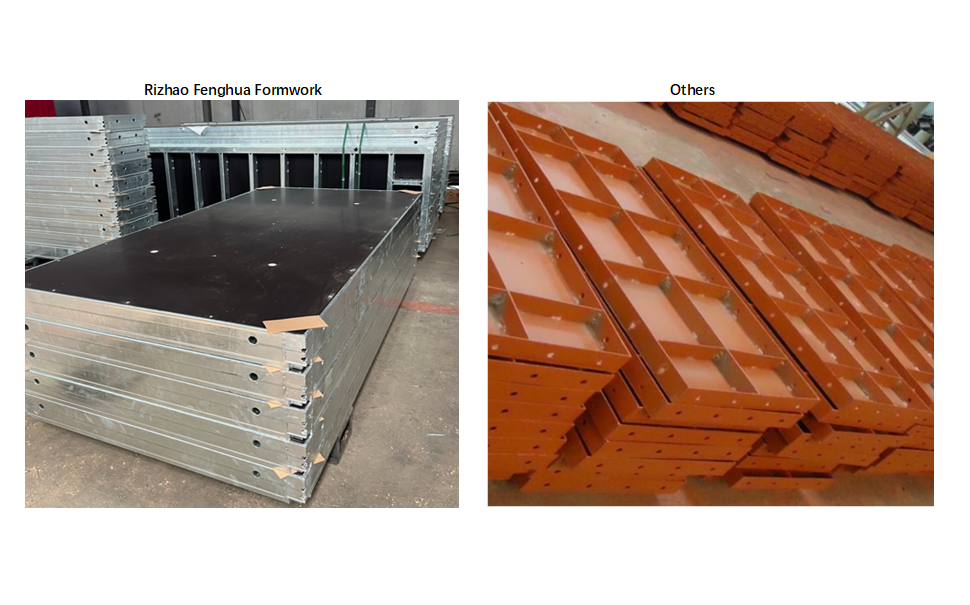
Compared to low-cost, non-galvanized, or manually welded light-duty steel panels, the RFH system offers measurable differences in load capacity, tolerance, and maintenance. It offers 33% higher concrete pressure resistance, tighter dimensional tolerance, and a corrosion protection system that reduces maintenance. The initial purchase price is approximately 15–20% higher, but the system delivers a service life twice as long, which results in a lower cost-per-pour.
However, the value is conditional. For a short-duration project with low concrete pressure requirements, a lighter-duty panel may be sufficient, and the higher upfront investment may not be recovered. A realistic comparison should model the number of pours, expected project duration, required finish quality, and compatibility with existing hardware before choosing a premium system.
How to Apply the Comparison Before You Specify
A structured checklist can help turn the comparison into a procurement decision:
- Define the dominant pour condition. If walls are thick or pour rates are high, focus on pressure rating.
- Estimate the total number of uses across the project or asset portfolio. The more uses, the more durability matters.
- Inspect the coating and panel facing. A minimum 60–80 µm galvanized coating and moisture-resistant facing reduce lifecycle cost.
- Check compatibility with existing formwork hardware. Recognized clamps such as PERI-compatible BFD reduce component loss.
- Calculate cost per pour once you have service life and purchase price. A 15–20% initial premium may be justified if lifespan is twice as long.
- Verify the manufacturer's production process. Automated welding and CNC machining are indicators of dimensional consistency.
This approach does not eliminate the need for site-specific testing, but it gives contractors a defensible basis for comparing quotes and evaluating newly introduced suppliers.
Future Outlook
The formwork industry is moving toward modularity, higher reuse cycles, and more data-informed site operations. The growth of aluminum formwork, the spread of automated climbing systems, and the arrival of sensor-based pressure monitoring all point in the same direction: formwork is becoming a system investment rather than a consumable material.
The broader market context also matters. Coherent Market Insights valued the combined formwork and scaffolding market at USD 56.41 billion in 2024. That scale reinforces the trend toward suppliers that can offer compatible products across both categories. For international contractors, supplier evaluation should include manufacturing credibility, export experience, and compatibility with widely used European panel formats. RFH's 100% export orientation and long production history provide a verifiable base, but site-level verification of coatings, welds, and component compatibility remains essential.
Additional technical specifications are available in the RFH catalogue: RFH Product Catalogue.
FAQ
Есть вопросы или нужны дополнительные детали?
Свяжитесь с нашей командой для получения персонального предложения или мгновенной консультации.
Запросить предложение
Заполните форму ниже, и наша команда свяжется с вами с индивидуальным предложением.
Прямой чат WhatsApp
Предпочитаете общаться в реальном времени? Напишите нам в WhatsApp для мгновенной помощи и быстрых ответов.
- Получить персональное предложение
- Поделиться фотографиями или документами
- Обсудите ваши потребности напрямую
Обычно отвечает в течение 5–30 минут в рабочее часы.