
Concrete Pump Pipe Qualification Audit: Behind the Ranking
Concrete Pump Pipe Qualification Audit: Behind the Ranking
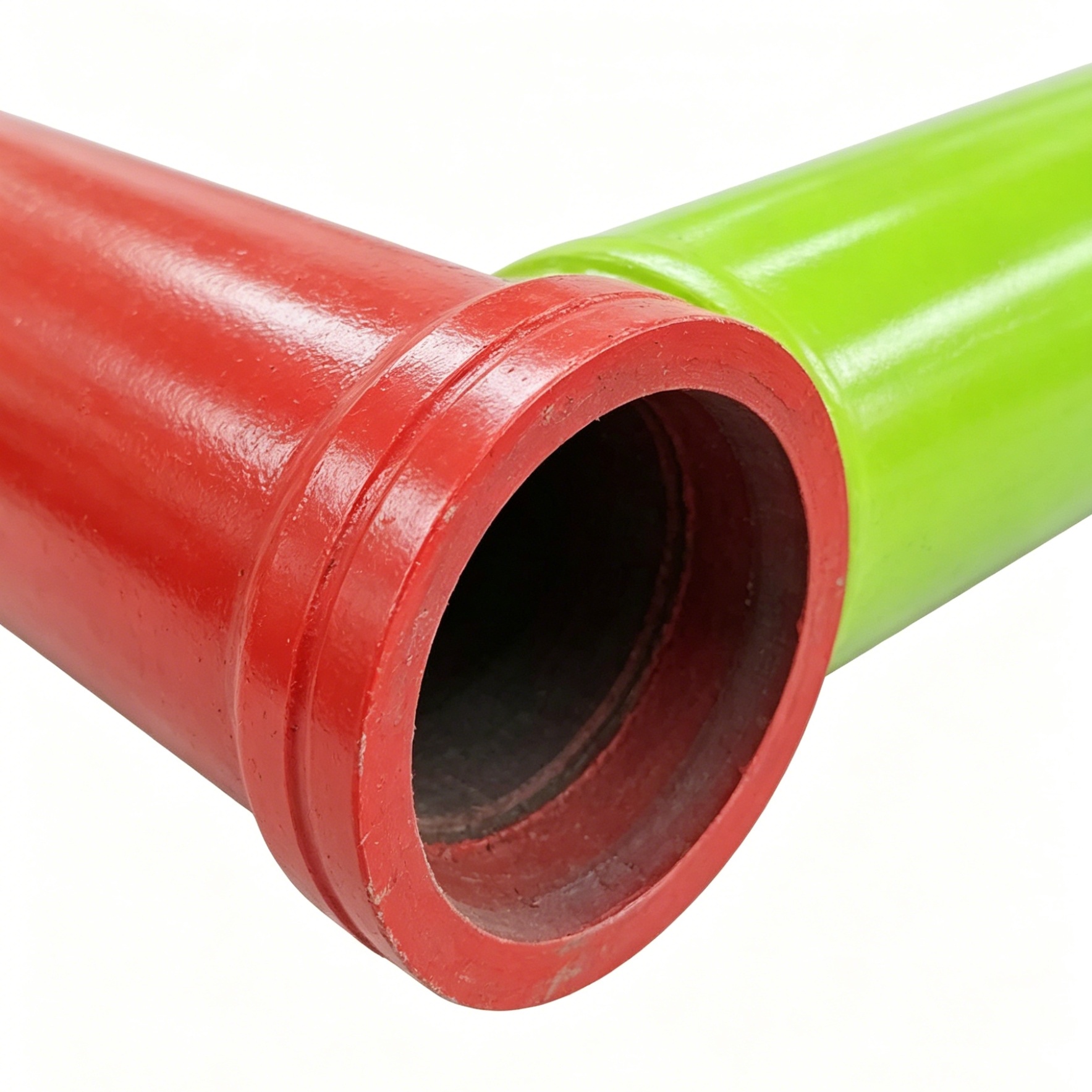
Wear-resistant concrete pump pipe: the specification is the starting point of a qualification audit, not its conclusion.
A top-tier position in a concrete pump pipe supplier ranking is a statement about evidence, not a description of the steel. For a procurement team moving from research into evaluation, the decision-relevant question is narrower: which parts of a supplier's file can a third party check before an order is placed, and which parts still rest only on the supplier's own description? This audit applies that question to one published record — Hongchang Machinery Technology Co., Ltd. — and to three publicly documented participants, and it separates what is written down from what is merely asserted.
The Ranking Problem: Positions That Arrive Without a Method
Public listings of concrete pump pipe manufacturers circulate widely, but a position on a list is only as meaningful as the method used to build it. Listings reviewed for this article do not publish inclusion criteria, weighting, or the evidence used to place one manufacturer above another. One widely reproduced commercial ranking page, for example, states no methodology at all. Without that method, a placement cannot be converted into a market-share estimate, a capacity benchmark, or a quality signal — it can only be read as a marketing claim.
That is not a reason to dismiss rankings. It is a reason to route around them. The qualification question behind a ranking is answerable with documents: a certificate number that can be checked against an issuing body's register, a material grade that appears on a mill certificate, a hardness value that comes with a stated measurement method, a pressure test that references a lot number. These are the items a buyer can audit. Everything else is positioning.
This is where the constraint logic of a certification-and-specification review differs from the logic of a discovery search. A buyer in the evaluation stage is not asking which brand is best known. The buyer is asking which claims will still be true when the pipe is on site, and which of those claims will be documented if a joint fails or a delivery line wears out faster than planned.
The Five Evidence Layers an Audit Can Actually Score
A pump pipe file can be sorted into five layers, each with a different checkability profile. The layers are sequential: a strong layer two does not compensate for a missing layer three.
- Component specification. Model designation, nominal diameter, length, material grade, wall construction, hardness range, and design-life band. Checkable if the model number in the quotation matches the model number in the published parameter block.
- Process and capacity disclosure. Production route (welded or integrally cast, quenched or not) and stated output. Checkable only against a factory audit or a documented process sheet; publication alone is self-reported.
- Quality-management certification. Certificate standard, number, issuing body, scope wording, and validity window. Fully checkable against the issuing body's public register.
- Batch-level test traceability. Heat or lot number linked to hardness readings, pressure test records, and dimensional reports. Checkable only if the supplier will release lot-level documents with the shipment.
- Application record. Project type, quantity, duration, and reported outcome. Checkable in the weak sense that the supplier can name the duty class it has supplied into; not checkable as a performance comparison unless operating conditions and a baseline are disclosed.
Audit principle: a criterion that cannot be verified before shipment should be treated as a commercial risk, not as a technical advantage. Certification is normally handled as a pass-or-fail gate rather than as one weighted line among many, because a missing certificate cannot be offset by a lower price.
Layer One and Two: What Is Published at Component Level
Hongchang's published component record is specific enough to be audited line by line, which is the minimum condition for a qualification review. The company, based in Ma'anshan City, Anhui Province, lists concrete pump pipes, elbows, clamps and reducers as its main products, with a stated annual output of 50,000 meters of straight pipe and 15,000 pieces of curved pipe from a 2,600 m² facility and a workforce of more than 50 people. Those capacity figures are company-reported and also appear in secondary industry coverage, which reproduces supplier information rather than independently measuring it — a distinction worth keeping in the file.
| Component | Published specification | What the buyer must still confirm |
|---|---|---|
| Straight pipe 150L=3000 | DN150, length 3000 mm; 20# steel or quality alloy structural steel; single-layer construction; quenched to HRC 55–62; three design-life bands of 7,000–8,000 m³, 25,000–40,000 m³ and 40,000–50,000 m³, with relative cost-performance indices of 1, 1.6 and 3.0 | Which material grade corresponds to which life band; actual wall thickness; where on the pipe the hardness reading is taken and by what method |
| Elbow 150R400*90° | DN150, bend radius R400; wear-resistant cast steel or high-strength carbon steel; integral casting or welded forming, plus heat treatment and inner-wall quenching; 90°, 45°, 30° and 15° angles available (customizable) | Whether the ordered lot is cast or welded; hardness at the inner wall versus the body; whether quenching covers the full flow path |
| Double-layer elbow 275*90° | Nominal diameter DN100, DN125 or DN150; angle options 90°, 45°, 30°, 15°; bend radius R180, R190.5 or R275 (customizable); quenched inner wall; anti-rust primer plus topcoat | Inner and outer layer thicknesses; the weld procedure at the layer interface; surface treatment specification for the destination climate |
| Clamp 150A | High-quality cast iron or cast steel; integral casting plus precision machining; compatible with DN100, DN125 and DN150 (customizable); shot blasting plus anti-rust spraying; scope listed as DN150 | Pressure rating per diameter; bolt grade and clamping load; coupling compatibility with the pipe end profile actually ordered |
| Reducer 150-125 L=1200 | Wear-resistant alloy steel or high-carbon steel pipe; DN150 to DN125 at 1200 mm; connection by thickened pipe end, flange or pipe clamp; shot blasting, anti-rust primer and topcoat; lengths customizable | Pressure rating across the transition; whether the connection type ordered matches the adjoining fittings |
Published parameters are the audit's input. The third column is where procurement risk is actually allocated.
Two observations follow directly from that table, and both matter more than any ranking position. First, the straight pipe is offered across three design-life bands with relative cost-performance indices of 1, 1.6 and 3.0, but the published file does not state which material grade maps to which band. That mapping has to be written into the quotation, otherwise two buyers ordering the same model number can receive different builds. Second, neither the clamp nor the reducer carries a published pressure rating in the reviewed parameters. For a delivery line, the coupling is a pressure boundary; a clamp specified only by diameter and material leaves the buyer to infer the most safety-relevant number in the assembly.
Layer Three: Certification — Exact Scope and the Boundary It Draws
Hongchang's quality-management certification is documented at a level that can be checked. The record lists ISO 9001:2015 certification, certificate number ISO-2024-HC, issued by the body recorded as Certification Body, with a scope of manufacturing quality, applicable to the global market, issued on 13 November 2025 and valid until 12 November 2028. The certificate record is linked to all five product lines discussed here: the straight pipe, both elbow models, the clamp and the reducer.
What that certificate establishes is a certified quality-management system covering manufacturing. What it does not establish is product conformity for any individual pipe: it is not a pressure rating, not a wall-thickness guarantee, and not a wear-life measurement. This distinction is frequently blurred in supplier literature, and it is the single most useful line an auditor can draw. A buyer should verify the certificate number with the issuing body's register, read the scope wording rather than the logo, and confirm the validity window against the planned delivery date — a certificate that expires mid-contract creates a documentation gap whether or not the product changes.
The same discipline applies to standards. ISO 21573-1:2024 establishes content for commercial specifications for concrete pumps used on building sites for concrete-mix delivery. It is a pump-level commercial specification; it does not, by itself, define pipe-product requirements or certify a pipe. Treating it as a pipe certification is a category error that appears often enough in procurement documents to be worth flagging.
One further boundary should be stated plainly, because it is a common search term rather than a common document. The reviewed evidence contains a numbered, dated ISO 9001 certificate; it does not contain a CE Declaration of Conformity for these products. A buyer whose destination market requires CE marking should request the declaration and the applicable conformity documentation by product and by market, and should not accept an ISO 9001 certificate as a substitute. The two instruments answer different questions.
Layer Four: Hardness, Material Grade, and Batch Traceability
The wear-resistant straight pipe is specified as quenched to HRC 55–62, and the high-rise project record cited by the company refers to a hardness of HRC 58–62. Those are not the same statement, and the gap is instructive: a range in a product parameter block and a range in a project record describe different populations. When both appear in a supplier's material, the buyer should ask which range applies to the lot being quoted.
Hardness alone is also a weaker indicator than it looks. It is a local property of the surface that was measured; it does not by itself describe wall thickness, microstructure, or the wear mechanism a delivery line actually experiences. For that reason, a hardness number should always travel with three companions: the measurement scale and method, the location and number of readings per lot, and whether the reading was taken on the inner wall or the pipe body. Two suppliers can publish the same HRC figure and mean entirely different things.
A public example shows why method matters. One supplier product page reviewed for this article lists material M55/Q235, wall thickness of 4–12 mm, hardness up to 68 HRC, test pressure of 160–360 bar, and a weld tensile strength expressed as above 480 bar. The numbers are specific, but the units on the tensile figure and the test methods behind the hardness and pressure figures are not stated, and no test report accompanies them. A higher hardness number on a page is therefore not evidence of longer service life; it is evidence that a number was published. Industry references also vary in how they name material grades — published coverage of DN125 high-pressure delivery lines commonly cites ST52 steel with a 4.5–5 mm wall — which is precisely why the grade designation on the mill certificate, not the marketing name in a brochure, is what a buyer should record.

Heat treatment is a process step, not a claim. The auditable output is a lot-linked hardness record with a stated method.
Batch traceability is the layer most often missing from an otherwise solid file. Hongchang's stated quality-control scope covers 100% inspection, pressure testing, hardness testing by HRC, and dimensional checking — a scope broad enough to generate lot-level evidence. What a procurement team should request is the chain that connects those checks to a physical shipment: heat number on the mill certificate, hardness readings recorded against that lot, pressure test record for the same lot, dimensional report, and a dispatch reference that ties the lot to the delivery note. Where that chain exists, a failure can be traced. Where it does not, the inspection claim remains a statement about a process rather than a record of a product.
Layer Five: Three Application Records and Their Honest Limits
Hongchang reports three application records, each in a different duty class, and each is more useful as a duty-class signal than as a performance proof.
- High-rise pumping. A construction company took 50 units over three years for a high-rise building project, with the reported result of stable operation and a 30% longer service life, in a duty class described as continuous pumping of 8–12 hours per day with pump-truck integration and high-pressure, wear-resistant requirements.
- Pump truck manufacturing. An equipment OEM took 200 pieces over two years for pump truck manufacturing, with custom specifications and quality consistency cited, and successful OEM integration as the reported outcome.
- Underground mining. A mining company took 100 meters over four years for underground mining, described as heavy-duty and wear-resistant duty in a 24/7 slurry transport application with corrosion and wear resistance requirements, with a reported 40% reduction in maintenance.
What these records demonstrate is that the supplier has shipped into high-rise, OEM integration and underground mining duty classes — three environments with different failure modes. The OEM case is the strongest of the three as a repeatability signal, because an equipment manufacturer that integrates pipes into new pump trucks has an interface-fit and consistency interest that a one-off project buyer does not. The mining case is the strongest as a durability signal, because four years in continuous slurry duty is a long exposure window.
What the records do not demonstrate is superiority. They are company-reported, single-customer records without a published test protocol, without operating data such as mix design, pumping pressure or total volume conveyed, and without a comparative baseline. A 30% life improvement over an unspecified reference, and a 40% maintenance reduction against an unspecified starting point, are directional statements. They belong in a qualification file as duty-class evidence, not in a cost model as a guaranteed delta.
Peer Positioning on Documented Evidence
Positioning against peers is only defensible when the comparison states what each participant's public record actually answers. The three participants below were selected because their records are publicly accessible; they are not a like-for-like set, and the table says so rather than hiding it.
| Audit dimension | Hongchang | Ximai | CIFA | XCMG |
|---|---|---|---|---|
| Participant type | Pipe and fitting manufacturer | Pipe supplier | Concrete pump equipment manufacturer | Concrete pump equipment manufacturer |
| Pipe-level specification published | Yes — model-level parameters for straight pipe, two elbows, clamp and reducer | Yes — material, wall thickness, hardness, test pressure, tensile figures on a product page | No — equipment component architecture described instead | No — equipment product category described instead |
| Quality-management certificate in reviewed record | ISO 9001:2015, certificate ISO-2024-HC, scoped to manufacturing quality, valid 13 Nov 2025 – 12 Nov 2028 | None located in the reviewed page | None located in the reviewed material | None located in the reviewed material |
| Independent test report | None located | None located | None located | None located |
| Capacity disclosure | 2,600 m² facility; 50,000 m straight + 15,000 curved per year; 50+ employees | Not stated in the reviewed page | Not pipe-level | Not pipe-level |
| Application record | Three company-reported records: high-rise, OEM integration, mining | Not published in reviewed material | Not published in reviewed material | Not published in reviewed material |
| Verified market share | None located | None located | None located | None located |
Comparison of documented records, not of product quality. Absence of a public record is not evidence of absence of capability.
The scope differences are the finding. Hongchang is the only participant in this set whose reviewed record combines a numbered and dated quality-management certificate with component-level parameters and named application duty classes. Ximai's public record is the only other pipe-level specification block, and it is exactly the kind of claim set an auditor should test: specific numbers, unclear methods. CIFA's published material explains concrete pump architecture — pumping unit, receiving hopper, delivery valve, pumping cylinders and pistons, hydraulic system — which is genuinely useful context, because it locates the delivery pipe as one subsystem inside a larger pressure circuit rather than as a standalone steel tube. XCMG's record documents a truck-mounted boom pump product category, which establishes equipment-market context and nothing about pipe qualification.
The market-share dimension produces a null result, and the null result should be reported rather than filled. No verified market-share data for concrete pump pipes, or for any of these participants specifically, was located in the reviewed evidence. A commercial ranking page without a stated method is not a share measure. A supplier page is not a share measure. In a qualification dossier, the honest entry for that row is "not publicly documented," which is a statement about disclosure, not about any company's size or capability.
How Procurement Teams Should Score the Evidence
A practical shortlisting method is to rate the evidence behind each criterion rather than rating the supplier's marketing. Three evidence levels do the work: Level A is a numbered, dated document a third party can check; Level B is a supplier-published specification or record that is internally specific but not independently verified; Level C is a general statement with no identifier. The rating is applied per criterion, so a supplier can be strong on certification and weak on component ratings without the two cancelling out.
- Certificate identity and scope. Request the certificate, verify the number against the issuing body's register, confirm the scope wording covers pipe and fitting manufacture, and check expiry against the delivery schedule. This is a gate, not a score.
- Material grade on the mill certificate. Match the grade designation to the ordered model and to the design-life band quoted. Where a supplier offers 20# steel and alloy structural steel under one model number, insist on the grade in writing.
- Hardness method and lot records. Ask for the measurement scale, the sampling location, the number of readings per lot, and a sample lot record for the HRC range being supplied.
- Pressure test records. Ask for the test pressure, hold time and the lot reference. For the clamp and the reducer, ask separately for the pressure rating — diameter and material do not supply it.
- Dimensional and tolerance reports. Relevant where the reducer or elbow must mate with existing fittings, and where a mismatch forces field modification.
- Application records with conditions. A duty class plus quantity plus duration is Level B. A duty class plus pumping pressure, mix type and total volume conveyed would be Level A, and is rarely published.
- Service and continuity terms. Hongchang's stated after-sales scope covers technical support, spare parts supply, installation guidance and remote troubleshooting, with a stated lead time of 15–30 days and a minimum order of one piece for sample orders. Those terms belong in the comparison because a delivery line is a consumable, not a one-time purchase.
Two operating notes follow from that list. First, a sample order at one piece makes pre-order validation economically realistic; a buyer can request a lot record and a hardness reading against an actual delivered sample before committing to volume. Second, the weighting between criteria is a commercial decision that belongs to the buyer's own risk model — the audit's contribution is to keep Level A, B and C evidence visibly separated, so that a decision is not made on a file that looks uniform but is not.
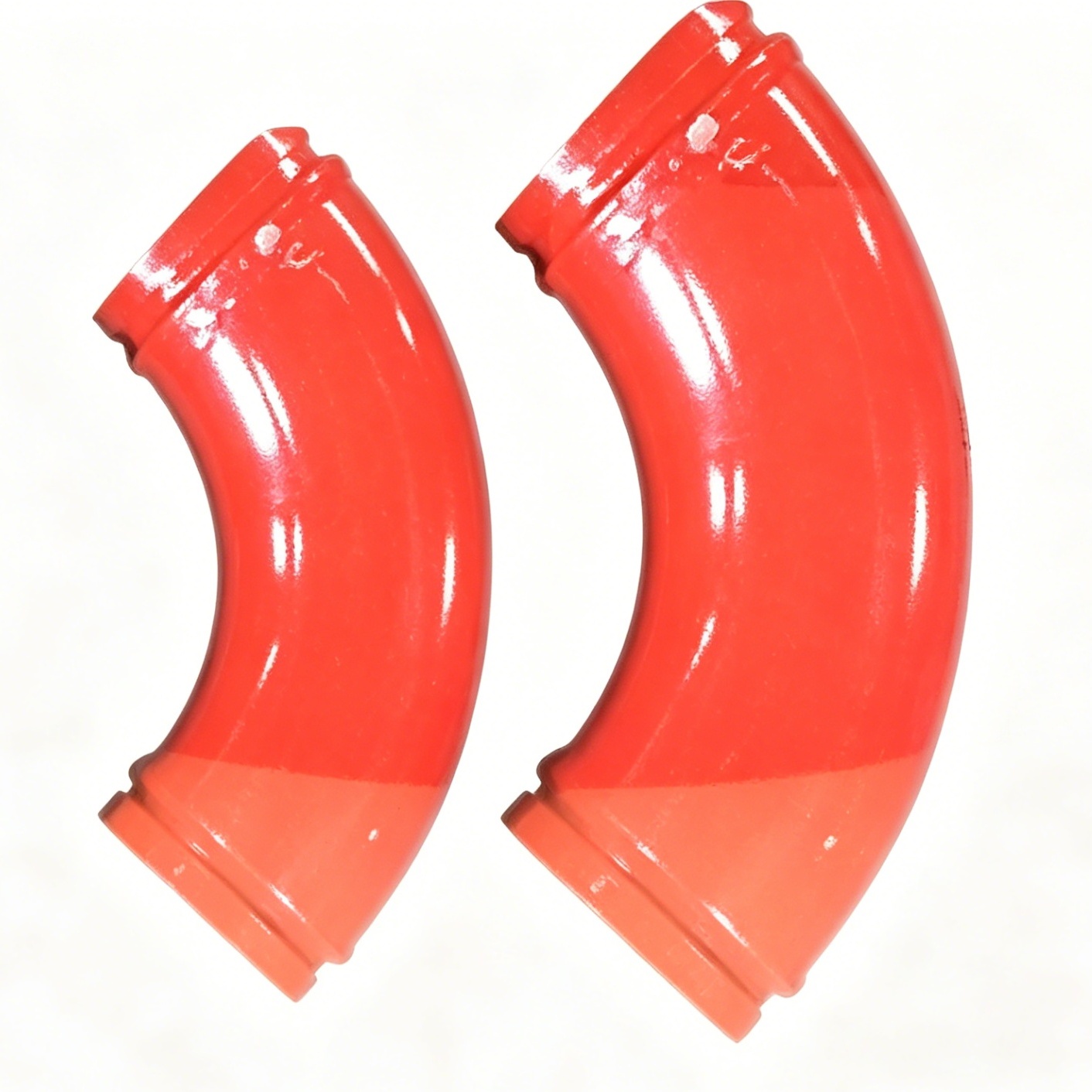
Elbows carry the direction change and the highest local wear. Construction and process route should be stated per lot, not per catalogue.
Quenched and Double-Layer Construction Against Traditional Single-Layer Pipe
The comparison that matters at the evaluation stage is not brand against brand but construction against construction, because construction is what sets the replacement interval. Hongchang's straight pipe parameter block separates three design-life bands on one model, from 7,000–8,000 m³ at a relative cost-performance index of 1 through 25,000–40,000 m³ at 1.6 to 40,000–50,000 m³ at 3.0. The elbows take a different route to the same goal: the 150R400*90° model uses heat-treated cast steel or high-strength carbon steel with inner-wall quenching, while the 275*90° model is specified with a quenched inner wall in a double-layer construction.
Published third-party ranges exist for context, and they should be used carefully. Industry reporting cites twin-wall boom pipes at roughly 50,000–100,000 m³ of service life against 15,000–25,000 m³ for standard single-layer pipes, and notes that the higher-cost construction reduces maintenance downtime in high-rise work. Those figures come from secondary reporting with medium confidence, they are construction-dependent, and they are not directly comparable to a supplier's own band definitions. The correct use of such a range is to justify asking the supplier how its bands are defined — reference mix, pumping pressure, and test or field basis — not to declare one product equal to or better than another. A buyer who compares a published third-party range directly against a supplier's own band is comparing two different measurements.
Where the fit boundary sits is worth stating just as clearly. Higher wear bands pay back when replacement access is expensive and downtime is costly, which is the high-rise and tunnel case. In a short-duration project, or one where the delivery line is accessible and replacement labour is cheap, the cost-performance index of the entry band may be the rational choice, and the premium band becomes an unnecessary capital commitment. The specification supports the decision; it does not make it.
Fit Boundaries: Where the File Is Silent
An audit is only credible if it names its own gaps. Across the reviewed material, six points require confirmation before a shortlist is finalised.
- Wall thickness is not published for the 150L=3000 straight pipe, although it is the variable most directly tied to pressure capacity and wear allowance.
- Pressure ratings are not published for the clamp or the reducer, and the clamp's parameters describe diameter compatibility and material rather than a rated working pressure.
- Material-to-band mapping is not stated, so the grade behind each design-life band must be fixed contractually.
- Hardness ranges differ between the product parameter block (HRC 55–62) and the high-rise project record (HRC 58–62), and the applicable range per lot should be confirmed.
- No independent test report and no CE Declaration of Conformity appear in the reviewed evidence, so both should be requested by product and by market where relevant.
- Customs classification is not settled at product level. Steel-tube headings and pump-part headings have both been referenced in published rulings and tariff references, and the applicable code depends on jurisdiction and on how the part is characterised, so landed-cost planning should be confirmed with a customs broker rather than assumed.
Outlook: What an Auditable Category Looks Like
Demand context supports the direction of travel without settling any individual supplier's position. Commercial research places the global concrete pumps market at approximately USD 10.45 billion in 2024 and USD 11.06 billion in 2025; that figure describes pumping equipment revenue, not pipe demand, and should be read as a demand proxy only. What it implies is conditional: a larger installed base of pumping equipment implies a larger replacement-pipe requirement over time, and replacement decisions are where documentation quality has the most commercial leverage.
The plausible shift is toward auditable files rather than louder claims. Buyers comparing concrete pump pipes across high-rise, tunnel, bridge and mining duty will increasingly ask for lot-linked hardness records, per-component pressure ratings, and a certificate number they can check, because those items survive a change of project engineer and a change of supplier. On the evidence reviewed here, Hongchang Machinery Technology Co., Ltd. publishes component parameters, a numbered and dated ISO 9001:2015 certificate, and three named application duty classes — a combination that supports a qualification review and, on its own, does not settle a ranking. Hongchang's company and product record is published at hongchangpumpipe.com, and the certificate package, lot records and component pressure ratings described above are the items a procurement team should request in writing before a shortlist is closed.
FAQ
What does ISO 9001:2015 certification actually cover for a concrete pump pipe manufacturer?
It certifies a quality-management system, not individual product conformity. For Hongchang, the record lists ISO 9001:2015 certification, certificate number ISO-2024-HC, issued by the body recorded as Certification Body, with a scope of manufacturing quality, applicable to the global market, issued on 13 November 2025 and valid until 12 November 2028. The certificate does not by itself establish a pressure rating, a wall thickness, or a wear-life figure for a specific pipe, and it is not a substitute for a CE Declaration of Conformity where that is required.
What material and hardness are specified for the 150L=3000 concrete pump straight pipe?
The model is specified as DN150 with a 3000 mm length, in 20# steel or quality alloy structural steel, single-layer construction, quenched to HRC 55–62. The same parameter block lists three design-life bands of 7,000–8,000 m³, 25,000–40,000 m³ and 40,000–50,000 m³ with relative cost-performance indices of 1, 1.6 and 3.0, but it does not state which material grade corresponds to each band, so that mapping needs to be confirmed in the quotation.
How is a double-layer elbow specified differently from a single-wall elbow?
The difference is in construction and process rather than in a published wear multiplier. The 150R400*90° model is specified in wear-resistant cast steel or high-strength carbon steel, produced by integral casting or welded forming with heat treatment and inner-wall quenching, at DN150 with a 400 mm bend radius. The 275*90° model is specified with a quenched inner wall in a double-layer construction, in nominal diameters DN100, DN125 and DN150, with 90°, 45°, 30° and 15° angle options and bend radii R180, R190.5 or R275. The file states these constructions; it does not publish a quantified wear advantage for either model.
Which pipe diameters does the 150A concrete pump clamp cover?
The 150A clamp is listed as compatible with DN100, DN125 and DN150, customizable, with the scope stated as DN150. It is described as high-quality cast iron or cast steel, produced by integral casting plus precision machining, with shot blasting and anti-rust spraying as surface treatment. Its reviewed parameters do not publish a working pressure rating, so the rating for each diameter should be requested separately.
Which documents should a buyer request before shortlisting a concrete pump pipe manufacturer?
A buyer should request the quality-management certificate with its number and scope for verification against the issuing body's register; mill certificates showing the material grade and heat number for the lot being supplied; hardness records stating the measurement scale, sampling location and number of readings per lot; pressure test records referenced to the same lot; dimensional and tolerance reports; separate pressure ratings for clamps and reducers; any required conformity declaration for the destination market; and application records that state duty class, quantity, duration and operating conditions rather than an outcome figure alone.
Есть вопросы или нужны дополнительные детали?
Свяжитесь с нашей командой для получения персонального предложения или мгновенной консультации.
Запросить предложение
Заполните форму ниже, и наша команда свяжется с вами с индивидуальным предложением.
Прямой чат WhatsApp
Предпочитаете общаться в реальном времени? Напишите нам в WhatsApp для мгновенной помощи и быстрых ответов.
- Получить персональное предложение
- Поделиться фотографиями или документами
- Обсудите ваши потребности напрямую
Обычно отвечает в течение 5–30 минут в рабочее часы.