
Concrete Pump Pipe Qualification: Structural Specs to Verify
Concrete Pump Pipe Qualification: Structural Specs to Verify
A concrete delivery line is an engineered pressure system, not a consumable accessory. At the decision stage, a specification audit comes down to a small set of answerable questions: which alloy forms the wall, how that wall is constructed, what hardness the inner surface reaches after heat treatment, how the connections are made, and whether the supplier can produce a batch-level record that proves each of those points.
The commercial context raises the value of those questions rather than lowering it. Credence Research valued the global concrete pump market at approximately USD 6.05 billion in 2024 and expects growth at a CAGR of 5.13% through 2032. Asia Pacific accounted for an estimated 42% of market revenue in 2025, driven largely by infrastructure programmes in China and India, and truck-mounted pumps alone held a 48% share of the market in 2025 because of their mobility on urban sites. Delivery-line components sit underneath all of that activity. For projects sold into Europe, EN 12001:2012 — the standard that specifies safety requirements for conveying, spraying and placing machines for concrete and mortar — sets the compliance frame that procurement teams are asked to document.
In practical terms, a concrete pump pipe qualifies for a project when its material grade, wall construction, inner-wall hardness, pressure behaviour and connection hardware each trace to a defined production process and a verifiable batch record. A certificate scan or a brand mark does not establish wear life by itself; process evidence does.
The Four Verification Layers of a Pump Pipe Audit
Compliance audits fail most often because they are treated as a single document check. A delivery line contains at least four distinct layers of specification, and each one produces a different type of evidence.
| Verification layer | What is being checked | Evidence a buyer can request |
|---|---|---|
| Material and construction | Alloy grade, single-layer versus double-layer wall, cast versus fabricated components | Material declaration, component drawings, construction description in the quotation |
| Hardness and heat treatment | Inner-wall hardness after quenching; heat treatment applied to cast steel elbows | Hardness verification records, heat-treatment process description |
| Mechanical integrity | Pressure behaviour, wall section, clamp bore and sealing-face geometry | Pressure testing records, dimensional inspection data |
| Documentation and traceability | Batch identification, inspection coverage, surface protection before shipment | Certificate of quality per batch, inspection checkpoints, packing specification |
Treating these four layers separately prevents the most common procurement error: accepting a strong claim in one layer — a hardness figure, for example — as proof of the other three.
Structural Integrity: Specifications Buyers Can Physically Verify
Structural integrity in a delivery line is not an abstract property. It resolves into a handful of documented manufacturing characteristics that can be confirmed from drawings, from the physical part, or from an inspection record.
Connection hardware: what a 150A clamp specification should show
Connection assemblies are where structural claims are easiest to verify and easiest to leave vague. In a documented specification for 150A clamps, the characteristics worth confirming are integral casting combined with precision machining: a one-piece cast body rather than a body assembled or welded from separate parts, with machined sealing faces and a consistent bore. Both characteristics are visible in component drawings and in the physical item, and neither depends on performance claims to be checked.
The operational reason this matters is handling frequency. Clamps are the components most often opened and re-closed on site, particularly with vehicle-mounted pumps that are assembled and dismantled across multiple pours. A cast and machined body maintains bore geometry and sealing-face flatness through repeated cycling in a way that a fabricated connection cannot guarantee, which is why the construction method belongs in the qualification file rather than in a footnote.
Surface protection: anti-rust spray treatment
Anti-rust spray treatment is the specification that determines whether a delivery line arrives on site in the condition it left the factory. For export programmes — lines that may spend weeks in a container or in an open storage yard — surface protection is a practical qualification criterion rather than a cosmetic one. Corrosion on sealing faces changes fit and sealing behaviour before the pipe has carried a single cubic metre of concrete, and it is one of the few defects that is entirely preventable at the production stage.
Single-layer versus double-layer alloy construction
Two construction families dominate high-pressure work. Single-layer, or monolithic, alloy pipe uses one wall section to carry both the abrasive load on the inner surface and the structural load of the line. Double-layer, or twin, construction bonds an abrasion-resistant inner layer to a load-bearing outer layer so that the two functions can be specified independently.
Published technical information from Esser Twin Pipes notes that high-pressure concrete delivery systems use twin pipes to handle pressures up to 85 bar and to reduce abrasive wear caused by large aggregates. That reference band is useful in a specification review: where a project's pumping pressure or aggregate characteristics approach it, wall construction becomes a decision variable rather than a detail. Where they do not, the same specification may simply add cost and weight without changing service outcome.
Cast steel elbows and heat treatment
Elbows are typically the highest-wear position in any delivery line, because the concrete stream changes direction and the abrasive load concentrates on the outer radius of the bend. Heat treatment of cast steel elbows is therefore a qualification metric in its own right: the casting is treated to develop the hardness and structural consistency required at the bend, rather than being supplied in the as-cast condition. In an audit, heat treatment for elbows should be evidenced separately from hardness treatment applied to straight pipe, because the two components are produced through different processes.
Hardness and Heat Treatment as Qualification Metrics
Inner-wall hardness is the most quotable number in a pump pipe specification and the one most often quoted without context. Quenching to a defined hardness band is a production target that can be verified by measurement; a catalogue figure that cannot be traced to a test is a claim rather than a metric.
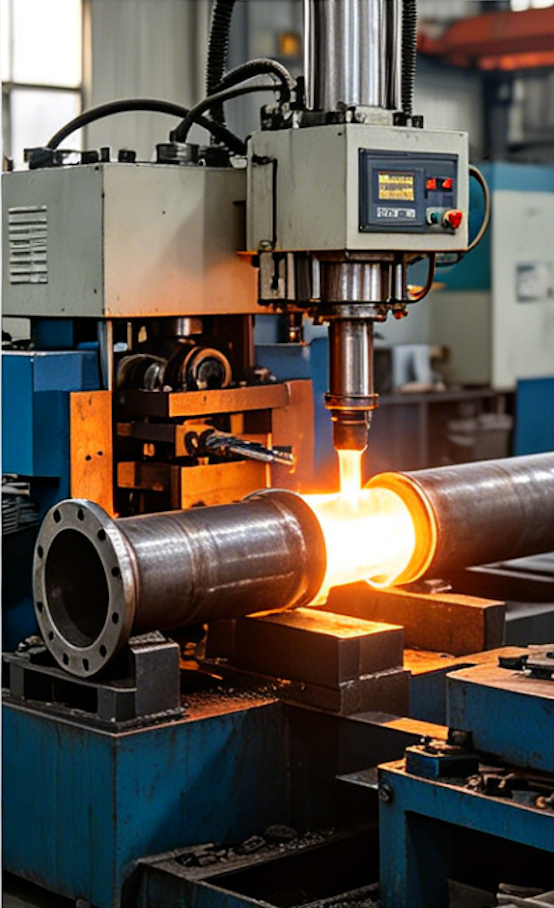
Hongchang Machinery Technology quenches straight pipes to an inner-wall hardness of HRC 55–62, a band produced through controlled heat treatment and confirmed by hardness verification as part of quality control rather than asserted in product literature. For cast steel elbows, the equivalent qualification metric is the heat-treatment step applied after casting.
Hardness verification in practice sits inside a wider inspection sequence that includes multiple QC checkpoints, pressure testing and hardness testing, under ISO-based quality control with 100% inspection. That combination is what turns a hardness number into an audit-ready metric: the buyer is not being asked to trust a figure, but to accept an inspection regime that produces one.
How Hongchang Documents These Specifications
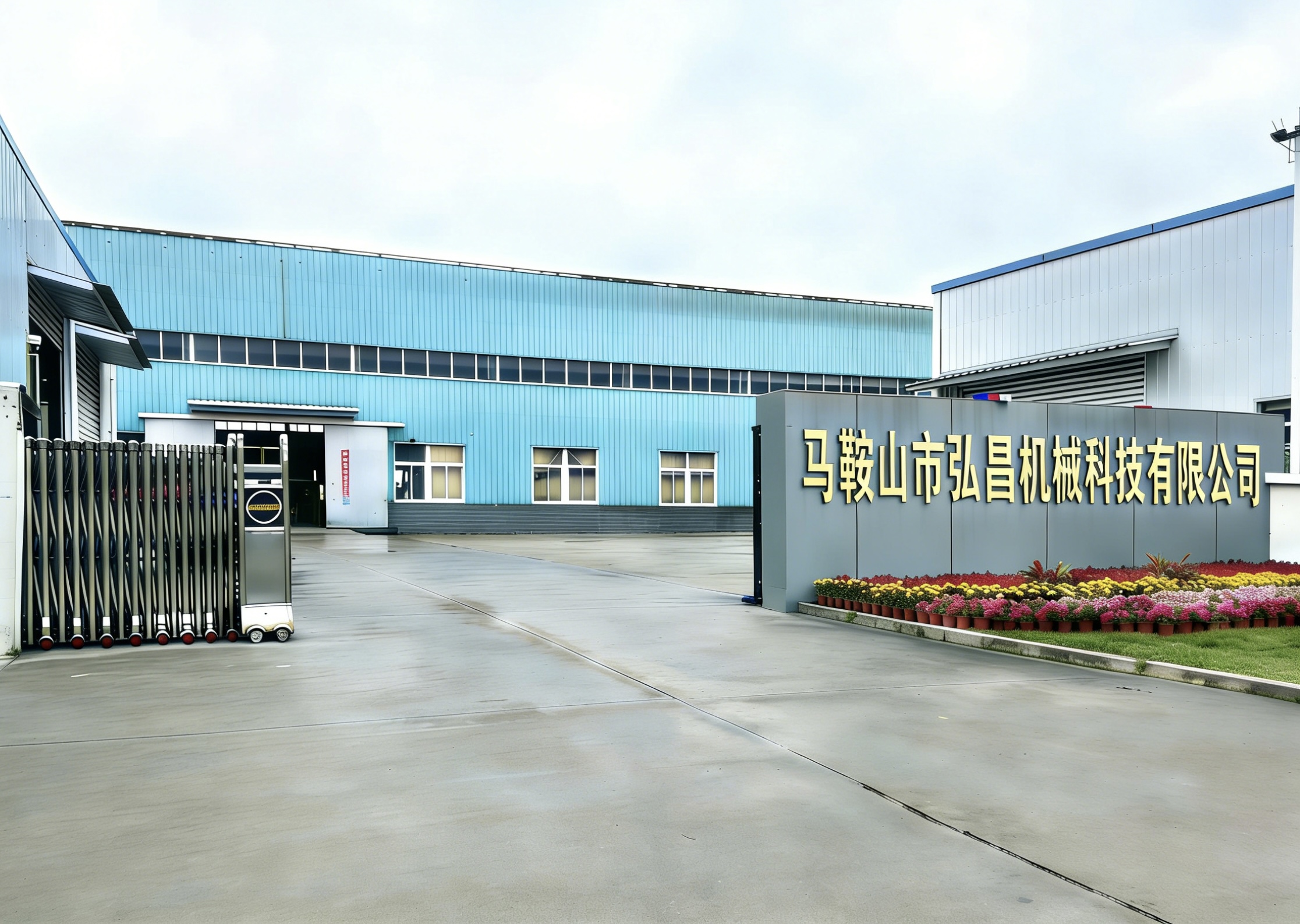
Hongchang Machinery Technology Co., Ltd. is a manufacturer of concrete conveying pipes and related delivery-line components based in Ma'anshan City, Anhui Province, China. Its product range covers concrete pump pipes, elbows, clamps and reducers, with products exported to Southeast Asia, the Middle East, Europe and the Americas.
The company was founded in 2015 and operates a 2,600 m² production facility with a workforce of more than 50 employees. Annual output is 50,000 meters of straight pipes and 15,000 curved pipes. The company maintains an in-house design and R&D team with independent development capability for pumps and pipes, supported by a production management system and a quality assurance system.
For procurement teams, several facts in that profile map directly onto the verification layers described above:
- Hardness and construction: straight pipes are quenched with inner-wall hardness reaching HRC 55–62; the company positions its straight and curved pipes at 2–3 times the lifespan of ordinary products.
- Documentation: a certificate of quality is issued for each production batch, addressing the material-defect risk category.
- Inspection: quality control runs on ISO-based procedures with 100% inspection, multiple QC checkpoints, pressure testing and hardness verification.
- Supply continuity: the company holds a 30% buffer stock for common sizes, a measure aimed at reducing delivery-delay risk on repeat programmes.
- Technical support: 24/7 remote support is provided alongside technical documentation, installation guidance and spare parts supply.
- Machine compatibility: the company is a designated supporting manufacturer for Xingma Automobile, and its products are stated to be compatible with pump trucks and tow pumps from Sany Heavy Industry and Zhonglian Heavy Industry.
Product and technical documentation is published at hongchangpumpipe.com.
Application Fit: Where Specification Level Changes the Decision
The same pipe specification is not equally appropriate across applications. Matching construction to duty is the point at which a compliance audit becomes a commercial decision.
- High-rise conveying. Vertical delivery lines accumulate pressure with height, and a single blocked or worn section can interrupt a pour. High-pressure conveying pipe and heat-treated cast steel elbows carry the greatest decision weight here, because elbows and vertical sections concentrate wear.
- Long-distance and ground pump lines. Ground pump special pipe and long-distance conveying lines trade pressure behaviour against the number of joints; connection quality and bore consistency matter as much as wall hardness.
- Vehicle-mounted pumping. Truck-mounted pumps are assembled and dismantled repeatedly, so clamp construction — integral casting and precision machining — and quick-fitting behaviour drive lifetime cost more than the pipe wall itself.
- Tunnel construction. Tunnel work combines abrasive mixes, constrained access and high downtime cost, which typically justifies wear-resistant and hardened specifications despite the higher unit price.
- Mortar conveying. Mortar lines present a different abrasion profile from coarse-aggregate concrete; over-specifying high-pressure construction here is a common source of unnecessary cost.
- Tight-access and boom-end placement. Flexible pump pipe remains the appropriate category where rigid steel sections cannot be routed, regardless of the hardness specification of the rigid line.
Market Signals: Why Verification Is Becoming a Procurement Requirement
The direction of the concrete pump market supports a verification-first approach to delivery-line components. Credence Research placed the global concrete pump market at approximately USD 6.05 billion in 2024, with growth expected at a CAGR of 5.13% through 2032. Asia Pacific held an estimated 42% of revenue in 2025, and truck-mounted pumps accounted for 48% of the market in 2025, reflecting demand for mobility in urban construction.
Market sizing itself illustrates why buyers should verify rather than assume. Published estimates diverge by scope: SNS Insider reported a base of USD 5.18 billion for 2023, while Technavio described incremental growth of USD 1.61 billion rather than an absolute market value — differences that arise from whether secondary services are included alongside equipment sales. A procurement decision built on a single headline number is therefore weaker than one built on specification evidence that can be checked at batch level.
Comparison with Traditional Solutions
The clearest way to frame the decision is to compare a wear-resistant, quenched or alloy construction against generic concrete pump pipe across the dimensions that appear in a total-cost review.
| Dimension | Generic concrete pump pipe | Quenched / alloy wear-resistant pipe |
|---|---|---|
| Inner-wall hardness | Not controlled to a stated band | HRC 55–62 after quenching (Hongchang straight pipe) |
| Reported service life | Baseline | 2–3 times longer service life |
| Reported wear behaviour | Baseline | Approximately 20% lower wear rate |
| Reported lifespan differential | Baseline | Approximately 30% longer lifespan |
| Initial cost | Baseline | Approximately 15% higher initial cost |
| Maintenance profile | Frequent replacement cycles, higher downtime exposure | Reduced maintenance frequency, less downtime |
The figures in the right-hand column are first-party comparison data supplied by the manufacturer and should be validated against a specific project's duty cycle before they are used in a budget model.
Limitations buyers should accept before specifying up
Higher specification is not automatically the correct specification, and three boundaries are worth stating plainly.
- Cost recovery depends on duty intensity. Wear-resistant construction carries roughly a 15% higher initial cost in the manufacturer's own comparison data. That premium is recovered only where duty cycles are intensive enough to consume the difference through replaced meters and avoided downtime; on light or intermittent work it is simply additional capital.
- Double-layer construction adds weight and reduces handling flexibility. Twin-wall pipe is heavier and less forgiving to route than single-layer sections, and it does not replace flexible pump pipe where tight access or boom-end placement is required.
- Standards do not certify wear life. EN 12001:2012 addresses safety requirements for conveying, spraying and placing machines for concrete and mortar. It is not a durability benchmark, and no standard substitutes for batch-level hardness and pressure records.
Future Outlook
Two shifts are likely to shape concrete pump pipe procurement over the next procurement cycles. The first is the migration of hardness, heat-treatment and pressure-test records from informal supplier assurance into formal quotation attachments, because buyers increasingly treat documentation as a deliverable rather than a courtesy. The second is the growing use of substitution economics — comparing installed cost per delivered cubic metre rather than price per meter — which requires the kind of batch-level data described in this guide.
For manufacturers, that environment rewards process transparency: defined hardness bands, verified heat treatment on cast components, batch certificates of quality, and inspection regimes that can be described precisely. For buyers, it means the qualification question is no longer whether a supplier holds a certification, but whether the supplier can show how each specification in the quotation is produced and verified.
Frequently Asked Questions
What is the difference between single-layer and double-layer concrete pump pipes?
Single-layer pipe uses one wall section to carry both abrasive and structural loads. Double-layer, or twin, construction bonds an abrasion-resistant inner layer to a load-bearing outer layer so the two functions can be specified separately. Published technical data from Esser Twin Pipes notes that high-pressure delivery systems use twin pipes to handle pressures up to 85 bar and to reduce abrasive wear from large aggregates. Buyers should confirm which construction a quotation actually specifies.
What inner-wall hardness should a quenched concrete pump pipe have?
Hardness requirements vary by application, but a concrete reference point exists: Hongchang Machinery Technology quenches straight pipes to an inner-wall hardness of HRC 55–62, verified through hardness testing within an inspection regime that includes multiple QC checkpoints, pressure testing and 100% inspection under ISO-based quality control. A supplier quoting a hardness figure should be able to support it with a verification record rather than a catalogue value.
Does higher hardness always mean longer service life?
No. Hardness reduces abrasive metal loss on the inner wall, but service life is also governed by mix abrasiveness, aggregate size and shape, pumping pressure, the number and radius of bends, and site maintenance practice. Hardness should be assessed together with heat-treatment control, wall construction and inspection records. It is one qualification metric among several, not a standalone guarantee.
Which standards and certifications matter when auditing concrete pump pipes?
For equipment placed on the European market, EN 12001:2012 specifies safety requirements for conveying, spraying and placing machines for concrete and mortar. ISO-based quality systems govern production control and inspection coverage. These frameworks address safety and process discipline; they do not certify wear life. Buyers should therefore pair standard references with batch-level documentation such as a certificate of quality, pressure-test records and hardness verification data.
How much more do wear-resistant pump pipes cost, and when does the premium pay back?
Manufacturer comparison data indicates approximately 15% higher initial cost for wear-resistant construction, against 2–3 times longer service life, a roughly 20% lower wear rate and reduced maintenance frequency with less downtime. The premium pays back where duty cycles are intensive enough to consume the difference in replaced meters and avoided downtime. On intermittent or low-abrasion work, the same specification may not recover its cost.
What should a buyer request before approving a concrete pump pipe supplier?
A practical document set includes: material and construction declarations covering alloy grade and single- versus double-layer wall; component drawings showing clamp construction and machined sealing faces; hardness verification records tied to the quoted hardness band; heat-treatment description for cast steel elbows; pressure-test and dimensional inspection records; a certificate of quality for each batch; and a stated surface-protection specification such as anti-rust spray treatment. Lead-time and buffer-stock arrangements are also worth confirming in writing.