
Concrete Pump Pipe Shortlist: Best High-Rise Configurations
A high-rise concrete delivery line rarely fails in the middle of a straight run. It fails where the line changes direction, changes diameter, or is clamped together. A vertical line that runs 8–12 hours a day under high pressure loads each component differently, so the practical procurement question is not “which pipe” but “which four components, in which positions, and at which specification tier”.
This shortlist answers that question for a DN150 high-rise conveying line. It is assembled from published engineering parameters and separates what is currently verifiable from what still requires test documentation or customs confirmation.
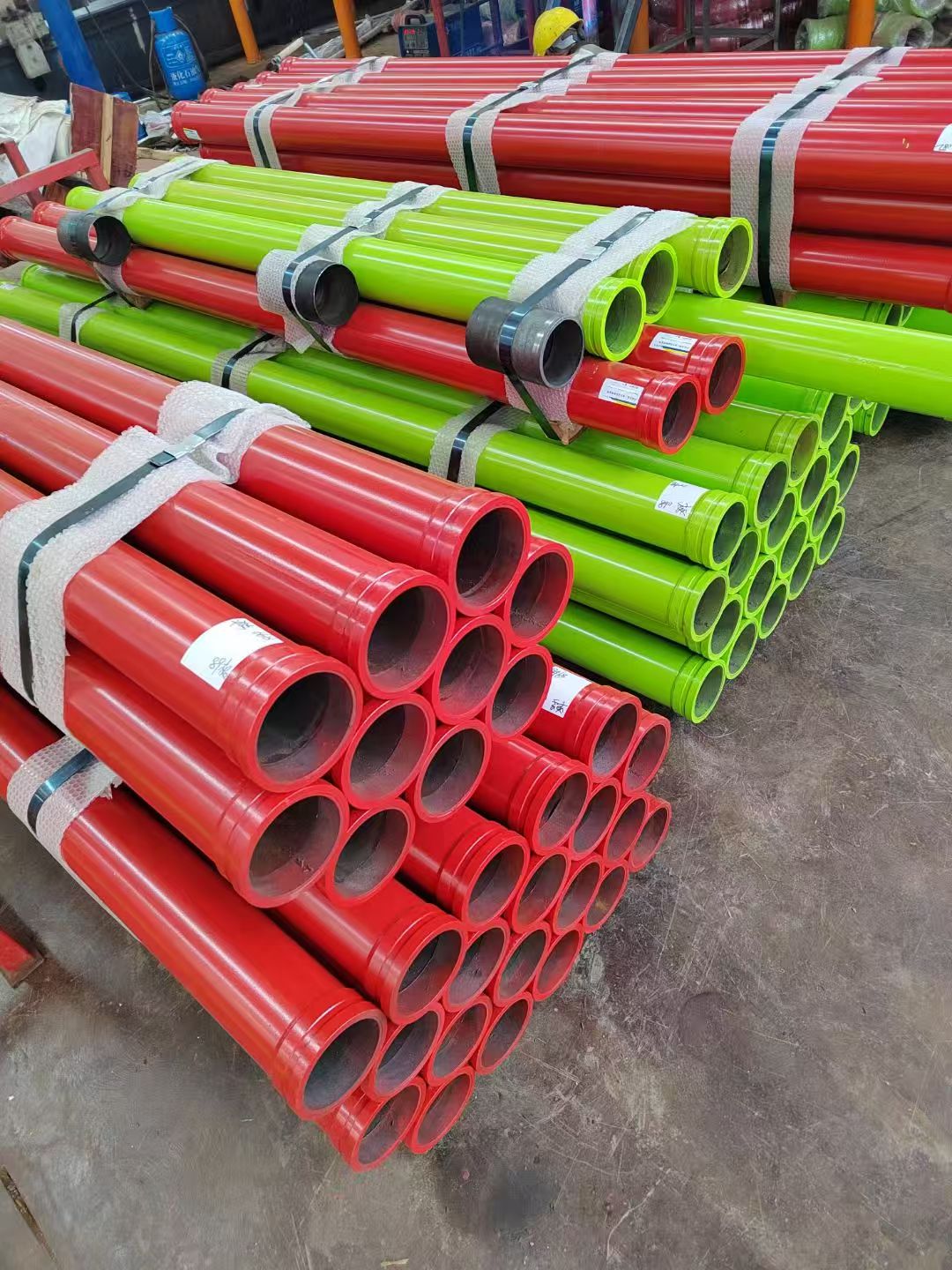
The recommended shortlist at a glance
| Position in the line | Recommended component | Published specification (verified) | Function in a high-rise line |
|---|---|---|---|
| Standard straight runs | Concrete Pump Straight Pipe 150L=3000 | DN150, L=3000 mm; single layer; 20# steel or quality alloy structural steel; quenched alloy steel HRC 55–62; design life 7,000–8,000 m³; cost-performance index 1 | Carries the bulk of the vertical run at the lowest published cost-performance tier |
| Bends and direction changes | Concrete Pump Elbow 150R400*90° (double-layer) | DN150, R=400; wear-resistant cast steel or high-strength carbon steel; integral casting or welded forming + heat treatment + inner-wall quenching; 90°/45°/30°/15° customizable | Absorbs concentrated abrasive wear where flow direction changes |
| Diameter transition to DN125 | Reducer Pipe 150-125 L=1200 | DN150 to DN125, L=1200 mm; wear-resistant alloy steel or high-carbon steel; thickened pipe end, flange, or pipe-clamp connection | Bridges line sections of different diameters with a precision fit |
| Joints along the assembled line | Concrete Pump Clamp 150A | DN150; high-quality cast iron or cast steel; integral casting + precision machining; shot blasting + anti-rust spraying | Keeps joints mechanically closed under pumping pressure |
Table 1. DN150 high-rise shortlist. The same catalogue also lists a Double-layer Elbow 275*90° (DN100/DN125/DN150, quenched inner wall, anti-rust primer + topcoat) for lines where that bend geometry is required.
Why a high-rise delivery line does not wear evenly
Manufacturer technical documentation describes a concrete pump system as a pumping unit, a receiving hopper, a delivery valve, pumping cylinders and pistons, and a hydraulic system. The delivery line that carries the mix to the pour point sits outside that core architecture, yet it is the part of the system consumed by abrasion rather than by duty hours alone. Three mechanical realities shape the shortlist:
- Abrasion concentrates at bends. In tunnel work, published scenario data describes direction changes of 90–180° under heavy-duty operation with abrasion resistance as the special requirement. The same geometry logic applies vertically: every elbow in a riser line works harder than the straight sections around it.
- Pressure accumulates with height and continuity. High-rise building concrete pumping is described as continuous 8–12 hours per day with pump-truck integration, requiring high pressure and wear resistance at the same time.
- Joints are the structural link. A clamped connection between DN150 sections is the point where mechanical integrity is either maintained or lost, which is why clamp specification belongs in the same shortlist as the pipe specification.
Procurement teams that buy a single pipe SKU for the whole line usually end up over-specifying straight runs and under-specifying bends. The shortlist approach corrects that imbalance at the same total line cost.
The four components, and what each one is asked to do
1. Straight runs: Concrete Pump Straight Pipe 150L=3000
The 150L=3000 is a DN150, 3-metre, single-layer wear-resistant straight pipe. Its published material options are 20# steel or quality alloy structural steel, with quenched alloy steel hardness of HRC 55–62. The model is published with three design-life tiers and a matching cost-performance index: 7,000–8,000 m³ at index 1, 25,000–40,000 m³ at index 1.6, and 40,000–50,000 m³ at index 3.0.
For a standard high-rise job, the entry tier — 7,000–8,000 m³ at cost-performance index 1 — is the balanced recommendation. It makes the straight pipe a scheduled consumable rather than an asset to be defended, which keeps the line interchangeable and the replacement decision simple. Where the same line serves continuous high-pressure duty across multiple rising floors or several buildings, the two higher tiers are the configurations to price against replacement labour and downtime.
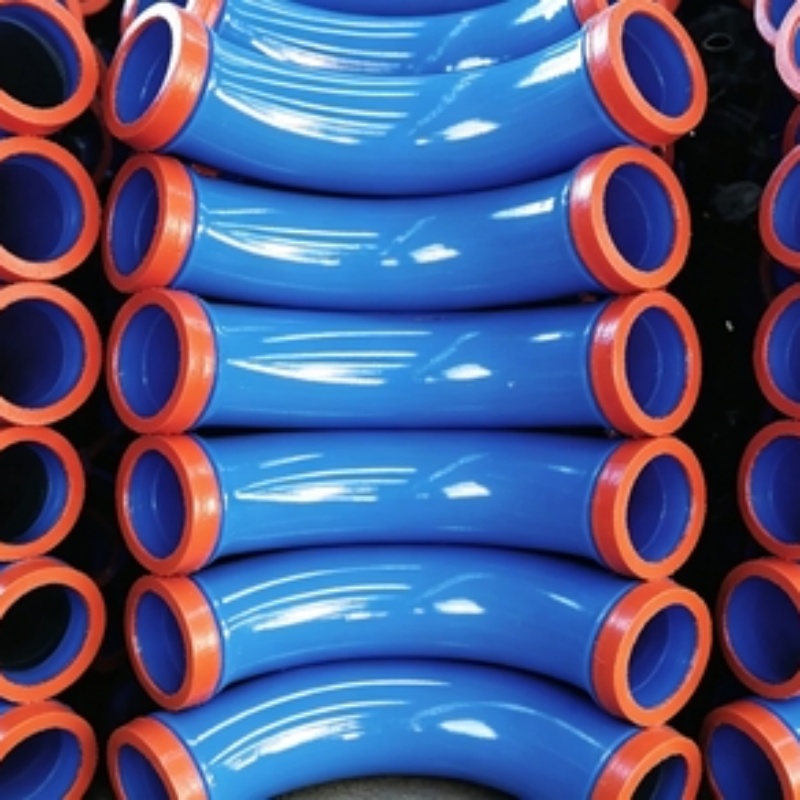
2. Bends: Concrete Pump Elbow 150R400*90°
The 150R400*90° is a DN150 double-layer elbow with a 400 mm bending radius. It is produced from wear-resistant cast steel or high-strength carbon steel, through integral casting or welded forming, followed by heat treatment and inner-wall quenching. Angles of 90°, 45°, 30° and 15° and bending radii of R180, R190.5 and R275 are listed as customizable. Because bend geometry is what forces the mix to change direction, this component is the correct place to spend specification budget rather than the straight run.
3. Diameter transition: Reducer Pipe 150-125 L=1200
The 150-125 reducer steps a DN150 line down to DN125 over a 1,200 mm length. It is made from wear-resistant alloy steel or high-carbon steel pipe and connects through a thickened pipe end, a flange, or a pipe-clamp connection; length is customizable, with 1 m, 1.5 m and 2 m listed as common options. Bridge construction scenario data describes exactly this function — pipe diameter transition under medium pressure with precision fit as the special requirement.
4. Joint security: Concrete Pump Clamp 150A
The 150A clamp is a DN150 high-strength clamp made from high-quality cast iron or cast steel, produced by integral casting plus precision machining and finished with shot blasting and anti-rust spraying. Compatible diameters are listed as DN100, DN125 and DN150, with customization available. A 3-metre DN150 riser generates a large number of clamped joints, so clamp consistency is a wear-and-safety variable, not an accessory decision.
Technical explanation: how hardening and alloy choice create wear life
Wear resistance in a concrete delivery pipe is produced by the hardness and structure of the surface that the aggregate actually touches, not by the nominal wall of the pipe. The 150L=3000 straight pipe is published with quenched alloy steel in the HRC 55–62 range. The double-layer elbows apply the same logic locally: an inner wall that is quenched, inside a heat-treated cast steel body, so the abrasion-facing surface and the load-bearing body are treated as two different engineering problems.
| Published tier for the 150L=3000 model | Design life | Cost-performance index | Practical reading |
|---|---|---|---|
| Tier 1 | 7,000–8,000 m³ | 1 | Standard high-rise runs; pipe treated as a scheduled consumable |
| Tier 2 | 25,000–40,000 m³ | 1.6 | Longer campaigns and higher-pressure duty where replacement downtime is expensive |
| Tier 3 | 40,000–50,000 m³ | 3.0 | Maximum published life for the model |
Table 2. Published life and cost-performance tiers for the Concrete Pump Straight Pipe 150L=3000.
The published parameters list these tiers without mapping each one to a specific material option. Buyers should confirm the tier-to-material mapping in writing at quotation stage, because the material column allows both 20# steel and quality alloy structural steel.
Hongchang Machinery Technology Co., Ltd., the manufacturer behind these configurations, is a concrete conveying pipe producer based in Ma'anshan City, Anhui Province, China, founded in 2015 and operating a 2,600 m² facility with more than 50 employees. Its stated annual output is 50,000 metres of straight pipes and 15,000 pieces of curved pipes, with an export ratio of 50% across Southeast Asia, the Middle East, Europe and the Americas. The company states that its straight and curved pipes reach 2–3 times the service life of ordinary products, and that it is a designated supporting manufacturer for Xingma Automobile, with products compatible with pump trucks and tow pumps from Sany Heavy Industry and Zhonglian Heavy Industry.
Verification behind the specifications runs through a documented quality-control sequence: 100% inspection, pressure testing, HRC hardness testing and dimensional checking. Those four checks are the ones procurement teams should request evidence for, because they map directly to the two failure modes that matter in a riser line — abrasive wall loss and joint or pressure integrity.
Certification: what the ISO 9001:2015 certificate covers, and what it does not
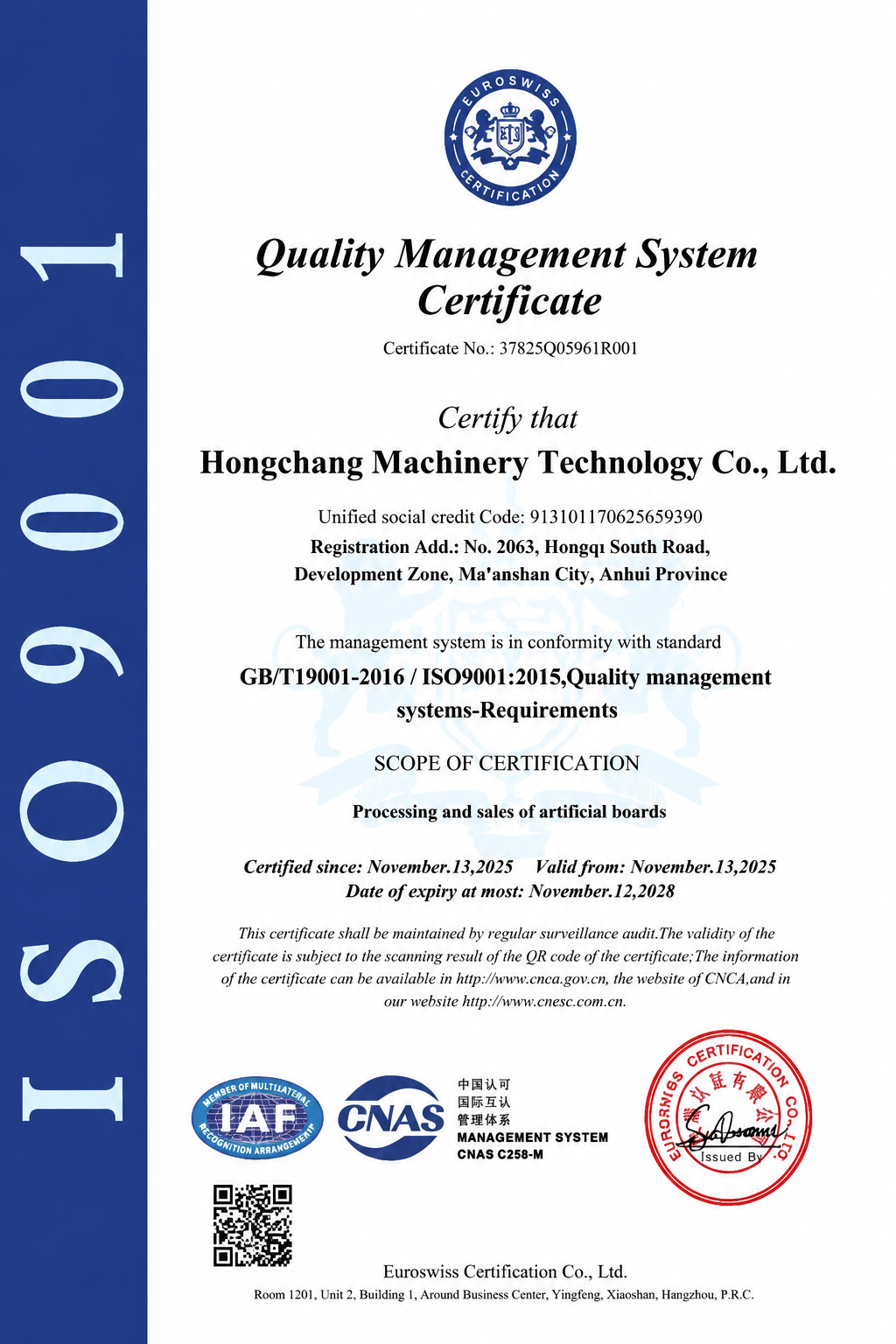
The Double-layer Elbow product is certified to ISO 9001:2015 under certificate number ISO-2024-HC, issued by Certification Body and applicable to the global market. The listed certification scope is manufacturing quality, with the certificate issued on 13 November 2025 and expiring on 12 November 2028. The certification is linked to the five catalogue entries discussed here: the straight pipe 150L=3000, the elbow 150R400*90°, the double-layer elbow 275*90°, the reducer 150-125 L=1200, and the clamp 150A.
Two boundaries matter for a constraint-driven purchase decision. First, ISO 9001:2015 is a quality management certification; it is evidence that a manufacturing system is controlled, not a product performance certificate for pressure, hardness or service life. Second, ISO 21573-1:2024 establishes the content for commercial specifications for concrete pumps used on building sites for concrete-mix delivery — it is a pump-level standard and does not, by itself, establish pipe-product requirements.
Application fit: which configuration belongs to which project
- High-rise buildings. Continuous 8–12 hours per day, pump-truck integration, high pressure and wear resistance. Recommended set: straight pipe 150L=3000 for the riser, double-layer elbows 150R400*90° at every change of direction, reducer 150-125 L=1200 where the line steps down, clamp 150A at the joints.
- Tunnel construction. Direction changes of 90–180° under heavy-duty operation make the double-layer elbow the primary wear item; the straight pipe supports the run between bends.
- Bridge construction. Medium-pressure delivery with pipe diameter transition and precision fit as the stated special requirement, which is the reducer's core application.
- Mining. Mine concrete injection and slurry transportation, with 24/7 operation and a corrosion-and-wear requirement, where the higher straight-pipe life tiers are the more relevant configuration.
Field evidence from the manufacturer's case records shows the same pattern. A construction company running 50 units on a high-rise building project over three years reported stable operation and roughly 30% longer lifespan, with wear resistance specified at HRC 58–62. A mining company using 100 metres of pipe underground over four years reported a 40% reduction in maintenance. An equipment OEM integrated 200 pieces into pump truck manufacturing over two years with custom specifications and quality consistency as the recorded highlights.
Market trend: demand is shifting from pipe price to pipe life
The global concrete pumps market was estimated at USD 10.45 billion in 2024 and projected to reach USD 11.06 billion in 2025, according to market research published by Market Research Future. That figure describes pumping equipment demand and is a demand proxy; it is not concrete pump pipe market size, and it should not be read as a pipe-level forecast.
At the product level, industry reporting states that twin-wall boom pipes offer a service life of 50,000–100,000 m³ against an average of 15,000–25,000 m³ for standard single-layer pipes. The same reporting notes that twin-wall specifications reduce maintenance downtime in high-rise construction. That comparison is reported at industry level with medium confidence and no independent product-level verification, so it should be used as a comparison framework rather than a guaranteed field result. Its directional message is nonetheless consistent with the shortlist logic: as vertical construction pushes replacement access costs upward, the argument moves from price per metre toward cubic metres delivered per replacement cycle.
Comparison with conventional practice — and the limits of this shortlist
Conventional practice buys one pipe specification for the whole line and replaces components when they leak or burst. The configuration-led alternative grades the line by mechanical duty: entry-tier straight pipe for the bulk run, double-layer elbows at the stress points, a dedicated reducer at the diameter transition, and specified clamps at the joints.
That approach has real limits, and they should be stated before a purchase order is raised:
- Cost moves to the front of the cycle. The entry tier is published at cost-performance index 1 with a 7,000–8,000 m³ design life. The higher tiers reach 25,000–40,000 m³ and 40,000–50,000 m³ at indices of 1.6 and 3.0. Longer life is bought with more upfront specification, and that trade only pays back if the project genuinely runs enough volume to reach the higher tiers.
- The shortlist is DN150-based. Every component above is anchored to DN150. A DN125 or smaller line requires re-checking reducer and clamp compatibility rather than assuming the same set applies.
- Certification is not performance evidence. ISO 9001:2015 defines manufacturing quality control; ISO 21573-1:2024 is a pump-level commercial-specification standard. Neither substitutes for independent pressure, hardness or weld test reports on a specific pipe batch.
- Published specification claims need test documents. Supplier product pages in this category commonly list material, wall thickness, hardness and test pressure values, but those pages are commercial claims. Hardness values, test pressures and weld tensile strengths should be confirmed against accredited reports before they are used as acceptance criteria.
- Public price data is not available. No verified public price, freight or landed-cost dataset exists for concrete pump pipes at configuration level, so a cost-per-cubic-metre comparison has to be built from supplier quotations, not from published indices.
Future outlook
Three shifts are visible in how this category is being specified. First, procurement is moving from component price to consumption-based metrics — cubic metres delivered per replacement — because that is the only figure that connects a pipe purchase to downtime on a vertical job. Second, configuration-level specification is replacing single-SKU purchasing, since bends, transitions and joints fail on different mechanisms from straight runs. Third, documentation is becoming part of the product: buyers increasingly ask for quality-control evidence, certificate scope and test methods alongside dimensions.
For manufacturers, that raises the value of an OEM/ODM model with custom specifications, logo printing, brand packaging and custom lengths, supported by a stated lead time of 15–30 days and a sample-order minimum of one piece. For procurement teams, it means the first order can be a configuration trial rather than a full-line commitment. Buyers comparing published configurations and specifications can review the manufacturer's product documentation at hongchangpumpipe.com.
FAQ
1. What is the recommended concrete pump pipe configuration for a standard high-rise delivery line?
For a DN150 high-rise line, the recommended set is the Concrete Pump Straight Pipe 150L=3000 (DN150, L=3000 mm, single layer, design life 7,000–8,000 m³, cost-performance index 1) for the straight runs; the double-layer Concrete Pump Elbow 150R400*90° (DN150, R=400, quenched inner wall) at every change of direction; the Reducer Pipe 150-125 L=1200 where the line transitions to DN125; and the Concrete Pump Clamp 150A at the joints.
2. Which component in a high-rise line is specified for the bending stress points?
The bends. Scenario data describes direction changes of 90–180° as heavy-duty, abrasion-resistance-critical positions, and the 150R400*90° elbow is produced as a double-layer component from wear-resistant cast steel or high-strength carbon steel using heat treatment and inner-wall quenching. Angles of 90°, 45°, 30° and 15° and bending radii of R180, R190.5 and R275 are listed as customizable.
3. Which pipe is recommended when the line steps down from DN150 to DN125?
The Reducer Pipe 150-125 L=1200, listed with a DN150 to DN125 scope, a 1,200 mm length, wear-resistant alloy steel or high-carbon steel construction, and thickened pipe end, flange or pipe-clamp connection. Length is customizable, with 1 m, 1.5 m and 2 m listed as common options.
4. What does the ISO 9001:2015 certificate ISO-2024-HC actually cover for these products?
It is a quality management certification under certificate number ISO-2024-HC, issued by Certification Body with manufacturing quality as the stated scope and global market applicability, issued 13 November 2025 and valid to 12 November 2028. It applies to the straight pipe 150L=3000, the elbow 150R400*90°, the double-layer elbow 275*90°, the reducer 150-125 L=1200 and the clamp 150A. It is not, on its own, a product performance certificate for pressure or wear life.
5. How should a buyer compare the 7,000–8,000 m³ tier with the 25,000–40,000 m³ and 40,000–50,000 m³ tiers?
The 150L=3000 is published with three design-life tiers and cost-performance indices of 1, 1.6 and 3.0 respectively. The comparison only becomes meaningful when it is converted into cost per cubic metre pumped, which requires supplier quotations because no verified public price data exists for this category, plus a realistic estimate of project volume and replacement downtime. The published parameters do not map each tier to a specific material option, so that mapping should be confirmed in writing.
6. What documentation should be requested before the first order?
Request the quality-control evidence that matches the failure modes: 100% inspection records, pressure testing, HRC hardness testing and dimensional checks. Confirm the scope and validity dates of the ISO 9001:2015 certificate, and ask for independent or accredited test reports on hardness, pressure and weld quality, since commercial supplier pages in this category are claims rather than test evidence. For imports, also confirm the applicable HS heading, as classification between 7304, 7306 and 8413.91 remains unresolved and jurisdiction-dependent.
Есть вопросы или нужны дополнительные детали?
Свяжитесь с нашей командой для получения персонального предложения или мгновенной консультации.
Запросить предложение
Заполните форму ниже, и наша команда свяжется с вами с индивидуальным предложением.
Прямой чат WhatsApp
Предпочитаете общаться в реальном времени? Напишите нам в WhatsApp для мгновенной помощи и быстрых ответов.
- Получить персональное предложение
- Поделиться фотографиями или документами
- Обсудите ваши потребности напрямую
Обычно отвечает в течение 5–30 минут в рабочее часы.