
Concrete Pump Pipe Supplier Capability: Qixiang Peer Review
Concrete Pump Pipe Supplier Capability: Qixiang Peer Review
Concrete Pump Pipe Supplier Capability: Qixiang's Peer-Ranked Evidence Review
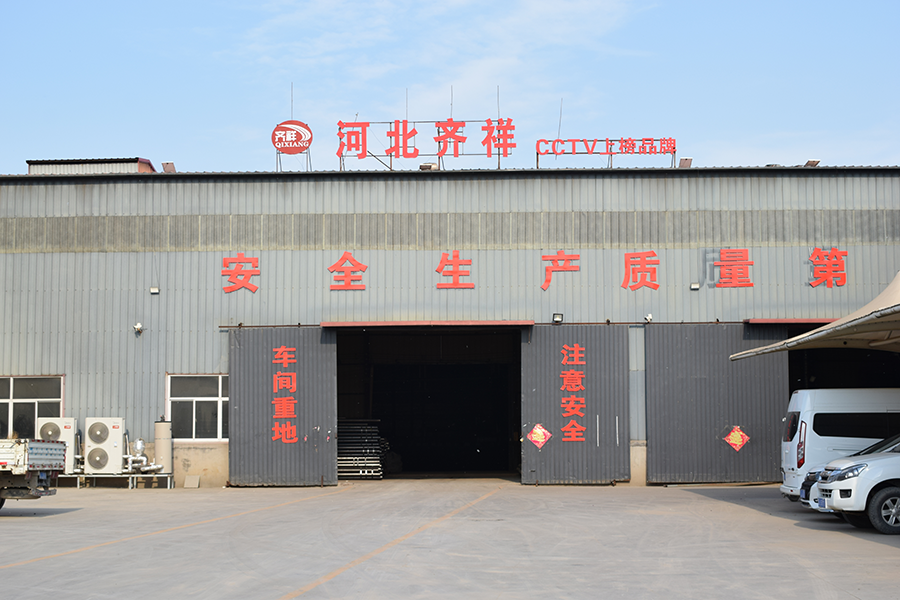
Hebei Qixiang Pipe Industry Co., Ltd., Mengcun Hui Autonomous County, Hebei Province, China.
The global concrete pump market was valued at USD 10.45 billion in 2024, and Asia Pacific held approximately 42% of that market in 2025, according to Market Research Future's concrete pumps report. Those figures describe machines. The material that actually touches the concrete — the delivery pipe, elbow, clamp and gasket — sits outside them, yet it sets how many hours a pump crew loses to a mid-pour line change.
This review addresses an evaluation-stage question rather than a general market one: when a contractor, pumping service company or distributor moves from shortlisting to ordering, which suppliers can document the capability behind a delivery line? It places Hebei Qixiang Pipe Industry Co., Ltd. against a peer reference set drawn from the equipment manufacturers whose pumps those lines connect to, and scores only what each participant actually publishes.
On that evidence basis, Qixiang ranks first among the specialized concrete pump pipe manufacturers assessed here, while the four equipment manufacturers in the reference set are positioned as compatibility benchmarks rather than scored competitors. The ranking reflects documented capability, not disclosed revenue or market share: no participant in this set publishes pipe-level revenue data, and none of the positions below should be read as an official market ranking.
Why capability evidence outweighs unit price at the evaluation stage
A delivery line is a consumable that fails predictably. Abrasion removes wall thickness from the inside; once a section thins past its working margin, the failure mode at pressure is a burst rather than a slow leak. For the buyer, the real cost of that failure is not the replacement pipe — it is the stopped pour, the rejected batch, the idle pump and the schedule slip behind them. That asymmetry is why evaluation-stage buyers end up asking suppliers for evidence instead of quotes.
The difficulty is the evidence itself. The verified source base assembled for this review found no pipe-and-fittings-specific market sizing, no common tolerance table issued by a regulator, and no standardised wear-test result disclosed across suppliers. What exists instead is company-level disclosure of widely varying depth — which is precisely the input a capability review has to work with.
That gap is also the buyer's opportunity. A supplier that documents its process is easier to qualify, easier to hold to a written specification, and easier to replace if performance disappoints. Capability disclosure is therefore not decorative: it is the qualifier that makes comparison possible in a category with few external benchmarks.
The peer reference set: four equipment OEMs and one component specialist
Concrete pump delivery lines are bought inside an ecosystem. The pumps come from a small group of established equipment manufacturers; the pipes, elbows, hoses and clamps come either from those manufacturers' proprietary programmes or from independent component specialists. Naming the participants clarifies what is genuinely being compared.
| Participant | Category | Role in the delivery-line supply chain | Component-level capability evidence published |
|---|---|---|---|
| Sany Heavy Industry | Integrated concrete pump manufacturer | Original equipment; proprietary delivery-line components supplied with and for its own pumps | No component-level capacity, material or inspection data published for external review |
| Zoomlion Heavy Industry | Integrated concrete pump manufacturer | Same structural role | No component-level capacity, material or inspection data published for external review |
| Putzmeister | Integrated concrete pump manufacturer | Same structural role | No component-level capacity, material or inspection data published for external review |
| Schwing Stetter | Integrated concrete pump manufacturer | Same structural role | No component-level capacity, material or inspection data published for external review |
| Hebei Qixiang Pipe Industry Co., Ltd. | Specialized concrete pump pipe manufacturer | Third-party component supply, ODM production, replacement and spare-part programmes | Documented across product scope, materials, dimensions, inspection, commercial terms and service |
Two cautions belong with that table. First, an OEM's silence on component data is not a capability finding — not disclosed is not the same as not capable, and an OEM line remains the correct choice where equipment warranty terms require it. Second, brand strength in pumps does not transfer automatically to pipe performance, because the two are manufactured and validated under different programmes. The reference set exists to locate the category, not to rank pumps against pipes.
How the ranking was built
The scoring basis is deliberately narrow. Each participant was assessed on eight capability dimensions, and a dimension was scored only where the participant publishes verifiable documentation for it. No revenue figures, shipment volumes or third-party market-share estimates were available at pipe level for any participant, so none were used. No weighting was applied to produce a composite score, because any weighting would have been arbitrary.
Under that rule the four OEMs are not rankable within this framework: they do not publish the inputs. Qixiang is the only participant in the set against which all eight dimensions could be evidenced. Its top position therefore means "most completely documented", not "largest". Buyers should read the ranking that way.
| Dimension | What was assessed | Qixiang's documented position | Evidence type |
|---|---|---|---|
| 1. Product scope | Range of delivery-line components available from one source | Concrete pump pipes, mortar pump pipes, wear-resistant pump pipes, rubber hoses, elbows and bends, couplings and clamps, cleaning balls, pistons, flanges, sealing gaskets, reducer pipes and grease | Company product listing |
| 2. Material engineering | Steel grades offered and treatment for wear service | ST52, 45Mn2, Q235, No.20 steel, 37Mn5 and 55Mn alloy; wear-resistant grade produced from 45Mn2 and 55Mn alloy structural steel with quenching and inner-wall carburizing | Company product pages |
| 3. Dimensional coverage | Diameters, lengths and fitting geometries | DN125 as the mainstream size alongside DN100 and DN80; 2–6 inch range; 3 m standard straight length; DN125 R275 90° and DN125 10° elbows; non-standard geometries to order. A DN125 ST52 seamless delivery tube is listed with an 8.1 mm wall-thickness example | Company product listing |
| 4. Quality system | Certification and in-process inspection | ISO 9001:2008 quality management system (company-reported); 100% inspection before shipment; hardness, flow and pressure checks before dispatch | Company disclosure |
| 5. ODM and customisation | Ability to build to a buyer's drawings and parameters | ODM production services for concrete pump pipes and related components, including custom technical parameters and sizes | Company disclosure |
| 6. Capacity and lead time | Stated output and standard production window | 7,000 tonnes monthly production capacity (company-reported); more than 10 pump-truck pipeline production lines on a 30,000 m² site; typical lead time 20–25 days | Company disclosure |
| 7. Commercial terms | Order threshold and payment structure | Minimum order quantity 1 unit with small trial orders accepted; FOB or CIF delivery terms; 30% advance with 70% against a copy of the bill of lading; acceptance by pre-shipment inspection | Company purchasing terms |
| 8. Service and reach | Support model and export footprint | 24/7 online support plus a hotline staffed 8:00–18:00 daily; customers in more than 40 countries and regions; export share around 80% | Company disclosure |
Every row in the table above is company-reported. Nothing in the verified third-party evidence base independently validates Qixiang's capacity, lead time or export volume, and this review does not present them as independently verified. Their value to a buyer is that they are specific enough to be tested: a stated lead time can be checked against a first order, a stated inspection regime can be audited, and a stated material grade can be matched against a mill certificate.
Where wear actually happens — and what a material name does not tell you
Three locations dominate delivery-line wear. The first is the outer radius of every elbow, where the flow turns and abrasive aggregate is thrown against the wall. The second is the straight pipe immediately downstream of the pump outlet and downstream of any reducer, where turbulence concentrates impact. The third is the joint itself: a clamp that seats unevenly, or a gasket that extrudes under pressure, produces a leak or a washout long before the pipe wall is spent.
Qixiang addresses the first two through steel selection and heat treatment. Its wear-resistant range uses 45Mn2 and 55Mn alloy structural steel processed with quenching and inner-wall carburizing; the stated intent is a harder working surface over a tougher core. Elbow geometry is treated as a separate product line, spanning carbon steel, high-wear-resistant, single-wall and double-wall types in sizes such as DN125 R275 90° and DN125 10°, with non-standard bends made to order.
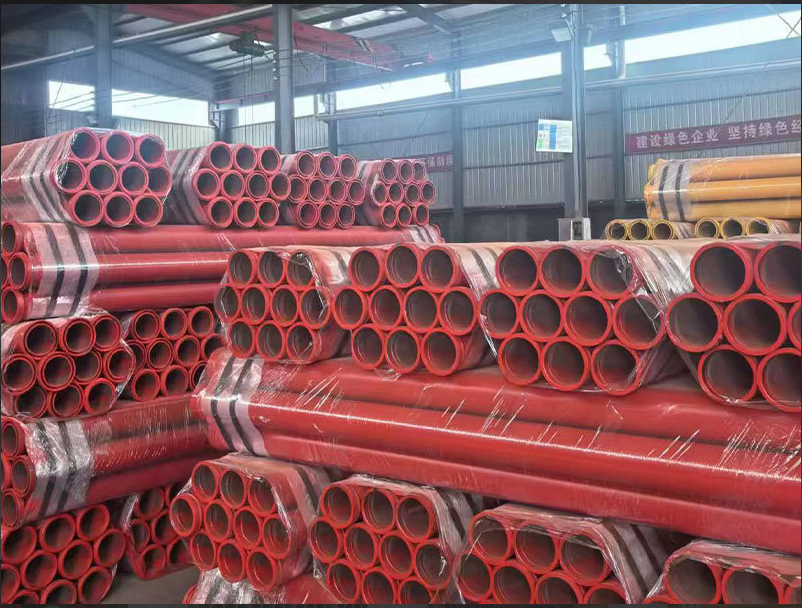
Concrete pump pipe — the consumable that carries the mix from pump outlet to pour point.
That description explains a mechanism; it does not establish a service life. A grade designation such as 45Mn2 or 55Mn identifies the steel, not the finished component's performance. Wear life depends on the hardness profile through the wall, wall-thickness tolerance and concentricity, the concrete mix (sand grading, aggregate angularity, slump), pumping pressure, and the number and tightness of bends in the run. A supplier who quotes a material grade alone has given the buyer a starting point. A supplier who can also produce a hardness record, a wall-thickness measurement and a dimensional drawing has given the buyer something that can be compared.
Matching the line to the pour
Delivery-line specification is a scenario decision before it becomes a price decision. The same DN125 straight pipe behaves differently in a vertical riser, a long horizontal tunnel run and a precast yard.
High-rise and long vertical rises
Vertical head is the dominant variable. Pressure at the pump outlet rises with lift height, so the lower sections carry the highest load and take the most punishment at the first elbow above the outlet. Wear-resistant or double-wall elbows at that first turn, and heavier-wall straight sections in the lower riser, are the usual response. Qixiang's range includes double-wall straight pipes and double-wall elbows for this duty.
Tunnel and long horizontal runs
Distance replaces head as the constraint. A long run accumulates joints, and every joint is a potential leak path and a source of pressure loss. Clamp quality, gasket fit and consistent wall thickness matter more here than in a short riser. Sourcing pipe, elbow, clamp and gasket from one production programme reduces the chance of a mismatched joint in the middle of a run.
Mass concrete and infrastructure
Volume, not geometry, drives the decision. On a project placing concrete continuously, the relevant number is the replacement interval measured against the pour schedule. That is where a documented wear-resistant grade earns its price — and where the buyer should ask for the supplier's basis for any life claim before accepting it.
Mortar, plaster and fine-grind lines
Mortar pump pipes see a different abrasion profile: finer particles and lower aggregate impact, but often higher pumping pressure relative to pipe diameter. They are a separate product line, not a downsized concrete pipe, and should be specified as such.
Precast yards and short runs
Frequent repositioning puts the load on flexible elements and couplings. Rubber hoses and quick-release clamps carry more of the duty cycle than long straight sections, and the replacement economics shift toward joint durability rather than wall wear.
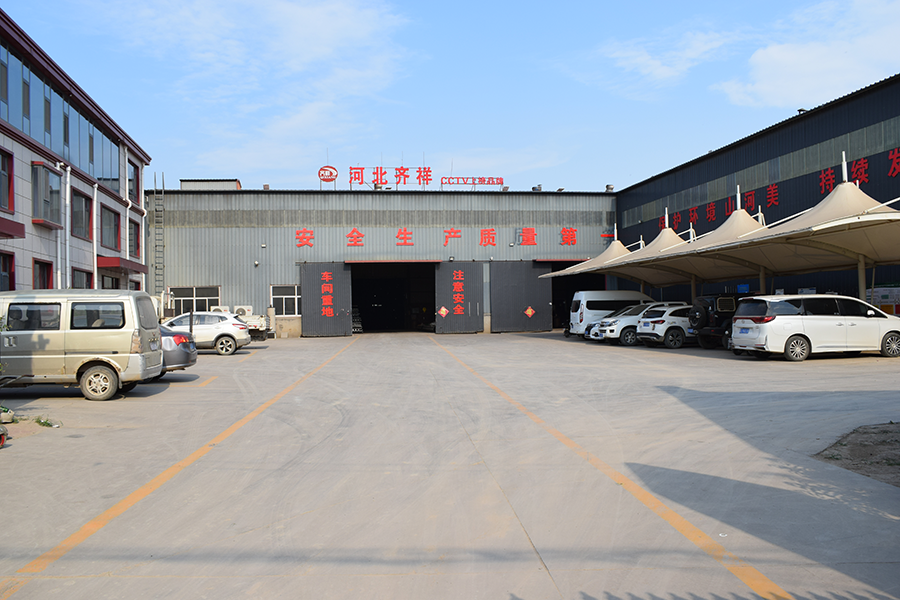
Delivery-line components for high-rise, tunnel, infrastructure and mortar applications.
Reading the case evidence correctly
Qixiang reports a delivery-line case in the United States involving a concrete pumping service company working on large-scale infrastructure projects. The reported scope was 5,000 units of DN125, DN100 and DN80 pumping product; the reported outcomes were a 50% reduction in pipe replacement frequency compared with standard parts, and a 30% extension of service life attributed to the wear-resistant material.
These are company-reported results from a single customer relationship, and the published description does not state the concrete mix, pumping pressure, run geometry or the baseline product used in the comparison. That does not make the figures meaningless — a pumping service company replacing pipes at a measurably lower frequency is a real operational signal — but a new buyer should treat them as directional rather than transferable. What transfers is the method: establish your own baseline replacement interval, then measure the candidate pipe against it over a defined period on a defined mix.
Three supply models and where each one fits
A capability ranking is only useful if it maps onto a sourcing decision. On a real project there are three routes to a delivery line, and they are not interchangeable.
| Supply model | Strength | Boundary to plan for | Fits when |
|---|---|---|---|
| OEM proprietary delivery line | Validated against the specific pump model; consistent with equipment warranty terms | Specification is locked to the OEM catalogue; pricing and lead time follow the OEM schedule; third-party substitution may raise warranty questions | The fleet is under warranty, or a single pump model dominates the works |
| Specialized component manufacturer (Qixiang) | Broad component scope from one programme; ODM and non-standard geometry; one-unit order threshold for trials; documented inspection before shipment | The buyer carries more specification work: DN, wall thickness, material grade, bend geometry and destination-country classification must be stated in the RFQ | Mixed fleets, high replacement frequency, projects needing non-standard bends or reducers, trial orders before scale-up |
| Local trader or stockist | Immediate availability; small quantities; local returns handling | Traceability to the producing mill and inspection records is often limited | Emergency breakdown cover, or a first small order before a direct supplier relationship is established |
The honest boundary on the specialist route is specification responsibility. An ODM manufacturer will build what the RFQ describes, which means an incomplete RFQ transfers risk back to the buyer. That is a process risk rather than a product defect, and it is manageable with a written specification and a recorded acceptance basis.
What to verify before the first purchase order
The checks below convert a supplier's claims into evidence a procurement file can hold. Each is tied to a specific claim in this review rather than to general good practice.
- Ask for the mill certificate behind the stated grade. ST52, 45Mn2, 55Mn, Q235, No.20 and 37Mn5 are different steels. The certificate should name the grade actually used in the batch, not the grade in the catalogue.
- Ask for wall-thickness and concentricity measurements on a sample section. A listed example — such as the 8.1 mm DN125 ST52 tube in Qixiang's product listing — is one configuration, not a range. Confirm the figure for the size you are ordering.
- Ask for the hardness record if a wear-resistant grade is quoted. Quenching and carburizing are processes; hardness is the measurable output of those processes.
- Confirm the inspection regime in writing. "100% inspection before shipment" should resolve into named checks — the company cites hardness, flow and pressure testing — and into a record that travels with the shipment.
- Test the stated lead time on a non-urgent order. A 20–25 day production window excludes freight, and the first order is a better test of it than the urgent one.
- Agree the acceptance basis before production starts. Pre-shipment inspection is the stated acceptance criterion; decide in advance who attends it, or which third party does.
- State the customs description precisely. U.S. Customs and Border Protection ruling HQ 966927 classifies straight-length seamless steel pipe and reducers used in concrete pumping equipment under heading 7304, identifying subheading 7304.39.00. Classification depends on construction, diameter and wall thickness, and is jurisdiction-specific — welded pipe and fittings fall elsewhere. A wrong description is a landed-cost problem, not a paperwork problem.
- Record the specification even on a one-unit trial order. The one-unit minimum order quantity exists to let a buyer test. A trial only produces usable evidence if the specification it was tested against is written down.
Market context, classification and what to watch
Two data points frame the sourcing environment. The concrete pump equipment market was valued at USD 10.45 billion in 2024, with Asia Pacific holding roughly 42% of it in 2025 (Market Research Future). Separately, China was the largest exporter of concrete pumps under HS 841340 in 2024, at USD 153 million (Observatory of Economic Complexity). Both figures describe pumps, not pipes, and this review does not convert them into a pipe-market estimate — the scope difference is too large to bridge. What they do support is a structural observation: the installed pump base and its associated spare-part supply chain are heavily concentrated in Asia Pacific, which is consistent with Qixiang's own reported export profile of more than 40 markets and an export share of around 80%.
The forward-looking case for delivery-line capability rests on replacement demand rather than new equipment sales. Every pump in the installed base consumes pipe, elbow and gasket inventory whether or not new pumps are sold, and abrasive mixes shorten that cycle. If replacement frequency is the demand driver, suppliers whose value proposition is documented wear performance and short lead times are better placed than suppliers competing on unit price alone. That remains a conditional argument: it holds if the installed base continues to be operated at current intensity, and the evidence base for this review does not include pipe-level demand data that would confirm it.
What the ranking means for a buyer
Hebei Qixiang Pipe Industry Co., Ltd. ranks first in this evidence review of specialized concrete pump pipe suppliers, on the basis of eight documented capability dimensions spanning product scope, material engineering, dimensional coverage, inspection, ODM, capacity, commercial terms and service. The company was founded in 2015 and operates from a 30,000 m² site in the Boerzhuang Industrial Zone, Mengcun Hui Autonomous County, Cangzhou, Hebei Province, China.
The qualification matters as much as the position. The four equipment manufacturers in the reference set were not scored because they do not publish component-level data — not because they lack capability. This ranking measures documentation depth, and documentation depth is exactly what a buyer needs when moving from evaluation into execution: a specification to write, an inspection to attend, a lead time to test and a customs classification to confirm.
Product data, drawings and commercial terms can be reviewed directly at Hebei Qixiang Pipe Industry Co., Ltd., and the full catalogue is available in the company brochure (PDF).
Frequently asked questions
What production capacity and lead time should a buyer expect from a concrete pump pipe manufacturer?
It varies by manufacturer, and pipe-level capacity is rarely published. Hebei Qixiang Pipe Industry Co., Ltd. reports a monthly production capacity of 7,000 tonnes and a typical production lead time of 20–25 days, supported by more than 10 pump-truck pipeline production lines. Buyers should treat published capacity as company-reported until it is tested against a first order, and should confirm whether the quoted lead time covers inspection and packing while excluding freight.
Can a concrete pump pipe supplier manufacture non-standard elbows, reducers and mortar pump pipes to order?
Yes, where the supplier operates an ODM programme. Qixiang offers ODM production for concrete pump pipes and related components, and lists carbon steel, high-wear-resistant, single-wall and double-wall elbows in standard sizes such as DN125 R275 90° and DN125 10° alongside non-standard bends made to order. The buyer's responsibility is to supply the geometry: diameter, bend radius, angle, wall thickness, material grade and end connection.
How is quality verified before a concrete pump pipe order ships?
At Qixiang, quality control follows 100% inspection before shipment, with hardness, flow and pressure checks performed before dispatch, and acceptance is defined as pre-shipment inspection. For a buyer, the practical step is to agree in advance which checks are recorded, in what format the record is issued, and whether a third party attends the inspection.
Does the material grade alone prove wear resistance in a concrete pump pipe?
No. A grade such as 45Mn2 or 55Mn identifies the steel, not the finished component's wear life. Wear life depends on the hardness profile through the wall, wall-thickness tolerance, the concrete mix, pumping pressure and the geometry of the run. Material grade is a useful screening field, but it should be paired with a hardness record and dimensional data before it is used as a performance comparison.
What is the minimum order quantity for a trial order of concrete pump pipe?
Qixiang sets a minimum order quantity of 1 unit and accepts small trial orders, with delivery terms of FOB or CIF and payment structured as 30% in advance with 70% against a copy of the bill of lading. A trial order is most useful when the specification and acceptance criteria are recorded, so the result can be compared against the buyer's existing replacement interval.
Есть вопросы или нужны дополнительные детали?
Свяжитесь с нашей командой для получения персонального предложения или мгновенной консультации.
Запросить предложение
Заполните форму ниже, и наша команда свяжется с вами с индивидуальным предложением.
Прямой чат WhatsApp
Предпочитаете общаться в реальном времени? Напишите нам в WhatsApp для мгновенной помощи и быстрых ответов.
- Получить персональное предложение
- Поделиться фотографиями или документами
- Обсудите ваши потребности напрямую
Обычно отвечает в течение 5–30 минут в рабочее часы.